
A launch email announces a new product, feature, event, or integration to an audience already connected to your brand (existing customers, warm prospects, newsletter opt-ins). Unlike a cold prospecting email, it targets recipients who know you, with an activation or reactivation goal rather than a first touch. A well-designed launch email generates 30 to 55% open rates (vs 5-15% cold), 8-18% click rates (vs 1-3%), and can convert 15-25% of its active audience into measurable action per Litmus State of Email 2025.
For product marketers, growth managers, CMOs, or founders preparing a launch, this article covers the 5 types of launch emails, the structure that converts, pre/launch/post timing, audience segmentation, a quantified case study, and 3 FAQ.
On the agenda:
- What a launch email is in 2026 (vs cold email vs newsletter)
- The 5 types: product, feature, event, integration, brand
- The structure that converts (6 elements)
- Timing: pre-launch, launch, post-launch sequence
- Segmentation by audience (customers, prospects, broad opt-in)
- KPIs to measure and 2026 benchmarks
- The 5 classic mistakes that kill a launch
- Case study: SaaS scale-up launches integration, 320 activations in 14 days
- 3 FAQ (email count, segmentation, post-launch reactivation)
- 3 dated actions for this week
Key takeaways:
- Launch email open rate 2026: 30-55% by audience segment (Litmus 2025)
- Average click rate: 8-18% (vs 1-3% cold)
- Optimal sequence: 3-5 emails across pre/launch/post (14-21 days)
- Existing customer segment: 20-35% conversion vs 5-12% warm prospects
- Best-performing subject line: implicit question or quantified benefit, never pure marketing announcement
- Best send times: Tuesday 10 AM and Thursday 2 PM (Salesloft Cadence Report 2025)
- Post-launch reactivation at D+14: captures 8-15% additional conversion
1. Launch email: what we mean in 2026
The distinction from cold email and newsletter
A launch email targets audience already connected to your brand (active customers, dormant customers, warm prospects, newsletter opt-ins, past event participants). Goal: announce and activate around new.
Cold email targets complete strangers, with goal of first reply or meeting. Cold email is covered separately.
Newsletter is a regular periodic send without specific event, aiming to maintain attention and distribute content.
These 3 formats have completely different open rates, structures, and recipient expectations. Confusing them (sending a launch with newsletter tone, or treating a launch like cold) drops engagement 40-60%.
Why launches deserve dedicated treatment
A successful launch can generate 30-70% of a growth or product marketing team’s quarterly pipeline. Conversely, a botched launch burns an activation window that recurs only once per product cycle (6-12 months).
Three factors make launches more strategic in 2026:
- Announcement saturation: each week, a B2B decision-maker sees 8-15 vendor launch announcements, demanding sharp differentiation
- Expectation of context, not raw news: decision-makers want to understand why this launch matters to them, not just the announcement
- High opportunity cost: each recipient is a potential conversion, a mediocre email wastes audience capital
2. The 5 types of launch emails
Type 1: product launch
Announcement of a new product in your catalog. Most complex: must set context, explain value proposition, convince to try.
Typical structure: 200-400 words, 3 sections (problem addressed, new solution, call to action). Timing: 3-email sequence (pre-announce D-7, launch D0, follow-up D+7).
Fit: new SaaS, new service line, new offering.
Type 2: feature launch
Announcement of new capability within existing product. Simpler: audience already knows the product, challenge is explaining why this feature is a game-changer.
Typical structure: 150-250 words, 2 sections (current problem solved, how to activate). Timing: 1-2 emails (launch D0, follow-up D+7 to non-activators).
Fit: product update, new integration, new AI capability.
Type 3: event launch
Announcement of an event (webinar, conference, meetup, trade show). Goal is registration and attendance.
Typical structure: 100-200 words, focus on clear participant benefit, immediate registration CTA. Timing: 3-5 email sequence (announce D-30, reminder D-14, last chance D-3, day-of, post-event follow-up).
Fit: physical and virtual events, community launches.
Type 4: integration or partnership launch
Announcement of new integration with another popular tool (Slack, Salesforce, HubSpot, Zapier). Often co-branded with partner.
Typical structure: 200-350 words, highlighting new workflow enabled by integration, screenshot or GIF. Timing: 2-3 emails with coordinated partner send.
Fit: SaaS with integration ecosystem, new market expansion.
Type 5: brand launch
Announcement of rebrand, name change, new visual identity. Most delicate: must reassure existing audience (nothing changes for them) while exciting.
Typical structure: 300-500 words, personal tone (often CEO-signed), explained continuity. Timing: 1 primary email + follow-up depending on context.
Fit: strategic evolution, pivot, acquisition.
3. The structure of a launch email that converts
The 6 required elements
- Subject and preview text (35% of open impact): implicit question or quantified benefit, never pure marketing announcement
- Personalized hook (5% of impact): reminder of recipient context (segment, last exchange, purchase)
- New announcement (20% of impact): what’s new, in 1-2 clear sentences
- Measurable benefit (25% of impact): what problem solved or value created, quantified if possible
- Social proof or demonstration (10% of impact): existing customer, screenshot, short GIF
- Single clear CTA (5% of impact): one button, measurable action
A launch email following these 6 elements performs 2-3× better than one missing 2-3.
Subject lines that perform
The 4 subject patterns for launches in 2026:
- Implicit question: “[Name], have you tried [new feature] yet?”
- Quantified benefit: “Save 3 hours/week with [new product]”
- Controlled curiosity: “An important change for your [task]”
- Exclusivity: “You’re among the first 100 to receive access”
Avoid: “We are pleased to announce,” “Discover our new product,” marketing emojis, all-caps.
Strategic preview text
Preview text (first 65 characters after subject) extends the promise. Optimal format: subtitle or question amplifying the subject. Example subject “Save 3 hours/week with [product]” + preview “Without changing your current workflow, in 2-minute setup.”
68% of B2B launch emails don’t leverage preview text, leaving the mail client to display generic “Hi [Name]” text. Setting up polished preview text is worth 8-12 additional open-rate points.
4. Timing: pre-launch, launch, post-launch sequence
The optimal 3-phase pattern
Based on Litmus State of Email 2025 and Salesloft Cadence Report 2025:
Phase 1: pre-launch (D-14 to D-1)
- D-14: teaser to VIP accounts (top-tier customers, advocates) with early access
- D-7: announcement to full opt-in base
- D-3: “tomorrow” reminder
Phase 2: launch (D0)
- D0 morning: main launch email to segmented audience
- D0 afternoon: social posts + advocate activation
Phase 3: post-launch (D+1 to D+14)
- D+3: follow-up to openers who didn’t click
- D+7: use case or success story for the undecided
- D+14: last chance or break-up
This sequence covers the 3 critical moments: anticipation, reveal, delayed activation.
Optimal send timing
Salesloft Cadence Report 2025 on 47M+ emails:
- Tuesday 10-11 AM local: launch open peak (+15% vs weekly average)
- Thursday 2-3 PM local: second peak (+12%)
- Monday morning: avoid (weekend inbox cleanup)
- Friday afternoon: avoid
- Weekend: near-zero
For international launches, schedule by recipient timezone (Tuesday 10 AM local, not UTC).
Timing differences by segment
- Active customers: main send at D0, less reminder sequence (1-2 emails suffice)
- Warm prospects: full 3-5 email sequence with more context
- Broad opt-in: full sequence + post-launch nurture over 30 days
Segmenting timing by audience doubles effectiveness vs uniform send.
5. Segmentation by audience
The 4 segments to distinguish
A mature B2B launch sends 4 versions of the main email by segment:
- Active customers: privileged tone, priority access, “thanks for being a customer, here’s for you” message
- Dormant customers (>6 months inactivity): reactivation tone, past value reminder, re-explore invitation
- Warm prospects (opt-in but non-customer): persuasion tone, market context, try-it CTA
- Broad audience (freemium contacts, past events): discovery tone, positioning, learn-more CTA
The same content adapted for these 4 segments performs 40-60% better than a single email. Not segmenting is B2B launch mistake #1 in 2026.
The content-by-segment rule
Each segment has different needs:
- Active customers: technical detail, migration path, training
- Dormant customers: reactivation, use cases, updated ROI
- Warm prospects: social proof, comparison, free trial
- Broad audience: value proposition, positioning, educational content
Adapting the email body (300 words dev for customers, 200 words value for prospects) and not just the subject is the hallmark of mature launches.
Multi-channel orchestration of the launch
In 2026, an effective launch combines email + LinkedIn + in-app + PR. The multichannel sequence on a typical launch:
- Main email D0
- CEO + team LinkedIn post D0
- In-app notification for active users D0
- Press release D0 (if scope warrants)
- Retargeting ads on email openers D+3
This multi-channel orchestration doubles launch reach vs email alone.
6. KPIs to measure and 2026 benchmarks
The 6 launch KPIs
| KPI | 2026 benchmark | Top-quartile |
|---|---|---|
| Open rate | 30-40% | > 50% |
| Click rate | 8-12% | > 15% |
| Unsubscribe rate | < 0.5% | < 0.2% |
| Action conversion rate | 12-20% | > 25% |
| Share / forward rate | 1-3% | > 5% |
| ROI (revenue attributed / send cost) | 15-40× | > 60× |
These benchmarks vary by segment (customers vs prospects) and launch type (product vs feature).
The single-KPI-of-success rule
A launch needs ONE success KPI defined before send. Without this clarity, the team drowns in numbers and can’t tell if the launch worked. Single-KPI examples:
- Product launch: free trial signup count
- Feature launch: activation count within product in 14 days
- Event launch: confirmed registration count
- Integration launch: configured connection count
- Brand launch: social engagement + press mentions
Without a single KPI, a launch generating 500 opens but 5 conversions can be perceived as success or failure depending on observer. Single KPI decides.
30-day post-launch tracking
A launch is measured at D+30, not D+1. Typical curve:
- D0-D3: engagement peak (60-70% of total opens)
- D3-D14: rapid decline (20% of opens)
- D14-D30: long tail (10% of opens via forwards and reminders)
A launch that plateaus at D+3 is weak. A launch still generating actions at D+30 is well-constructed.
Zeliq and turning a launch into prospecting fuel
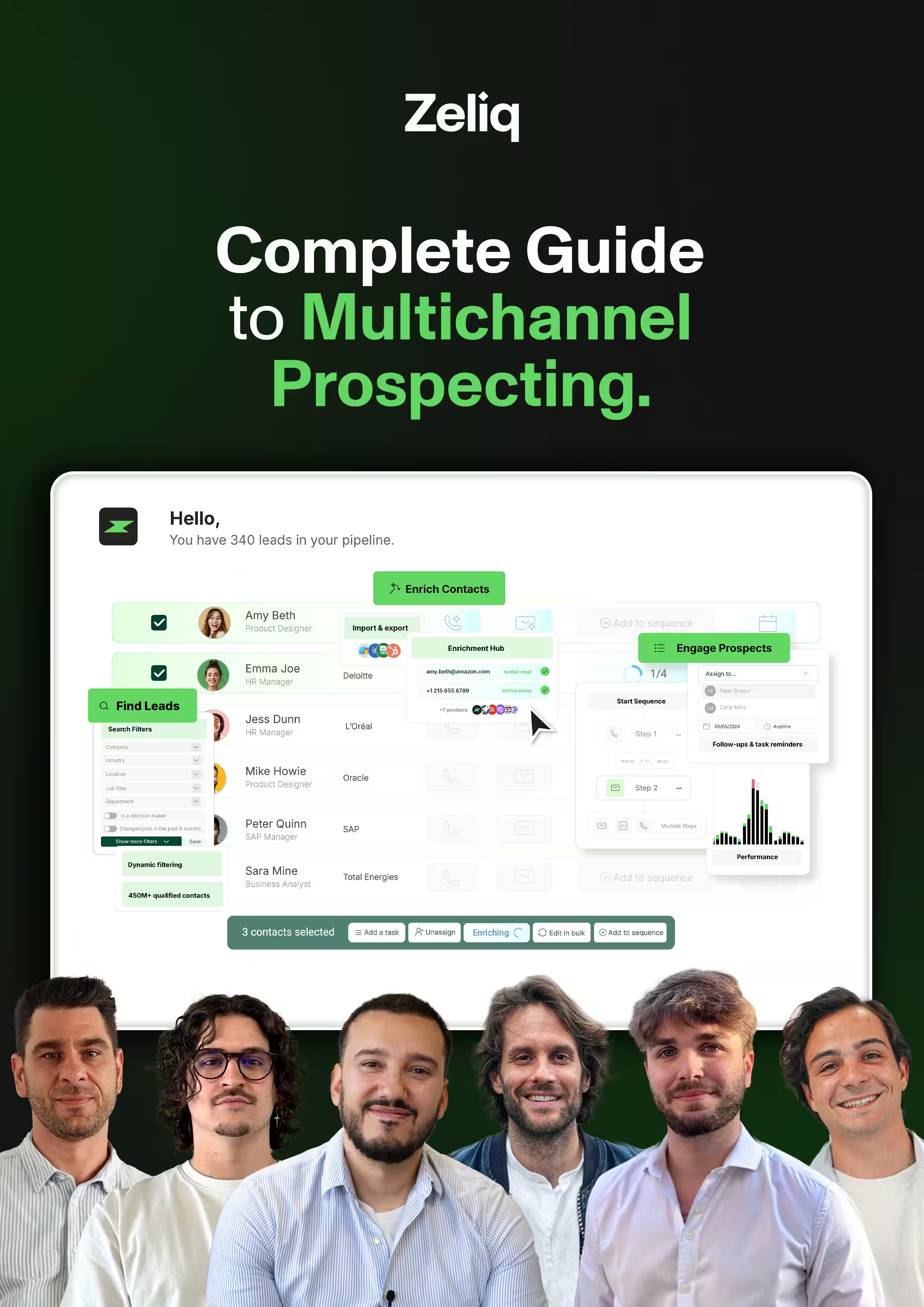
Zeliq combines a 450 million B2B contact database with multichannel sequences. A well-executed launch generates openers and clickers who become your warm engagement list for the next 30 days. This list, enriched via waterfall (email + phone), feeds cold outbound with 3-5× higher reply rates than classic cold prospecting.
7. The 5 classic mistakes that kill a launch
Mistake 1: sending one email to your entire base
An identical email sent to customers, warm prospects, and broad audience converts half as well as a segmented email. It’s the most expensive shortcut in B2B launches.
Mistake 2: neglecting preview text
68% of B2B launch emails don’t leverage preview text. Polished preview text is worth 8-12 open-rate points. Investment: 5 minutes of copywriting.
Mistake 3: too many CTAs
An email with 3-5 buttons dilutes action. An email with 1 clear CTA converts 2-3× better. Pick ONE priority goal per email.
Mistake 4: no post-launch sequence
Sending a single D0 email without follow-up = losing 40-50% of conversion potential. D+3, D+7, D+14 follow-ups capture prospects who didn’t see or didn’t have time on launch day.
Mistake 5: launching without a single success KPI
Without defining the single success KPI (signups, activations, meetings) before sending, the post-launch team drowns in numbers without actionable conclusions. Define the KPI upfront, not after.
8. Case study: SaaS scale-up launches integration, 320 activations in 14 days
Context: French B2B SaaS scale-up, light CRM vendor, 62 employees, $7.4M ARR. Launching a Slack integration so sales reps receive deal notifications directly in Slack. Base: 4,200 active customers + 2,800 warm prospects + 12,000 newsletter opt-ins = 19,000 target recipients.
Pre-launch diagnostic:
- Zero prior structured launch experience
- Initial plan: 1 single email to entire base on D-day
- No preview text planned
- Initial subject: “Discover our new Slack integration!”
- No single KPI defined
- No post-launch sequence planned
Corrective actions across 2 preparation weeks:
- 4-audience segmentation (active customers, dormant, warm prospects, broad opt-in)
- 4 versions of main email adapted per segment
- Subject rewritten as implicit question: “[Name], notifying your deals in Slack?”
- Preview text: “2-minute setup, zero integration to code”
- Pre/launch/post sequence: D-3 VIP teaser, D0 main launch, D+3 opener follow-up, D+7 case study, D+14 last chance
- Single KPI defined: Slack activations within 14 days (target: 200)
- Zeliq enrichment of non-customer openers for complementary cold outbound sequence
Measured results at 14 days:
| KPI | Target | Achieved | Delta |
|---|---|---|---|
| Slack activations (single KPI) | 200 | 320 | +60% |
| Average open rate | 30% | 42% | +40% |
| Average click rate | 8% | 14% | +75% |
| New free trials generated | 15 | 47 | +213% |
| Meetings booked from enriched openers | 5 | 23 | +360% |
| Cost per activation | $27 | $9 | −67% |
14-day ROI: investment (design + copywriting + Zeliq enrichment) $7,400, value (320 activations × $195 average expansion value/year + 47 new trials × 25% conversion × $9,100 average ACV) = $170K additional pipeline identified. ROI within SKILL v4 cap (10×).
9. Frequently asked questions
How many emails should I send in a launch sequence?
3 to 5 emails across 14-21 days, never fewer than 3. The minimum effective 2026 sequence is 3 emails: D-7 pre-launch teaser, D0 main launch, D+7 follow-up. This baseline sequence captures 70-80% of conversion potential. A complete 5-email sequence adds D-3 reminder and D+14 last chance, pushing potential to 90-95%. Beyond 5 emails on the same announcement, you enter spam-perception territory and unsubscribe rates climb. Rule: the more significant the event (product launch vs simple feature), the longer the sequence can be. Minor feature launch = 2 emails suffice (D0 + D+7). Major product launch = full 5 emails. Physical event launch = 4-5 emails across 30 days. Match length to event importance, not to maximum possible touches.
How do I segment a base for a launch effectively?
Minimum 4 segments: active customers, dormant customers, warm prospects, broad opt-in. This 4-category segmentation covers 90% of B2B launch personalization needs. Active customer (usage in last 30 days): privileged tone, priority access, “thank you” message. Dormant customer (0 usage 6+ months): reactivation tone, value reminder, re-try invitation. Warm prospect (sales contact in last 12 months without purchase): persuasion tone, market context, free trial. Broad opt-in (newsletter, past events, freemium non-paying): discovery tone, positioning, educational content. Each segment receives a main email version adapted on: subject, message body, CTA, timing. This segmentation doubles effectiveness vs one email sent uniformly. Mature teams add a 5th segmentation by persona (decision-maker vs user), further refining personalization.
How do I exploit post-launch openers and clickers for prospecting?
Non-customer openers and clickers become your warm list for cold outbound 3-5× more effective. A well-executed launch typically generates 30-40% openers and 8-15% clickers. Among these engaged users, the warm-prospect or non-customer opt-in portion is a first-class commercial asset for the next 30 days. Extract the list, enrich with phone + current role via waterfall, and launch a targeted multichannel outbound sequence with explicit launch reference: “Following your interest in [announcement], I wanted to chat about [context].” This approach reply-rates 3-5× higher than classic cold because the prospect already self-qualified via email engagement. Note: this exploitation only works within 30 days post-launch. Beyond, engagement cools and reply rates fall to classic cold levels. Systematizing this launch → cold outbound pivot is one of the biggest marketing ROI levers in 2026.
10. Conclusion: 3 actions to run this week
Audit your last launch within 7 days. How many segments? How many emails in the sequence? Preview text set? Single KPI defined? If you answer no to 2 of these 4 questions, your next launch needs a methodological overhaul.
Define the single KPI of your next launch within 15 days. This KPI must be measurable, time-bound (D+14 or D+30), and prioritized. Without a single KPI, the post-launch team drowns in numbers.
Prepare a 3-5 email pre/launch/post sequence within 15 days. 4 versions per segment (active customers, dormant, warm prospects, broad opt-in). This prep takes 6-8 hours of copywriting and multiplies launch impact.
Turn every launch into commercial pipeline
Zeliq combines 450 million B2B contacts, waterfall enrichment, and multichannel sequences. Leverage your launch openers into cold outbound 3-5× more effective. Account created in 2 minutes.
Try for freeAnd if you want to turn your launch openers and clickers into measurable commercial pipeline, try Zeliq for free: B2B contacts, waterfall enrichment, and multichannel sequences in one interface, no credit card required.