
Prospecting is the engine that keeps your sales funnel moving and your pipeline alive. Whether you’re an SDR building your first prospecting calendar or a Head of Sales trying to scale pipeline growth across regions, having a clear, structured prospecting plan is the difference between guesswork and consistent results.
Unlike lead generation, which is usually inbound and marketing-sourced, sales prospecting is outbound by nature. It’s your sales team going out, identifying potential customers, and starting real conversations (on LinkedIn, over phone calls, or via sharp, timely email outreach).
Done right, it builds pipeline fast. Done wrong, it burns time and budgets.
This guide breaks down what modern prospecting strategies look like in real life. You’ll learn how to build effective sequences, speak directly to your ideal customer, and avoid the generic spam that gets ignored.
We’ll talk cold calling, social media, CRM use cases, and even how to set KPIs that reflect sales prospecting progress, not just activity.
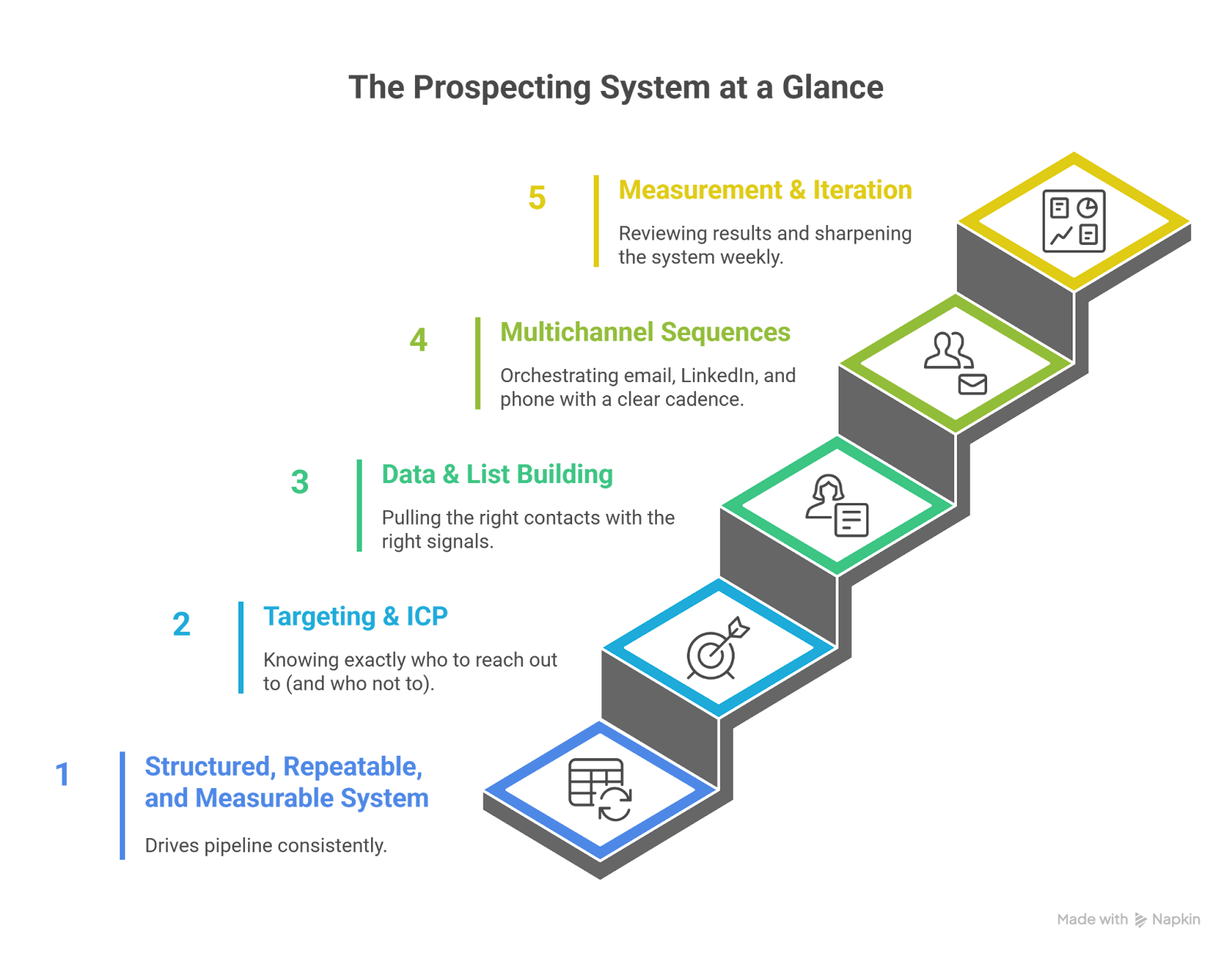
Prospecting strategies only work when they’re part of a system. And that’s exactly what we’re going to help you build, step by step.
For an even broader overview of outbound motions, this ultimate guide to sales prospecting walks through channels, tactics, and real examples you can layer on top of this plan.
What is sales prospecting?
If you’re in sales, prospecting is your job’s starting line.
It’s the moment you stop waiting for leads and go out to find potential customers yourself. At its core, prospecting means identifying the right people inside the right companies, and starting conversations that can lead to something real.
But here’s the nuance: sales prospecting isn’t the same as lead generation. The latter usually sits with marketing: attracting traffic, collecting form fills, warming up demand.
Prospecting?
That’s outbound. It’s direct, it’s deliberate, and it’s handled by sales reps who know what they’re looking for.
You’ll typically find prospecting somewhere between the top and middle of your sales funnel. Think of it like this:
- Marketing creates awareness.
- Prospecting turns that awareness into meetings set.
- From there, the sales team works to qualify, propose, and close.
This is where metrics matter. A good prospecting motion isn’t judged by how many emails were sent or how many cold calls were made.
It’s about outcomes:
- How many qualified conversations are happening?
- Are they with your ideal customer?
- Is pipeline actually being created?
Done well, prospecting becomes a growth lever. It helps your sales team focus on what counts: buyers who are ready to move.
For a broader view of how prospecting fits into the rest of your funnel, this breakdown of the B2B sales process shows how each stage connects from first touch to closed-won.
If client acquisition is your main focus right now, this guide on how to prospect clients shows how to turn raw lists into real business opportunities.
What are effective prospecting strategies?
There’s no single winning formula in prospecting, but the best sales professionals share one common trait: they build systems.
Random outreach doesn’t scale. What does? A structured, repeatable approach that aligns your sales strategy with how modern buyers actually behave.
Multi-channel by default
Your buyers aren’t stuck in one place, and your outreach shouldn’t be either. A strong prospecting strategy combines LinkedIn, email, and phone calls, often layered with thoughtful touches like commenting on posts, sharing content, or inviting someone to a niche webinar.
Each channel serves a purpose:
- Email offers clarity and context: ideal for value-based pitches.
- Phone adds speed and tone: still the fastest way to build trust.
- LinkedIn builds familiarity: useful for credibility and “face before pitch.”
The trick isn’t just showing up everywhere. It’s showing up consistently, with a message that feels tailored, not templated.
ICP and buyer personas
You can’t sell to everyone. That’s why a sharp Ideal Customer Profile matters.
Document not just industry and size, but also tech stack, use case, decision-making process, and typical objections. This helps your sales reps focus on potential clients who are worth their time.
Go deeper than job titles: understand who influences the deal, who blocks it, and what each person actually cares about.
Message-market fit
A great message doesn’t sell the product: it shows you understand the problem.
The strongest prospecting copy follows a simple structure:
- one problem,
- one outcome,
- one clear next step.
It’s about the buyer, not you.
That means ditching vague claims like “we help teams work better” and replacing them with real insight:
“Sales teams using [X] recovered 12% of lost pipeline from slow handoffs. Here’s how they spotted it in under 10 minutes.”
It’s that level of specificity that earns replies.
Prospecting calendar
Prospecting only works if it happens every day. Block time for it, non-negotiable.
Your sales team should have dedicated time for:
- Research and targeting,
- Fresh outreach,
- Follow-ups and nurture touches.
Weekly, review what’s working:
- Which accounts are progressing?
- Which messages are converting?
Monthly, tweak your ICP and update messaging based on replies and patterns.
It’s not about intensity, it’s about rhythm. That’s how you build pipeline growth over time.
How to create a prospecting plan?
You can’t scale what you haven’t structured.
A good prospecting plan gives your sales team clarity, rhythm, and confidence. Instead of wondering who to reach out to, where to find them, or what to say, your team knows exactly what happens next.
Let’s break it down.
Step 1: Define targets
Start with your ICP, but go beyond the basics.
- Who are your best-fit accounts based on industry, size, use case, or tech stack?
- What kind of buyer actually converts, expands, and stays?
You also need to define who not to chase.
Build a “negative persona” list: small companies with no budget, industries stuck in 12-month buying cycles, or teams locked into a competitor’s stack.
Then segment. Group accounts by use case, region, or motion (e.g. expansion vs. net-new). You’re building lanes for your reps to follow, fast.
Step 2: Build lists and data with ZELIQ search
With your targets set, go hunt.
Use ZELIQ to pull qualified contacts (decision makers, influencers, or operational buyers) with verified emails and direct dials.
Cross-check with LinkedIn or Sales Navigator to confirm titles and intent.
Every contact should include:
- Email + phone (when possible),
- Job title + seniority,
- Relevant firmographics and triggers (like hiring or funding).
Sync all of this into your CRM, not spreadsheets. Clean, centralized data means faster outreach and cleaner reporting.
Step 3: Choose channels and cadence
One channel isn’t enough.
Build a 10-day sequence that rotates touchpoints:
- Day 1: email with a personal opener,
- Day 2: LinkedIn view + follow,
- Day 3: call with voicemail,
- Day 5: case study email,
- Day 6: comment on their post,
- Day 8: follow-up call,
- Day 10: final email + InMail.
Keep each message sharp. No fluff, no copy-paste jobs. Your goal is consistent visibility, not pressure.
Step 4: Craft messaging
This is where you win or lose attention. Start with a relevant hook, maybe a recent post, job change, or signal tied to their role.
Speak to one pain, one metric, one outcome. End with a low-friction ask:
“Open to a quick 12-min benchmark chat?” is stronger than “Book a demo.”
Build a template library by persona, but keep it live. Your reps should constantly tweak based on reply patterns.
Step 5: Tooling and workflow
Your sales stack should work for you, not the other way around.
Minimum setup:
- CRM (source of truth),
- ZELIQ for list building and enrichment,
- Sequencer for emails,
- LinkedIn plug-in for outreach,
- Dialer for phone activity,
- Dashboards to track progress.
Every tool should talk to the CRM.
No duplicate data. No manual logging.
Step 6: Compliance and consent
Outreach needs to be smart and respectful.
Always:
- Use verified B2B data,
- Include opt-out in every email,
- Honor “no” across all channels,
- Keep tone professional, not pushy.
Compliance isn’t red tape, it builds trust. And trust boosts reply rates.
Step 7: Launch, measure, iterate
Don’t over-plan. Ship it.
Test two cadence versions. After a week, compare results:
- Which message gets replies?
- Which channel books meetings?
Refine fast. Every quarter, refresh sequences, audit the ICP, and kill what doesn’t convert. Great outbound teams don’t just build systems, they make them sharper every month.
How to identify potential customers?
Finding leads is easy.
Finding the right ones? That’s what separates activity from results.
If your reps are spending time on low-fit accounts, you’re not just wasting effort: you’re delaying pipeline.
Targeting signals
Strong outbound starts with signal-based targeting. Look at three layers:
- Firmographics: Industry, company size, location, team structure. But don’t stop there, track growth too. Fast-growing companies (hiring, funding, M&A) are more likely to buy now.
- Technographics: What tools are they using? A team running HubSpot and Lemlist might be ripe for an outreach upgrade. Spot integrations, gaps, and overlaps. Tech stack says a lot about maturity, and pain points.
- Trigger events: This is where timing lives. New exec hires, job posts for SDRs, recent funding, a product launch. These are real-life signals that something is shifting inside the company. And change creates openings.
Layer those signals.
A mid-market SaaS company hiring SDRs, running Salesloft, and just raised a Series B? That’s not a lead, it’s a hot zone.
Qualifying early
Before investing effort, gut-check the fit.
A quick 3-point screen can save hours of waste:
- Fit: Does this match your ICP?
- Timing: Is there a sign they might need help now?
- Potential value: Is there a big enough upside to pursue?
If it scores low, don’t delete it: move it to nurture. Sometimes “not now” becomes “ready” six months later.
Build a simple scoring model. Keep it light:
- ICP match: 1-3 points
- Trigger signal: 1-3 points
- Tech alignment: 1-3 points
- Buying power: 1-3 points
Anything 9+ goes to high-touch sequences. 6-8 gets standard outreach.
Below that? Park it. Save your team’s energy for prospects that actually move the needle.
If you want to go deeper into discovery questions and filters, this playbook on qualifying a prospect breaks down how to separate real opportunities from polite interest.
What are the best prospecting techniques?
There’s no magic channel.
What works is knowing how, and when, to use each one. The best sales prospecting techniques aren’t just tactics. They’re chosen plays, adjusted to your target audience, your motion, and your market.
LinkedIn (modern prospecting)
This isn’t just a place to connect: it’s where sales professionals build familiarity before the first touch.
Start by optimizing your profile. Make your headline outcome-driven (“Helping RevOps leaders cut pipeline waste”), not a job title.
Then shift into active mode:
- Save ICP searches and build lead lists,
- Comment on posts with insight, not flattery,
- Send connection requests with context, not just “Hi, let’s connect.”
Once you’ve engaged, send a relevant DM:
“Saw your post on onboarding ramp. Curious: do you see more issues with SDR process or tooling?”
It’s a low-pressure way to start high-quality conversations.
Email outreach
Still the backbone of sales prospecting, when done right. Keep it tight: 30-90 words, one clear CTA, and absolutely no fluff.
- Subject line? Make it contextual.
- Opening line? Make it personal.
- CTA? Make it easy to say yes.
Thread your follow-ups every few days, switch angles (insight, social proof, soft break-up), and track what lands.
Phone calls
Yes, they still work, if you earn the right to talk.
Don’t pitch.
Start with a permission-based opener:
“Hey Sarah, it’s Jake from ZELIQ. I know I’m catching you cold. Mind if I share why I thought this might be useful?”
This lowers resistance and invites conversation.
Keep it short, specific, and value-led.
And if you leave a voicemail? Reference the follow-up email you’re about to send.
For more concrete examples you can plug into your outreach, this cold call script guide walks through proven structures, openings, and variations to test with your team.
To sharpen the way you use phone outreach inside your prospecting plan, these proven cold calling techniques cover timing, talk tracks, and small tweaks that lift connect and meeting rates.
Content assists
Smart teams use content to open doors. Not PDFs or pitch decks: real, useful stuff:
- A 2-page benchmark,
- A checklist tied to their tech stack,
- A short case snippet with a number that matters.
Use content to educate, not convince. If your message helps (even before the meeting) you’re already building trust.
How to improve sales prospecting?
Most sales teams don’t suffer from a lack of effort, they suffer from a lack of clarity. More calls, more emails, more touches? That’s not a strategy. What improves sales prospecting isn’t more, it’s better.
Focus on what you're offering
Before pressing send, ask yourself: why should this person care?
Your outreach needs to carry a real benefit, not a vague value prop.
Show:
- A clear outcome (“Cut your lead response time by 43%”),
- Credibility or proof (“used by 12 Series A sales teams”),
- A micro-ask (“Open to a quick take on your current sequence?”).
If your message reads like it was written for ten other prospects, it won’t land. Personalize, but with purpose, not just “I saw you went to [University].”
Build a “wins library”
Every time a rep books a meeting, close-won a deal, or got a great reply, save it. Create a shared doc with:
- Cold emails that got 50%+ reply rates,
- LinkedIn DMs that led to intros,
- Call openers that cut through gatekeepers.
Review these in team standups. Prospecting is a craft, you get better by stealing from what works.
Level up your team
Sales prospecting is teachable.
- Roleplay weekly.
- Share call recordings.
- Run objection workshops.
- And coach in context, not just on theory, but on actual live sequences.
If your reps aren’t improving week to week, your pipeline won’t either.
Tighten the handoff to AEs
Finally, prospecting doesn't end with a booked meeting.
It ends with a quality conversation that leads to real pipeline.
So work closely with AEs. Debrief regularly. Share what messaging got traction. Build feedback loops between discovery and outreach.
The sharper the front, the smoother the close.
How to track sales prospecting progress?
Activity metrics
Activity metrics are your early warning system.
They measure what reps can control: calls made, emails sent, LinkedIn touches, and meetings booked.
It’s about consistency and volume: are we doing the work?
Track:
- Dials and connects,
- Net new and follow-up emails,
- LinkedIn actions (views, DMs, comments),
- Coverage vs. plan (% of accounts touched weekly).
Set benchmarks per rep and per segment: high-touch for Tier 1, higher volume for Tier 3. Report daily and weekly, at both individual and team levels.
This is pipeline protection.
When activity drops, pipeline slows 30-60 days later.
Daily standups help catch issues early:
- low call numbers,
- weak LinkedIn presence,
- or email inactivity
… can all signal breakdowns.
Outcome metrics
Volume without effectiveness is wasted effort. Outcome metrics track whether your messaging and targeting actually land.
Key indicators:
- Reply rate,
- Positive reply rate,
- Call conversation rate,
- Meeting set rate,
- SAOs/SQLs created,
- Conversion through stages.
Go deeper: segment by channel, persona, industry, and messaging variant.
LinkedIn may drive better replies from execs; email might convert ops roles faster.
This level of analysis tells you what’s working (so you can double down) and where to pivot. It’s how you move from “busy” to “effective.”
Funnel health
You need more than meetings, you need momentum. Funnel health metrics show whether your prospecting campaign is producing a qualified pipeline that moves.
Track:
- Pipeline value added this week,
- Meeting-to-opportunity rate,
- Opportunity aging by stage.
Stuck deals are red flags.
No movement for 14+ days? Restart the sequence.
Try a new contact, offer a different value angle, or share a use case.
A healthy outbound funnel shows weekly opportunity creation, consistent meeting-to-pipeline flow, and clear progression. If any of that slows, don’t wait, diagnose and relaunch.
Feedback loop
Tracking only works if it feeds action. A strong feedback loop turns raw data into real improvement.
Structure it:
- Weekly: review top objections in team meetings,
- Bi-weekly: adjust scripts, rewrite angles,
- Monthly: refresh sequences and test new CTAs or formats.
Log every objection, question, and “not now.”
Categorize patterns (budget, status quo, timing), and build battle cards with tested replies.
This creates a living sales library. It also builds team intelligence: your outreach becomes smarter with every interaction.
The goal?
A sales prospecting system that improves as fast as your market shifts. That’s how you stay relevant, and ahead.
How to optimize LinkedIn for prospecting?
LinkedIn is a daily prospecting engine. When optimized properly, your profile, posts, and messages can attract and convert high-quality leads without ever leaving the platform.
Profile
Your LinkedIn profile isn’t a résumé: it’s a sales asset.
The headline should speak directly to buyer outcomes:
“Helping RevOps leaders eliminate pipeline leaks in 90 days” beats “Account Executive at ZELIQ.”
Use the Featured section to show proof: case studies, playbooks, client quotes. Add a clear CTA: a Calendly link, a “free audit” form, or a resource page.
In the About section, follow this flow:
- Problem: describe the challenge your buyers face, in their words.
- Credibility: why you’re qualified to solve it.
- Offer: what you deliver and how.
- Contact: make next steps clear.
Keep it short, skimmable, and outcome-oriented. Done right, your profile builds trust before you send a single DM.
Daily actions
Prospecting on LinkedIn works when it’s habitual.
Daily (15-25 mins):
- Comment on 5-10 posts from ICPs or thought leaders: be insightful, not flattering.
- Send 5-10 connection requests with real context: a shared event, a smart post, a market shift.
- Reply to DMs and comments to warm up conversations.
- Weekly, publish one post: short, clear, and tied to your market’s pain points or lessons learned.
Track metrics that matter:
- Connection acceptance rate,
- Conversations started,
- Value-led DMs that convert into calls.
Consistency compounds.
After a few weeks, outbound becomes easier, because your name already feels familiar.
Messaging
No one wants a pitch in their inbox. Start with relevance, not sales.
In your first DM:
- Reference something specific: a post, trend, or challenge,
- Ask a low-friction question that invites a reply.
Example: “Caught your post on SDR ramp-up. Curious, is call reluctance still a top challenge?” - Follow-up with value, not pressure. Share a resource: a 2-slide playbook, a case insight, or a short teardown that speaks to their world.
Once you’ve earned engagement, then suggest a short call: position it as a peer exchange, not a demo.
LinkedIn messaging that feels human gets replies. Respect attention, add value, and keep it light.
How to structure email outreach in your plan?
Email remains one of the most scalable channels for outbound.
With the right structure, sequencing, and data tracking, you can start meaningful conversations that lead to pipeline.
Framework
Effective email outreach is short, sharp, and personal.
Use this structure across your team to stay scalable without sacrificing relevance.
Subject line format:
→ {Trigger or Outcome} for {Company}
Examples:
- “Reducing AE ramp time at RevGrid”
- “Sales efficiency after your Series A?”
Email body (under 90 words):
- 1 line of context: why now (role, trigger, or pattern),
- 2 bullets on outcomes (not features),
- 1 low-friction CTA with two time options.
“Open to comparison with recent benchmarks? Tues 11:30 or Thu 3:00?”
Sequence: 4-6 touches over 10-14 days. Vary each message:
- Risk of inaction,
- Efficiency gains,
- Social proof,
- Resource drop,
- Soft break-up.
Add LinkedIn or a call mid-sequence to boost reply rates.
The goal isn’t to pitch, it’s to start a conversation.
Tracking
Email outreach is only valuable if it’s measured and refined.
Monitor performance at both the rep and sequence level.
Track:
- Open rate (subject line and targeting quality),
- Reply rate (messaging relevance),
- Positive vs. neutral replies,
- Meetings booked (your real success metric).
Neutral replies like “Send more info” show mild interest but weak CTA pull, adjust accordingly.
Remove non-engagers after two full sequences. Don’t risk domain health chasing unresponsive leads. Instead, drop them into a low-frequency nurture track.
Review data bi-weekly.
Kill sequences that underperform, duplicate what works, and A/B test one element at a time (subject, opener, CTA). Treat email like an active system, not a static playbook.
What are the best prospecting techniques for meetings?
Trigger-led outreach
This technique works because it’s anchored in timing.
When a prospect posts a hiring push, announces funding, or launches a new product: reach out. These signals show openness to change.
Reference the trigger, then offer a tailored micro-assessment:
“Saw the SDR team is growing. Can share a 10-min ramp readiness check.”
It feels contextual, not generic.
Avoid templates; connect your message to their current momentum. Done right, the outreach shortens the trust curve and increases meeting conversion, because it sounds like a recommendation, not a sales pitch.
Social proof
It builds instant credibility. If it’s sharp and specific.
The formula:
“Companies like yours → result → timeline.”
“Helped a Series B SaaS cut no-shows from 28% to 9% in 60 days. Want the playbook?”
- Don’t flood with logos or links: wait for interest. Proof should feel like a shortcut to insight, not a brag.
- Keep it brief, quantified, and tied to outcomes the buyer cares about. When relevance is high and risk feels low, meetings follow.
How to measure sales productivity inside the prospecting plan?
Core indicators
Sales productivity is about efficiency: how well actions turn into pipeline.
Track the full flow: Activities → Replies → Meetings → Opportunities → Pipeline Value.
This helps pinpoint where performance breaks: low replies = messaging issues; low meetings = weak CTA; no opps = poor qualification.
Go deeper with cost metrics:
- Cost per Meeting (CPM)
- Cost per Opportunity (CPO)
Factor in rep time, tools, and data costs. If CPM or CPO climb, you're burning effort without ROI.
Your North Star: pipeline value generated per rep, per week. If input hours rise but output stagnates, productivity is leaking.
For a wider look at how prospecting ties into overall performance, this playbook on increasing sales productivity explains how to connect daily activities, tools, and coaching back to revenue per rep.
Targets
- Start with baselines by channel and persona: email may convert with ops, calls with sales leaders.
- Then, aim for 5-10% improvement/month. Pick one metric per sprint (e.g., reply rate), test, and refine.
- Also, audit time use. If reps spend 40%+ on admin, you're not optimizing.
- Automate low-value steps (snippets, enrichment, CRM syncs), to free reps for real conversations.
- Review targets quarterly to adapt to market shifts. The goal: smarter input, stronger output, minimal friction
What are effective prospecting templates and scripts?
Strong prospecting starts with messaging that’s timely, relevant, and low-pressure. These ready-to-use templates keep it conversational while driving action.
Email (first touch)
Subject: Quick idea for {Company}’s {initiative}
Hi {Name},
Noticed {trigger}, that often leads to {pain point} at this stage.
Teams like {peer} cut {task} by {X%} using {method}, could be relevant.
Open to a 15-min compare? Tues 10:30 or Wed 2:15 better?
{Your Name}
Short, specific, anchored in relevance.
Add a one-line P.S. with a useful stat if needed, but no links.
The goal? Earn the reply, not the sale.
Email (follow-up)
Hi {Name},
Looping back with 2 bullets on recent impact in {industry}:
• {Outcome 1} in {time} (adjusted {lever})
• {Outcome 2} with {method or tool}
If this missed the mark, I’ll close the loop.
{Your Name}
Keep the tone respectful.
One follow-up should drop a stat or checklist.
Change angle each time, don’t repeat the pitch.
LinkedIn DM (after engagement)
Hi {Name},
Appreciate your {comment/post} on {topic}. One thing we’ve seen help teams like yours: {quick insight or tactic}.
Tried something similar?
If helpful, happy to share the 5-min version next week. Worth a quick chat?
Conversational, relevant, zero pressure.
Make it feel like a peer exchange, not a setup.
Call opener
{First Name}, this is {Your Name}, quick one: two questions on {process/topic}.
If not relevant, I’ll hop. 60 seconds?
If they say yes, follow with:
“Are you running {process} manually or through a tool?”
This earns the right to explore (not pitch) and sets up the next step naturally.
How to track and report prospecting in the CRM?
A clean CRM data is the backbone of scalable prospecting.
Data hygiene
Enforce key fields on every contact:
- Source,
- segment,
- persona,
- channel,
- status,
- and next action.
No status? No pipeline.
Every outbound touch must log a follow-up task. Without it, you lose visibility, continuity, and rep accountability.
Standardize naming and tagging so sequences can be tracked and iterated. Sloppy inputs lead to bad data, and worse decisions.
Dashboards
Your CRM should surface what’s working, fast.
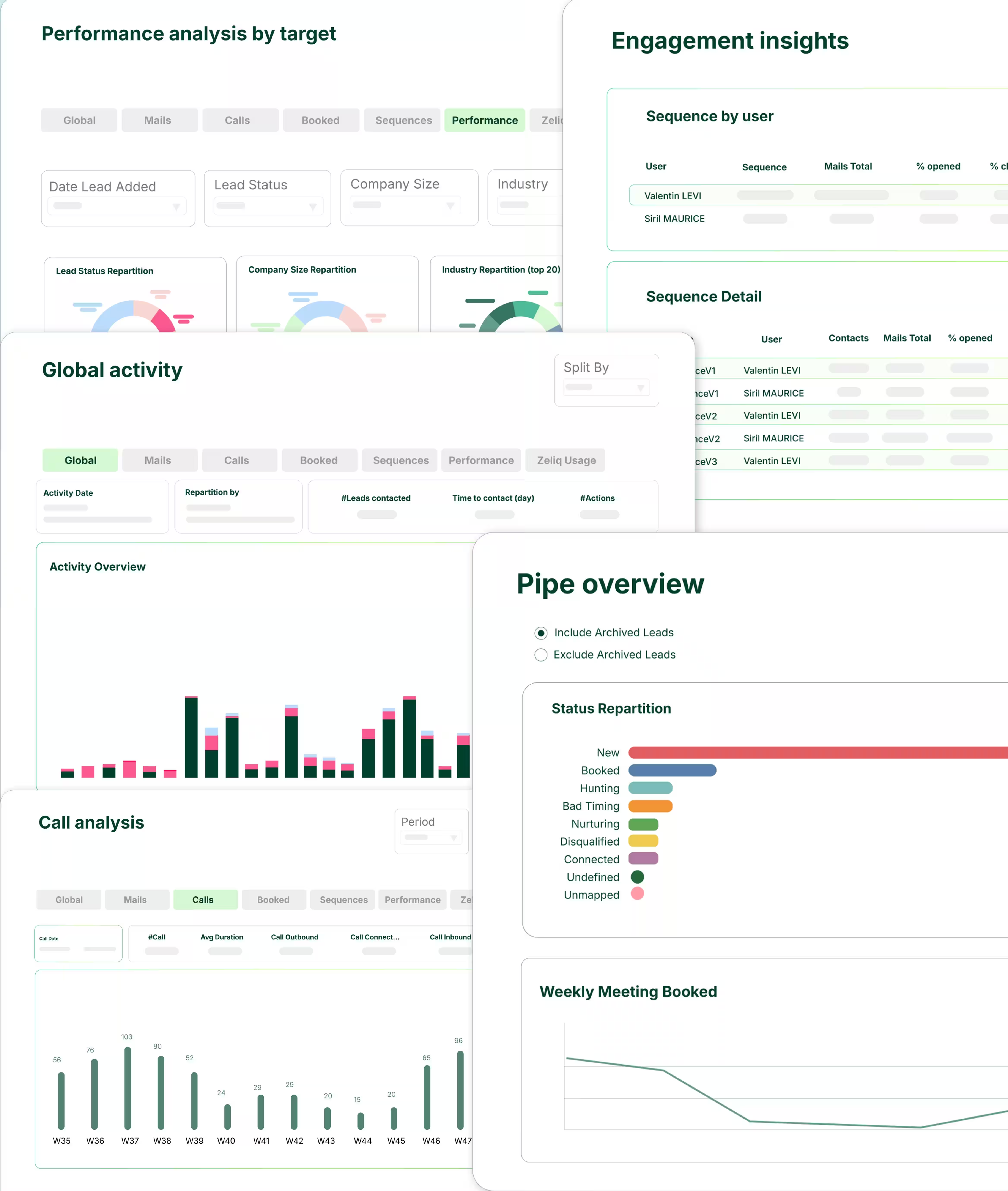
Track:
- Activity by rep and channel
- Conversion by sequence
- Meetings booked per week
Monitor list health too: bounce rates, invalid emails, and segment saturation.
Good dashboards tell the story: where volume drops, where messaging converts, and where pipeline is building or stalling.
What are effective prospecting strategies for different roles?
Effective prospecting adapts to the person. Tailor your outreach by role to match priorities, decision power, and preferred communication style.
Executives
C-levels respond to precision and timing.
Best windows: late afternoons or after hours. Keep messages concise, outcome-driven, and avoid attachments: they won’t open them.
Use mutual connections or referrals to warm the intro. End with a binary CTA:
“Worth a quick 15-min sync? Tue 5:30 or Thu 6:15?”
Respect their time, lead with business impact, and signal credibility fast. VPs don’t book meetings, they forward to someone who will.
If your target accounts sit at the upper end of the market, this guide to enterprise prospecting shows how to adapt your targeting, messaging, and cadence for complex buying committees.
Managers/Operators
Target late mornings or early afternoons. These buyers care about workflow impact, efficiency, and team performance.
Use messaging like:
“Cut admin time by 30% with zero process disruption.”
Offer quick demos, screen-share walkthroughs, or before/after snapshots. They’ll bite if it saves time and makes them look good to their VP.
Practitioners
Practitioners respond to how, not why. Share actionable tips, templates, or micro-wins relevant to their day-to-day.
Great offers:
- Invite to a 20-min webinar,
- Offer a 5-step guide or cheat sheet,
- DM a quick use case.
Make it tactical.
If they learn something, they’ll bring it up to their manager.
How to improve prospecting with tools and software?
Must-haves
A strong prospecting stack increases output and eliminates friction. This is because prospecting is the process that connects your team with potential buyers and primes your pipeline long before deals are closed.
The essentials:
- CRM: single source of truth for contact data, history, and reporting.
A clean CRM lays the foundation to improve your sales and gives your revenue leaders insight into every rep’s performance. - Data enrichment: accurate emails, firmographics, buyer signals.
These datasets help sales people focus only on high‑intent profiles and avoid wasted outreach. - Email sequencer: automate cadences, A/B test, and track reply rates.
Well‑structured sequences are among the key performance signals that show how efficiently your team is engaging the market. - LinkedIn helper: speed up profile insights, comments, and DMs.
It’s not just about automation, it’s about building trust with potential buyers by being relevant, visible, and consistent in their feed. - Call dialer: boost live connections and log calls with analytics.
Used right, it supports your sales process, making sure every call is tracked, coached, and improved.
Make sure all tools sync with your CRM: activity logs, contact updates, and outcomes. This is one of the toughest but most powerful prospecting tips: removal of manual data entry lets your team spend time reaching out, not catching up.
A connected stack compounds efficiency; a disconnected one kills it.
Selection criteria
Choose tools that remove friction, not add admin.
Key factors:
- Fast onboarding, minimal setup.
- Smart automation that supports personalization.
- Deliverability controls to protect domain health.
- Channel-level analytics for coaching.
- Role-based access for SDRs, AEs, and ops.
Avoid duplicate data entry or disconnected workflows. The best tech feels invisible: it works in the background so reps can focus on the work that drives revenue.
How to track and report prospecting performance?
Tracking prospecting is about learning fast and improving consistently. Use daily and weekly systems to turn activity into insight and insight into results.
Daily scorecard
The daily scorecard keeps execution sharp.
Reps should log:
- Planned vs completed activities (calls, emails, DMs),
- Replies (positive, neutral, negative),
- Meetings booked,
- Insights (objections, competitor mentions).
Flag stuck accounts (no movement after 3-4 touches) and decide: escalate, switch angle, or pause.
For managers, daily scorecards expose gaps early. Low replies? Fix messaging. Good replies, no meetings? Rework CTA.
It’s a fast feedback loop that keeps momentum high.
Weekly review
Weekly reviews turn activity into strategy.
Analyze:
- Channel performance: which drove replies + meetings?
- Top messages: save high-converting copy.
- Segment conversion: cut time-wasters, double down where it works.
Then, set 1-2 tests for next week: new hook, new CTA, timing tweak.
Update the prospecting calendar and rep capacity to ensure future coverage. One good week doesn’t protect the quarter, planning does.
Prospecting doesn’t need to be overwhelming, it needs to be structured.
With the right system, your team can move from guesswork to pipeline growth that compounds week after week.
From ICP clarity to LinkedIn plays, email scripts, and CRM tracking, this guide gives you a repeatable framework to follow. Now it’s your turn to operationalize it.
ZELIQ was built to help sales teams do exactly that: faster, smarter, and without the admin drag. Ready to put this plan into action? Start your free trial of ZELIQ and turn strategy into meetings.
Table of contents
Placeholder Title
Table of contents
Placeholder Title
Placeholder Title