
You pick up your phone, dial a number, and the person on the other end has no idea who you are. That is cold calling. Many have buried it; the CEO of a major consulting firm even declared in 2007 that “cold calling is dead”. Nearly twenty years later, the salespeople who book meetings at scale still use it, because no other channel creates a real conversation as fast.
But 2026 cold calling has little in common with the 2000s version. The data is better, the tools are better, buyers are more solicited, and the benchmarks are public. This guide defines cold calling, gives the real numbers (connect rate, conversion, frequency), lays out the structure of an effective call, details the LAER framework for objections, and ends with a worked cost comparison between hiring an SDR and equipping the team you already have.
What you’ll find:
- A precise definition of cold calling and the line versus cold email and warm calling
- The real 2026 numbers for B2B phone prospecting
- The structure of an effective cold call (4 phases, 5 minutes max)
- Opening techniques that work and those that kill the call
- The LAER framework for handling objections
- The KPIs to track and a worked SDR vs platform cost comparison
Cold calling: a precise definition
Cold calling is a phone call placed to a prospect with whom the salesperson has no prior connection. The prospect has not downloaded a white paper, has not reached out, has not asked to be contacted. They do not know who is calling and are not expecting the call.
That is what separates it from warm calling, which targets a prospect who has already shown a signal of interest (repeat site visits, multiple email opens, content downloads), and from a callback on an identified inbound lead. The three require different skills, and cold calling remains by far the hardest.
Cold calling inside an outbound motion
Cold calling is one of the three pillars of outbound prospecting, alongside cold email and the LinkedIn message. It is the synchronous component: no delay, no queue, no rumination. The prospect hears your voice and reacts in the second. That immediacy is both an asset (you get a reply, even a negative one) and a constraint (you do not get a draft).
In B2B, cold calls most often target identified decision-makers: an SDR calling a Head of Marketing at a mid-market tech company, an account executive calling a buyer at a large industrial group. The target is precise, the conversation is meant to be short, and the goal is almost always to book a meeting, not to sell on the call.
Cold call vs cold email: the operational difference
Cold call and cold email share a goal (start a conversation with a stranger) but operate at opposite tempos.
| Criterion | Cold call | Cold email |
|---|---|---|
| Synchronous | Yes, immediate reply | No, asynchronous |
| Realistic daily volume | 50-80 calls per SDR | 200-500 sends per SDR |
| Reply rate | 8-12% connect, 2-3% meetings | 1-5% reply depending on targeting |
| Marginal cost | SDR time (1-3 min/call) | Near zero, automatable |
| Cognitive effort | High, must pivot live | Moderate, you reread before sending |
| Critical data | Verified direct mobile number | Verified email and correct pattern |
| Dominant skill | Improvisation, listening, voice | Writing, subject line, sequence |
These two channels do not compete. The best approach, documented by several studies, combines them. A Cognism study of over 204,000 calls in 2025-2026 showed that an email + phone sequence produces a reply rate more than twice that of email alone. Adding LinkedIn strengthens the effect further. For more, our dedicated guide to multichannel prospecting details these sequences.
The 2026 B2B cold calling benchmarks
Talking about cold calling with no numbers is talking into the void. Here are the public orders of magnitude from major 2025-2026 studies.
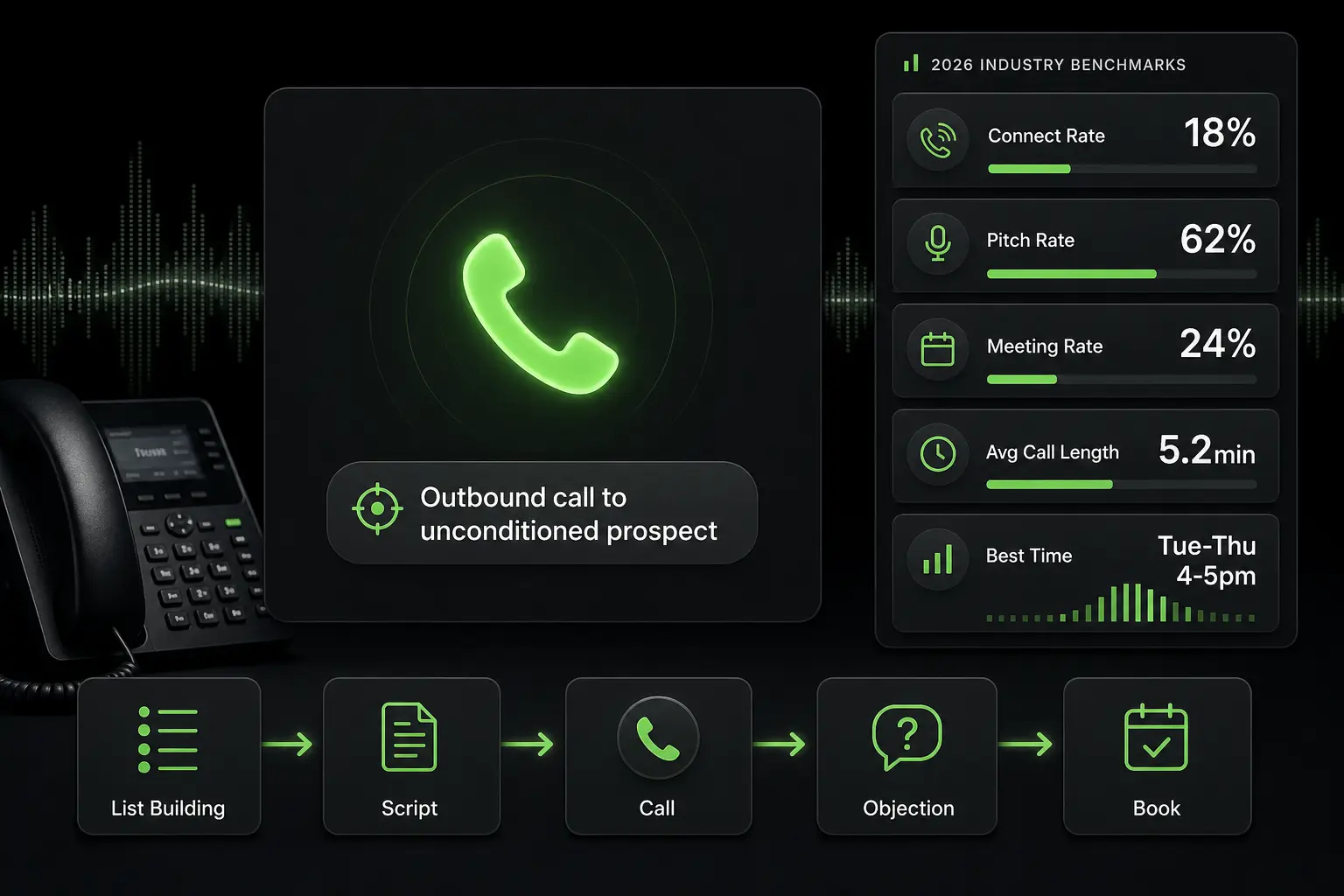
Connect rate (calls that land a real conversation)
- 8-12%: average on a generic list of unverified numbers
- 18-22%: on verified direct mobile numbers
- 25%+: for top-quartile SDRs, combining clean data, optimal timing and proven openers
Moving from a generic list to verified direct mobiles roughly doubles the connect rate. That is the most mechanical leverage of modern cold calling: before you work on the voice, you work on the data. To understand how to retrieve these numbers, see our article on phone contact details.
Meeting conversion
- 2-3%: average of calls placed that lead to a booked meeting (Cognism 2026 study)
- 6-10%+: top performers, on the same volumes
This figure has dropped in 2026 (2.3% per Cognism, down from 4.82% the previous year), reflecting saturation among B2B decision-makers. But the gap between the average and the top quartile remains wide, which means individual upside still exists.
Volume and persistence
- 80% of B2B sales require 5 to 12 touches before closing
- 92% of reps give up before the 4th attempt
Put differently, half of the “impossible” deals are actually abandoned three touchpoints too early. Follow-up discipline, more than single-call talent, makes the long-term difference.
Optimal timing
The data converges on the best B2B time slots:
- Tuesday to Thursday, 10-11 AM and 2-3 PM in the prospect’s local timezone
- Avoid Monday morning (catching up on weekend) and Friday afternoon (winding down)
Calling in these windows gives a 30-50% connect rate lift compared to calls placed at random throughout the day.
Data first, voice second
The most rewarding lever of a cold call is the quality of the number. Zeliq retrieves your prospects’ verified direct mobiles through waterfall enrichment that queries more than 40 providers. Explore B2B data enrichment.
The structure of an effective cold call: 4 phases in 5 minutes
A good cold call does not go past five minutes. Beyond that, you tire the prospect before you have interested them. The structure always follows the same four phases, with indicative durations.
Phase 1: the opening (10 seconds)
You have exactly ten seconds to give the prospect a reason to keep the conversation going. Not ten minutes, not one minute. Ten seconds.
An effective opening does three things: it identifies you clearly, gives the precise reason for the call, and asks permission to continue. Example: “Hi {first name}, this is {your first name} from {company}. I’m calling because I saw you {specific trigger}. Got two minutes for me to tell you why?”
Two schools compete: permission-based openers (“Got two minutes?”) and non-permission openers (which go straight to value). The first work better with senior profiles and heavily solicited markets; the second work better when your hook is strong and you do not want to create friction. Test on your audience.
Phase 2: qualification (30 to 60 seconds)
Once you have permission, you do not launch a pitch. You ask two to three open questions to confirm the topic concerns the prospect. Example: “How are you handling {problem related to your offer} today? What’s working, what’s costing you time?”
The analysis of more than 25,000 sales conversations by speech analytics tools gives a precise marker: top performers have a 43:57 talk-to-listen ratio. In other words, they listen more than they talk. That is the opposite of the chatty-rep image, and it is the most measurable gap between an average SDR and an excellent one.
Phase 3: the value proposition (1 to 2 minutes)
When qualification confirms the fit, you state in one concrete sentence what you offer, anchored in what you just heard. No product pitch, no features. One measurable benefit, illustrated by a comparable client case. Example: “An SDR team your size at {comparable client} cut their number-search time in half by switching to our platform, and doubled their booked meetings.”
Phase 4: the meeting request (30 seconds)
The goal is never to sell on the phone, it is to get a slot for a real conversation. Propose two specific dates, not “when are you available”. “Tuesday 2 PM or Thursday 10 AM, work for you?” reduces the decision to a yes on one or the other.
If the prospect refuses, ask what is missing for them to accept later, and propose a follow-up at an agreed date. A “no” well unpacked is worth more than a fuzzy “maybe”.
Talk track over script: why
Rigid scripts no longer work in 2026. B2B buyers spot the scripted voice immediately and mentally hang up before the first sentence ends.
Modern practice uses a talk track: a flexible framework that guides the SDR through each phase, with reference lines and variants based on the prospect’s reactions, while leaving room for natural conversation. The SDR knows where they are going, without reciting.
A good talk track contains:
- 3 to 5 tested openers, chosen by profile
- 5 to 10 qualification questions per persona
- 3 to 5 value propositions per use case
- The mapping of frequent objections and their responses
Building this talk track is a team effort, not a day-one deliverable. It grows with every coached call, every re-listened recording.
The LAER framework for handling objections
A Gong study analyzing tens of thousands of calls concludes that 80% of cold call objections are not rational refusals. They are defensive reflexes: the prospect is not rejecting your offer, they are rejecting the interruption. That nuance changes everything in how to respond.
The reference framework in US sales teams is called LAER: Listen, Acknowledge, Explore, Respond.
| Step | What the SDR does |
|---|---|
| Listen | Lets the prospect finish their objection, without interrupting |
| Acknowledge | Acknowledges the objection (“I understand why you’d say that”) |
| Explore | Asks a question to dig deeper (“What makes you say that?”) |
| Respond | Replies briefly, with a fact or example, then sends back a question |
Concretely, facing “We already have a tool for that”:
- Bad response: “But ours is better because…” (rebuttal = wall)
- LAER response: “Absolutely, many of our customers were already equipped before us. What do you like about your current tool, and what could be better?”
The second approach turns the objection into information. You do not yet know if you will sell, but you know what is really happening at the prospect, and the conversation continues.
The 5 mistakes that doom a cold call
Five patterns come up constantly in failing calls.
First, the immediate pitch: launching into product features by the second sentence. That is the rookie SDR’s #1 mistake. If the prospect does not know precisely why you are calling, they mentally check out.
Next, lack of preparation. Calling without having looked at the LinkedIn profile, the company news, the exact role. Three qualification questions are enough to reveal unpreparedness and the conversation ends.
Awkward insistence: calling back right after a “no”, or leaving four voicemails in two days. That reads as aggression and closes the door for good.
The monologue. An SDR talking 70% of the time learns nothing about their prospect. The target ratio remains around 43:57 talk-to-listen.
The fuzzy goal. A call with no clear next step in mind (meeting, quote, product demo) ends with an “I’ll send you an email” that never materializes. Exit every call with a dated action for both sides.
The KPIs to steer your phone prospecting
Without measurement, no improvement. Here are the metrics mature sales teams track week over week.
- Dials per day: calls placed. Target: 50 to 80 for a full-time SDR, depending on target complexity.
- Connect rate: calls leading to a real conversation (≥30 seconds). Target: 15-22% on verified direct mobile.
- Conversation rate: calls with conversation that move into real qualification. Target: 40-60% of connects.
- Meeting booked rate: meetings booked over calls placed. Target: 2-3% average, 6-10% top quartile.
- Meeting held rate: meetings held over meetings booked. Target: 65-80%. Below that, qualification or timing issue.
- Meeting-to-opportunity: opportunities created over meetings held. Target: 30-50%.
These six numbers form the minimum dashboard for a sales manager. The strength of such tracking is not so much the absolute number as the drift over time: a connect rate that falls signals data degradation, a meeting held rate that drops signals lax qualification.
Worked example: hire an SDR or equip the team?
A US-based B2B mid-market company hesitates between hiring an additional SDR or equipping its existing team with a modern prospecting platform. The typical one-year calculation:
Option A: hire a junior SDR
- Base salary: $65,000 per year
- Benefits and payroll taxes (~25%): $16,250
- OTE variable hit: $20,000
- Desk, equipment, training, management: $5,000
- Total annual cost: ~$106,250
- Ramp-up: 4-6 months before full performance
- Expected output: ~30 qualified meetings per month at steady state (60 calls/day × 21 days × 2.5%)
Option B: equip the 3 existing SDRs with a prospecting platform
- Annual platform subscription (3 seats): $9,000-18,000 depending on plan, see Zeliq pricing
- Onboarding: 2 days
- No payroll taxes, no extra desk
- Expected output: an SDR equipped with a solid database and multichannel sequences books 50 to 80% more meetings than an SDR without tools, i.e. ~15 extra meetings per month per SDR (45 total)
Option B comes out cheaper and more effective, provided your existing SDRs know how to sell. If your SDRs are already maxed out on human capacity, hiring becomes relevant. The trade-off is rarely “SDR or tool”: it is “SDR + tool versus SDR alone”. That is, in 80% of B2B sales committees, the debate of the year.
Cold calling and compliance: what you need to know
Phone prospecting is regulated. In the United States, the TCPA (Telephone Consumer Protection Act) and the National Do Not Call Registry strictly govern telemarketing. B2B is less exposed than B2C, but using auto-dialers without prior consent is risky.
In the UK and EU, the GDPR applies the moment a number identifies a person, and a work mobile is personal data. Legitimate interest is the usual lawful basis in B2B, subject to informing the person and honoring their right to object. The UK adds the Telephone Preference Service for marketing calls.
Beyond the legal framework, the reasonable time slot is universally understood as 9 AM to 7 PM on weekdays in the prospect’s timezone. Calling outside hurts your brand, independent of legality.
Cold calling, AI and 2026: what has changed
Three shifts have already transformed cold calling in 2026.
Conversation intelligence (Gong, Chorus, Clari Copilot, Mojo) records, transcribes and analyzes calls. The SDR can re-listen to calls, the manager can coach on specific excerpts, the team can identify the openings and transitions that work. The effect on skill growth is documented: teams that adopt a speech analytics tool see their meeting booked rate progress by 15 to 30% within 6 months.
Modern dialers (Aircall, Ringover, CloudTalk, Orum) remove dead time. Instead of dialing manually, the SDR chains calls automatically. On a single day, the productivity gap with a regular phone is on the order of 2 to 3x.
Intent data enrichment identifies accounts in motion (hiring, funding, product launch) to prioritize calls when the prospect has a live project. A call to a prospect with an intent signal converts 3 to 5 times better than a pure cold call.
These three shifts do not replace the SDR. They move their work toward what genuinely creates value: the conversation, the listening, the framing. For a Business Developer, that is the promise of a day with more qualified conversations and fewer mechanical tasks.
How Zeliq streamlines modern cold calling
Zeliq addresses the three conditions of a profitable cold call in 2026. The platform identifies the right contacts in a database of more than 450 million profiles, retrieves their verified direct numbers through waterfall enrichment that queries more than 40 providers, and builds the call into multichannel sequences with email and LinkedIn to warm the prospects before the call. An equipped SDR places 2 to 3 times more useful calls per day (verified numbers, prepared prospects), with a higher connect rate. To structure this effort, see how Zeliq supports a Business Developer or a sales manager driving outbound at scale.
Cold calls that turn into meetings
Zeliq finds the right contacts, their verified direct numbers, and orchestrates your multichannel sequences. Account created in 2 minutes, no credit card.
Try for freeIs cold calling still effective in 2026?
Yes, but on conditions. The 2026 numbers (2-3% conversion to meetings on average, 6-10% top quartile) show the channel still delivers, provided you have verified direct numbers, a personalized hook and a call slotted into a multichannel sequence. The isolated cold call, with a generic list and a recited script, no longer works. The modern cold call, however, remains one of the few channels that produces a real conversation in under a minute.
How many calls should an SDR make per day?
The commonly accepted target in B2B sits between 50 and 80 calls per day for a full-time SDR, meaning roughly 5 to 8 useful conversations a day. That range assumes verified direct numbers and a dialer platform that removes dead time. Without those conditions, the same SDR dials 30 to 40 numbers a day, half of them inactive, and holds 2 to 3 real conversations.
What’s the difference between a cold call and a cold email?
A cold call is synchronous: the reply comes in seconds, you get an immediate yes or no, but daily volume is capped by time (50-80 calls). A cold email is asynchronous: you reach 200 to 500 prospects a day at near-zero marginal cost, but the average reply rate is lower and the conversation is won across several sends. The two channels work better together than apart: combining email + call produces a reply rate twice that of email alone (Cognism 2026 study).
Zeliq and industrializing cold calling
Cold calling is only effective with verified phones and a multichannel sequencer. Zeliq combines 450 million B2B contacts with verified direct phones and native cold-calling integrations (Aircall, Ringover). Your reps chain call, email and LinkedIn in a calibrated cadence.
Conclusion: three actions to put in place this week
Cold calling has not disappeared, it has professionalized. Three concrete actions to calibrate your effort.
- Measure your current connect rate on the last 100 calls. If you are below 15%, the problem is data before voice. Invest in verifying your direct mobile numbers.
- Record and re-listen to 5 cold calls this week, with a manager or a peer. Measure your talk-to-listen ratio. If it goes above 50%, you are talking too much. The target is 43:57.
- Slot your cold calls into a multichannel sequence. No more cold calls with zero prior touch. An opening email, a LinkedIn message, then the call two to five days later doubles your measurable reply rate.
To compare the plans suited to your team and weigh the cost of a platform against an additional SDR, see Zeliq pricing.
And if you want to industrialize your B2B cold calling with verified phones and Aircall/Ringover integration, try Zeliq for free and move from isolated call to multichannel sequence.