

Follow-Up Call: Scripts, Timing, and Frameworks That Actually Work
The follow-up call is one of the most underused and underprepared moves in a sales rep’s playbook. Most reps make the first call with a solid script, then improvise everything after that. The result? Awkward, forgettable conversations that push prospects away instead of pulling them closer. This guide fixes that. You’ll get a clear framework, word-for-word scripts for four key scenarios, voicemail templates, objection-handling language, cadence guidance, and a multichannel strategy to use when the phone alone isn’t enough.
What Is a Follow-Up Call, and When Should You Make One?
A follow-up call is any outbound call you make after an initial point of contact: an email, a first call, a demo, or a proposal. Its goal is not to repeat what you already said. Its goal is to move the deal forward by adding new value, resolving doubt, or simply creating the moment your prospect needs to make a decision.
You should consider a follow-up call in three main situations:
- After an email that went unanswered. Many prospects read emails and intend to reply later, then forget. A well-timed call can catch them at the right moment without feeling intrusive.
- After a first call with a positive outcome. If a prospect said “send me more info” or “let’s reconnect next week,” a follow-up call is the natural next step. It shows professionalism and reliability.
- After sending a proposal. Proposals often stall in inboxes. A timely follow-up call moves the conversation from “I’ll look at it eventually” to “let’s talk about next steps.”
The underlying principle: every follow-up call should have a reason to exist. Not just “I’m calling to follow up” but “I’m calling because I noticed X” or “I wanted to share something relevant to what you mentioned.”
Fundamentals of an Effective Follow-Up Call
Before diving into scripts, let’s cover the three fundamentals that separate forgettable calls from ones that convert.
1. Timing
The first 24 to 48 hours after initial contact are your highest-leverage window. After that, response rates drop quickly. For proposal follow-ups, 3 to 5 business days is the sweet spot: enough time for the prospect to review, not so long that the momentum dies.
Avoid calling on Monday mornings (prospects are overwhelmed) and Friday afternoons (minds are elsewhere). Tuesday through Thursday, between 10 AM and 12 PM or 2 PM and 4 PM, consistently outperforms other windows.
2. Tone
Your tone on a follow-up call matters even more than your words. Come in calm, confident, and helpful rather than anxious or apologetic. Never open with “I know you’re busy, I won’t take much of your time.” That signals low confidence. Instead, open with clarity and purpose.
3. Preparation
Before every call, review: - What you discussed or sent previously - Any relevant company news (funding, product launches, hiring signals) - One specific value point tied to their situation - Your clear ask for this call (a meeting, a decision, feedback)
With those fundamentals in place, the calls feel natural, not scripted.
The Follow-Up Call Framework: Four Steps
Every effective follow-up call follows a simple structure. You can adapt the language to each scenario, but the bones stay the same.
Step 1: Greeting and context. State who you are, why you’re calling, and reference the prior touchpoint immediately. Do not assume they remember you.
Step 2: Value reminder. In one sentence, restate the core reason your solution is relevant to them. Tie it to something specific they shared.
Step 3: New angle or information. Add something new: a relevant case study, a stat, a change in their industry, a question you thought of after your last conversation. This is what transforms a follow-up into a conversation.
Step 4: Clear ask. Make a single, specific ask. “Does Thursday at 2 PM work for a 20-minute call?” beats “Would you ever have time to reconnect sometime?”
Scripts for Four Key Follow-Up Call Scenarios
Script 1: Follow-Up After No Email Reply
Use this when your prospecting email went unanswered after 3 to 5 days.
“Hi [Name], this is [Your Name] from Zeliq. I sent you an email on [day] about [topic] and wanted to follow up by phone since it’s sometimes easier to connect this way. The quick version: we help [relevant outcome for their role]. I had a specific idea for [Company] I wanted to run by you. Is now a decent moment, or would another time work better?”
Why it works: It acknowledges the email, offers context without repeating the full pitch, and ends with a low-pressure two-option close.
Script 2: Follow-Up After a First Call (Positive Outcome)
Use this when the prospect said something encouraging, like “send me more info” or “let’s reconnect.”
“Hi [Name], it’s [Your Name] from Zeliq. We spoke [X days] ago about [specific topic they mentioned]. I sent over [what you sent], and I wanted to follow up to see if you had any questions after taking a look. I also thought of one more thing relevant to what you shared about [their specific challenge]. Have you had a chance to review it, or would a quick walkthrough be helpful?”
Why it works: It references the previous call specifically, adds something new, and offers a concrete next step.
Script 3: Follow-Up After Sending a Proposal
Use this when a proposal has been sitting for 3 to 5 business days without a response.
“Hi [Name], it’s [Your Name] from Zeliq. I sent over the proposal on [date] and wanted to check in to see if you had any questions or if anything came up since we last spoke. I know these decisions involve multiple people sometimes, so I also wanted to make sure you had everything you need to move forward internally. What’s your current thinking?”
Why it works: It opens the door without pressure, acknowledges internal complexity, and ends with an open question to surface objections.
Script 4: Follow-Up After a Demo
Use this when the prospect attended a demo but hasn’t responded to your post-demo email.
“Hi [Name], it’s [Your Name] from Zeliq. We did a demo on [date] and I wanted to circle back since I know you were looking at [specific feature or outcome they mentioned]. I’ve seen a few companies similar to [theirs] get [specific result] pretty quickly after getting started. I wanted to hear your honest reaction to what you saw and figure out if there’s a path forward that makes sense for your team.”
Why it works: It personalizes based on the demo content, adds social proof, and invites honest feedback rather than a forced yes.
Voicemail Scripts (20 to 30 Seconds Max)
Most follow-up calls will hit voicemail. A good voicemail is short, clear, and ends with a reason to call back (or doesn’t demand one at all).
Voicemail after no email reply:
“Hi [Name], this is [Your Name] from Zeliq. I reached out by email last week about [topic] and wanted to follow up directly. My number is [number]. If it’s easier, I’ll send you a quick note. Either way, looking forward to connecting.”
Voicemail after a proposal:
“Hi [Name], it’s [Your Name] from Zeliq. I sent over the proposal on [date] and just wanted to make sure it landed and see if anything came up. My number is [number]. No rush, happy to chat whenever works for you.”
Key rules for voicemails: State your name and company early (not at the end). Keep it under 30 seconds. Always have one clear message: I sent something, I wanted to follow up, here’s how to reach me.
Handling Objections Specific to Follow-Up Calls
Follow-up calls surface a different category of objections than first calls. Here’s how to handle the three most common ones.
“I’m still evaluating.”
Don’t panic. This is actually a positive signal. They haven’t said no.
“That makes complete sense, and I don’t want to rush your process. Can I ask: what are the main things you’re still weighing? That way I can make sure you have exactly what you need to make a confident decision.”
“I haven’t had time to look at it yet.”
Don’t apologize. Redirect to value.
“Totally understand. Would it actually be easier if I gave you the 3-minute version right now, so you don’t have to read through everything? I can make sure you’re only spending time on what’s actually relevant to you.”
“We decided to go with someone else.”
Stay composed. This is a door, not a wall.
“I appreciate you telling me directly, that’s genuinely helpful. Can I ask: was it a features question, a pricing question, or something else? I’d love to understand so I can improve, and honestly, circumstances change, so I’d be happy to stay in touch.”
How Many Follow-Up Calls Is Too Many?
The research is clear: most deals require 5 to 8 touchpoints before converting, but most reps give up after 1 or 2. At the same time, calling every single day is a fast track to being blocked.
A healthy follow-up call cadence for a typical outbound sequence looks like this:
| Day | Action |
|---|---|
| Day 1 | First call + email |
| Day 3 | Follow-up call (if no reply) |
| Day 7 | Second follow-up call |
| Day 14 | Final call with a clear close |
That’s 2 to 3 follow-up calls in a sequence, with enough space between them to avoid feeling aggressive. If there’s still no response after the final call, move to a nurture track rather than continuing to push.
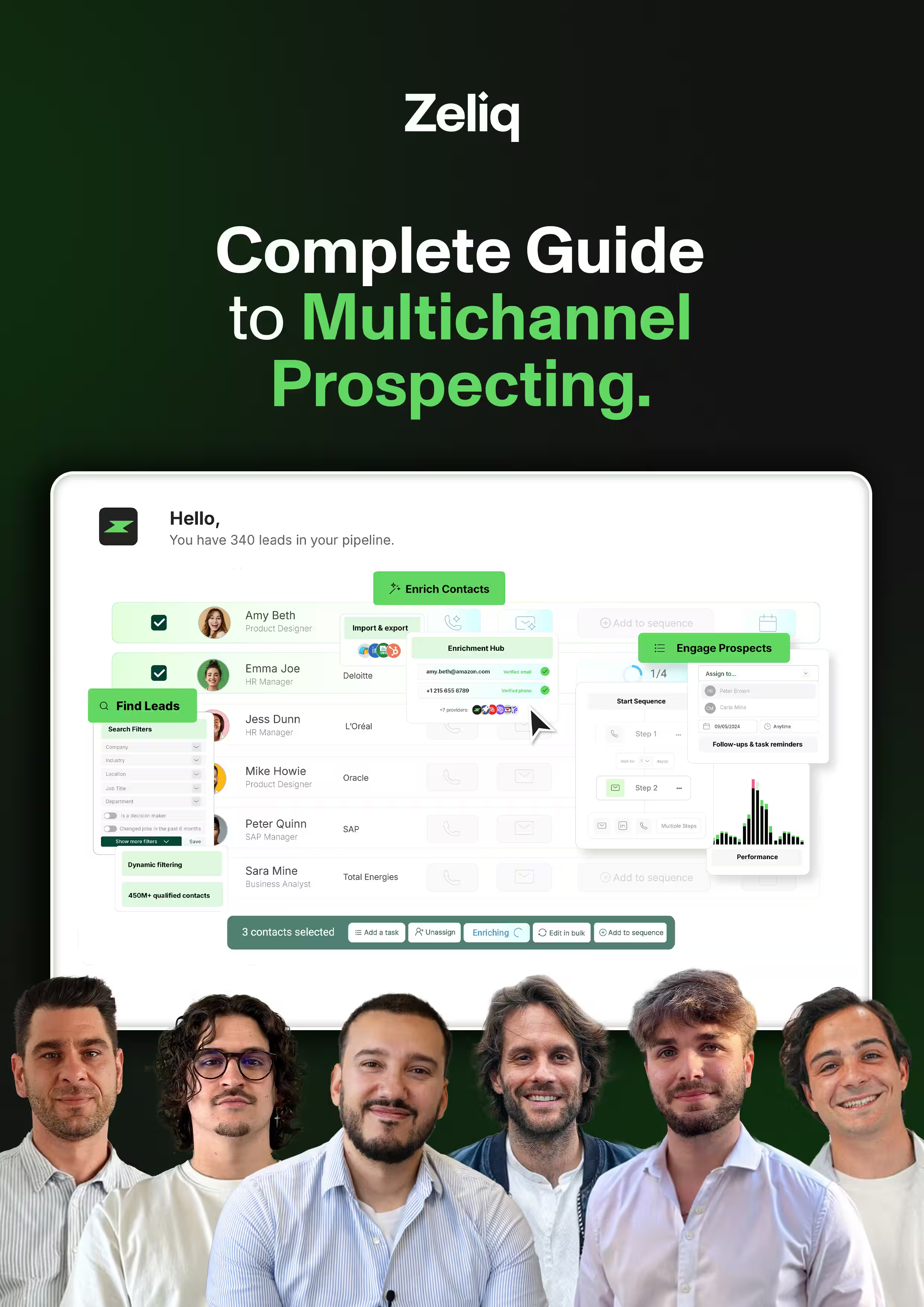
With Zeliq’s multichannel prospecting features, you can build and manage these sequences across channels without losing track of where each prospect stands.
Multichannel Follow-Up: When to Switch Channels
The phone is powerful, but it’s not always the right tool. Here’s a simple decision framework:
Stick with the phone when you’ve had a warm previous interaction, when the deal is high-value, or when speed matters.
Switch to email when the prospect has replied to email before but not answered calls, when you need to share something visual (a deck, a proposal, data), or when you want to summarize what was said on a call.
Move to LinkedIn when the phone and email aren’t working, when the prospect is active on LinkedIn, or when you want to build credibility before the next call. A quick, non-pitchy LinkedIn message (“Saw your post about X, thought of something relevant”) can warm up a cold prospect faster than a third voicemail.
The key is to vary the channel before repeating the same one. If two calls haven’t worked, don’t make a third call: send a LinkedIn message or a brief email with a new angle. Zeliq’s browser extension makes it easy to pull up verified contact data and switch channels without leaving your workflow.
Building a Scalable Follow-Up Call Process with Zeliq
Great follow-up calls don’t happen by accident. They happen when reps have the right contact data, the right timing, and the right context at their fingertips.
With Zeliq’s B2B contact data features, you can make sure you’re calling the right person at the right company, with verified phone numbers and emails, so no effort is wasted on bad data. And with B2B data enrichment, you can surface the context you need before every call: company size, recent activity, tech stack, and more, so your follow-ups feel personalized rather than generic.
The reps who consistently convert on follow-up calls aren’t the ones with the best improvisational skills. They’re the ones with the best systems: good data, good timing, and a clear framework for every scenario.
Stop winging your follow-up calls. Zeliq gives you verified contact data, multichannel sequences, and the context you need to make every call count.
Try Zeliq for free