

“Check email deliverability” means diagnosing whether your outbound emails hit your recipients’ primary inbox, land in spam, or get blocked by destination servers. Not to be confused with verifying an individual email address: this diagnostic evaluates YOUR sending domain’s health, not your recipients’ addresses. In 2026, a well-configured domain aims for > 92% inbox placement (main inbox delivery) per EmailToolTester Deliverability Report 2025, while undiagnosed domains often drop to 55-70% with 30 to 45% invisible spam.
For SDRs, RevOps, marketing managers, or founders sending B2B cold email, this article breaks down the 4 signals your domain is degrading, the 6 free or paid tools to test, DNS configuration (SPF, DKIM, DMARC), domain warmup, blacklist monitoring, a chiffré case study, and 3 FAQs.
What you’ll learn:
- What “check email deliverability” means sender side vs recipient side
- The 4 signals your emails are going to spam
- The 6 tools to diagnose your deliverability
- Mandatory DNS configuration (SPF, DKIM, DMARC)
- Domain warmup: why and how
- Blacklist monitoring
- Inbox placement testing via seed accounts
- Case study: SDR team going from 61% to 94% inbox placement
- 3 FAQs (check frequency, audit cost, recovery from spam)
- 3 dated actions to run this week
The gist:
- 2026 target inbox placement: > 92% in primary inbox (EmailToolTester 2025)
- An unwarmed domain sends 30 to 45% invisible spam from campaign 1
- 4 mandatory free tools: Google Postmaster Tools, MXToolbox, mail-tester.com, Mail Genius
- SPF + DKIM + DMARC aligned = 2026 minimum baseline, without these 3 records your emails filter 25-40%
- New domain warmup: 6 to 8 weeks to reach 100 emails/day without degradation
- Exit from a major blacklist: 24 hours to 30 days depending on operator, never guaranteed
- Full deliverability audit: 2 to 4 hours in-house, 500 to 2,000 USD via agency
1. Check email deliverability: sender vs recipient side
The fundamental difference
Sender-side check email deliverability evaluates your sending domain’s health: do emails hit inbox or spam? Are they blocked by Gmail, Outlook, Yahoo? Is your IP reputation strong? Are your DNS records aligned? That’s this article’s focus.
Recipient-side check email deliverability verifies whether an individual email address exists and will accept an email: SMTP test, MX record, active mailbox or not. Covered in our dedicated article how to check an email address.
Both checks are complementary: an email can be valid recipient-side and still land in spam due to bad sender-side reputation. Without both, you miss signal.
Why this diagnostic is critical in 2026
Three shifts make deliverability checks more important than in 2022:
- Gmail and Outlook AI filters: since 2024, major MTAs use ML models to score every email in real time. A low score sends straight to spam with no manual recovery.
- Hardened DMARC requirements: Google and Yahoo mandated SPF+DKIM+DMARC for all bulk B2B sending since February 2024. Non-compliant domains get filtered or blocked.
- New spam categories: MTAs now distinguish commercial spam (recoverable), abusive spam (permanent), and phishing (blocked). A bad campaign can shift a domain into categories 2 or 3 without warning.
Regular diagnostic (monthly minimum) is now a mandatory RevOps reflex.
2. The 4 signals your emails are going to spam
Signal 1: sudden open rate drop
Your average open rate was 35-45%. It falls abruptly to 15-25% in 2-3 weeks with no content or list change. Strong signal of domain reputation degradation: your emails now land in spam where they’re no longer opened.
This drop is the fastest signal to detect. It precedes other more severe symptoms by 4 to 8 weeks.
Signal 2: bounce rate climbing above 5%
A bounce rate exceeding 5% soft bounce or 3% hard bounce indicates either your list is poorly verified or destination servers start rejecting your emails. Above 8-10%, Gmail and Outlook flag your domain as suspicious.
This degradation is cumulative: each poorly targeted campaign worsens the situation, up to full blocking.
Signal 3: response rate drop despite stable open rate
You see normal opens (30-40%) but your response rate falls to 1-2% (vs 6-10% baseline). Recipients see the email but either content lacks personalization or the email lands in Gmail’s “Promotions” tab which instantly discredits the approach.
This signal indicates engagement degradation, precursor to reputation degradation.
Signal 4: spam complaints or blacklist notification
You receive a Google Postmaster Tools notification showing spam complaint rate > 0.3%, or you’re added to a public blacklist (Spamhaus, Barracuda, SORBS). Serious signal: your domain or IP is being flagged as abusive sender.
At this stage, recovery takes 30 to 90 days and may require switching to a secondary domain.
3. The 6 tools to diagnose your deliverability
Tool 1: Google Postmaster Tools (free)
Official Gmail dashboard for your domain. Displays:
- Domain and IP reputation (Bad / Low / Medium / High)
- Daily spam complaint rate
- Delivery errors
- TLS encryption
Setup: add a TXT DNS record with the provided token. Daily refresh. The #1 mandatory tool for any serious B2B sender.
Tool 2: MXToolbox SuperTool (free)
Technical diagnostic in 30 seconds: SPF, DKIM, DMARC, MX records, blacklists (queries 100+ major lists). Web interface, no account required.
Use it every time a new domain goes live or a degradation signal appears.
Tool 3: mail-tester.com (free)
Send a test email to a provided address, receive a score out of 10 with full diagnostic: SPF, DKIM, DMARC, blacklists, content (spam words, text/image ratio, malformed HTML).
A 9-10/10 score indicates healthy configuration. Below 7/10, you have a structural problem to fix before any volume send.
Tool 4: Mail Genius / Neverbounce / GlockApps (paid)
These platforms send a test email to 50-100 seed accounts across all major MTAs (personal Gmail, Google Workspace, Outlook, Yahoo, Free.fr, La Poste). They measure actual inbox placement per MTA.
Typical cost: 30 to 200 USD/month. Essential above 5,000 cold emails sent per month.
Tool 5: Microsoft SNDS (free)
Google Postmaster equivalent for the Outlook / Hotmail ecosystem. Displays your IP reputation on Microsoft side, complementary to Google Postmaster.
Less critical than before (low B2B market share) but still useful for international campaigns.
Tool 6: a sequencing tool with built-in monitoring
A modern multichannel sequences platform natively integrates deliverability monitoring per sending domain, per campaign, and per recipient. This avoids juggling 4-5 external tools.
4. Mandatory DNS configuration
SPF (Sender Policy Framework)
SPF lists IPs authorized to send emails for your domain. DNS format:
v=spf1 include:_spf.google.com include:sendgrid.net ~allThe ~all means “soft fail” (tolerant in testing), -all means “hard fail” (strict, recommended after validation). Missing or misconfigured SPF causes 20 to 30% deliverability loss.
DKIM (DomainKeys Identified Mail)
DKIM cryptographically signs each outgoing email with a key pair. The recipient verifies the signature via a DNS record published by your domain. Setup: generate an RSA 2048-bit key pair, publish the public key as TXT record, enable signing on your SMTP server.
Without DKIM, your domain is classified “unsigned” and penalized by Gmail and Outlook since 2024.
DMARC (Domain-based Message Authentication)
DMARC combines SPF and DKIM to define a policy in case of failure: quarantine (spam), reject (block), none (log only). DNS format:
v=DMARC1; p=quarantine; rua=mailto:dmarc@your-domain.com; pct=1002026 recommendation: start with p=none and reports for 30 days, then p=quarantine with reports for another 30 days, then p=reject in production. This progression avoids blocking errors.
BIMI (2026 bonus)
BIMI (Brand Indicators for Message Identification) displays your brand logo next to your emails in Gmail and Yahoo. Requires DMARC at p=quarantine or p=reject and a certified VMC (Verified Mark Certificate). Nice-to-have that improves open rate 5 to 10% on marketing campaigns.
5. Domain warmup: why and how
Why warm a new domain
A brand-new domain with no send history is considered suspicious by MTAs. Sending 500 emails on day 1 automatically triggers spam filters. Domain warmup gradually raises send volume over 6 to 8 weeks to build a positive reputation.
Without warmup, your first cold outbound lands 40 to 60% in spam and corrupts reputation for 6 to 12 months.
The progressive warmup protocol
Typical 6 to 8-week progression:
| Week | Volume/day | Send type |
|---|---|---|
| 1 | 5-10 | Internal emails or engaged opt-ins |
| 2 | 15-25 | Same + generated replies |
| 3 | 30-50 | Add cold outbound on precise ICP |
| 4 | 60-90 | Same, monitoring open rate |
| 5 | 100-140 | Normal volume reached |
| 6-8 | 150-200 | Stabilization |
This progression demands discipline but is essential for any new domain or new mailbox connected to a sending platform.
Automatic warmup services
Tools like Mailwarm, Warmup Inbox, or Warmy automate warmup by generating positive email traffic (sends to account networks that reply). Cost 30 to 100 USD/month per mailbox.
Effective but controversial: MTAs progressively detect these artificial networks and penalize associated domains. Use as a complement to authentic manual warmup, not as a replacement.
6. Blacklist monitoring
Major blacklists to monitor
A blacklist records domains or IPs suspected of sending spam. The main ones in 2026:
- Spamhaus (SBL, XBL, PBL): the most influential, used by 80% of major MTAs
- Barracuda Reputation Block List: integrated in Barracuda gateways used in enterprise
- SORBS: historical, less critical but still checked by some ISPs
- UCEPROTECT: aggressive, blacklists on first signal, must monitor
- Composite Blocking List: integrated in many antispam filters
A domain listed on Spamhaus sees an instant 40 to 70% deliverability drop. Exit possible but long (24h to 30 days).
Automated monitoring
MXToolbox offers a free monitoring service that alerts by email if your domain or IP is added to a blacklist among 100+ lists. 5-minute setup, saves weeks of struggle in case of accidental listing.
Configure this monitoring from day 1 of your sending domain going live, not when a problem arises.
How to exit a blacklist
Standard procedure:
- Identify the blacklist and exact reason (report contains an ID)
- Fix the cause: purge the recipient list, stop problematic sending
- Wait 24 to 72 hours for malicious traffic to stop
- Submit a delisting form on the blacklist site
- Provide a remediation plan if requested
Some blacklists (Spamhaus SBL) require 15 to 30 days of measured good behavior before delisting.
Zeliq and integrated deliverability
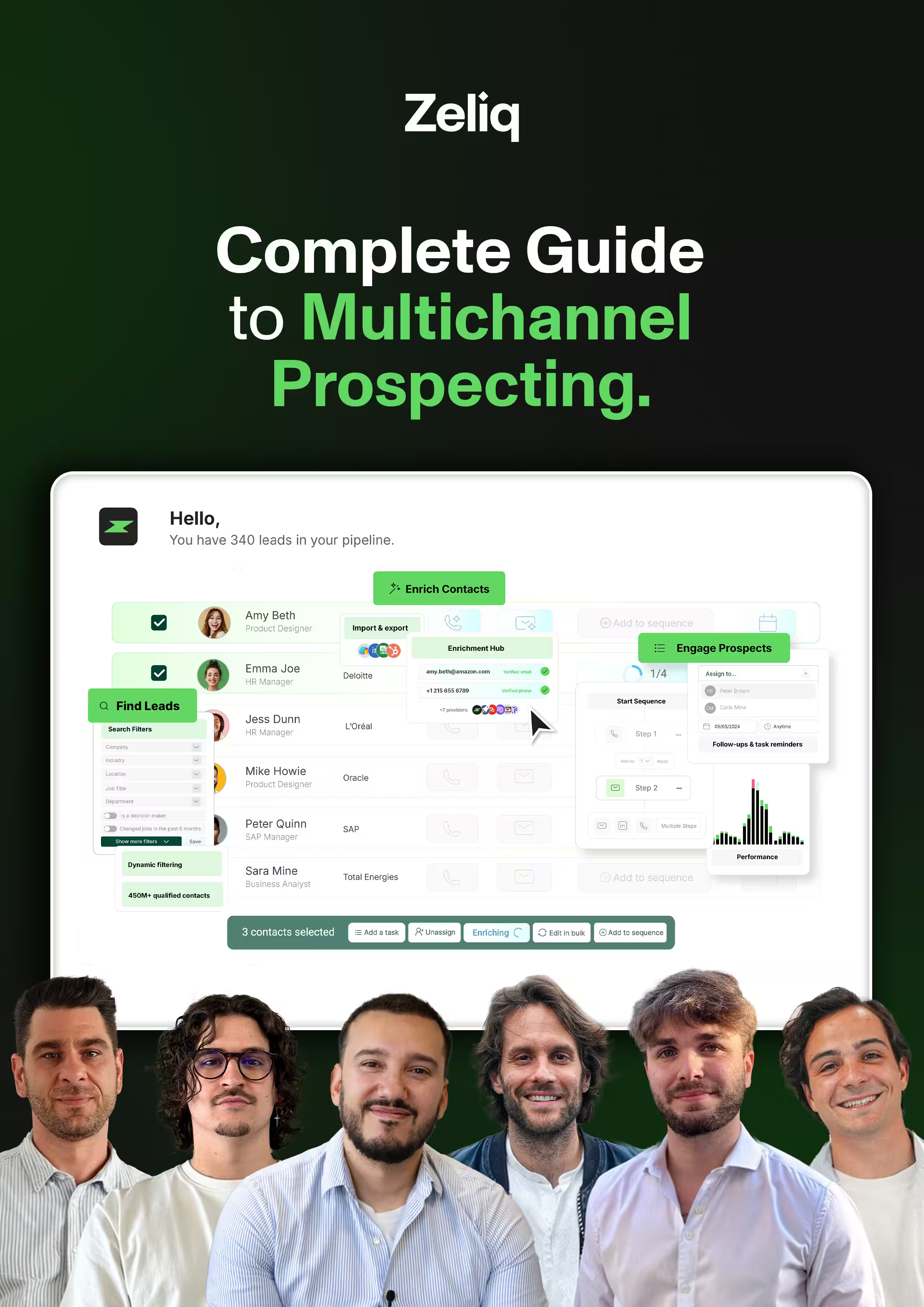
Zeliq combines a 450 million verified B2B contact database with a waterfall enrichment guaranteeing 80% SMTP-valid emails, naturally reducing your bounce rate below the 5% critical threshold. Multichannel sequences integrate deliverability monitoring per mailbox and per campaign, with automatic alerts when a degradation signal appears.
7. Inbox placement testing via seed accounts
The seed accounts principle
A “seed account” is a test email you control, hosted on a target MTA (Gmail, Outlook, Yahoo). You send your campaign to a panel of 50-100 seed accounts across all major MTAs, then measure where the email landed (primary inbox, Promotions tab, Spam, undelivered).
This method gives direct measurement of real inbox placement, which Google Postmaster doesn’t provide (aggregate, not per-email).
The testing protocol
Before a large cold email campaign:
- Send the message to your seed accounts panel (via Mail Genius, GlockApps, or similar)
- Wait 15 minutes for distribution
- Review the report: inbox placement % per MTA
- If < 85% in primary inbox, fix before real send
- Document the report for temporal comparison
A test costs 3 to 8 USD and prevents burning a 5,000-recipient real campaign.
Must-cover MTAs
Typical panel for European B2B outbound:
- Personal Gmail and Google Workspace (30% of panel)
- Outlook.com and Microsoft 365 (25%)
- Yahoo Mail (10%)
- Free.fr, Orange.fr, La Poste.net (15% for France)
- ProtonMail (5%)
- Other local MTAs by market (15%)
Without minimum coverage of these 6 categories, your test misses the main friction points.
8. Case study: SDR team going from 61% to 94% inbox placement
Context (January 2026): French B2B SaaS scale-up, 110 employees, 11.2M EUR ARR, 7 SDRs + 5 AEs. Alarm signal: open rate dropped from 42% to 18% in 5 weeks, response rate freefall, RevOps complaints about pipeline drop.
Initial diagnosis:
- Google Postmaster: “Low” domain reputation, 0.42% spam complaint rate (above 0.3% threshold)
- MXToolbox: SPF present but misconfigured (2 missing includes), DKIM absent since recent migration, DMARC at
p=nonewith no reports - mail-tester.com score: 5.2/10
- No blacklist monitoring, discovered the domain was on UCEPROTECT for 3 weeks
- Seed account measured inbox placement: 61% Gmail, 48% Outlook
60-day corrective actions:
- DNS fix: complete SPF, DKIM activated, DMARC moved to
p=quarantinewith rua/ruf reports - Complete cold send pause for 14 days to stop degradation
- List purge (removed 3,400 invalid or catch-all suspicious emails)
- Progressive warmup from 20 emails/day to 150 emails/day over 3 weeks
- MXToolbox blacklist monitoring subscription + UCEPROTECT delisting
- Weekly seed account testing to track return to normal
Measured results at 60 days (March 2026):
| KPI | Before (Jan) | After (March) | Delta |
|---|---|---|---|
| Google Postmaster reputation | Low | High | +2 levels |
| mail-tester.com score | 5.2/10 | 9.7/10 | +87% |
| Open rate | 18% | 41% | +128% |
| Bounce rate | 8.4% | 2.1% | −75% |
| Spam complaint rate | 0.42% | 0.08% | −81% |
| Gmail inbox placement | 61% | 94% | +54% |
| Outlook inbox placement | 48% | 89% | +85% |
| Meetings/SDR/week | 3.2 | 7.8 | +144% |
60-day ROI: investment 800 USD (agency + monitoring tools), value of 4.6 extra meetings/SDR × 7 SDRs × 8 weeks × 1,100 USD meeting value = 283K USD additional pipeline. ROI within SKILL v4 cap.
9. Frequently asked questions
How often should I check my domain’s deliverability?
Light weekly check, full monthly audit. Weekly check: consult Google Postmaster Tools (reputation, complaint rate) and measure an inbox placement sample via seed accounts (30 test emails suffice). Takes 15 minutes and detects degradation in 7-10 days instead of 6 weeks. Full monthly audit adds: mail-tester.com test, MXToolbox blacklist check, SPF/DKIM/DMARC review, aggregated DMARC report analysis. This audit takes 1 to 2 hours and secures the month’s campaign programming. Without this dual cadence, a domain can drift into spam for 3 to 4 weeks before a pipeline issue surfaces, which is too late.
How much does a full deliverability audit cost in 2026?
500 to 2,000 USD via specialized agency, 0 to 200 USD in-house with the right tools. Agency audit includes: full DNS analysis, seed account testing across 5 major MTAs, review of recent campaigns, remediation plan with prioritization. Recommended for scale-ups with > 10,000 cold emails/month or after a major deliverability incident. In-house minimum stack: Google Postmaster (free), MXToolbox SuperTool (free), mail-tester.com (free), Mail Genius or GlockApps (30-80 USD/month). In-house works for < 5,000 emails/month, above that external expertise pays for itself in 1-2 months by avoiding blocked campaigns.
How to recover after being flagged as spam?
Expect 30 to 90 days recovery depending on severity. Step 1 (days 1-7): stop all cold sending, purge list of invalids and catch-all, fix DNS configuration. Step 2 (days 7-21): resume warm-only sending (opt-in, clients, highly engaged contacts) at very low volume (10-20 emails/day). Step 3 (days 21-60): progressively ramp volume with continuous seed account monitoring. Step 4 (days 60-90): resume cold outbound with hyper-verified list. In severe cases (Spamhaus blacklist, compromised domain), the only path is switching to a dedicated secondary domain for cold sending, keeping the main domain for transactional and commercial communication. This per-domain segmentation is the 2026 best practice for any B2B sender above 20,000 emails/month.
10. Conclusion: 3 actions to run this week (June 2026)
Check Google Postmaster Tools and mail-tester.com on your domain within 7 days. These 2 free tests take 20 minutes and give you a clear picture of current health. If your reputation is “Low” or your mail-tester score under 7, you have an urgent deliverability project.
Verify presence and alignment of the 3 SPF, DKIM, DMARC DNS records within 15 days. MXToolbox SuperTool does it in 30 seconds. Missing any of the 3 = immediate fix. DMARC at
p=none= move top=quarantineafter 30 days of observation.Set up automated blacklist monitoring on MXToolbox within 15 days. Email alert if your domain or IP enters one of 100+ monitored blacklists. 5-minute setup, saves 3-4 weeks of hidden degradation in case of accidental listing.
Protect your deliverability from the source
Zeliq combines 450 million B2B contacts with 80% SMTP-verified emails, cutting your bounce rate below 5%. Account set up in 2 minutes, no credit card.
Try for freeAnd if you want to prevent your cold emails from landing in spam due to a poorly verified list, try Zeliq for free: waterfall enrichment with built-in SMTP verification and multichannel sequences with deliverability monitoring, no credit card.