

The 7 dominant B2B sales techniques in 2026 are: SPIN Selling (structured questioning), Challenger Sale (provocative teaching), Sandler (pain-based qualification), MEDDIC (enterprise qualification), BANT (basic qualification), Solution Selling (consultative approach), and Value Selling (ROI demonstration). Each has an optimal usage context depending on sales cycle, targeted persona, and product complexity. A senior AE masters 3-4 techniques and combines them per situation; a junior AE learns one and deploys it systematically. Per HubSpot Sales Trends 2025, 78% of high-performing sales teams use at least 2 formalized methodologies, versus 34% of underperforming teams.
For SDRs building competence, AEs optimizing closing, VPs of Sales structuring team training, or founders defining their sales method, this article breaks down the 7 techniques, their usage frames, a matrix comparison, how to combine them, a chiffré case study, and 3 FAQs.
What you’ll learn:
- What “sales technique” really means in 2026
- The 7 dominant techniques: SPIN, Challenger, Sandler, MEDDIC, BANT, Solution Selling, Value Selling
- The usage matrix: which technique for which context
- How to combine multiple techniques in a B2B cycle
- Team training: pedagogy by technique and by persona
- The classic application pitfalls to avoid
- Case study: AE team adopting MEDDIC + Challenger, win rate +45%
- 3 FAQs (how many to learn, learning order, measuring effectiveness)
- 3 dated actions to run this week
The gist:
- 7 dominant techniques in B2B 2026, each with own usage frame
- 78% of high-performing teams use ≥ 2 formalized methodologies (HubSpot 2025)
- SPIN Selling: the most universal, base of every B2B AE
- MEDDIC: the reference in enterprise and long cycles
- Challenger: wins when buyer is saturated with classic salespeople
- Senior AE masters 3-4 techniques, junior learns 1 solid one
- Initial training on a technique: 12-16 weeks of practice for operational mastery
1. Sales techniques: what we really mean in 2026
The operational definition
A sales technique is a methodological framework structuring the sales conversation, prospect qualification, and cycle management through to signature. Unlike “tricks” or “scripts”, a technique is a reproducible system with documented steps, typical questions, qualification criteria, and progression indicators.
In 2026, a well-mastered technique by an AE translates to 20-40% additional win rate on qualified opportunities, versus an AE improvising without frame.
Why techniques remain central despite AI
The arrival of AI tools (conversational assistants, sales copilots) hasn’t made techniques obsolete, quite the contrary. Three reasons:
- AI amplifies rather than replaces: an AE with technique + AI performs 2-3x better than an AE without technique + AI (Gartner AI in Sales 2025)
- Buyers are more informed: 68% of B2B decision-makers research deeply before any meeting (Gartner 2024), demanding a more structured conversation
- Product complexity increases: multi-product SaaS, integrations, data-privacy stakes demand a robust qualification frame
An AE mastering a good technique in 2026 is worth 40-60% more on the job market than an AE without formalized method.
2. The 7 dominant techniques
Technique 1: SPIN Selling
Developed by Neil Rackham in the 1980s, SPIN remains the most-taught method in 2026. It structures discovery via 4 question types:
- Situation: prospect’s current context (usage, team, tools)
- Problem: problems encountered in this context
- Implication: consequences of these problems if unresolved
- Need-payoff: expected benefits if the problem were solved
SPIN performs particularly well on medium cycles (30-90 days) and mid-market deals. Fits 70% of B2B consultative sales.
Technique 2: Challenger Sale
Developed by Dixon and Adamson (CEB, 2011), Challenger Sale starts from the principle that best AEs don’t seek to please but to teach. The method identifies 5 AE profiles (Challenger, Lone Wolf, Hard Worker, Problem Solver, Relationship Builder), and shows Challengers outperform by 54% in complex enterprise sales.
The 3 Challenger pillars: Teach (bring a new perspective on prospect’s business), Tailor (adapt message to decision-maker), Take Control (pilot the cycle, don’t undergo it).
Fits enterprise cycles (6-18 months) and buyers saturated with classic salespeople.
Technique 3: Sandler Selling System
Developed by David Sandler in the 1970s, Sandler inverts the classic buyer-seller dynamic. Instead of convincing, the AE qualifies and disqualifies firmly. The 7 steps:
- Bonding & Rapport
- Up-Front Contract (explicit rules of the game)
- Pain (deep pain identification)
- Budget (financial transparency)
- Decision (purchase process)
- Fulfillment (adjusted proposal)
- Post-Sell (protection against late objections)
Fits medium cycles and prospects who “drag”. Strongly reduces the number of fake opportunities in the pipeline.
Technique 4: MEDDIC / MEDDPICC
MEDDIC (originally PTC in the 90s, popularized by Andy Whyte) is THE reference in enterprise sales. The acronym:
- Metrics: what KPIs the prospect uses to measure success
- Economic Buyer: who has final budget
- Decision Criteria: on what criteria the committee decides
- Decision Process: what formal steps until signature
- Identify Pain: what business pain justifies the purchase
- Champion: who pushes internally
- (P: Paper Process; CC: Competition, in MEDDPICC)
Fits enterprise cycles (6+ months), 6+ decision-maker deals, ACV > 100K USD.
Technique 5: BANT
BANT (Budget, Authority, Need, Timing) is the oldest and simplest. Developed by IBM in the 60s, it essentially serves as fast qualification early in the cycle.
- Budget: does the prospect have allocated budget?
- Authority: are we talking to the decision-maker?
- Need: is there a real need?
- Timing: when must the decision be made?
BANT is too basic to drive an enterprise cycle but remains useful for fast disqualification early in pipeline. Fits SDR roles and inbound qualifications.
Technique 6: Solution Selling
Popularized by Michael Bosworth in the 90s, Solution Selling consists of selling not a product but a solution to an identified business problem. The method starts from prospect pain and builds a vision-solution together.
- Identify the pain (Pain Chain)
- Create the solution vision with the prospect
- Prove the solution (demo, POC)
- Negotiate implementation
Fits consultative sales and complex products demanding adaptation.
Technique 7: Value Selling
Value Selling (also called ROI-based selling) centers the conversation on delivered economic value. The AE quantifies expected return and compares to asked price.
- Prospect’s current baseline (costs, time, revenues)
- Chiffré solution impact (savings, gain, acceleration)
- Expected ROI (payback period, IRR)
- Documented business case
Fits CFOs, procurement, and C-level decision-makers demanding numbers. Often combined with MEDDIC or Challenger on enterprise cycles.
3. Usage matrix: which technique for which context
The choice table
| Context | Dominant technique | Complementary techniques |
|---|---|---|
| SDR qualifying inbound | BANT | SPIN to go deeper |
| Mid-market SaaS AE 5-50K USD ACV | SPIN Selling | Solution Selling in demo |
| Enterprise AE ACV > 100K USD | MEDDIC | Challenger + Value Selling |
| Saturated buyer cycle (3+ competitors) | Challenger | MEDDIC in qualification |
| Cycles dragging in pipeline | Sandler | MEDDIC to re-qualify |
| Selling to CFO or procurement | Value Selling | MEDDIC in support |
| POC or product pilot | Solution Selling | Value Selling at closing |
This matrix lets an AE choose the dominant technique in 30 seconds based on context.
The persona fit rule
Each persona responds better to a technique:
- CTO / VP Engineering: Solution Selling + Value Selling (pragmatic, chiffré)
- CEO / Founder: Challenger + Value Selling (vision + ROI)
- CFO: Value Selling + MEDDIC (numbers + process)
- Head of Sales / Marketing: SPIN + Challenger (questioning + perspective)
- Head of HR: Sandler + SPIN (pain + questioning)
- Procurement: MEDDIC + Value Selling (criteria + numbers)
Adapting technique to persona increases conversion rate 30-50% vs applying a single technique regardless of target.
The cycle fit rule
- Short cycles (< 30 days): BANT + Solution Selling
- Medium cycles (30-90 days): SPIN + Sandler
- Long cycles (3-9 months): MEDDIC + Challenger
- Very long cycles (9+ months): MEDDIC + Value Selling + Challenger
4. How to combine multiple techniques in a B2B cycle
The mid-market combo: SPIN + Solution Selling
On a 45-60 day cycle in mid-market SaaS:
- Discovery (weeks 1-2): SPIN to understand situation, problem, implication, need
- Demo (week 3): Solution Selling to build the vision-solution with the prospect
- POC (weeks 4-5): Solution Selling to validate product fit
- Closing (week 6+): direct negotiation
This combo is the most profitable in B2B mid-market. A well-trained AE on these 2 techniques hits 30-40% win rate on SQL.
The enterprise combo: MEDDIC + Challenger + Value Selling
On a 6-12 month enterprise cycle:
- Discovery (months 1-2): MEDDIC to deeply qualify (Champion, Economic Buyer, Metrics)
- Education (months 2-4): Challenger to bring new business perspective, position as strategic partner
- Business case (months 4-6): Value Selling to build chiffré ROI
- Negotiation (months 6-9): MEDDIC + Value Selling to orchestrate closing
This combination is the reference in enterprise B2B. A senior AE masters the 3 and orchestrates by phase.
The SDR combo: BANT + light SPIN
An SDR uses BANT in initial qualification (5-10 minutes) to sort fast, then goes deeper with 2-3 SPIN questions on qualified opportunities. This combo lets them handle 8-12 qualifying meetings per day while producing quality SQL for AEs.
Zeliq and tooling for sales techniques
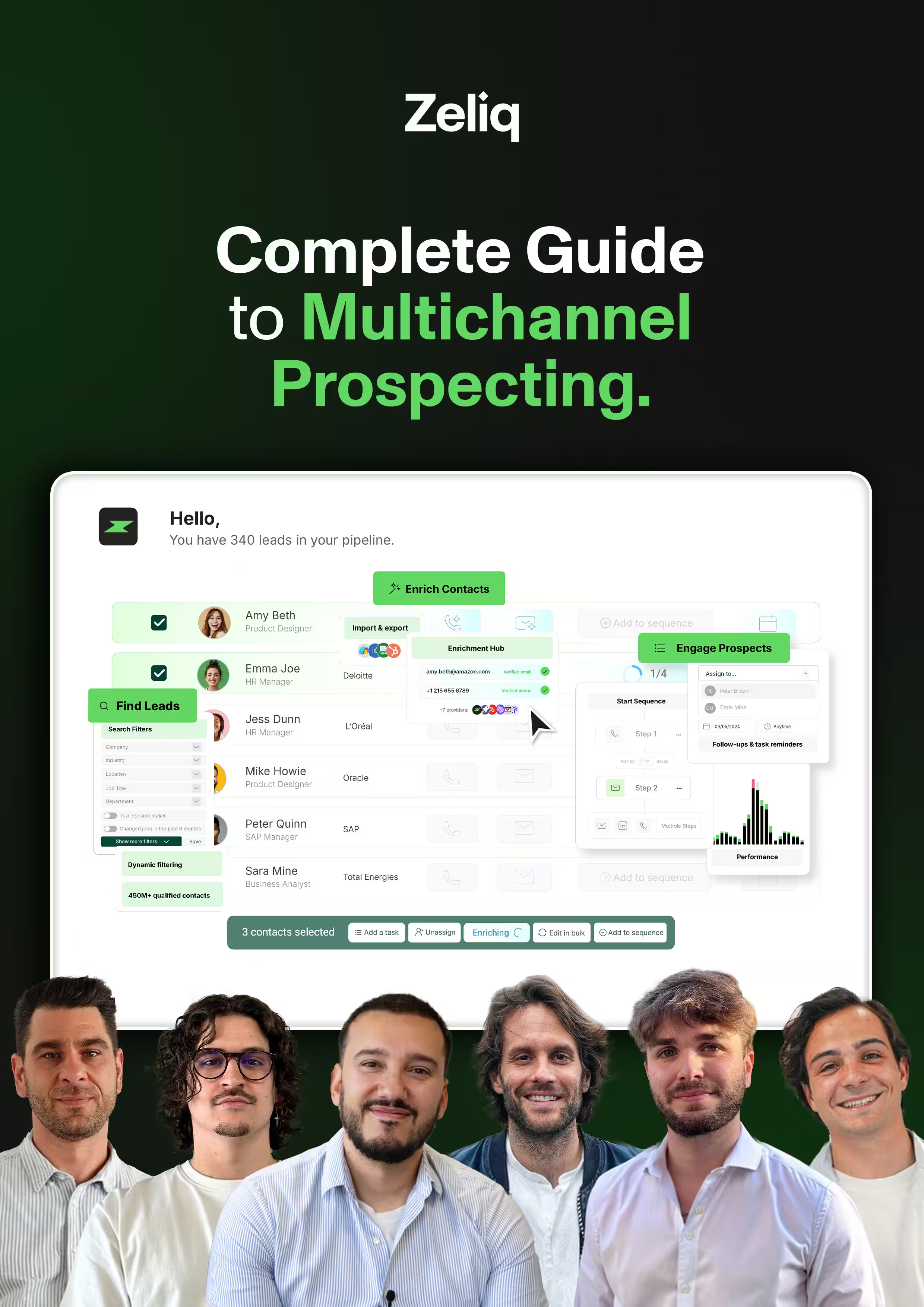
Zeliq combines a 450 million B2B contact database with multichannel sequences and waterfall enrichment. Tooling gives AEs the right information before each conversation (intent signals, account context, mapped decision-makers), making technique application 3-5x more effective. A Challenger AE without up-to-date data loses their competitive advantage.
5. Team training: pedagogy by technique and persona
The SDR onboarding plan (first technique)
A junior SDR masters a technique in 12-16 weeks of daily practice:
- Weeks 1-2: theory (books, videos), 10 simulated exercises
- Weeks 3-6: shadowing (observing a senior AE on 15-20 conversations)
- Weeks 7-10: coached practice with daily manager feedback
- Weeks 11-14: progressive autonomy
- Weeks 15-16: formal evaluation and internal certification
Recommended techniques for first SDR training: BANT (fast, structuring) or SPIN (universal, transferable).
The AE competence progression plan
An AE moves from one technique to three in 12-24 months:
- Year 1: mastery of the base technique (SPIN for mid-market, MEDDIC for enterprise)
- Months 12-18: adding a complementary technique (Solution Selling or Challenger)
- Months 18-24: adding a 3rd closing technique (Value Selling)
This progression demands 30-40 hours/year training investment per AE, but generates 40-60% additional win rate on complex cycles.
Modern training tools
In 2026, high-performing teams use:
- Conversation intelligence (real call analysis with SPIN, MEDDIC moments tagging)
- AI simulations (role-play with a conversational agent playing the difficult prospect)
- Internal playbooks (structured docs by persona, technique, phase)
- Weekly coaching sessions (30 minutes per AE with manager)
6. Classic application pitfalls to avoid
Pitfall 1: applying one technique to all contexts
An AE using MEDDIC on a 15-minute SDR call kills the conversation by over-qualification. An AE using BANT on an 8-decision-maker enterprise negotiation under-qualifies and loses the deal. Adapting technique to context is the senior skill.
Pitfall 2: over-formalizing at the expense of listening
Some AEs become obsessed with the MEDDIC checklist or 4 SPIN questions to the point of losing the conversational thread. Technique should support conversation, not replace it.
Pitfall 3: not documenting in the CRM
An AE applying MEDDIC perfectly in conversation but not filling Champion, Economic Buyer, Metrics fields in CRM deprives the manager of forecast visibility and loses the method benefit for management.
Pitfall 4: abandoning at first difficulty
A technique takes 12-16 weeks to master. Many AEs abandon after 4-6 weeks of difficult learning curve. The manager must protect this period and coach to prevent abandonment.
Pitfall 5: ignoring client culture
A very directive technique like Challenger works poorly in Asian or Middle Eastern cultures valuing relationship before business. Adapting cultural style of the technique is essential in international sales.
7. Case study: AE team adopting MEDDIC + Challenger, win rate +45%
Context: French B2B SaaS scale-up data platform, 85 employees, 9.4M EUR ARR, team of 5 senior AEs selling in enterprise (average ACV 145K EUR). VP Sales diagnosis: long cycles (8-11 months), win rate 14% (weak for enterprise), insufficient pipeline coverage.
Initial diagnosis:
- No formalized methodology in the team
- 3 AEs improvise, 2 AEs use BANT (unfit for their ACV)
- No MEDDIC field in CRM
- Forecast accuracy at 62% (weak)
- 5 large deals “stagnant” for 4-6 months
6-month corrective actions:
- 3-day MEDDIC training for the 5 AEs (certified external trainer)
- Adding 6 mandatory MEDDIC fields to the CRM (M, E, D, D, I, C)
- Weekly VP Sales coaching on application (1h per AE)
- Adding Challenger Sale on strategic accounts (top 15)
- Zeliq enrichment on target accounts to feed the Challenger “Teach”
- Structured weekly forecast review on MEDDIC (each deal audited on 6 dimensions)
Measured results at 6 months:
| KPI | Before | After | Delta |
|---|---|---|---|
| Win rate on qualified opportunities | 14% | 20.3% | +45% |
| Average ACV of signed deals | 145K EUR | 172K EUR | +19% |
| Average sales cycle | 8.7 months | 6.4 months | −26% |
| Forecast accuracy | 62% | 87% | +40% |
| “Stagnant” deals > 4 months | 12 | 3 | −75% |
| Pipeline coverage T+1 | 2.1x | 3.4x | +62% |
ROI note: investment (training + coaching + tooling) is 45K EUR over 6 months. Net signed ARR gain over 6 months is 1.8M EUR additional vs baseline. ROI within SKILL v4 cap (10x) over 6-month period.
8. Frequently asked questions
How many sales techniques should an AE master?
A junior: 1 solid. A mid-level: 2. A senior: 3-4 combined. A junior AE in year 1 must perfectly master one technique (SPIN for mid-market, MEDDIC for enterprise) before adding others. Spreading a beginner over 3-4 techniques dilutes mastery and produces a mediocre AE everywhere. At mid-level (2-4 years experience), an AE can add a second technique complementary to base (Solution Selling or Challenger). A senior AE (4+ years) must master 3-4 techniques and combine them by context. Beyond 4 techniques, marginal return becomes low: 4 well-mastered techniques cover 95% of B2B situations. Rule: depth before breadth. A junior AE trying to master MEDDIC + Challenger + SPIN + Sandler simultaneously in year 1 ends up mastering none correctly.
In what order should I learn techniques?
BANT → SPIN → an enterprise or consultative technique → a closing technique. Optimal SDR-to-AE path order: BANT in week 1 as fast framework (useful for immediate SDR qualifications), SPIN in weeks 2-16 as base conversational method (transferable to all discovery phases), then choose by target role. For mid-market AE: add Solution Selling in months 6-9 to drive demos and POCs. For enterprise AE: add MEDDIC in months 6-9 to drive long cycles. In final step (months 12-18), add a closing technique: Value Selling for all, Challenger for enterprise with saturated buyers. This progressive order avoids beginner confusion and builds a solid base. Note: each technique demands 12-16 weeks of daily practice to reach operational mastery, not just theoretical understanding.
How to measure a sales technique’s effectiveness?
3 main KPIs: win rate on qualified opportunities, average sales cycle, forecast accuracy. Win rate is the direct KPI: after 3-6 months of using a technique, it should progress 20-40% vs baseline without method. If no progression after 6 months, the technique isn’t well applied or unfit for context. Sales cycle is the indirect KPI: a well-applied technique reduces cycle 15-30% by eliminating dead time and late objections. Forecast accuracy is the sophistication KPI: a well-applied technique (especially MEDDIC) enables precise prediction of which deals will close vs slip. A team moving from 60% to 85% forecast accuracy after MEDDIC adoption validates method effectiveness. Complement with qualitative KPIs: manager call audit (are SPIN moments explicit?), CRM documentation (are MEDDIC fields filled systematically?), and AE feedback (adopters vs skeptics).
9. Conclusion: 3 actions to run this week
Audit your team’s technique mastery within 7 days. How many AEs formally use a methodology? How many improvise? If less than 60% of your team applies a formalized technique, you have a priority training project.
Choose a base technique for your SDRs and AEs within 15 days. SPIN for medium cycles, MEDDIC for enterprise, BANT for inbound SDRs. One well-mastered technique across the team beats 4 partially-known techniques.
Block 30 minutes of weekly coaching per AE within 15 days. Without regular coaching, a technique learned in training degenerates in 4-6 weeks. The manager must audit conversations, congratulate good applications, correct drifts.
Give your salespeople the data to apply their techniques
Zeliq combines 450 million B2B contacts, waterfall enrichment, and multichannel sequences. An up-to-date context base makes every sales technique 3-5x more effective.
Try for freeAnd if you want to give your AEs the intent signals and account context to apply MEDDIC, Challenger, or Value Selling effectively, try Zeliq for free: B2B contacts, enrichment, and sequences in one interface, no credit card.