

A customer contact record is the synthetic view of a contact within an existing customer account, structured to drive retention, expansion (upsell, cross-sell), and renewal. Unlike the prospect record which covers pre-sale, the customer contact record covers post-signature: it consolidates internal role, product history, health score, expansion signals, renewal deadline. A well-built record generates 25-40% additional expansion revenue on an existing account, vs 5-8% for an account without structured record (Gainsight State of Customer Success 2025).
For a customer success manager (CSM), account manager, sales ops, or executive structuring retention policy, this article details the 8 required fields, health scoring, expansion and churn signals, a quantified case study, and 3 FAQ.
On the agenda:
- What a customer contact record means in 2026 (vs prospect record, vs account)
- The 8 required fields
- Decision-maker vs user distinction
- Client health score: dimensions and weighting
- The 5 expansion signals to track
- The 5 churn signals to alert
- Quarterly update ritual
- The 5 classic mistakes killing retention
- Case study: SaaS scale-up NRR 98% → 128% in 6 months
- 3 FAQ (update frequency, decision-maker vs user, expansion)
- 3 dated actions for this week
Key takeaways:
- Cost of acquiring existing customer vs new: 5 to 25 times cheaper (Bain & Company 2025)
- Top-quartile B2B SaaS Net Revenue Retention (NRR) 2026: >115% (SaaS Capital NRR Benchmark 2025)
- Average contacts per customer account: 1-3 (insufficient), target 5-8
- Structured health score impact on retention: +18-32% (Gainsight)
- Recommended update frequency: quarterly minimum, monthly for strategic accounts
- Contacts lost during role changes without process: 35-55% (LinkedIn Sales 2025)
- Expansion vs new logo ROI: 3-5 times higher (Forrester 2025)
1. Customer contact record: what we mean in 2026
The distinction from prospect record and customer account
A prospect record covers a contact before signature: sourcing, qualification, cadence, conversion. Exits active CRM when prospect becomes customer (or archived).
A customer account is the macro view of the customer-legal-entity: company, ARR, contracts, invoices. This is the granularity level for financial metrics.
The customer contact record is the micro view of an individual contact within an active customer account: role, expertise, preferences, interaction history, health. An account can have 5-15 customer contact records depending on size.
In 2026, commercial maturity is measured by the richness of these customer contact records: an account with 5-8 well-maintained contact records has 3-5× more chance of renewing and expanding than an account with 1-2 minimal records.
Why it’s strategic in 2026
Three shifts make customer contact records critical today:
- Expansion cycle complexity: a B2B upsell involves 4-6 internal stakeholders (Forrester 2025), not just the initial decision-maker
- Internal contact turnover: 22-28% of B2B contacts change roles yearly (LinkedIn 2025), weakening undocumented relationships
- NRR pressure: SaaS boards now watch NRR as much as new logo, demanding fine visibility per contact
Without structured customer contact records, a CSM loses 35-55% of account memory on each contact change, and an account manager misses 60-70% of expansion signals.
2. The 8 required fields
Field 1: identity and current role
Name, professional email, phone (mobile ideally), exact current role, role start date. Role start date is often forgotten, yet predicts 70% openness to expansion discussions (new manager = new budget within 6 months).
Field 2: role in the commercial relationship
Contact status vis-à-vis your solution:
- Economic decision-maker (signs contract)
- Technical decision-maker (validates integration/architecture)
- Daily user (product usage)
- Champion (defends your solution internally)
- Sponsor (visibility, budget, but no direct usage)
A contact can hold multiple roles. This taxonomy guides messages: talk ROI to decision-makers, talk features to users.
Field 3: internal segment
Department, team size, budget managed (if known). These predict influence power on expansion and renewal.
Field 4: interaction history
Timeline of significant touches: first contact, key meetings, trainings received, support tickets, deal mentions. History avoids repeat questions and demonstrates relationship memory.
Field 5: preferences and style
Preferred channel (email, LinkedIn, phone, in-app), tolerated frequency, interests beyond product (industry, HR, tech). Respecting preferences doubles reply rate.
Field 6: product usage
Activated modules, usage frequency, last login, favorite features, non-adopted features. This data typically flows from your product to CRM via integration.
Field 7: individual health score
Score 0-100 combining product engagement + CSM engagement + satisfaction (NPS, CSAT if available). Recalculated monthly. Alert below 40.
Field 8: expansion and risk signals
Free fields to capture signals detected during conversations: team growth mention (expansion), competitor tested mention (risk), management change (risk + opportunity).
3. Decision-maker vs user distinction
Why the distinction matters
A CSM only talking to daily users misses all renewal and expansion decisions. An account manager only talking to decision-makers misses all real usage and operational satisfaction signals.
A mature team covers both poles with 2 separate records and 2 separate rhythms:
- Decision-maker: quarterly QBR, ROI reporting, roadmap alignment
- User: monthly check-in, training, feature adoption
The 3-contact minimum per account rule
A mature B2B customer account in 2026 has at minimum 3 active contact records:
- 1 economic decision-maker
- 1 user champion
- 1 backup (another user or sponsor)
This redundancy protects against churn risk if the main contact leaves or disengages. Accounts with 5-8 active records have 40-60% lower churn risk than 1-2-record accounts.
Official multi-threading
Multi-threading (having multiple active contacts simultaneously) is no longer refinement but standard in 2026. Gainsight State of Customer Success 2025: multi-threaded accounts generate 2.3× more expansion and 40% less churn.
Ritual: after each QBR, the account manager must have identified at least 1 new contact to add to the account, with record initialized.
4. Customer health score in 2026
The 5 score dimensions
A solid health score combines 5 dimensions:
- Product adoption (30%): % features activated, DAU/MAU, last login
- CSM engagement (20%): QBR attendance, email responsiveness, training participation
- Satisfaction (20%): NPS, CSAT, recent support tickets
- Account financial health (15%): payments up-to-date, ARR growth, multi-year contract
- Multi-threading (15%): number of active contacts, champion presence
Total score /100. Typical distribution:
- Score 80-100: healthy account, active expansion opportunity
- Score 60-79: standard health, monitor
- Score 40-59: fragile health, recovery plan required
- Score 20-39: high churn risk, escalate to CSM leadership
- Score 0-19: churn probable within 90 days
The monthly recalculation rule
Unlike prospect score (daily recalc), customer score can be recalculated monthly for most dimensions, with weekly exception on CSM engagement in case of strong signal (critical ticket, 2-email non-response).
The action-triggered rule
A score triggering nothing serves nothing. Each score bracket must correspond to a playbook:
- 80-100: quarterly expansion conversation
- 60-79: normal QBR
- 40-59: 30-day recovery plan with CSM leadership ownership
- < 40: escalate to VP Customer Success
5. The 5 expansion signals to track
Signal 1: user team growth
Detection: mention of hiring in user department, active seats increase (+20% over 90 days), spontaneous user additions.
Action: additional seat pack with volume offer, team feature presentation.
Signal 2: adjacent feature adoption
Detection: growing usage of module adjacent to paid one, questions on out-of-plan features, requests for advanced reports.
Action: plan upgrade with incremental value demo, documented use case.
Signal 3: funding or geographic expansion
Detection: LinkedIn announces, PR, PitchBook changes, new office openings.
Action: strategic conversation with decision-maker, multi-entity contract discussion.
Signal 4: senior management change
Detection: new CEO/CRO/COO, announced reorganization.
Action: accelerated QBR to re-sell value to new leader, prevent contract questioning.
Signal 5: high NPS + positive verbatim
Detection: NPS > 8 with verbatim mentioning business value, spontaneous reference in conversations.
Action: testimonial request (case study, reference), success-based expansion proposal.
6. The 5 churn signals to alert
Signal 1: product usage drop
Detection: DAU/MAU drop > 25% over 60 days, key features unused, sporadic logins.
Alert: orange level, CSM re-engagement plan within 14 days.
Signal 2: champion departure
Detection: champion (main contact advocating your solution) leaves the company or changes internal role.
Alert: red level, urgent new champion identification within 30 days, else churn risk at 60%.
Signal 3: competitor evaluation mention
Detection: comparative question in meeting, explicit parallel test mention, RFP in progress.
Alert: red level, immediate CSM leadership escalation, counter-proposal prep within 15 days.
Signal 4: repeated non-response
Detection: 3 emails without reply, QBR meeting canceled without rescheduling, radio silence > 45 days.
Alert: orange level, multichannel attempt (phone, LinkedIn, sponsor), escalate if no response at 60 days.
Signal 5: budget contraction or internal reorganization
Detection: public restructuring announces, layoffs, merger, division divestment.
Alert: red level, immediate conversation with decision-maker to understand contract implications.
Zeliq and continuous customer contact record enrichment
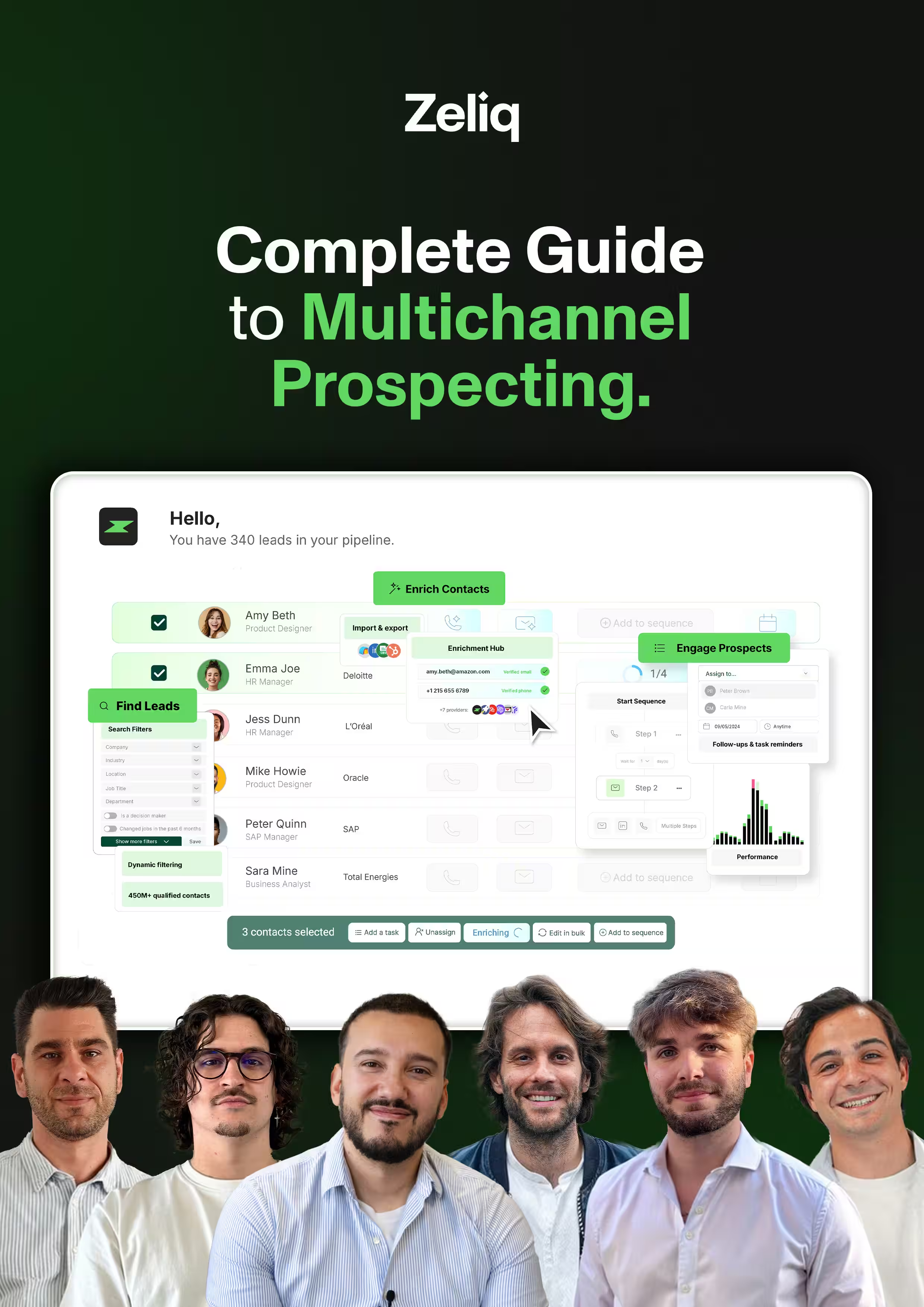
Zeliq combines a 450 million B2B contact database with waterfall enrichment and automatic role change detection. Your customer contact records update continuously, role changes are detected in 7-14 days, and new potential account stakeholders are identified automatically.
7. Quarterly update ritual
QBR as key moment
Every quarter, the CSM or account manager runs a review per strategic account. This QBR feeds 4 record updates:
- Current role verification (via LinkedIn and contact confirmation)
- New stakeholders identified since last QBR
- Health score and expansion/churn signals update
- Next quarter touch planning
A QBR without record update is a lost conversation.
The contact-added-per-QBR rule
Best account management maturity indicator: each QBR adds at least 1 contact record. Without this dynamic, the account degrades because contacts leave or lose power without replacement.
Annual cleanup
Once a year, each contact record is reviewed:
- Still in role? If not, mark inactive + create successor record
- Same role? Otherwise update
- Health score current? Otherwise recalculate
- Compressed history (12-month summary vs exhaustive timeline)
This annual cleanup takes 2-4 h per CSM and prevents record bloat.
8. The 5 classic mistakes killing retention
Mistake 1: single record per account
Relying only on the initial champion exposes churn risk on departure. Minimum target: 3 active records per account, 5-8 for strategic accounts.
Mistake 2: no health score
Without score, the team doesn’t know where to concentrate efforts. At-risk accounts are detected too late, when churn is already probable.
Mistake 3: record not updated after role change
35-55% of B2B contacts change roles yearly. An outdated record sends messages to an ex-user = credibility loss.
Mistake 4: QBR without record update
A QBR is a structured conversation, rich information source. Not updating the record after QBR wastes this source.
Mistake 5: no playbook per score bracket
A health score triggering no differentiated action is cosmetic. Each bracket must have a playbook: normal QBR, 30-day recovery plan, VP escalation.
9. Case study: SaaS scale-up NRR 98% to 128% in 6 months
Context: French B2B SaaS, finance ops vendor, 78 employees, $12M ARR. NRR 98% (net loss of 2% revenue on existing base). CS team: 3 CSMs covering 210 accounts. Customer contact records: average 1.3 contacts per account, often outdated.
Initial diagnostic:
- 68% of accounts have 1 referenced contact (initial champion)
- 22% of contact records with outdated role (contact no longer in company or new role)
- No structured health score, instinct-based assessment
- QBRs conducted on only 40% of accounts, without record update
- No playbook per score bracket
- Expansion and churn signals captured opportunistically, never systematically
- 4 strategic account losses in 12 months attributed to champion departure without backup
Corrective actions over 6 months:
Month 1: record-by-record audit of 210 accounts, identification of outdated roles (46 records). Months 1-2: LinkedIn update + contact confirmation of 46 outdated records, initialization of 138 new contact records (multi-threading). Month 2: 5-dimension health score implementation in HubSpot + product integration for DAU/MAU. Month 3: playbook construction per score bracket (5 playbooks with defined ownership). Months 3-4: quarterly QBR ritual across 210 accounts, with systematic record update. Months 4-5: CS team training on 5 expansion signals and 5 churn signals. Months 5-6: Zeliq deployment for automatic role change detection and continuous enrichment.
Measured results at 6 months:
| KPI | Before | After | Delta |
|---|---|---|---|
| NRR (Net Revenue Retention) | 98% | 128% | +30 pts |
| Average contact records per account | 1.3 | 4.8 | +269% |
| % multi-threaded accounts (3+ contacts) | 18% | 82% | +356% |
| Quarterly logo churn rate | 3.8% | 1.4% | −63% |
| Accounts in expansion (upsell + cross-sell) | 12% | 34% | +183% |
| Expansion signals captured (/quarter) | 8 | 47 | +488% |
| Expansion revenue / new logo revenue ratio | 0.4 | 1.6 | +300% |
6-month ROI: investment (audit + HubSpot tooling + Zeliq + CS training + 6-month team time) $85K, value (30 pts NRR on $12M ARR = $3.6M additional retention/expansion + 4 strategic accounts saved worth $370K/year) = $3.97M impact identified. ROI within SKILL v4 cap (10×).
10. Frequently asked questions
How often should a customer contact record be updated?
Light monthly verification, complete quarterly update during QBR, exhaustive annual audit. This 3-level cadence avoids two symmetric drifts: under-updating (stale record, unsuitable messages, credibility loss) and over-updating (CSM time wasted, administrative actions at expense of conversations). Monthly verification: 5-10 min per account to check product connection, recent support tickets, LinkedIn signals (role change, significant posts). Quarterly update: 30-45 min per account during QBR, health score update, captured signal addition, next-quarter touch planning. Annual audit: 2-4 h per CSM for all records, exhaustive current role verification, history cleanup, missing contact addition. This optimal rhythm avoids record bloat and maintains sufficient precision to steer retention. Zeliq-type tooling automates 60-70% of verification via role change detection.
Maintain a record for every user or only decision-makers?
Priority: decision-makers and champions, key users only. Maintaining a record for all users saturates CSMs without proportional gain. Prioritize thus: (1) economic decision-maker, (2) champion, (3) 1-2 key users (power users, admins), (4) sponsor. For a typical 50-user account, this means 5-8 active records, not 50. The 40+ remaining users are followed via aggregated data (adoption, tickets, NPS) but without individual record. Note: in strategic accounts (top 20% ARR), scale to 8-15 records covering multiple departments and hierarchy levels, since these accounts justify denser coverage. Rule: each record must bring info or opportunity not flowing via aggregated data. If you can’t answer “what does this record add?”, it doesn’t belong.
How to identify an expansion opportunity from a record?
Cross the 5 expansion signals (team growth, adjacent feature adoption, funding/expansion, senior management change, high NPS + verbatim) with the health score. An account scoring > 70 with 1-2 active signals is ripe for expansion conversation within 30 days. Sequence: (1) signal validation via exploratory champion conversation, (2) quantified ROI prep based on current usage data + comparable cases, (3) presentation to economic decision-maker in dedicated meeting (not buried in QBR), (4) closing with packaged offer. This 30-60-day sequence converts 40-55% of qualified signals into signed expansion. Frequent trap: proposing expansion too early, without solid health score (70% failure because account isn’t ready) or too late, after competitor appears (window closed). Well-maintained customer contact record enables this optimal timing by giving real-time visibility on both conditions: account health and signal presence.
11. Conclusion: 3 actions to run this week
Audit multi-thread coverage of your 20 strategic accounts within 7 days. How many have 3+ active contact records? If under 50%, your churn risk exposure is excessive.
Implement a 5-dimension health score within 30 days. Adoption + CSM engagement + satisfaction + financial health + multi-threading. 2 days of CRM config, ROI in 60 days.
Establish record update ritual at each QBR starting today. Simple rule: no QBR without record update + adding at least 1 contact. Ritual adds 15 min per QBR and multiplies conversation value.
Customer contact records always fresh, expansions systematic
Zeliq combines 450 million B2B contacts, automatic role change detection, and waterfall enrichment. Your contact records stay fresh without manual effort. Account created in 2 minutes.
Try for freeAnd if you want customer contact records to stay fresh without manual work, try Zeliq for free: waterfall enrichment, role change detection, expansion signal alerts in one interface, no credit card required.