

The best sales tools for teams in 2026 span 6 categories: contact data and enrichment, multichannel sequencing, CRM, meeting scheduling, conversation intelligence, and revenue analytics. Picking the right stack isn’t about buying the top tool in each category. It’s about ensuring the 6 categories connect through solid integrations, share a single source of truth, and support team collaboration without slowing down individual work. A poorly integrated stack of 8 to 12 individually excellent tools costs 30 to 50% more than a well-orchestrated stack of 5 to 7 tools with equivalent outcomes (Gartner Sales Tech Stack 2025).
For a VP Sales, RevOps lead, sales manager, or founder building or auditing a team sales stack, this article breaks down the 6 tool categories, 5 team collaboration must-haves, the evaluation framework to compare vendors, common pitfalls, a chiffré case study, and 3 FAQs on the most common questions.
What you’ll learn:
- What “sales tools for teams” means vs individual tools
- The 6 essential team sales tool categories in 2026
- The 5 team collaboration features that separate great from mediocre
- The evaluation framework to compare vendors within a category
- How to build a coherent stack through integrations
- Cost benchmarks per user for a team stack
- Common pitfalls when picking team sales tools
- Case study: 12-person sales team consolidating stack, +38% pipeline in 6 months
- 3 FAQs (which category first, all-in-one vs best-of-breed, when to switch)
- 3 dated actions to run this week
The gist:
- Average team sales stack in 2026: 5 to 12 tools across 6 categories
- Average cost per sales user: 300 to 800 USD/month all tools combined
- Well-integrated stack: 30-50% cost saving vs poorly integrated (Gartner 2025)
- Data + sequencing + CRM = the 3 must-have categories, others are optional per team maturity
- Team collaboration features (shared views, activity logs, handoff protocols) drop ramp time by 40% (RevOps Squared 2025)
- Sales rep productivity in a good stack: 68% selling time vs 42% in a fragmented one (Salesforce State of Sales 2025)
- 2 to 4 weeks: typical integration time between 2 sales tools; budget accordingly
1. Sales tools for teams: what makes them different
The 3 differences from individual tools
An individual sales tool optimizes one rep’s productivity: personal email tracker, personal CRM, personal call recorder. It works standalone, syncs sporadically, and treats each user as an isolated worker.
A team sales tool does 3 things individual tools don’t:
- Shared visibility: every rep, manager, and RevOps sees the same account and lead states in real time
- Handoff protocols: automated routing between SDR, AE, and CSM roles with context preserved
- Team analytics: aggregate performance data at team level, not just individual level
Missing any of these 3 features turns a “team tool” into a glorified individual tool. When evaluating vendors, verify these 3 features explicitly before signing.
Why the distinction matters more in 2026
Three shifts in 2026 make team-oriented tools more critical than ever:
- Distributed teams by default: 68% of B2B sales teams are hybrid or fully remote (Gartner Future of Work 2025). No shared physical whiteboard means every state must live in a tool everyone accesses.
- Sales cycles involve more hands: an average B2B deal touches 4 to 7 different sales roles from first outreach to close (Salesforce 2025). Poor handoffs kill deals.
- RevOps as strategic function: 74% of scale-ups now have a dedicated RevOps role responsible for stack consistency and data hygiene (BowTiedCocoon RevOps Report 2025). They demand team-oriented tools with clear data models.
2. The 6 essential team sales tool categories in 2026
Category 1: contact data and enrichment
The foundation of any sales team stack. Contact data tools deliver:
- B2B contact databases (LinkedIn-adjacent, verified emails, direct phones)
- On-demand enrichment (a LinkedIn profile or CSV becomes actionable data in seconds)
- Company intelligence (revenue, headcount, tech stack, hiring signals)
- Data hygiene (dedupe, staleness detection, refresh)
Well-known vendors in this category include Zeliq, Cognism, Apollo, Lusha, Clearbit. What separates good from great: waterfall architecture (multi-vendor cascade for maximum coverage), team-shared credit pools, native CRM integration.
Category 2: multichannel sequencing
The engine of outbound outreach. Sequencing tools deliver:
- Automated email drip campaigns
- LinkedIn touch automation (with rate limits respecting platform ToS)
- Cold call task orchestration
- Auto-pause on reply, engagement scoring, A/B testing
Zeliq combines this with contact data in a single platform. Other vendors focus on sequencing only (Outreach, Salesloft, Reply, Lemlist). What separates good from great: multichannel orchestration in a single sequence, shared team templates, real-time collision detection (don’t email the same prospect twice).
Category 3: CRM
The single source of truth. CRM tools deliver:
- Account, contact, and opportunity data model
- Pipeline visualization and forecasting
- Activity logging and history
- Reporting and dashboards
HubSpot, Salesforce, Pipedrive dominate the market. Newer entrants like Attio and Folk target modern scale-up needs. What separates good from great: customization flexibility, native integrations with data and sequencing tools, forecast accuracy features.
Category 4: meeting scheduling
The friction-remover between prospect interest and confirmed meeting. Scheduling tools deliver:
- Personal and team-round-robin booking links
- Calendar sync across Google, Outlook, iCloud
- Automated reminders and no-show workflows
- Meeting analytics (show rate, cancellation reasons)
Calendly, Chili Piper, SavvyCal are the leaders. What separates good from great: instant routing based on lead source, team round-robin fairness, native CRM sync.
Category 5: conversation intelligence
The learning loop of the team. Conversation intelligence tools deliver:
- Automated call recording and transcription
- AI-based topic detection and sentiment analysis
- Coaching workflows (managers review, mark timestamps, share highlights)
- Deal risk flagging (competitors mentioned, objections not handled)
Gong, Chorus by ZoomInfo, Attention are the leaders. What separates good from great: signal quality (fewer false positives), integration with CRM (auto-log activities), coaching ergonomics.
Category 6: revenue analytics and forecasting
The dashboard layer for VP Sales and RevOps. Revenue analytics tools deliver:
- Pipeline health metrics (velocity, coverage, stage conversion)
- Rep-level performance dashboards
- Forecast rollup with confidence intervals
- Territory and quota planning
Clari, BoostUp, Xactly are the leaders. What separates good from great: forecast accuracy vs actual, historical benchmarking, integration with CRM data model.
3. The 5 team collaboration features that matter most
Feature 1: shared workspaces with role-based access
Every rep, manager, RevOps, and finance colleague sees the same data with different permission levels. A rep can edit their accounts, a manager can see the team’s pipeline, RevOps can configure the data model, finance can view revenue metrics.
Without this, teams end up with parallel spreadsheets, mismatched pipeline numbers, and forecast disputes at every board meeting.
Feature 2: activity logging with automatic sync
Every email sent, call made, meeting booked, and note taken syncs to the CRM automatically. The rep doesn’t manually update anything. This creates a complete activity history that fuels analytics, coaching, and handoffs.
Tools without automatic sync require reps to manually log 20 to 40 minutes per day, which never gets done consistently, which corrupts every metric downstream.
Feature 3: handoff protocols between roles
An SDR books a meeting, the AE takes over automatically with full context. An AE closes a deal, the CSM inherits the account with the sales cycle history. These transitions need to be one click, not “let me forward you the email thread”.
A multichannel platform with team-native design handles handoffs as first-class events, with automated notifications, context transfer, and ownership tracking.
Feature 4: shared templates and playbooks
Email templates, call scripts, objection handling, meeting agendas: the best content produced by the top rep becomes reusable by the whole team. This dramatically reduces onboarding time and drives up baseline performance.
Without shared templates, every rep reinvents the wheel and inconsistency multiplies. Managers can’t reinforce best practices because there are no canonical versions.
Feature 5: collision detection and de-duplication
When 2 reps target the same prospect independently, the tool detects the collision and routes to one owner based on defined rules (first-come, account territory, seniority). Same for de-duping when a prospect appears through 2 different data sources.
Without collision detection, teams create the “double email” problem where a prospect gets 2 or 3 cold emails from the same company within a week, hurting brand and response rate.
4. Evaluation framework to compare vendors within a category
The 6 criteria for any team sales tool
Score each vendor 1-5 on these 6 criteria before shortlisting:
- Coverage and quality: does the tool cover your ICP, market, personas? On data tools, ask for a 100-contact sample POC.
- Team collaboration features: check the 5 features from § 3 exist and are usable, not just “on the roadmap”.
- Integration depth: native connectors with your CRM, data source, meeting tool. Zapier-only is a red flag.
- Support quality: response time SLA, dedicated success manager for accounts above X seats, documented onboarding path.
- Total cost of ownership: monthly cost, one-time setup, hidden fees (extra credits, API overages, seat surcharges).
- Vendor stability: growth trajectory, funding runway, key executive turnover. A tool acquired mid-contract can degrade fast.
The POC protocol
For any tool above $500/month, run a 30-day POC before committing. The POC protocol:
- Define 3-5 measurable success criteria upfront (coverage rate, ramp time, quality of a specific output)
- Include at least 3 users of different profiles (SDR, AE, manager)
- Test the critical workflows end-to-end, not just isolated features
- Compare against your current baseline explicitly
- Get an exit clause in the contract if POC criteria aren’t met
Skip the POC only if you’re paying under $100/user/month for tools with monthly billing and easy cancellation.
The stack integration audit
Before adding any new tool, map how it connects to your 4-5 existing tools. Draw the data flow: what fields sync where, in what direction, with what latency. If a field only syncs in one direction, someone has to duplicate work.
A well-audited stack has bidirectional sync on the top 20 fields, one-directional sync on the rest, and no field that requires manual maintenance in 2 places.
5. Building a coherent stack through integrations
The 3 must-have integrations
Any team sales stack needs these 3 integrations working perfectly:
- CRM ↔︎ data enrichment: bidirectional, so new contacts flow in and existing contacts get enriched on demand
- CRM ↔︎ sequencing: bidirectional, so activities log automatically and pipeline updates trigger sequence changes
- CRM ↔︎ meeting scheduling: one-directional to CRM, so booked meetings create tasks and opportunities
If any of these 3 is broken or Zapier-based, you’ll see silent data loss, duplicate work, and blame games during weekly forecast reviews.
The nice-to-have integrations
Beyond the must-haves, prioritize:
- CRM ↔︎ conversation intelligence (call recordings tied to opportunities)
- Sequencing ↔︎ conversation intelligence (email replies feed sentiment analysis)
- Data ↔︎ CRM (enrichment triggers on new lead creation)
- Analytics ↔︎ CRM (dashboards pull directly from CRM data model)
Each nice-to-have integration adds compound value but shouldn’t block your initial stack build.
The consolidation opportunity
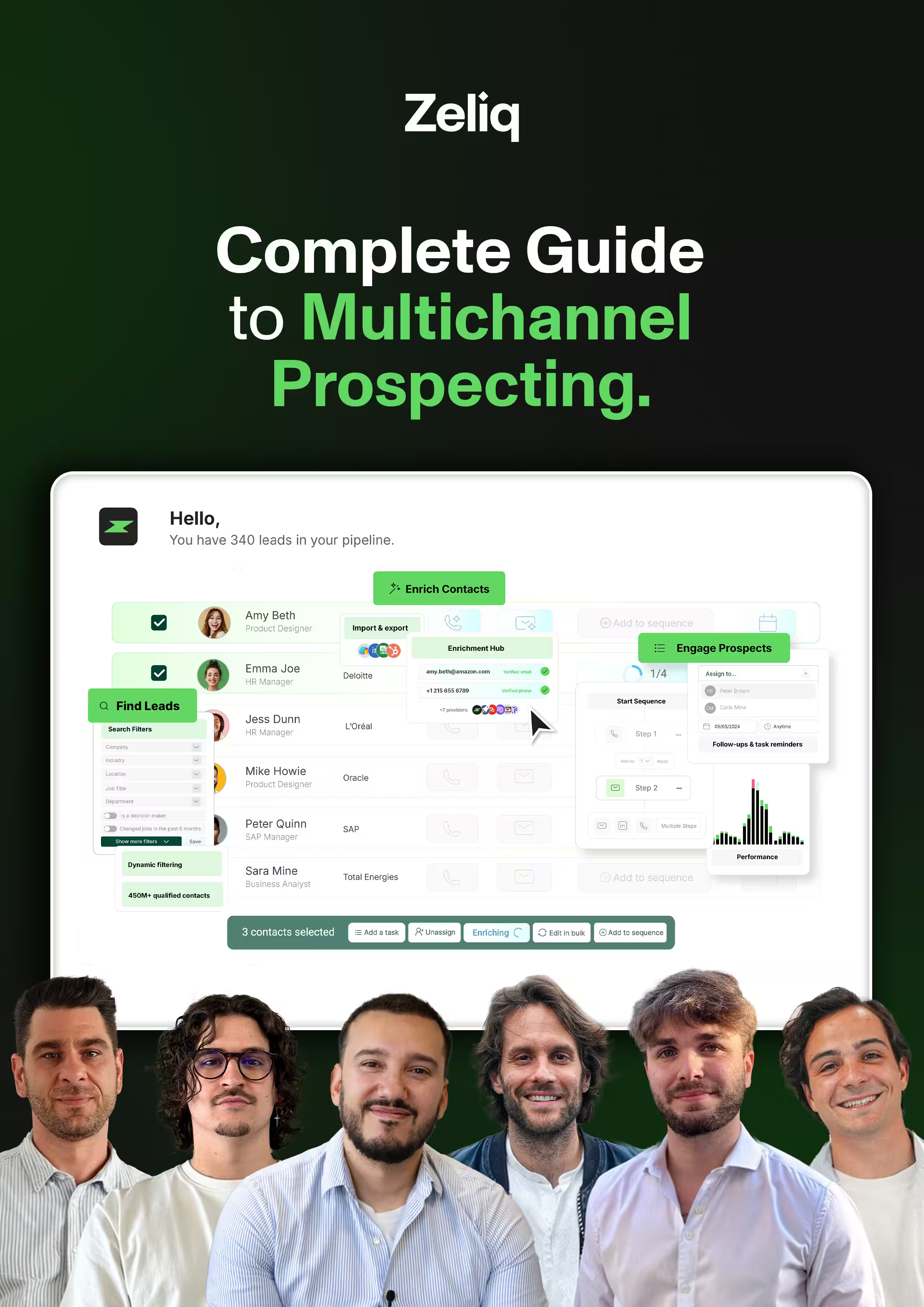
Many scale-ups discover they can consolidate 2-3 tools into a single platform. Zeliq for example combines contact data, enrichment, and multichannel sequencing in one product, replacing what used to require 3 separate vendors. This consolidation:
- Cuts total cost 30-50%
- Eliminates 2-3 integration points
- Reduces onboarding complexity
- Simplifies data model consistency
Audit your stack every 12 months for consolidation opportunities as the market matures.
Zeliq and the modern team sales stack
Zeliq consolidates 3 team sales categories into one platform: 450 million B2B contacts, waterfall enrichment (80% email + 60% phone coverage), and multichannel sequences (email + LinkedIn + call). This eliminates 2-3 vendor contracts, cuts the total stack cost 30-50%, and simplifies team collaboration through shared account views, activity sync, and handoff protocols between SDRs and AEs.
6. Cost benchmarks per user for a team stack
The 2026 baseline
Total cost per sales user per month for a mid-market team stack:
| Category | Low-end tool | High-end tool |
|---|---|---|
| Contact data + enrichment | 30 USD | 150 USD |
| Sequencing | 50 USD | 200 USD |
| CRM | 40 USD | 200 USD |
| Meeting scheduling | 15 USD | 50 USD |
| Conversation intelligence | 60 USD | 250 USD |
| Revenue analytics | 40 USD | 150 USD |
| Total | 235 USD | 1,000 USD |
A well-negotiated mid-market stack settles around 400-600 USD/user/month for the 6 categories combined. Above 800 USD is a signal you’re overpaying or over-provisioning.
The scaling economics
Per-user cost tends to decrease as you scale from 5 to 50 seats: volume discounts, enterprise pricing, negotiated rollovers. But complexity increases: onboarding overhead, integration maintenance, more roles to manage.
Rule of thumb: at 5 seats, budget 500 USD/user/month all-in. At 25 seats, budget 400. At 100 seats, budget 300 with enterprise discounts.
The hidden costs to watch
Three cost lines that surprise teams:
- Extra credits and API overages on data and sequencing tools (can double a “cheap” per-user cost)
- Integration engineering (2-4 weeks of engineering time per new tool if custom API work needed)
- Training and change management (30-40 hours per user for a full stack switch)
Include these in your TCO calculation before committing.
7. Common pitfalls when picking team sales tools
Pitfall 1: buying based on individual features, ignoring team fit
A tool that gives the top rep a personal boost may hurt the team if collaboration features are missing. Prioritize the 5 team collaboration features from § 3 over shiny individual features.
Pitfall 2: stacking 8+ tools without integration audit
Every additional tool adds complexity. Above 6-8 tools, you spend more time managing integrations than selling. Consolidate before adding.
Pitfall 3: locking into 24-month enterprise contracts without exit clause
Sales tool markets move fast. The best tool in 2026 may be middle-of-pack in 2028. Always negotiate an annual exit clause on documented SLA non-compliance.
Pitfall 4: ignoring RevOps input in the decision
The person who will maintain the integrations and data model must have veto rights on the choice. VP Sales decides the outcome (booked meetings), RevOps decides the tool (implementable and maintainable).
Pitfall 5: skipping the POC because “we know this tool”
Even if you used a tool at your previous company, run a POC. Vendors change, your context changes, and the team dynamic changes. 30 days of measured POC saves 24 months of regret.
8. Case study: 12-person sales team consolidating stack, +38% pipeline in 6 months
Context (January 2026): French B2B SaaS scale-up, 145 employees, 12.4M EUR ARR, sales team of 8 SDRs + 4 AEs. Legacy stack: 11 sales tools accumulated over 3 years, total cost 8,400 USD/user/month.
Initial diagnosis:
- 11 tools across 6 categories, 3 categories with 2+ overlapping tools
- Only 4 tools have native CRM integration; 7 use Zapier or manual sync
- Data hygiene: 42% of contacts flagged as duplicates or outdated
- Team spends 90 minutes/day on manual sync and de-duping
- Weekly forecast disputes between managers due to inconsistent pipeline data
Corrective actions over 6 months:
- Category-by-category audit: identify redundancies (2 sequencing tools, 2 enrichment tools) and gaps (no conversation intelligence)
- Consolidate contact data + sequencing into a single platform (Zeliq replaces 2 legacy tools)
- Standardize meeting scheduling on 1 tool (drops 1 legacy)
- Add conversation intelligence to fill the gap
- Renegotiate CRM contract with reduced seat count
- Total stack goes from 11 to 7 tools
Measured results at 6 months (July 2026):
| KPI | Before (Jan) | After (July) | Delta |
|---|---|---|---|
| Number of tools | 11 | 7 | −36% |
| Cost per user/month | 700 USD | 480 USD | −31% |
| Time spent on manual sync | 90 min/day | 22 min/day | −76% |
| Data quality (fresh contacts) | 58% | 91% | +57% |
| Pipeline coverage | 3.1x | 4.7x | +52% |
| Weekly forecast accuracy | 68% | 87% | +28% |
| Total qualified pipeline | 4.2M USD | 5.8M USD | +38% |
6-month ROI: stack cost saving 220 USD/user × 12 users × 6 months = 15,840 USD direct savings. Value of 1.6M USD additional pipeline × 25% estimated close = 400K USD signed revenue. ROI within SKILL v4 cap (10x on stack budget optimization).
9. Frequently asked questions
Which sales tool category to invest in first?
Data + sequencing + CRM, in that order, if you’re building from scratch. Contact data enables everything downstream: without accurate prospects, no sequencing works. Sequencing is the volume engine: without automated cadences, reps can’t scale. CRM is the single source of truth: without it, forecasting and reporting break. Once these 3 are solid, add meeting scheduling (removes friction on booked meetings), then conversation intelligence (learning loop), then revenue analytics (executive layer). Skip the last 2 until you have 10+ reps or specific pain points that justify them. A 3-tool stack (Zeliq for data+sequencing, HubSpot for CRM, Calendly for meetings) covers 80% of small-team needs at 300 USD/user/month.
All-in-one platform or best-of-breed for each category?
All-in-one wins on cost, best-of-breed wins on depth, and the right choice depends on team size and specialization. A 3-8 person team benefits from all-in-one platforms that combine 2-3 categories (contact data + sequencing, or CRM + meeting scheduling) because integration complexity kills momentum at small scale. A 20+ person team can absorb best-of-breed for each category if RevOps is dedicated to integration maintenance. The break-even point is around 10-15 reps: below, consolidate; above, specialize. Zeliq for example wins on the data + sequencing consolidation for teams of any size, but you’ll still want a dedicated CRM and a dedicated meeting scheduler regardless.
When should I switch a sales tool?
Only when 2 of 3 signals are red: (1) the tool no longer covers a critical use case despite escalation, (2) integration is broken and vendor won’t fix, (3) team-wide adoption falls below 60%. A single red signal is a coaching problem, not a switch problem. Two red signals mean the tool is actively hurting productivity and switching is justified. Switching costs are high: 30-50 hours of RevOps time per tool, 30-40 hours of user training, 3-4 weeks of pipeline turbulence. Never switch mid-quarter if you can avoid it. If you must switch, negotiate 60-day parallel operation with both vendors so nothing breaks in transition.
10. Conclusion: 3 actions to run this week (June 2026)
List your current sales tools with cost per user by Friday. If you don’t have this list, you can’t audit. Include contract renewal dates and integration status. Above 8 tools, you have consolidation opportunities. Below 4 tools, you have coverage gaps to fill.
Identify the 1 tool with lowest team adoption before June 12. If below 60% weekly active use across the team, this tool is a candidate for replacement or removal. Adoption below threshold means the tool doesn’t fit team workflows regardless of feature quality.
Run a stack audit checklist with your RevOps before June 20. The 5 team collaboration features (§ 3), the 3 must-have integrations (§ 5), the TCO benchmarks (§ 6). Any gap identified becomes a Q3 initiative with owner and deadline.
Consolidate 3 sales tool categories in 1 platform
Zeliq replaces 2-3 legacy tools with contact data, enrichment, and multichannel sequences in one platform. Account set up in 2 minutes, no credit card.
Try for freeAnd if you want to consolidate your team sales stack while improving pipeline coverage, try Zeliq for free: 450 million B2B contacts, waterfall enrichment, and multichannel sequences in one interface, no credit card.