

The 6 dominant B2B sales types in 2026 are: transactional sales (simple deal, short cycle), consultative sales (medium deal, 30-90 day cycle), complex enterprise sales (large deal, 6-18 month cycle), PLG (Product-Led Growth, freemium with expansion), ABM (Account-Based Marketing on strategic accounts), and self-service (autonomous purchase without salesperson). Each type structures team, tooling, commission plan, and KPIs differently. Choosing the right type depends on 4 factors: average deal price (ACV), product complexity, number of decision-makers involved, and target’s digital maturity. A wrong choice (e.g., enterprise sales on a self-service product) generates 40-60% underperformance per Gartner B2B GTM Report 2025.
For founders picking their GTM model, VPs of Sales restructuring their team, RevOps auditing fit, or CMOs aligning marketing and sales, this article breaks down the 6 types, a complete comparison matrix, how to choose by product, a chiffré case study of a model shift, and 3 FAQs.
What you’ll learn:
- What “sales type” means in B2B 2026
- The 6 dominant types: transactional, consultative, enterprise, PLG, ABM, self-service
- Comparison matrix: cycle, deal size, team, KPIs, tooling
- How to choose the right type by product and ICP
- The winning hybrid models in 2026 (PLG + Sales, ABM + Inbound)
- Implications on team structure and commission plan
- Case study: scale-up shifting from consultative to PLG + Sales, +85% ARR
- 3 FAQs (choosing type, changing model, measuring fit)
- 3 dated actions to run this week
The gist:
- 6 dominant types in 2026, each with own structure and tooling
- ACV < 3K EUR: self-service or PLG dominant
- ACV 3-30K EUR: transactional or consultative
- ACV 30-150K EUR: consultative or enterprise
- ACV > 150K EUR: enterprise or ABM
- Hybrid models gain 20-30% GTM velocity (Gartner 2025)
- Wrong type costs 40-60% underperformance vs aligned model (Gartner B2B GTM Report 2025)
- Optimal SDR/AE ratio varies by type: 2:1 transactional, 1:2 enterprise
1. B2B sales types: what we mean in 2026
The extended definition
A sales type defines the operational model by which a B2B product or service is sold: how many salespeople involved, over what cycle, with what accompaniment level, at what price, with what tools. Sales type conditions the entire GTM (Go-To-Market) organization: hiring, comp, tooling, marketing, product.
In 2026, the 6 dominant types coexist with hybrid variants. Choosing the right type isn’t cosmetic: it determines whether the product can scale economically or stays stuck at a capped revenue.
Why this choice is more strategic in 2026
Three shifts make type choice more critical than 5 years ago:
- Model multiplication: PLG barely existed in 2019, now represents 30% of B2B SaaS sales in 2026 (OpenView PLG Index 2025)
- Pressure on CAC (Customer Acquisition Cost): investors demand LTV/CAC > 3, excluding inefficient models
- Digital buyer expectations: 71% of B2B buyers want to try before buying (Gartner 2024), pushing toward PLG and self-service
These 3 pressures make regular audit of sales type strategic. A company staying on its historical type by inertia loses 30-50% competitiveness in 3-5 years.
2. The 6 dominant types
Type 1: transactional sales
Short cycle (1-14 days), single decision-maker, simple-to-understand product, moderate price (500 to 5K EUR per deal).
- Examples: analytics tracking tool at 500 EUR/month, entry-level SaaS license, one-off consulting service
- Typical team: SDR + junior AE 2:1
- KPIs: leads/day, close rate, cycle length
- Tooling: basic CRM + email + calendar
- Marketing: inbound content, paid direct ads
Profitable as soon as an AE does 40-80 deals per quarter. Historical model but still relevant for horizontal, low-differentiation products.
Type 2: consultative sales
Medium cycle (30-90 days), 2-4 decision-makers, product needing some context, medium price (5K to 50K EUR per deal). The AE plays a consulting role to align solution to needs.
- Examples: mid-market CRM, marketing automation tool, HR platform
- Typical team: SDR + senior AE 1:1, with Solution Engineer for complex accounts
- KPIs: SQL/month, meetings/month, win rate, deal velocity
- Tooling: advanced CRM, multichannel sequences, conversation intelligence
- Marketing: content marketing, webinars, light ABM
The dominant model in B2B mid-market. Fits 60% of SaaS scale-ups between 1M and 20M EUR ARR.
Type 3: complex enterprise sales
Long cycle (6-18 months), 6-15 decision-makers, strategic product transforming processes, high price (100K EUR to several M EUR per deal).
- Examples: Oracle ERP, Salesforce enterprise CRM, 500K EUR ARR data platform
- Typical team: SDR + senior AE 1:2 (inverse ratio), dedicated Solution Architects, Legal, RevOps
- KPIs: logo velocity, ACV, post-sale retention, forecast accuracy
- Tooling: enterprise CRM (Salesforce), ABM tools, procurement management
- Marketing: strategic 1-to-1 ABM, physical events, executive briefings
Fits Fortune 500 buyers, banks, administrations, multinational industrial groups. Very human and financially resource-intensive model.
Type 4: PLG (Product-Led Growth)
The product sells the product: free trial without salesperson, activation via usage, automatic upsell via usage limits. Salespeople intervene only on accounts showing strong adoption signals.
- Examples: Slack, Notion, Figma, Loom, Zapier, and many modern SaaS
- Typical team: Growth team + PLG-focused SDR/AE (activation, expansion)
- KPIs: activation rate, product-qualified leads (PQL), net revenue retention (NRR)
- Tooling: product analytics (Amplitude, Mixpanel), lifecycle emails, in-app messaging
- Marketing: SEO content, community, viral loops
Dominant model on horizontal products with low ACV (5K to 30K EUR). Fits 40-50% of SaaS launched since 2022.
Type 5: ABM (Account-Based Marketing)
Strategic selection of 50-500 target accounts, with coordinated marketing + sales + CS approach on each account. Each account treated as a “market of 1”, with personalized messaging and interactions.
- Examples: enterprise B2B sales targeting Fortune 500, strategic accounts
- Typical team: dedicated ABM team (SDR + Marketing + Executive Sponsor per account)
- KPIs: coverage ratio (% accounts engaged), pipeline created, deal cycle, ACV
- Tooling: ABM platform (Terminus, Demandbase), intent data, multi-signal enrichment
- Marketing: ultra-personalized content, physical direct mail, custom events
Fits enterprise buyers with ACV > 100K EUR and long cycles. Superior ROI but demands strong RevOps and marketing maturity.
Type 6: self-service
Buyer chooses, tests, pays without commercial interaction. Fits low prices (< 500 EUR ACV) and simple products.
- Examples: Mailchimp entry plans, HubSpot Starter, Canva Pro
- Typical team: minimal (customer support + Customer Marketing)
- KPIs: conversion rate, LTV, churn
- Tooling: product analytics, payment processor, help center
- Marketing: SEO content, paid ads, community
Very economically efficient model, but caps ARR per customer. Rarely used alone in B2B; often in combination with PLG or consultative.
3. Complete comparison matrix
| Criterion | Transactional | Consultative | Enterprise | PLG | ABM | Self-service |
|---|---|---|---|---|---|---|
| Typical ACV | 0.5-5K EUR | 5-50K EUR | 100K - 5M EUR | 5-30K EUR | 100K+ EUR | < 500 EUR |
| Cycle | 1-14 days | 30-90 days | 6-18 months | 0-30 days | 3-9 months | Immediate |
| Decision-makers | 1 | 2-4 | 6-15 | 1-3 | 5-12 | 1 |
| SDR:AE ratio | 2:1 | 1:1 | 1:2 | 0.5:1 | 1:2 | None |
| Marketing key | Ads, SEO | Content, webinars | ABM, events | SEO, community | 1-to-1 ABM | SEO |
| Sales tooling | Basic CRM | CRM + sequences | ABM platform | Product analytics | ABM tool | Payment |
| Product fit | Simple, horizontal | Moderate | Complex, strategic | Freemium-ready | Enterprise-fit | Instant value |
| CAC effort | Low | Medium | Very high | Low (post-activation) | High | Very low |
This table lets you quickly audit whether your current model is coherent with your product. An incoherence (e.g., consultative product sold self-service) often explains 30-40% of underperformance.
4. How to choose the right type by product
The 4 decision criteria
The choice happens on 4 dimensions:
- Average ACV: determines what CAC you can afford
- Product complexity: determines if the buyer can manage alone or needs accompaniment
- Number of decision-makers: determines purchase process complexity
- Target’s digital maturity: determines if self-service or PLG is culturally acceptable
The LTV/CAC 3:1 rule
A fundamental principle: customer LTV (Lifetime Value) must be at least 3x the CAC (acquisition cost). If CAC is too high for the ACV, the model isn’t economically viable.
- ACV 500 EUR: max CAC ~150 EUR (self-service, PLG, short transactional)
- ACV 10K EUR: max CAC ~3K EUR (structured transactional, consultative)
- ACV 100K EUR: max CAC ~30K EUR (consultative, enterprise, ABM)
- ACV 500K EUR: max CAC ~150K EUR (enterprise, ABM)
A 10K EUR CAC on a 500 EUR ACV is an economic disaster. This constraint automatically eliminates certain sales types for your product.
The signs of bad fit
3 signs that a sales type doesn’t fit your product:
- Sales cycle 3x longer than the benchmark for your type (e.g., 90 days transactional = abnormal)
- Win rate < 15% on qualified opportunities (mismatch persona / product)
- NRR < 90% (product doesn’t deliver the promised value in sale, high churn)
These 3 signs together indicate the current sales type isn’t aligned, and a full audit is necessary.
5. Winning hybrid models in 2026
PLG + Sales
The most popular model in 2026: free trial without salesperson (PLG) feeds pipeline, then sales intervention on accounts showing expansion signals.
Examples: Notion, Figma, Slack (before Salesforce). This model captures the best of both worlds: PLG virality and low CAC + enterprise expansion via salespeople.
ABM + Inbound
Complementarity between ABM (strategic 1-to-1 approach on 100-500 accounts) and Inbound (content to capture the other 5,000-10,000 accounts that self-qualify).
Fits B2B scale-ups at 5-30M EUR ARR addressing both enterprise and mid-market.
Enterprise + Community
Complementarity between strategic enterprise sales (10-50 large accounts) and community-led growth (10,000-50,000 users feeding pipeline via word of mouth).
Examples: Hubspot Academy, Zapier community. This model reduces enterprise CAC via community + generates brand awareness.
Zeliq and tooling by sales type
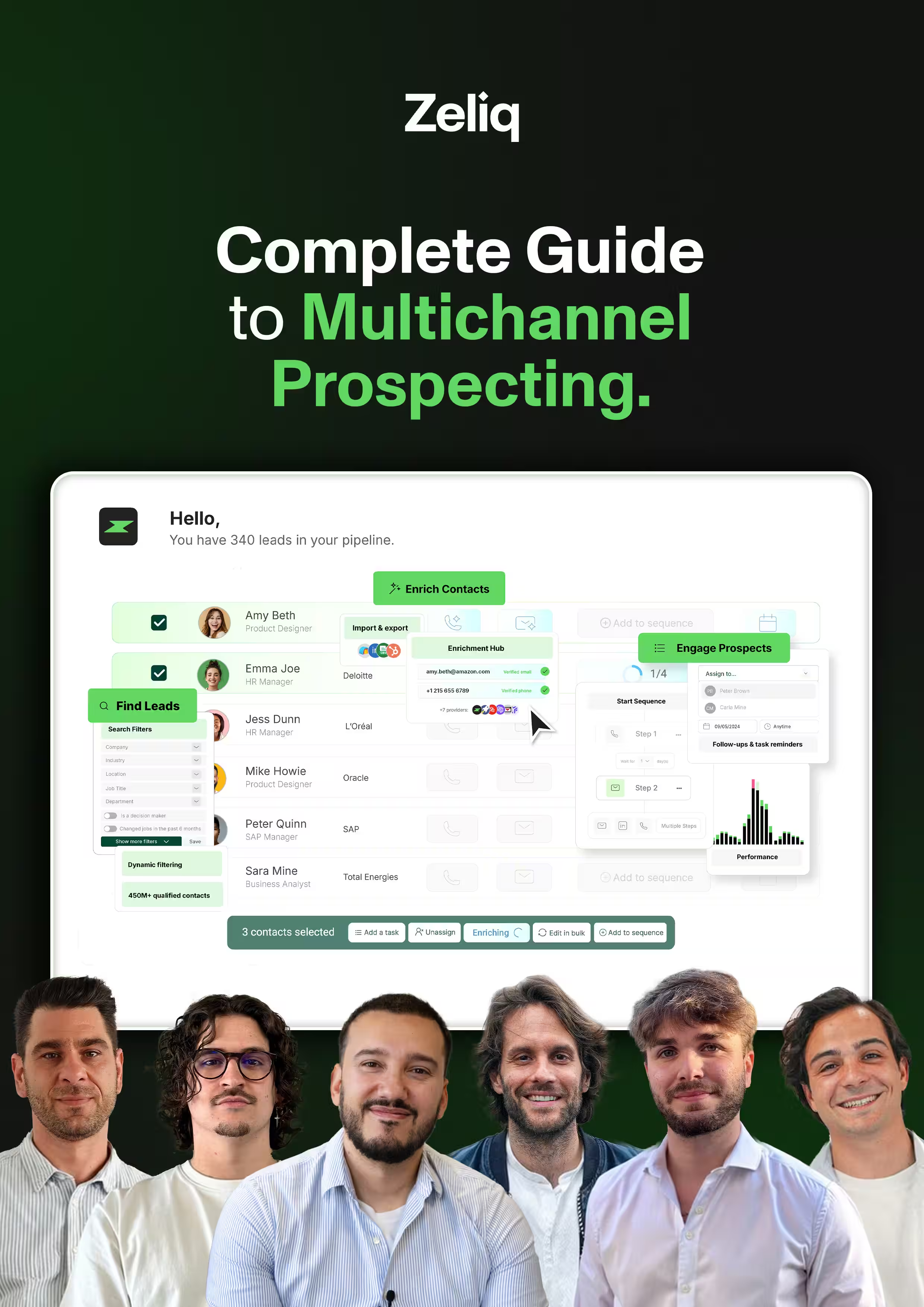
Zeliq combines a 450 million B2B contact database with multichannel sequences and waterfall enrichment. Tooling adapts by type: contacts + sequences for consultative and transactional; strategic enrichment + intent signals for ABM; LinkedIn extension + auto-outreach for PLG expansion. You align tooling and sales type without juggling multiple platforms.
6. Implications on team structure and commission plan
Team structure by type
- Transactional: flat team SDR + junior AE, no specialization
- Consultative: SDR + senior AE, Solution Engineer on some deals, emerging RevOps
- Enterprise: hierarchical team with senior AE + Solution Architects + Legal + RevOps + dedicated Marketing
- PLG: Growth team + PLG-focused Sales (activation, expansion), no classic SDR
- ABM: coordinated Marketing + SDR + AE + CS teams with Executive Sponsor per strategic account
- Self-service: minimal, mainly Customer Support
Switching from one type to another often requires significant team restructuring (6-12 months to be operational).
Commission plan by type
Commission tables vary significantly:
- Transactional: simple linear commission on deal count
- Consultative: tiered plan with accelerator above 100% quota
- Enterprise: mix ARR commission + milestone bonus (kick-off, go-live)
- PLG: commission on expansion NRR + PQL converted, less on new logos
- ABM: qualitative bonus on account coverage + commission on signed
- Self-service: no direct sales commission, support/CS bonus
The plan must reflect the levers actually actionable by the rep in their sales type.
7. Case study: scale-up shifting from consultative to PLG + Sales, +85% ARR
Context: French B2B SaaS scale-up, team collaboration tool publisher, 45 employees, 3.2M EUR ARR, 25%/year growth (stagnation vs 40%+ historical). Classic consultative sales model: SDR + AE.
2024 diagnosis:
- Sales cycle 45 days (long for 8K EUR ACV)
- Win rate 22% (correct but expensive in CAC)
- CAC 4,200 EUR for LTV 24K EUR → 5.7:1 ratio (good but optimizable)
- Many prospects test the product at freemium competitor before coming to us
- Total absence of own free trial
Decision: shift to PLG + Sales over 6 months:
- Launch freemium version with 4 seat max and limited features (Q1 2025)
- Marketing overhaul to capture self-service signups (product SEO, content)
- Team restructuring: SDR → Growth team, AE → PLG-focused (PQL expansion)
- New commission plan: 50% on NRR expansion, 40% on new logos converted from freemium, 10% qualitative adoption
- Tooling: product analytics (activation, PQL) + Zeliq for targeted outreach on activated accounts
Measured results at 12 months:
| KPI | Before | After | Delta |
|---|---|---|---|
| Total ARR | 3.2M EUR | 5.9M EUR | +85% |
| Freemium signups/month | 0 | 1,800 | new channel |
| Average sales cycle | 45 days | 18 days | −60% |
| Win rate on PQL | 0% | 42% | new |
| Average CAC | 4,200 EUR | 2,100 EUR | −50% |
| LTV/CAC ratio | 5.7:1 | 12.4:1 | +117% |
| Team size | 12 (sales) | 10 (growth + sales) | −17% |
ROI note: freemium investment + product refactoring + team restructuring = ~350K EUR over 6 months. ARR gain over 12 months = 2.7M EUR additional. ROI within SKILL v4 cap (10x) over 12-month period.
8. Frequently asked questions
How to choose the right sales type for my product?
Use the 4-dimension matrix: ACV, product complexity, number of decision-makers, digital maturity. Start by calculating your average ACV: under 500 EUR, self-service dominant; 500 EUR - 5K EUR, transactional; 5-50K EUR, consultative; above 50K EUR, enterprise or ABM. Then evaluate complexity: if a user can grasp the value in 2 minutes on your website, PLG or self-service are possible; if value requires a 30-minute demo, consultative becomes necessary. Finally, count decision-makers involved in purchase at your typical client: 1 = simple; 5+ = complex. This matrix eliminates 4 of 6 types and leaves 1-2 options that make economic sense for your product. The real test: LTV/CAC ratio. If your current model doesn’t deliver > 3:1 after 6 months, sales type isn’t aligned.
Is it possible to change sales type mid-course?
Yes, but it’s a 6-18 month project touching product, marketing, team, and culture. Common 2026 shifts: consultative → PLG + Sales (to scale), enterprise → targeted ABM (to focus), PLG → PLG + Sales (to capture enterprise). Each requires: product adjustment (create freemium for PLG, add enterprise features for enterprise), marketing overhaul (new channels, new content), team restructuring (30-50% of role changes or hires), new commission plan (align on new KPIs), and above all cultural accompaniment (consultative salespeople struggle with the shift to PLG where they lose cycle control). The project often costs 200-800K EUR depending on team size, but can unlock 2-5x more ARR if well executed. Don’t launch it without a CEO or VP Sales fully committed for 12 months.
How to measure if my sales type is the right fit?
3 main metrics: LTV/CAC ratio, sales cycle vs type benchmark, win rate on qualified opportunities. LTV/CAC ratio: target > 3:1 after 6 months execution; < 2:1 = non-viable model, must change. Sales cycle: compare to your type’s benchmark range (§ 2). If your cycle is 2-3x longer, there’s structural friction (bad product-market fit or bad type). Win rate: on qualified SQL opportunities, baseline is 20-30% consultative, 30-45% PLG, 15-25% enterprise. A win rate systematically below baseline indicates persona-product or type-product mismatch. Audit these 3 metrics quarterly. If 2 of 3 are red for 2 consecutive quarters, consider a type change.
9. Conclusion: 3 actions to run this week
Calculate your current LTV/CAC within 7 days. If under 3:1 after 6+ months of execution, your sales type isn’t aligned with your product. This is alarm signal #1.
Audit your sales cycle vs type benchmark within 15 days. Compare to matrix § 3. A cycle 2x longer than your type’s benchmark indicates structural friction that must be resolved before accelerating growth.
Test a hybrid model on a segment within 15 days if you’re in pure consultative or enterprise. PLG + Sales on SMBs, ABM on top 50 accounts: these hybrids reduce CAC 30-50% in 6-12 months when they make sense.
Align your tooling with your sales type
Zeliq combines 450 million B2B contacts, waterfall enrichment, and multichannel sequences. One platform adaptable to all sales types. Account set up in 2 minutes, no credit card.
Try for freeAnd if you want tooling that adapts to your sales type (transactional, consultative, PLG, ABM), try Zeliq for free: B2B contacts, waterfall enrichment, and multichannel sequences in one interface, no credit card.