

LinkedIn prospecting tools are software applications that let sales teams identify, enrich, and reach out to LinkedIn profiles at scale, covering seven core categories: profile search, list export, email enrichment, phone enrichment, engagement automation, message sequencing, and CRM sync. In 2026, Sales Navigator Core sits at $99.99 per seat per month and Advanced at $169 per seat per month per public LinkedIn pricing (verified September 2026), before layering the enrichment and outreach stack most teams add on top. This article maps the 7 tool categories, the workflow they combine into, cost benchmarks for a full stack, compliance guardrails, and 3 FAQ.
For a Head of Sales, SDR lead, RevOps engineer, or founder assembling a LinkedIn-driven outbound motion, this article covers what to buy for each layer and how to keep the total spend from ballooning.
On the agenda:
- What LinkedIn prospecting tools do (7 core categories)
- The typical LinkedIn-driven outbound workflow
- Sales Navigator vs the alternatives
- Enrichment layer: what LinkedIn does not give you
- Automation layer: connection requests, InMails, likes
- Sequencing layer: multichannel escalation
- CRM sync considerations
- Compliance: LinkedIn Terms of Service + GDPR + CAN-SPAM
- 3 FAQ (Sales Nav worth it, stack cost, automation limits)
Key takeaways:
- 7 core categories: profile search, list export, email enrichment, phone enrichment, engagement automation, sequencing, CRM sync
- Sales Navigator pricing verified 2026: Core $99.99/seat/month, Advanced $169/seat/month per LinkedIn public pricing
- Sales Nav gaps: no verified emails, no direct-dial phones, no intent data, per aggregated SERP references
- Full stack cost: $200-500 per SDR per month for a professional-grade LinkedIn outbound setup
- Automation limits: LinkedIn caps at approximately 100 connection requests per week for most accounts (as of 2026)
- Compliance: LinkedIn ToS restricts scraping; opt-out remains mandatory under CAN-SPAM and GDPR
1. What LinkedIn prospecting tools do (7 categories)
Modern LinkedIn prospecting is not one tool: it is a stack. Each layer solves a distinct problem the previous one leaves open.
Category 1, Profile search: filter LinkedIn’s professional graph by title, company, industry, tenure, location. Sales Navigator is the reference here; no alternative matches LinkedIn’s own graph precision.
Category 2, List export: capture the results of a search into a CSV or a CRM record. Sales Navigator does not export natively; Chrome extensions and automation platforms bridge this gap.
Category 3, Email enrichment: LinkedIn does not expose emails. Third-party enrichment matches a LinkedIn URL to a verified professional email at 60-90% match rate per aggregated benchmarks.
Category 4, Phone enrichment: LinkedIn does not expose direct dials. Third-party enrichment matches a LinkedIn URL to a mobile or line phone at 20-60% match rate depending on geography.
Category 5, Engagement automation: at-scale connection requests, profile likes, comments, InMails. Best used sparingly; LinkedIn actively penalizes aggressive automation.
Category 6, Message sequencing: multichannel outbound (LinkedIn + email + phone) with delayed follow-ups triggered by no-reply. See multichannel prospecting guide for the sequence design.
Category 7, CRM sync: push enriched contacts into HubSpot CRM, Salesforce, Pipedrive, or a similar CRM to run the sequence natively.
2. The typical LinkedIn-driven outbound workflow
Seven-stage cycle any professional-grade LinkedIn prospecting motion follows:
- Define the ICP in Sales Navigator search (title + industry + company size + tenure).
- Save the search as a list. Sales Navigator holds ~2,500 profiles per list.
- Export to CSV or push to the enrichment stack via a Chrome extension or an automation tool.
- Enrich each profile with verified email + direct phone.
- Verify emails SMTP-side before send (see cold email best practices for deliverability guardrails).
- Sequence across channels: LinkedIn connect + note, email 24h later if accepted, phone 3-5 days after email.
- Sync replies and outcomes back to the CRM.
Without the full stack, teams do stages 1-2 in Sales Navigator, then paste names into a spreadsheet and hand-search emails; a workflow that consumes 30-45 SDR seconds per contact.
3. Sales Navigator: what it does well, what it does not
Sales Navigator is unmatched at LinkedIn graph search. Its filters access data no third-party tool can replicate.
What Sales Navigator does well: - Advanced people and account search - Real-time notifications on job changes, mentions, TeamLink connections - InMail credits included in the plan - CRM integration for HubSpot CRM, Salesforce, and a few others
What Sales Navigator does not do: - No verified professional emails delivered - No direct-dial phones - No native intent or buying signals - No email sequencing - No native cold outreach automation
Pricing verified September 2026 per LinkedIn’s public pricing page: Core plan $99.99 per seat per month, Advanced $169 per seat per month. A 10-seat Advanced plan runs approximately $20,000 per year before any enrichment, verification, or dialer is added.
For teams that need only Sales Nav’s graph search and are happy handling everything else manually, the standalone plan can work. Anyone running professional outbound layers the enrichment + sequencing stack on top.
4. Enrichment layer
Third-party enrichment fills the gap Sales Navigator leaves. Common patterns:
Person enrichment: match LinkedIn URL to verified email + phone.
Company enrichment: fill firmographic detail (headcount, revenue, industry, tech stack) Sales Nav shows only at coarse granularity.
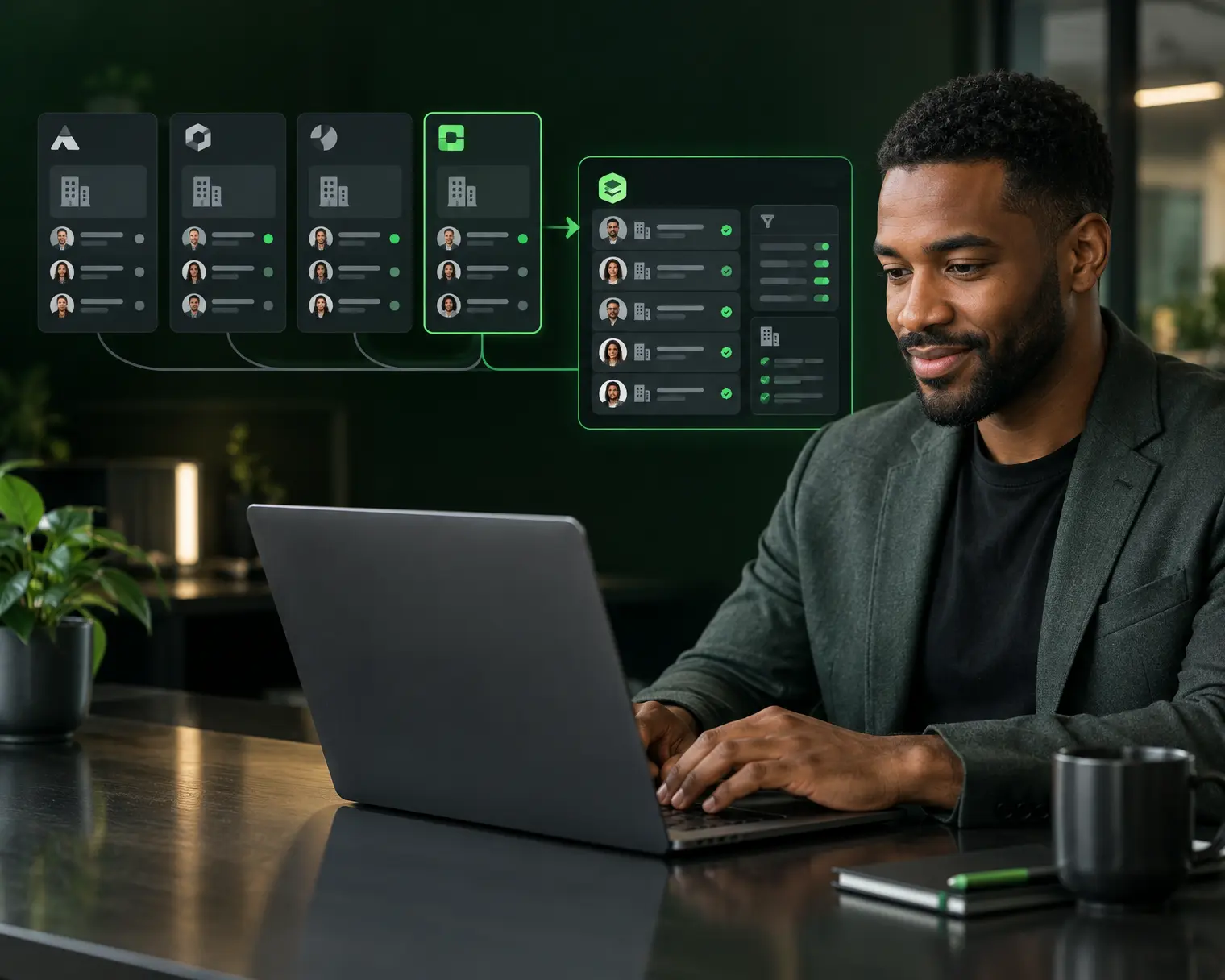
Waterfall enrichment: chain 3-4 vendors so a match miss on vendor A falls through to B, C, D. Match rate lifts from 55-70% single-vendor to 85-95% waterfall. Deeper coverage in B2B contact data.
Real-time vs batch: real-time API calls for signup-triggered enrichment, batch calls for weekly list cleanup.
Vendors commonly used: Cognism (EMEA-strong, phone-verified), Apollo (275M+ contacts per vendor claim), Zeliq (450M B2B contacts with waterfall built-in).
5. Automation layer: connection requests, InMails, engagement
LinkedIn enforces automation limits actively. Rough boundaries in 2026 (empirical benchmarks aggregated in SERP top 10, not always officially published by LinkedIn):
- Connection requests: ~100 per week per account
- InMail sends: 50-150 per month (paid plan dependent)
- Profile views: unlimited on paid plans, monitored on free
- Post likes / comments: monitored for bot-like patterns
- Follow-up messages after connection: no hard cap, softly rate-limited
Automation tools that push beyond these limits risk account restrictions or bans. Most reputable tools throttle themselves to stay under 80% of the empirical caps.
Warning: LinkedIn Terms of Service explicitly restricts scraping and automated access without permission. Automation tool selection is a compliance decision, not just a tooling one.
6. Sequencing layer: multichannel escalation
LinkedIn-only outreach converts at 1-3% reply rate. Adding email and phone escalation lifts to 5-15% depending on ICP and personalization quality.
Typical 10-day multichannel sequence: - Day 0: LinkedIn connect request with 300-char personalized note - Day 3: If connected, send an email tied to the LinkedIn context - Day 6: LinkedIn DM if no email reply - Day 8: Phone call escalation - Day 10: Breakup email
Sequence design matters more than tool choice. See improve email open rates for the copywriting layer.
7. CRM sync considerations
The end state of a LinkedIn prospecting cycle is a CRM record with enriched fields, sequence status, and outcome. Native CRM integrations of Sales Navigator (HubSpot CRM, Salesforce) push contacts but not sequences.
For full-cycle sync, most teams add a third-party sequencer that reads from the CRM and writes back sequence events. Fewer tool hops = fewer sync errors. The trend in 2026 is toward all-in-one platforms combining enrichment + sequencer + CRM push in one interface.
Zeliq and LinkedIn-driven prospecting
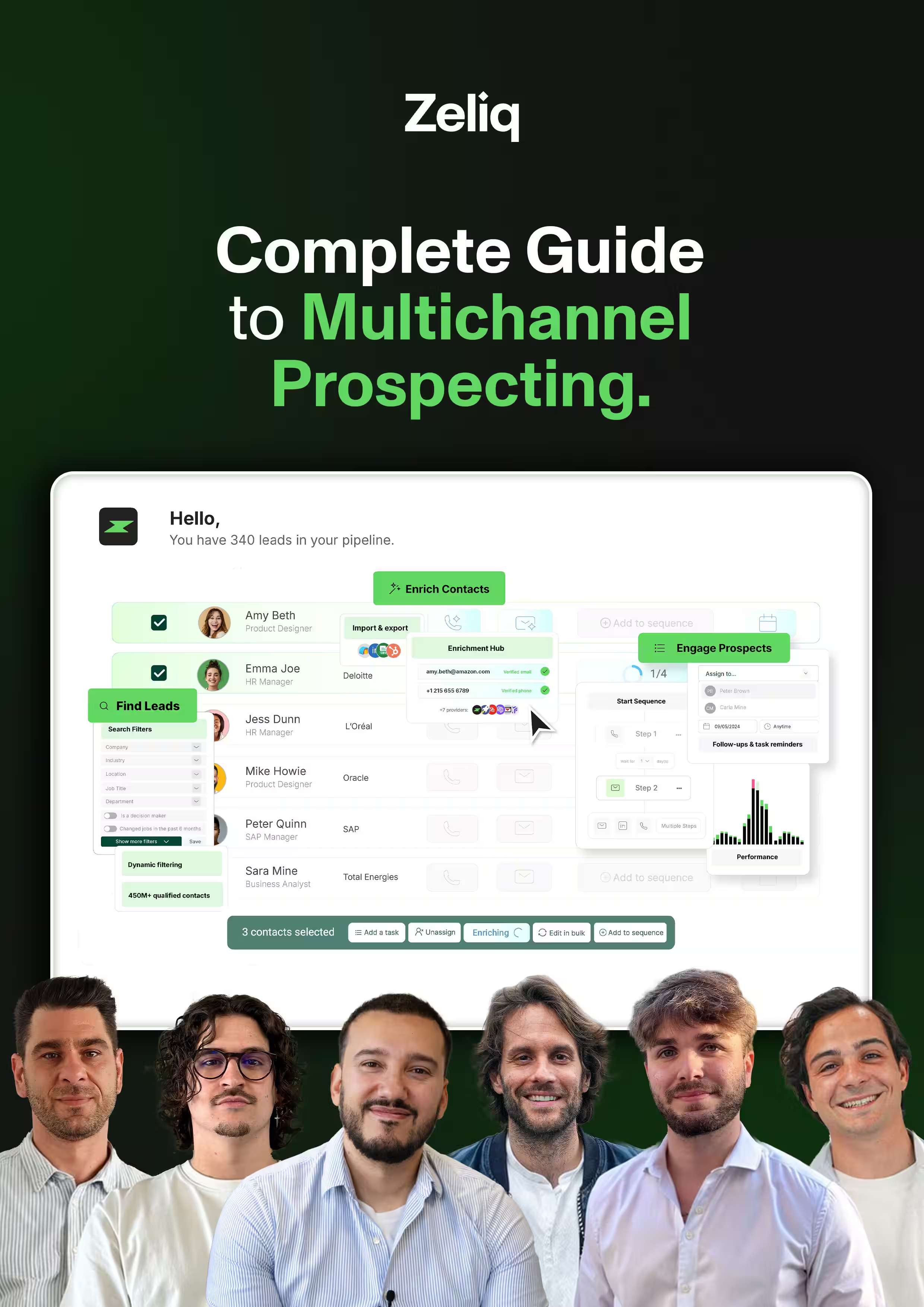
Zeliq combines a 450 million B2B contact database, waterfall enrichment across multiple sources with integrated email verification, and multichannel sequences in one interface. LinkedIn profile in, verified email + phone out, multichannel sequence running to the CRM, no tool hopping. GDPR-native suppression list included.
8. Compliance: LinkedIn ToS, GDPR, CAN-SPAM
LinkedIn Terms of Service: prohibit automated access without prior written permission. Bypassing this exposes the LinkedIn account (and by extension the team’s LinkedIn presence). Use tools that operate within LinkedIn’s public APIs or that stay within human-simulated rate limits.
GDPR: professional emails scraped from LinkedIn without documented legitimate interest expose the sender to CNIL enforcement. CNIL 2025 sanctions reached €486M total, including SOLOCAL’s €900k fine for prospecting emails without sufficient legal basis.
CAN-SPAM: US-side, the FTC compliance guide requires functional opt-out + accurate headers + valid physical address.
CCPA/CPRA: California disclosures for campaigns touching California residents.
The pattern that scales: source through a compliant enrichment vendor (documented legitimate interest + active suppression) rather than scraping LinkedIn directly.
9. Full stack cost benchmark
Concrete math for a professional-grade LinkedIn outbound setup, per SDR per month:
- Sales Navigator Advanced: $169
- Enrichment tool (mid-market plan): $100-300
- Verification tool (or bundled): $0-50
- Sequencer / multichannel tool (or bundled): $100-200
- Total per SDR: $370-720 per month
A 5-SDR team runs $1,850-$3,600 per month, or $22,000-$43,000 per year. Compressing the stack into an all-in-one platform typically saves 30-40% on the tool budget and 5-10 hours per SDR per month on integration debug.
10. Common mistakes
Mistake 1: Sales Navigator alone. Without enrichment, the workflow stops at name + title. Sales Nav is a search tool, not an outreach engine.
Mistake 2: Ignoring the compliance layer. Scraping LinkedIn directly = LinkedIn ToS violation + GDPR exposure.
Mistake 3: Automation above rate limits. Fast wins turn into account restrictions in 30-60 days.
Mistake 4: LinkedIn-only outreach. Reply rates cap around 1-3%. Add email and phone.
Mistake 5: No CRM sync. Sequence data trapped in the outreach tool = broken pipeline reporting.
11. Frequently asked questions
Is Sales Navigator worth it in 2026?
Yes for teams making 100+ LinkedIn-sourced touches per month per SDR, no for teams running mostly email or phone outreach. Sales Navigator’s value is graph search precision: no third-party tool matches LinkedIn’s own filters on title, tenure, company changes, TeamLink connections. At $99.99/month for Core or $169 for Advanced per seat, the cost-per-verified-lead makes sense when Sales Nav is the primary sourcing anchor. Below 100 touches/month, the fixed cost overwhelms marginal value, most tools with LinkedIn integrations pull enough public LinkedIn data to sub 100 monthly touches. Above 500 touches/month, Advanced is nearly mandatory for the extra filters (org charts, TeamLink) and higher InMail credits. The break-even math: $169/month divided by touches per month gives cost-per-touch. Below $1.50 per touch, Sales Nav is cheap; above $3 per touch, either scale usage or drop to Core. Common failure mode: team pays for 10 Advanced seats but only 2-3 SDRs use it heavily. Consolidate to power users, put lighter users on Core or free LinkedIn. Also factor tool alternatives: if the SDR already runs Cognism, Apollo, or Zeliq for enrichment, those tools’ LinkedIn Chrome extensions cover 70-80% of Sales Nav’s day-to-day use without the seat cost.
What is the total stack cost for a professional LinkedIn outbound setup?
$370-720 per SDR per month at mid-market vendor pricing, dropping to $200-400 with an all-in-one platform, before dialer and CRM seat costs. Component breakdown at typical mid-market pricing: (1) Sales Navigator Advanced $169/seat/month per LinkedIn public pricing verified September 2026, (2) enrichment tool $100-300 depending on vendor and credit volume (mid-market plans of Apollo, Cognism, Zeliq run in this range), (3) email verification tool $0-50 (often bundled with enrichment), (4) multichannel sequencer $100-200 (often bundled with all-in-one platforms). Total: $370-720/SDR/month for a stitched stack. All-in-one platforms combining enrichment + verification + sequencing into a single subscription typically run $150-400/seat/month, saving 30-40% on tool budget and 5-10 hours per SDR per month on integration maintenance. Beyond direct tool cost, factor CRM seat cost (HubSpot Professional $100-450/seat, Salesforce Sales Cloud $150-330/seat) and dialer if needed ($30-50/seat). A 5-SDR fully-loaded LinkedIn outbound setup lands at $30,000-$65,000/year on tools alone. Justify with pipeline generated: at $30/hour fully-loaded SDR cost and 10-15 hours/month freed by the stack, each SDR gets back $300-450/month of productive time, so the stack pays for itself if it lifts pipeline output 10-15% or more.
How aggressive can LinkedIn automation be without risking account restrictions?
Stay under 80% of empirical rate limits: approximately 80 connection requests per week, 50-100 InMails per month depending on plan, and human-timed engagement (likes, comments) rather than batch bot patterns. LinkedIn’s algorithm detects automation via three signals: (1) rate patterns above human speed (e.g., 30 connection requests in 10 minutes), (2) uniform interval spacing indicating scripted timing, (3) session concurrency across devices. Restrictions escalate from warning banners to search limitations to full account restrictions, typically triggered within 30-60 days of aggressive automation. Safe operating envelope in 2026: 80 connection requests per week with 30-90 second delays between them, InMails paced at 5-10 per day with personalization visible in the copy, engagement (likes, comments) mixed with authentic activity from the human owner of the account. Automation tools that publish “1,000 connections per week” claims are trading long-term account survival for short-term volume. Best practice: cap the automation at 60-70% of empirical limits, always include a human review step, and never run automation on the CEO’s or founder’s account. Account restrictions have real cost: rebuild time from a restricted account is 2-4 weeks, plus the lost signal of a warm LinkedIn presence for the sales team.
12. Conclusion: 3 actions to run
Audit your current LinkedIn stack within 7 days. List seat costs, real utilization per SDR, and gaps. If Sales Nav utilization is < 30% per seat, consolidate.
Test the enrichment layer on 200 LinkedIn URLs within 15 days. Pick 2-3 vendors’ free tiers. Measure email + phone match rate. Anything below 60% single-vendor suggests wrong vendor for your geography.
Consolidate toward all-in-one within 30 days if stack cost exceeds $500 per SDR per month. All-in-one platforms typically save 30-40% on tool budget while cutting integration maintenance to zero.
One platform for LinkedIn sourcing, enrichment, and multichannel sequences
Zeliq combines 450 million B2B contacts, waterfall enrichment with integrated verification, and multichannel sequences. LinkedIn profile in, verified email + phone out, sequence running to the CRM, no tool hopping. GDPR-native suppression included.
Try for freeAnd if you want to compress your LinkedIn prospecting stack into a single interface with waterfall enrichment and multichannel sequencing, try Zeliq for free: sourcing, enrichment, verification, and outreach all in one place, no credit card required.