

Lead lists are curated B2B contact collections used for targeted sales outreach, typically 500 to 50,000 records containing name, title, company, verified email, direct phone, and firmographic context. In 2026, B2B contact data degrades at roughly 2.1% per month (~22.5% per year, per multiple industry benchmarks aggregated in the top-10 SERP), which means refresh cadence matters as much as initial list quality. This article walks through the build-vs-buy decision, the 6 fields a professional list carries, cost math on both paths, refresh benchmarks, compliance guardrails, and 3 FAQ.
For a Head of Sales, RevOps, growth manager, SDR lead, or founder deciding whether to build lead lists in-house or buy them, this article gives the trade-offs, the numbers, and the compliance frame.
On the agenda:
- What a B2B lead list actually contains
- The build-vs-buy decision framework
- 6 fields in a professionally structured list
- Where to build from (LinkedIn Sales Nav, associations, directories)
- Where to buy from (major providers, positioning)
- How to verify a purchased list before use
- Refresh cadence: the 2.1%/month decay math
- Cost benchmarks: build in-house vs buy
- Compliance: CAN-SPAM + GDPR + CCPA
- 3 FAQ (cost, refresh, fields)
Key takeaways:
- Definition: curated B2B contacts (name, title, company, verified email, phone, firmographic) for sales outreach
- Data decay: ~2.1% per month, ~22.5% per year, per aggregated industry benchmarks
- Build vs buy break-even: build cheaper up to 500 contacts/month; buy pays for itself at 1,000+
- Structured list: 6 core fields plus 2-3 personalization triggers
- Verification mandatory: unverified purchased lists bounce 15-30%, wrecking domain reputation
- Compliance: FTC CAN-SPAM for US, GDPR (CNIL enforcement €486M in 2025) for EU
- Refresh cadence: every 6 months minimum, every 3 months for active-campaign lists
1. What a B2B lead list actually contains
A B2B lead list is a curated collection of business contacts. At minimum it holds identity + reachability. In practice, professional lists carry 6-8 fields that let SDR sequences personalize without extra research.
Common fields: - First name, last name - Job title, seniority level, department - Company name, domain, employee count, industry - Verified email, email_status (valid / catch_all / invalid) - Direct phone or line phone - LinkedIn URL - Firmographic tags (revenue bracket, funding stage, tech stack) - Behavioral signals (recent hire, funding round, tech switch)
The gap between an amateur and a professional list is not the row count but the field discipline. A 500-record list with 8 clean fields outperforms a 10,000-record list with only name + email.
2. The build-vs-buy decision framework
Three criteria decide the path:
Volume needed per month - < 200 contacts: build wins (labor cost small) - 200-1,000: mixed (build for high-value, buy for scale) - > 1,000: buy wins (labor cost dominates)
ICP specificity - Narrow niche (e.g., “CIOs of biotech companies 50-500 employees in Boston”): build (buyers rarely have this precision) - Broad ICP (e.g., “SaaS marketing directors, US”): buy (buyers have this covered)
Compliance requirements - US only, CAN-SPAM: either path works - EU/EMEA, GDPR-critical: buy from a GDPR-compliant vendor with active suppression, or build with documented legitimate interest
3. 6 fields in a professionally structured list
Core structure any sequence tool can consume:
| Field | Format | Why it matters |
|---|---|---|
| first_name | text | Personalization anchor |
| last_name | text | Deduplication key |
| title | text | Segmentation for sequence choice |
| company_domain | domain | Deduplication + email pattern |
| email_verified | valid / catch_all / invalid | Filter before send |
| phone_direct | E.164 | Multichannel escalation |
Optional but high-value: - linkedin_url (for InMail escalation) - last_enriched_at (freshness tracker, drives refresh) - persona_tag (VP Sales vs CMO vs CTO) - signal_tag (recent hire, series funding, tech switch)
4. Where to build from
If your ICP is narrow or if you want to own the sourcing IP, build:
LinkedIn Sales Navigator: filters by title, industry, company size, tenure. Export via manual copy or a Chrome extension. Typical volume: 100-300 profiles/hour manually, 500-1,000/hour with automation. Requires paid Sales Navigator seat.
Industry associations: SHRM, American Marketing Association, National Restaurant Association publish member directories. Members are opt-in professionals, quality is high. Access sometimes gated to member companies.
Chambers of Commerce: state-level chambers list 500-5,000 member companies each with contact details in 30-50% of cases. Local B2B (SMB, consultants, agencies) source of choice.
Government datasets: Companies House UK (4M+ companies), SEC EDGAR (US public companies), INSEE France (30M+ companies). Firmographic backbone, personal contacts must be sourced separately.
Product Hunt, AngelList, YC Startup Directory: founder-CEO sourcing for early-stage B2B. Free public data on 100k+ startups.
Google Maps + Instant Data Scraper: local B2B extraction (agencies, restaurants, gyms, dental practices). 200-500 businesses per hour. Requires email enrichment after.
5. Where to buy from
Vendors publish contact databases at various coverage/verification levels. Common patterns:
Enterprise-tier: ZoomInfo (260M+ contacts published), SalesIntel (human-verified), Cognism (EU-strong, phone-verified). Annual commits $15k-100k+/year, deepest coverage, strongest CRM integrations.
Self-serve mid-market: Apollo (275M+ contacts published), UpLead, Kaspr. Monthly plans $100-2,000, self-serve, free tiers available.
Regional specialists: Kaspr (France/Europe phones), Cognism (EMEA GDPR-strong), Zeliq (450M B2B contacts, waterfall enrichment built-in, European positioning).
Verification specialists: providers that layer email verification on top of raw databases. Bounce rate drops from 15-30% (raw) to 1-3% (verified).
For a deeper dive on selecting a database vendor, see the section on B2B contact data.
6. How to verify a purchased list
Never send to a purchased list before verifying. The typical workflow:
- SMTP verification on 100% of emails (NeverBounce, MillionVerifier, ZeroBounce). Removes hard-bounce candidates.
- Format check: filter out role-based emails (
info@,sales@) if outreach is 1-to-1. - Deduplication: strip records already in your CRM to avoid double-sending.
- Sample enrichment: pick 100 random contacts, cross-check title + LinkedIn URL. If more than 15% show mismatched titles, the vendor’s freshness is poor.
- Suppression list: cross-check against your unsubscribe database.
Bounce rate target after verification: 1-3%. Anything higher damages the sending domain’s reputation. See cold email best practices for deliverability guardrails downstream.
7. Refresh cadence: the 2.1%/month decay math
Aggregated industry benchmarks in the top-10 SERP converge on ~2.1% B2B contact data decay per month (~22.5% per year). Meaning: a 10,000-contact list you cleaned 12 months ago has ~2,250 records that are now wrong (person changed roles, company was acquired, email format changed).
Practical cadence: - Every 3 months: for lists in active outbound campaigns (high dollar cost per bad send) - Every 6 months: for lists in nurture mode - Every 12 months: for lists in dormant / long-tail nurture - Never let a list go > 18 months without refresh: past that threshold, the labor cost of contacting bad data exceeds the labor cost of full re-enrichment
Cost of a refresh cycle: $0.05-0.30 per contact depending on volume and vendor. On a 10,000-contact list, that’s $500-$3,000, offset by 2-3 weeks of protected deliverability.
8. Cost benchmarks: build vs buy
Concrete math for a mid-sized SDR team (5 SDRs, targeting 1,000 verified new contacts/month):
Build in-house: - LinkedIn Sales Navigator: $100-150 per SDR/month × 5 = $500-750/month - Manual sourcing + verification: 30-45 sec per contact × 1,000 = 8-12 hours - Fully-loaded SDR cost $30/hour = $240-360/month labor - Verification tool (free tier): $0-100/month - Total build: $740-1,210/month
Buy from a vendor: - Mid-market plan (Apollo, Zeliq, or similar): $200-500/month per seat × 5 = $1,000-2,500/month for full team, or ~$300-800 for a shared seat - Verification typically bundled - Time saved: 8-12 hours/month redirected to actual outreach = $240-360 of freed capacity - Total buy: $300-800/month net, plus freed labor
At 1,000 contacts/month, buy wins by $400-500/month net. Below 300 contacts/month, build wins. The switch point lands around 500-700 contacts/month for most teams.
Zeliq and integrated lead list building
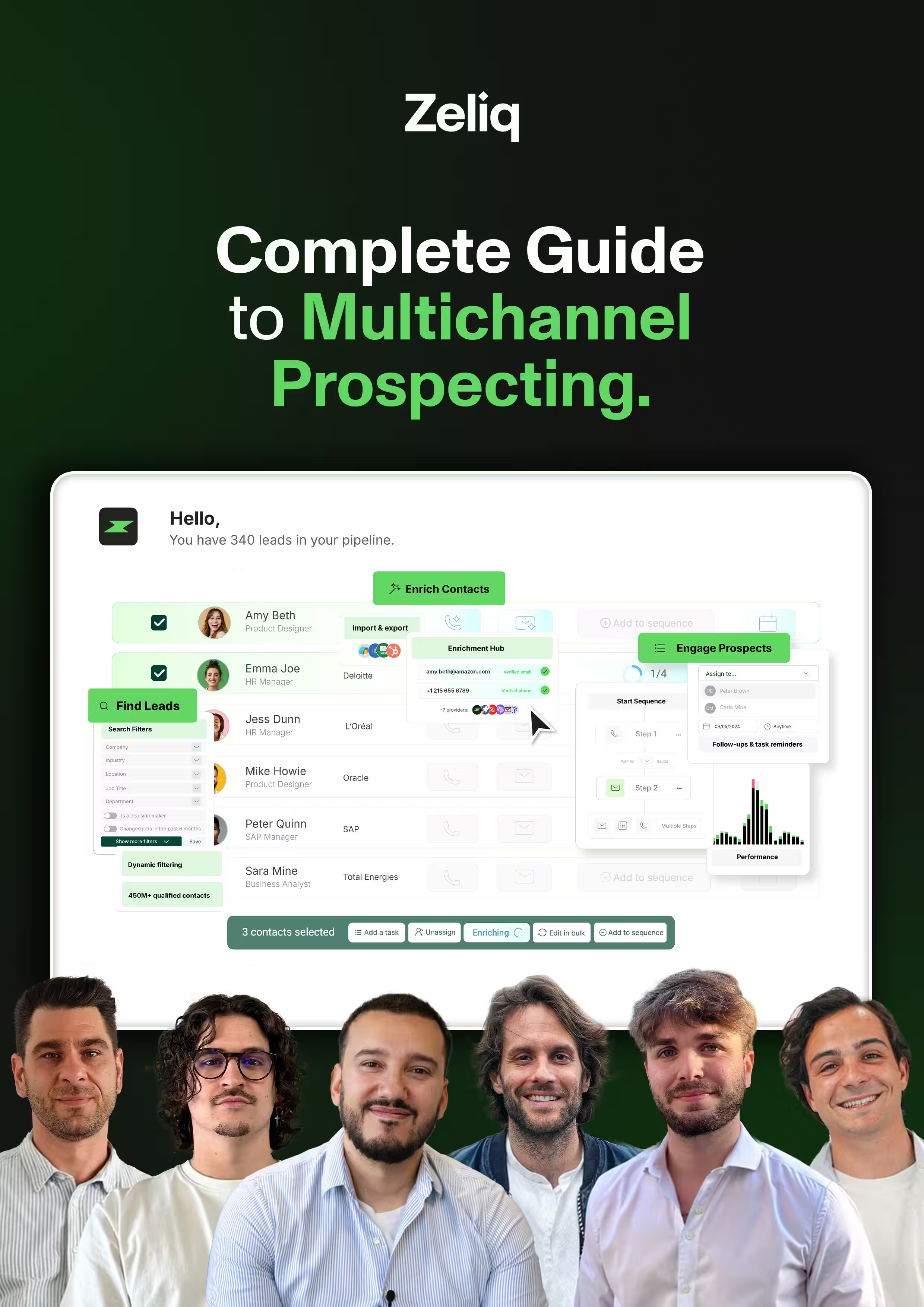
Zeliq combines a 450 million B2B contact database, waterfall enrichment across multiple data sources with integrated email verification, and multichannel sequences in one interface. Build precise ICP lists in minutes, ship verified contacts to the CRM, run the outbound sequence, all without hopping between tools. GDPR-native suppression list included.
9. Compliance: CAN-SPAM, GDPR, CCPA
US CAN-SPAM: B2B cold email permitted without prior consent under FTC compliance rules: accurate subject line + valid physical address in signature + functional opt-out + honor opt-out within 10 business days.
EU GDPR: B2B cold email uses “legitimate interest” (Article 6-1-f). Requirements: documented interest justification per ICP segment, opt-out on every email, respect suppression lists, 3-year post-last-contact retention. CNIL 2025 enforcement reached €486 million total (vs €55M in 2024), including SOLOCAL Marketing Services at €900,000 for prospecting emails sent without sufficient legal basis.
California CCPA/CPRA: right to know, delete, opt-out for California residents. B2B professional contacts have partial exemption but campaigns targeting California should include CCPA disclosures.
The compliance risk is highest for purchased lists from providers without active suppression processes. Prefer vendors that publish their suppression workflow openly.
10. Common mistakes
Mistake 1: Sending to a purchased list without verification. 15-30% bounce rate damages sending domain reputation for 2-4 weeks. Always SMTP-verify first.
Mistake 2: One-time list purchase with no refresh plan. At 2.1%/month decay, a bought list loses a fifth of its value in a year. Budget refresh from day 1.
Mistake 3: Chasing volume over ICP fit. 100 verified contacts matching your ICP outperform 10,000 unverified irrelevant records. Volume vanity metric.
Mistake 4: Skipping the suppression list check. Contacts on your unsubscribe list still receiving emails = CAN-SPAM violation = CNIL / FTC exposure.
Mistake 5: Building without documenting the sourcing method. For GDPR audits, you need to prove the legitimate interest basis for each ICP. “We scraped LinkedIn” is not a defense.
11. Frequently asked questions
How much does a B2B lead list cost, build vs buy?
Building in-house lands around $0.75-1.20 per verified contact all-in (LinkedIn Sales Nav seat + SDR sourcing time + verification); buying from a vendor runs $0.30-0.80 per contact at mid-market volume, dropping to $0.05-0.10 at enterprise annual commits. The decisive variable is fully-loaded SDR hourly cost: at $30-40/hour and 30-45 seconds per contact for build, labor alone is $0.25-0.50 per contact before tool costs. Add LinkedIn Sales Navigator at $150/seat/month allocated across contacts, verification at $0.001-0.01 each, and you’re at $0.75-1.20 all-in. Buying skips the labor almost entirely (vendor delivers verified contacts via API or CSV), so the cost is direct: $200-500/month for mid-market plans covering 500-2,000 verified contacts. Break-even between build and buy typically falls at 500-700 verified contacts per month per team. Below that, build wins on cost; above, buy wins on cost AND on freed labor for actual outreach. Always factor the indirect cost of poor data: unverified purchased lists bouncing at 15-30% cost 2-4 weeks of degraded deliverability, translating to thousands of dollars in missed pipeline.
How often should I refresh a B2B lead list?
Every 3 months for lists in active outbound campaigns, every 6 months for nurture lists, every 12 months for dormant lists, never let a list go beyond 18 months without full refresh. B2B contact data decays at approximately 2.1% per month (~22.5% per year) per aggregated industry benchmarks in the top-10 SERP: professionals change roles, companies get acquired, email formats change, phones get reassigned. On a 10,000-contact list that was clean 12 months ago, roughly 2,250 records are now wrong. Practical refresh: (1) automatic real-time re-enrichment of any contact that generates a bounce or an out-of-office response indicating role change, (2) quarterly batch enrichment of contacts with no engagement in the last 90 days, (3) annual full-base re-enrichment. Cost of a refresh cycle: $0.05-0.30 per contact depending on volume and vendor. On a 10,000-contact list, that’s $500-$3,000. Offsets: (a) 2-4 weeks of protected sending reputation vs the alternative of bad sends, (b) 2× reply rate improvement from personalization sharpness, (c) reduced SDR frustration from bouncing outreach. Track a last_enriched_at timestamp on every CRM record and set an alert when it crosses 6 months.
What fields should a B2B lead list contain?
Six core fields are mandatory (first_name, last_name, title, company_domain, email_verified with status, phone_direct) plus 2-3 optional personalization triggers (linkedin_url, last_enriched_at, signal_tag). The mandatory six drive the outbound: identity (first + last name), segmentation (title), deduplication key (company_domain), reachability (email + phone). Skipping any of these creates production friction at the sequence step. The optional layer drives conversion lift: linkedin_url for InMail or multichannel escalation, last_enriched_at for freshness alerting (auto-trigger re-enrichment beyond 6 months), signal_tag capturing intent triggers like “new CFO hired 30 days ago” or “$25M Series B announced last week”. Personalizing an opener with a signal tag lifts reply rate 3-4× vs a generic opener per industry benchmarks. Avoid these anti-patterns: (a) storing raw notes in a “comments” field with no structure, impossible to segment, (b) combining first + last name in a single field, (c) omitting email_verified status so unverified records slip into sequences, (d) tracking employee count as a text field (“50-100”) instead of a numeric bracket, breaks quantitative segmentation. Any modern CRM (HubSpot CRM, Salesforce, Pipedrive) supports this schema natively.
12. Conclusion: 3 actions to run
Audit your current list state within 7 days. Count records by
email_verifiedstatus. If more than 15% are unverified or missing status, priority is verification before any new send.Compute your build vs buy break-even within 15 days. Volume needed per month × labor cost per contact vs vendor pricing at that volume. Anything above 700 contacts/month per team typically justifies buying.
Set up a refresh cadence within 30 days. Alert on any contact with
last_enriched_atolder than 6 months. Schedule quarterly batch enrichment on inactive segments.
Skip the build vs buy debate: build precise lists in a verified database
Zeliq combines 450 million B2B contacts, waterfall enrichment with integrated verification, and multichannel sequences. Build ICP-precise lists, ship to CRM, run the outbound in one interface. GDPR-native suppression included.
Try for freeAnd if you want to skip the build vs buy dilemma and build precise lead lists directly against a verified 450M database with waterfall enrichment, try Zeliq for free: sourcing, enrichment, verification, and multichannel sequences in a single interface, no credit card required.