

To enrich contacts is to add missing or verified information to an existing B2B contact record, verified email, direct phone, job title, seniority, LinkedIn URL, company firmographics, tech stack, using external databases and verification services. In practice, most B2B teams enrich contacts at 4 moments: (1) at CRM record creation from a form or manual add, (2) in bulk when importing a new list, (3) on a cadence to refresh stale records, (4) inline in a sales sequence when prep data is missing. The goal is always the same: turn a partial contact into an actionable, verified profile before outbound. This article walks through the 5-step playbook, the 4 enrichment surfaces (email, phone, firmographic, technographic), waterfall vs single-vendor trade-offs, tools, GDPR guardrails, and 3 FAQ. Unlike a broader B2B contact data overview, this piece is operational: the exact steps to run this week.
For an SDR, RevOps engineer, growth marketer, or founder wanting a practical enrichment workflow, this article gives the sequence, the tools, and the checkpoints.
On the agenda:
- What « enrich contacts » actually means step by step
- The 5-step B2B enrichment playbook
- The 4 enrichment surfaces (email, phone, firmographic, technographic)
- Real-time enrichment vs batch enrichment
- Waterfall vs single-vendor
- Tools and their positioning
- GDPR guardrails
- 3 FAQ (frequency, cost, DIY vs vendor)
Key takeaways:
- Definition: add verified info to an existing contact record from external sources
- 5-step playbook: inventory → sourcing → enrichment → verification → segmentation
- 4 surfaces: email (60-90% match), phone (20-40% match), firmographic (90-95%), technographic (varies)
- Real-time: at record creation, sub-second response
- Batch: for legacy CRM cleanup, monthly refresh
- Waterfall: 3-4 vendor cascade for 85-95% match vs 55-70% single-vendor
- Frequency: re-enrich every 6-12 months as ~30% of professionals change roles/year
- GDPR: legitimate interest documented, opt-out honored via suppression list
1. What « enrich contacts » actually means
Enriching contacts is the practice of taking a contact record with holes, missing email, no phone, outdated title, unknown company size, and filling those holes with verified data from external sources. It is different from lead generation (creating new contacts) and from contact management (organizing what you already have).
The typical starting state
Look at any CRM more than 12 months old: 30-50% of records have missing fields. A common state:
- 100% have a name and company
- 70-80% have an email (but some outdated after role changes)
- 30-50% have a phone
- 40-60% have a current job title
- 20-30% have LinkedIn URL
- 5-10% have anything richer (department, seniority level, tech stack)
Enriching contacts closes these gaps. Well done, it turns a low-quality CRM into a segmentation-ready sales engine.
Why it matters
- Bounce rate: unverified emails bounce 15-30%; verified enriched emails bounce 1-3%
- Reply rate: personalized outreach with correct title + company signals 30-50% higher reply rate than generic
- Time saved: SDR spends 30-45s per manual enrichment; automated cuts to 1-2s
- Deliverability protection: reduced bounce protects the sending domain’s reputation
2. The 5-step enrichment playbook
Step 1: Inventory
Query your CRM for records with missing fields. Typical filters:
email IS NULL OR email = ''
OR phone IS NULL
OR title IS NULL
OR last_enriched_at < NOW() - 12 months
Segment by priority: high-value accounts first (existing customer contacts, active opportunities), then cold prospects. This inventory tells you the enrichment volume required for the next 30 days.
Step 2: Sourcing (if leads are new)
For records that don’t exist yet in the CRM (a new imported list, a fresh ICP scrape), source the identifier first:
- LinkedIn Sales Navigator search → export
- Apollo.io / Zeliq search endpoint
- Industry association member directory
- Conference attendee list
Sourcing produces a base row: name + company + LinkedIn URL, at minimum.
Step 3: Enrichment call
Run each contact through the enrichment API or tool. Choose the input identifier with the highest match rate:
- Email input → 90%+ match on verified profile completion
- LinkedIn URL input → 85-90% match
- Name + company_domain → 55-75% match single-vendor, 85-95% waterfall
For volume above 500 contacts/month, batch endpoint (/bulk) or async webhook is essential to avoid manual work.
Step 4: Verification
Verified emails only. Even after enrichment, an email may be a pattern guess or catch-all. Run each through /email/verify (built into most enrichment tools; standalone: NeverBounce, MillionVerifier, ZeroBounce).
Verified status set for each contact: verified, catch_all, invalid. Filter to verified before any outbound send.
Step 5: Segmentation
Enriched CRM now supports segmentation:
- By persona (title + seniority)
- By industry
- By company size (headcount bracket)
- By tech stack (uses Salesforce, uses HubSpot, uses X competitor)
- By location
- By buying signals (funding round, hiring surge, tech switch)
Segmented cohorts get tailored sequences. This is where enrichment ROI compounds: same contact list, 3-5x reply rate.
3. The 4 enrichment surfaces
Surface 1: Email
Find and verify the professional email for a contact. Combines pattern matching (firstname.lastname@company.com), historical databases, and SMTP verification. Match rate: 60-90% single-vendor by anchor input, 85-95% waterfall.
Surface 2: Phone
Find direct mobile or line phone. Harder, data is more fragmented, more GDPR-sensitive, especially outside the US. Match rate: 20-40% in France, 40-60% in the US, 30-50% in the UK/DACH.
Surface 3: Firmographic
Complete company-level info: employees, revenue, industry, HQ, funding, years founded. Match rate: 90-95% on companies with more than 20 employees.
Surface 4: Technographic
Detect the tech stack used by the company. Sources: JS/HTML tag detection on the site, job postings mentioning technologies, public integrations. Match rate varies by category (CRMs and marketing tools well detected; internal ERP and analytics harder).
4. Real-time vs batch enrichment
Real-time
Triggered at record creation. Best for inbound signups, form fills, product signups where enriched data drives immediate routing (which SDR gets this lead, which segment, which welcome sequence). Latency budget: sub-second to ~3 seconds max.
Batch
Scheduled cron job. Best for CRM cleanup, imported list preparation, quarterly re-enrichment cycles. Async processing over minutes to hours; no user-facing latency.
Most mature CRM setups use both: real-time on new inbound, batch monthly on the existing base.
5. Waterfall vs single-vendor
Single-vendor
Simpler integration, one API, one credit system. Match rate ceiling: 55-75% depending on vendor + ICP fit.
Waterfall
Chain 3-4 vendors. Vendor A first (highest match on your ICP), fallback to B, then C, then pattern-match + SMTP verification. Aggregate match: 85-95%.
Trade-offs
- Waterfall costs 1.3-1.8x per matched contact but delivers 30-40 pts more match
- Waterfall latency: 1-3s vs 300-800ms single-vendor
- Waterfall complexity: 2-3 weeks engineering time to build in-house; 3-5 days with a waterfall-native platform
Most teams end at waterfall by month 3-6 of enrichment maturity. Starting with single-vendor is fine to prove ROI.
6. Tools by positioning
Positioning only, no pricing (which changes).
Clearbit (HubSpot)
Strong on US firmographic + tech stack. Native HubSpot integration.
Apollo.io
Broad contact DB, sourcing + enrichment self-serve. Free tier.
Cognism
European positioning, GDPR-compliant certified.
Lusha
Focused on phones. Simple, quick to integrate.
Zeliq
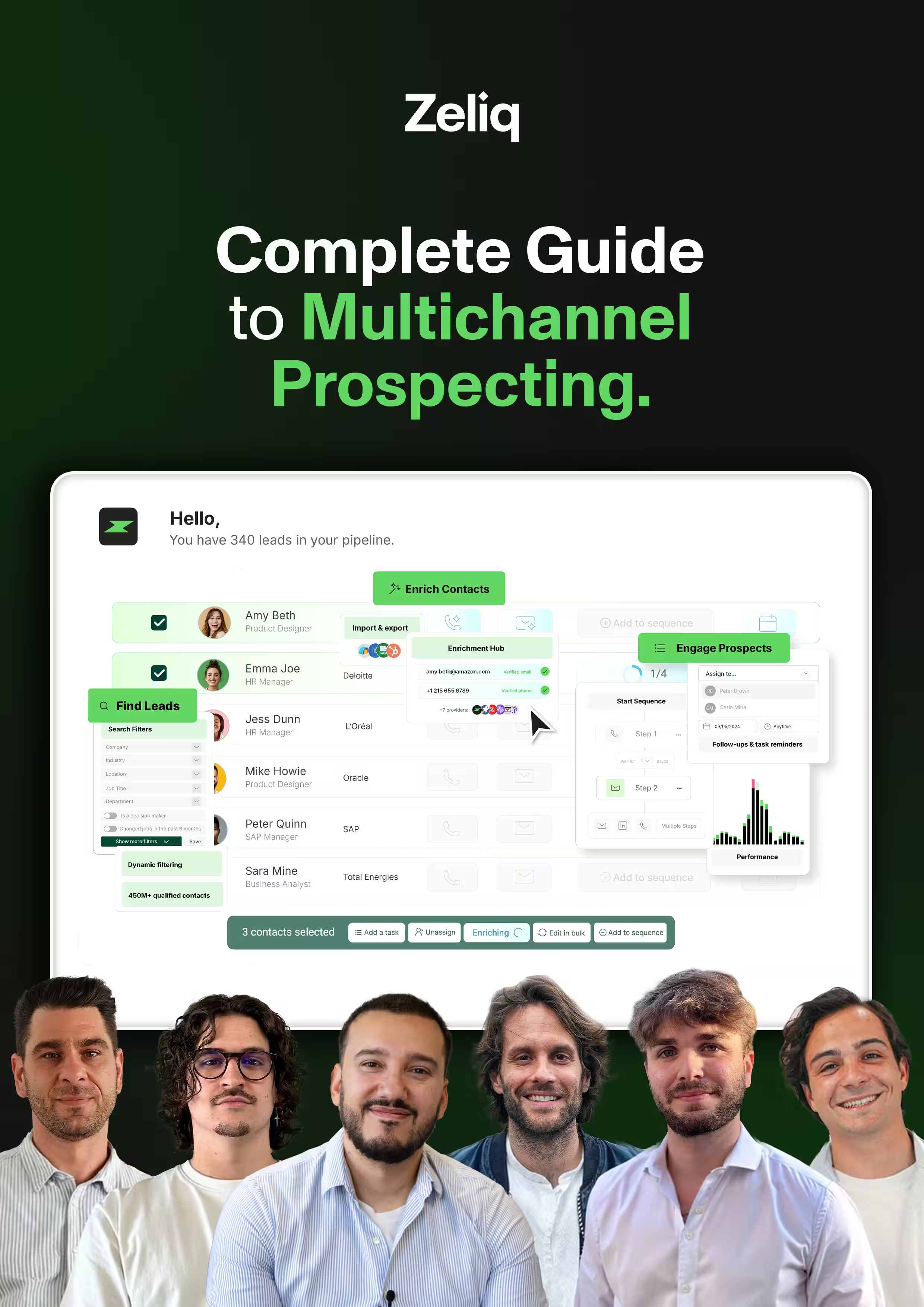
450 million B2B contacts, waterfall enrichment built-in, integrated email verification, multichannel sequences as follow-on. European positioning, GDPR by design.
Selection
- HubSpot CRM, US ICP → Clearbit
- Broad DB self-serve → Apollo
- Strict GDPR + EMEA phones → Cognism
- Phone-heavy → Lusha
- Waterfall + European → Zeliq
7. GDPR guardrails
For European ICPs:
- Document legitimate interest per ICP segment (see CNIL 2025 sanctions summary for enforcement precedents)
- Every outbound must include functional opt-out
- Query the vendor’s suppression list before send
- Retain contact data max 3 years post-last-contact
- Sign DPA with each vendor handling EU data
For US ICPs: CAN-SPAM requires functional opt-out and physical postal address in signature. Simpler than GDPR but not zero-effort. Full compliance requirements in the FTC CAN-SPAM Act Compliance Guide for Business.
8. Common pitfalls
Pitfall 1: Enriching without verification
Enriched but unverified emails still bounce 10-20%. Always verify.
Pitfall 2: Not caching
Enriching the same contact monthly = 12 credits/year unnecessary. Cache 30-90 days.
Pitfall 3: Skipping suppression check
Even a verified contact may have opted-out historically. Always query suppression list before send.
Pitfall 4: Single-vendor beyond 5,000 contacts/month
Ceiling around 55-75% match. Above 5,000/month, the missing 25-45% is thousands of contacts. Waterfall pays for itself here.
Pitfall 5: Over-enrichment
Enriching every field on every contact = 3-5x credit spend for marginal ROI. Enrich only the fields you use in segmentation or personalization.
Zeliq’s contact enrichment
Zeliq combines a 450 million contact base, waterfall enrichment built into a single interface (no need to orchestrate 3-4 vendors), integrated email verification, and multichannel sequences. GDPR-native suppression, European positioning. One tool for the full playbook: inventory → source → enrich → verify → sequence.
9. The 30-day enrichment sprint
For a team starting from scratch:
- Week 1: audit CRM, identify enrichment volume, pick one vendor free tier
- Week 2: run 500-contact test batch, measure real match rate and bounce
- Week 3: implement real-time enrichment on new signups + batch cleanup of top 1,000 records
- Week 4: set up monitoring (match rate, cost per contact, bounce delta) and decide on scaling (single-vendor annual vs waterfall)
Expected outcome after 30 days: 3-5% bounce rate (down from 15-30% raw), 30-50% higher reply rate on outbound sequences.
10. Frequently asked questions
How often should I re-enrich contacts in my CRM?
Every 6-12 months for email and title fields, every 12-24 months for firmographic data, and real-time for high-value opportunity contacts. B2B contact data degrades naturally as professionals change roles. US voluntary turnover reached 23.4% in 2026 per HR platform aggregates, while Mercer’s Turnover Survey reports a narrower 13% for the 2024-2025 window depending on measurement methodology. Even at the conservative end, an email found 12 months ago has 13-25% chance of being obsolete because the person changed companies, the company was acquired, or the email format changed. Without re-enrichment, your CRM loses 3-5% of its usable data quality each month. Practical cadence: (1) real-time enrichment on any new record entering the CRM, (2) every 6 months, re-enrich all contacts with no activity (open, reply, meeting) in the last 6 months, (3) every 12 months, re-enrich the entire base, (4) for active opportunity contacts, re-enrich before every major outreach (kickoff meeting, renewal, upsell). Cost of a re-enrichment cycle: $0.05-0.30 per contact depending on volume and vendor. Positive ROI as soon as you plan an outbound campaign, bounce rate reduced, personalization sharper, reply rate 2x. Track a « last_enriched_at » timestamp on every CRM record and set alerts when it crosses 6 months.
Should I DIY enrichment (call raw APIs) or use a vendor platform?
DIY makes sense below 10,000 contacts/year and when engineering resources are cheap; vendor platforms make sense above that volume or when time-to-value is critical. DIY math: buy raw enrichment API credits at $0.05-0.20/contact + engineering time to build the pipeline. Base pipeline (single-vendor + verification + caching) takes 1-2 weeks of one engineer. Adding waterfall, monitoring, error handling, and GDPR suppression: another 2-3 weeks. Ongoing maintenance: 5-10 hours/month. At 10,000 contacts/year, DIY total cost is ~$3,000 credits + $8,000 engineering initial + $6,000/year maintenance = ~$17,000 first year, ~$9,000/year steady state. Vendor platform (waterfall-as-a-service like Zeliq): $500-2,000/month all-in = $6,000-24,000/year, but zero engineering time and time-to-value 3-5 days instead of 5-8 weeks. Below 10,000 contacts/year: vendor is usually cheaper because your engineering hours aren’t free. Above 50,000 contacts/year: DIY starts making sense financially if you have engineering slack and need custom logic. The middle band (10k-50k/year) is where it really depends on your team’s priorities, most SDR teams pick vendor for speed; RevOps teams with in-house data engineers sometimes pick DIY for control.
What’s the realistic total cost to enrich 10,000 contacts?
$500-3,000 in direct API/tool cost, plus $200-1,500 in labor time depending on automation level, for a total of $700-4,500 end-to-end. Cost breakdown at 10,000 contacts: (1) Enrichment API/tool credits: $0.05-0.30/contact = $500-3,000. Waterfall vs single-vendor accounts for most of this range. (2) Email verification: $0.001-0.01/verify = $10-100. Usually bundled with enrichment tools now. (3) Suppression list check: usually included or negligible cost. (4) Labor time to set up and run: with automated pipeline, 5-15 hours = $150-450 at $30/hr fully-loaded SDR/RevOps cost. Without automation (manual batch upload, manual review), 30-50 hours = $900-1,500. (5) Bounce and deliverability protection (indirectly saved): unverified 15-30% bounce could damage reputation and cost 2-4 weeks of degraded deliverability, thousands of dollars in missed pipeline. Total end-to-end: $700-4,500. The dominant driver is whether you use waterfall (higher credit cost, higher match rate) or single-vendor (lower credit cost, lower match rate). At 10,000 contacts, waterfall’s higher match rate typically justifies the cost premium because the marginal 30-40% of matched contacts converts to real pipeline.
11. Conclusion: 3 actions to run
Audit your CRM within 7 days. Count records with missing email, phone, or title. If more than 30% have gaps, priority to enrichment.
Test one enrichment tool free tier within 15 days. Run 500 contacts through, measure match rate and bounce. Compare against your baseline.
Set up real-time + batch enrichment within 30 days. Real-time on new records; monthly batch for records untouched > 6 months. Set alerts when
last_enriched_atcrosses 6 months.
Enrich contacts once, correctly, waterfall built-in, sequences included
Zeliq combines 450 million B2B contacts, waterfall enrichment with integrated email verification, and multichannel sequences in one interface. 85-95% match rate, 1-3% bounce, GDPR by design.
Try for freeAnd if you want a single tool for the full enrich → verify → sequence playbook without stitching 4 vendors, try Zeliq for free: sourcing, enrichment, and multichannel sequences in one interface, no credit card required.