

Intent data is the set of behavioral signals indicating that a company or decision-maker is in an active phase of researching or purchasing a solution. In B2B, these signals include web searches on specific keywords, whitepaper downloads, repeated visits to competitor sites, sudden hiring in a department, or recent funding rounds. Unlike B2B contact data which completes static contact records, intent data reveals the « when »: at what moment to prioritize which prospect. A B2B pipeline fed by intent data typically shows an outbound conversion rate 2-3x higher than a cold pipeline. This article details 6 sources of intent data, 4 categories of signals, activation in sales sequence, 5 market tools, and 3 FAQ.
For a RevOps, growth marketer, Head of Sales, or founder looking to concentrate SDR efforts on hot accounts, this article covers sources, prioritization criteria, and operational activation.
On the agenda:
- What is intent data
- The 4 signal categories (first-party, second-party, third-party, contextual)
- 6 B2B intent data sources
- How to activate signals in an outbound sequence
- 5 market tools compared (positioning)
- Individual buying signals vs account signals
- The false positive pitfall
- 3 FAQ (signal freshness, cost, GDPR)
Key takeaways:
- Definition: behavioral signals indicating active buying intent
- 4 categories: first-party (site), second-party (partners), third-party (aggregators), contextual (news/hiring)
- Main sources: Bombora, 6sense, G2, LinkedIn Sales Insights, Google Search Console (internal), Crunchbase
- Action window: 24-72 hours typically (signals degrade fast)
- Conversion impact: x2-3 on booked meeting rates vs cold pure
- Activation: integrate signals into CRM scoring + automatic sequence trigger
- GDPR: first-party OK, third-party to verify per vendor
1. What is intent data
Intent data aggregates observable behaviors suggesting that a company or individual is actively researching a solution. Example: the VP Marketing of ABC company reads 3 articles on « multi-touch attribution » in 5 days, downloads a competitor whitepaper, visits a pricing page → high probability that ABC is evaluating an attribution solution.
These signals enable: - Prioritize: call ABC this week rather than in 3 months - Personalize: explicitly mention the theme in the first email - Timing: intervene during the active research window
Without vs with intent data
Without intent data, a B2B SDR contacts 100 « cold » prospects chosen per static ICP (function + industry + size). Typical response rate: 2-5%.
With intent data, the SDR contacts 30 « warm » prospects emitting intention signals. Typical response rate: 8-15%, with sales cycle shortened by 30-40%.
Intent data vs enrichment
- Enrichment: completes static data (email, company size)
- Intent data: reveals dynamic behavioral data (active research)
Both are complementary: enrichment identifies « who to contact », intent data identifies « when to contact ».
2. The 4 signal categories
First-party intent data
Signals collected on your own channels: site visits, whitepaper downloads, email opens/clicks, LinkedIn engagement, webinar participation. Source: your CRM, your Google Analytics, your marketing automation.
Strength: ultra-qualified (prospect comes to you). Weakness: volume limited to already-known visitors.
Second-party intent data
Signals shared between partners: e.g., a SaaS company shares with an integrator its client usage data to co-sell. Rare but very qualified.
Source: partner data-sharing agreements.
Third-party intent data
Signals collected by independent aggregators (Bombora, 6sense, TechTarget) across thousands of partner B2B sites. When a decision-maker reads 5 articles on « CRM SaaS » on network sites, the aggregator signals an intention « spike » at their company.
Strength: very large volume, reveals off-radar accounts. Weakness: less precise than first-party.
Contextual signals
Public events that trigger a need: recent funding round, CFO hiring, office opening, product launch, announced partnership. Source: Crunchbase, LinkedIn, press monitoring.
Strength: easy to source, actionable immediately. Weakness: indirect signal (company raised, they may buy tools in 12 months).
3. 6 B2B intent data sources
Source 1: Bombora
Historical aggregator. Network of 5,000+ B2B sites contributing their content consumption data. Detects « surges » by company and category.
Positioning: largest third-party network, enterprise cost, annual contract.
Source 2: 6sense
Combines intent data + AI prediction + ABM orchestration. All-in-one ABM platform positioning with intent at the core.
Source 3: G2
Signals from G2 marketplace: which companies check competitor pages, compare, read reviews. Hot signal (close to buying decision).
Positioning: qualified signals (near decision), but only for categories present on G2.
Source 4: LinkedIn Sales Insights
LinkedIn engagement signals: which companies look at your SDRs’ posts, engage with brand content. Native LinkedIn, very reliable.
Positioning: first reflex for teams already active in social selling.
Source 5: Google Search Console (internal)
Your own data: which keywords bring visitors, which companies visit your site (via reverse IP lookup like Leadfeeder, Albacross). First-party free.
Positioning: under-used, immediate ROI for companies with organic traffic > 5000 visits/month.
Source 6: Crunchbase / news APIs
Structural event signals: funding rounds, appointments, acquisitions. API to trigger sequences.
Positioning: contextual signals, complementary to behavioral signals.
4. How to activate signals in outbound sequence
Step 1: CRM scoring
Assign a score to signals: - Pricing page visit: +30 points - Whitepaper download: +25 points - 3 site visits in 5 days: +40 points - Bombora spike on key category: +50 points - Series B funding round: +35 points
An account exceeding 100 points in 30 days = SDR priority.
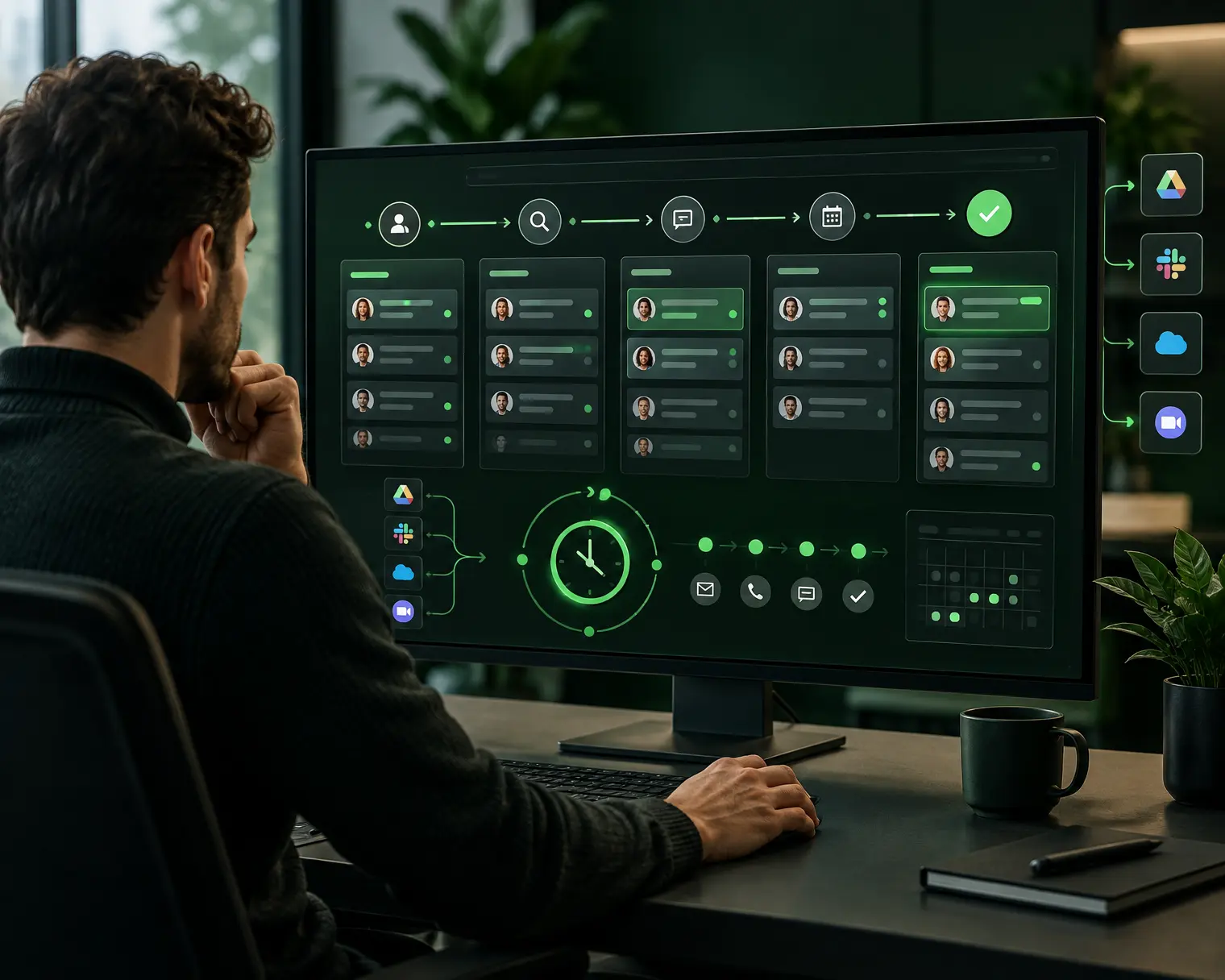
Step 2: auto sequence trigger
When score exceeds threshold, automatic CRM task creation « call within 24h » assigned to territory SDR. Zapier, HubSpot Workflows, Salesforce Process Builder handle this trigger.
Step 3: hyper-personalized first email
The first email mentions the signal in the opening: > « I saw that [Company] has been actively hiring in marketing these last 30 days — I imagine this comes with scaling challenges. We support [X similar companies] on exactly this phase. Quick 15 min chat this week? »
This hyper-personalization multiplies response rate by 3-4x vs generic cold email.
Step 4: measurement
Track in CRM: response rate « intent scored » accounts vs « cold ICP » accounts. The delta validates (or not) the ROI of intent data.
5. 5 market tools
Positioning (no pricing mentioned).
Bombora
Historical, third-party reference. Strong on US volume and coverage.
6sense
ABM platform combining intent + predictive + orchestration. Enterprise cost, long sales cycle.
Demandbase
6sense competitor, similar in all-in-one ABM positioning.
G2 Buyer Intent
G2 marketplace signals. Useful if your category is present on G2 (SaaS notably).
Zeliq
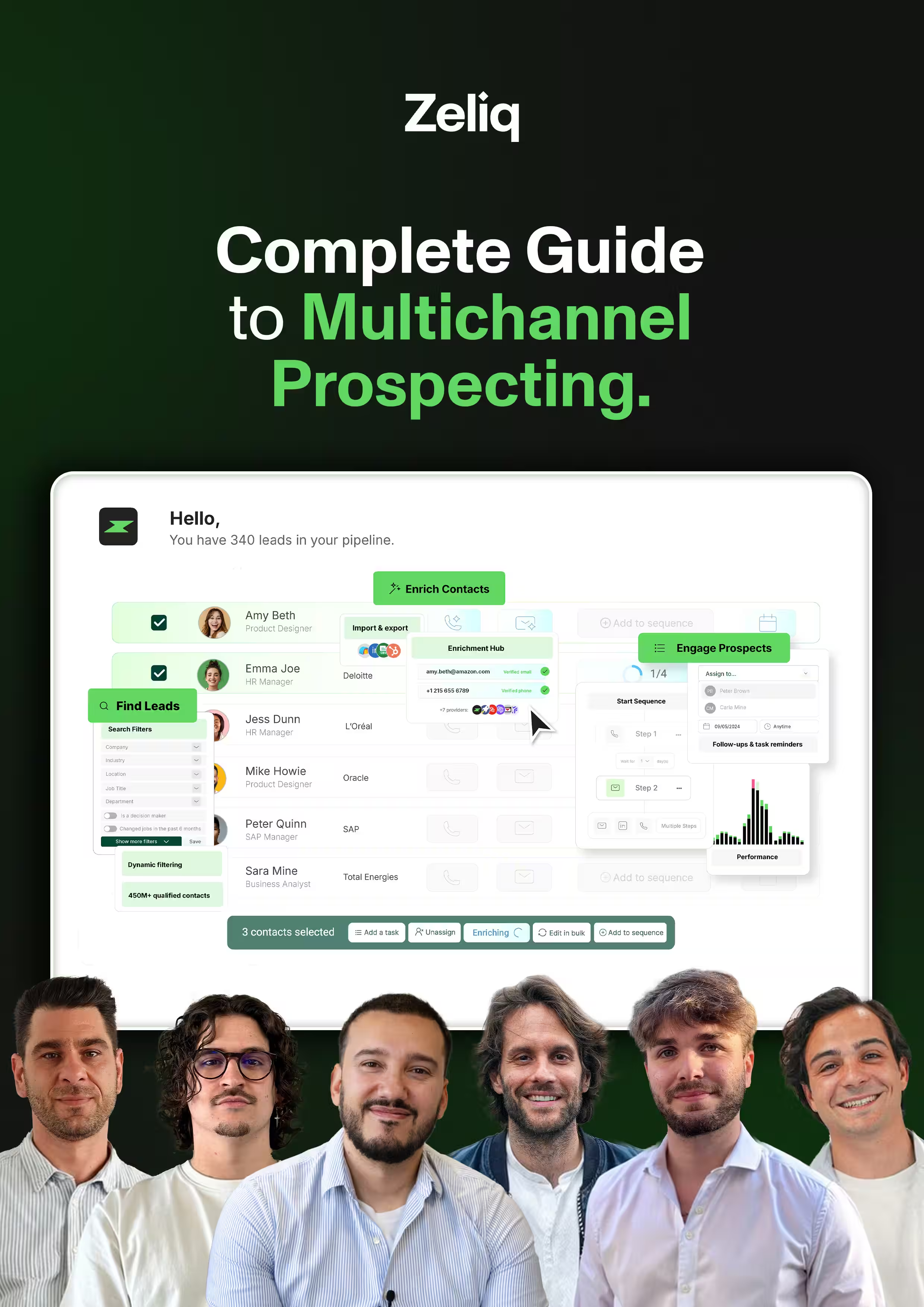
450 million B2B contact base with integrated buying signals (hiring, funding, technographic), waterfall enrichment and multichannel sequences. Positioned for European SDR teams seeking contextual intent + sourcing + outreach in a unified interface.
Choice grid
- Enterprise ABM volume + significant budget → 6sense or Demandbase
- Pure third-party, complement to existing stack → Bombora
- SaaS with G2 presence → G2 Buyer Intent
- All-in-one European SDRs → Zeliq
6. Individual buying signals vs account signals
Account signals
Bear on the entire company: « XYZ company has a Bombora spike on CRM category ». Doesn’t specify which decision-maker.
Usage: list accounts to prioritize, then identify the 5-10 decision-makers to contact in each.
Individual signals
Bear on a specific person: « Marie Dupont visited our pricing page 3 times ». Ultra-qualified.
Usage: direct trigger of sales sequence on Marie.
Combine both
Best-in-class: account signal (identifies hot account) + individual signal (identifies right contact). This combination multiplies booked meeting rate by 4-6x vs cold ICP.
7. The false positive pitfall
Intent data generates false positives that waste SDR time:
- Researcher / student / journalist: consults content out of curiosity, without buying intent
- Competitor: visits your site to benchmark
- Junior employee: reads without decision power
- Old signal: research took place 45 days ago, decision already made
Filters to apply:
- Only trigger if signal + ICP fit (decision function)
- Ignore signals > 30 days
- Cross with multiple signals (2-3 minimum) before trigger
- Purge identified false positives from scoring (SDR feedback loop)
Zeliq and integrated B2B buying signals
Zeliq combines a 450 million B2B contact database, waterfall enrichment, contextual signals (hiring, funding, technographic), integrated email verification, and multichannel sequences. Signal + contact + outreach in a single interface for European SDR teams.
8. Use case: convert a Bombora spike into a meeting
Typical activation sequence:
- Signal received: ABC account declares a « surge » level Bombora spike on category « marketing attribution ».
- Immediate enrichment: identify CMO, VP Marketing, Head of Growth at ABC (3-5 decision-makers).
- Cross-signal verification: ABC recently hired a CRO (LinkedIn) + increasing organic traffic (SimilarWeb). Confluence of 3 signals = highly prioritized account.
- Sequence trigger within 24h:
- Day 0: personalized email mentioning the context (hiring + growth)
- Day 2: LinkedIn InMail to CRO
- Day 4: call referring to the email
- Day 6: bump email with useful resource (specific Zeliq article)
- Day 10: last closure email
Typical booked meeting rate on this sequence: 12-20% vs 2-4% on pure cold.
9. Frequently asked questions
What is the action window for an intent data signal?
24 to 72 hours typically, up to 30 days maximum for structural signals like a funding round. Behavioral signals (site visits, downloads, Bombora spikes) degrade very fast: a company in active research phase typically converts within 30-90 days. Past 30 days, either the decision is made (often with a competitor), or the project is postponed. Optimal action window is thus the 24-72 hours following the signal. Bombora and 6sense diffuse signals daily; serious tools push signal via push notification or CRM integration in < 1 hour. Structural signals (funding round, CFO appointment) have a longer window: an announced round typically triggers 6-12 months of investments in tool stack, a new CFO appointment 3-6 months of financial rationalization. Best practice: two distinct sequences, a « fast track » 24-72h for behavioral signals and a « nurture » 15-30 days for structural signals, with messages adapted to timing.
How much does an intent data solution cost for a B2B SDR team?
From free (first-party via Google Analytics + reverse IP) to $30,000-80,000/year for an enterprise third-party platform like 6sense or Bombora Enterprise. Price palette by category: (1) First-party only (Google Analytics + Leadfeeder or Albacross for reverse IP): $0 to $500/month — most profitable to start, particularly if organic traffic > 5000 visits/month; (2) LinkedIn Sales Navigator + Sales Insights: $100-200/month per SDR, native LinkedIn signals; (3) G2 Buyer Intent: $15,000-30,000/year, qualified signals on SaaS; (4) Bombora alone: $20,000-60,000/year depending on volume; (5) 6sense or Demandbase all-in-one ABM: $40,000-80,000/year; (6) Zeliq or European equivalent: positioned SMB/mid-market, contextual signals included in global pricing. Positive ROI as soon as the solution generates 2-3 additional meetings/month per SDR: on an average ACV $15,000 and 20% closing rate, each bonus meeting = $3,000 of attributable pipeline. A 5 SDR team with 10 additional meetings/month = $150,000 additional pipeline, largely above the cost of a $30-50k/year solution.
Is third-party intent data GDPR compliant?
Third-party signals aggregated at company level (account-level) are generally GDPR compliant because anonymized; individual signals (person-level) require clear legal basis from vendor. Bombora, 6sense, and most third-party aggregators function primarily at account level: they detect that a company (via corporate IP or technical detection) is actively researching a category, without identifying the precise individual. This account-level aggregation doesn’t involve identifiable personal data → GDPR compliant without individual consent. Person-level signals (« Marie Dupont visited X pages ») are more sensitive: the vendor must have obtained consent of the person or have a valid legitimate interest legal basis. For Europe, prefer vendors with explicit GDPR compliance certification and active suppression list policy. First-party (your own cookies): GDPR compliant if your cookie banner collects appropriate consent. Prohibited without consent: cross-site tracking without opt-in, buying « warm leads » databases scraped without legal basis. Consult your DPO before activating person-level signals in Europe, notably for EU campaigns.
10. Conclusion: 3 actions to run
Activate free first-party signals within 7 days. Google Analytics + reverse IP tool (Leadfeeder, Albacross) to identify companies visiting your site. Immediate ROI without tool investment.
Select a third-party tool within 15 days based on your stack. SaaS with G2 category → G2 Buyer Intent; enterprise ABM → 6sense or Bombora; European SDRs → Zeliq.
Integrate signals into CRM scoring within 30 days. Threshold, auto sequence trigger, SDR feedback loop to purge false positives. Measure conversion uplift monthly.
Prospect only hot accounts with integrated buying signals
Zeliq combines 450 million B2B contacts, contextual signals (hiring, funding, technographic), waterfall enrichment and multichannel sequences in a European GDPR by design interface. Account created in 2 minutes.
Try for freeAnd if you want to concentrate your SDR efforts on hot accounts with integrated buying signals, try Zeliq for free: signals, sourcing, and sequences in one interface, no credit card required.