

Free lead lists are B2B contact databases available without paid subscription, public directories, LinkedIn Sales Navigator free tier, Chambers of Commerce, industry associations, LinkedIn Groups, downloadable Excel from partner sites, product review platforms, and government datasets. They cover 8 main sources, each with different volume and quality trade-offs. In practice, free lists deliver a 40-60% valid-email match rate versus 85-95% for paid enrichment, and require 3-5x more manual verification time. Unlike broader B2B contact data guides covering enrichment strategies, this article focuses specifically on where to find free leads today and how to use them without wasting SDR hours. Below: the 8 sources, exact use cases, hidden costs of « free », legality/GDPR considerations, and 3 FAQ.
For an SDR, founder, growth marketer or Head of Sales starting with a limited budget, this article covers where to find free B2B leads and the realistic quality you can expect.
On the agenda:
- What a « free lead list » really is
- 8 free sources to build a B2B list (LinkedIn free tier, directories, associations, etc.)
- The hidden costs of free (time, quality, bounce rate)
- Free-list workflow: sourcing → verification → enrichment
- Legality and GDPR/CCPA constraints
- When free suffices vs when to switch to paid
- Realistic conversion benchmarks
- 3 FAQ (bounce rate, GDPR risk, ROI at scale)
Key takeaways:
- 8 primary free sources: LinkedIn free tier, Chambers of Commerce, industry associations, Crunchbase free tier, Google Maps, government datasets (SEC EDGAR, Companies House), Product Hunt, and free trials of paid tools
- Realistic match rate: 40-60% valid emails on free lists vs 85-95% on paid enrichment
- Time cost: 30-45 seconds per lead manually vs 1-2 seconds with automated enrichment
- Bounce rate: 15-30% on unverified free lists vs 1-3% after SMTP verification
- Legal: US CAN-SPAM permits B2B cold email with opt-out; EU GDPR requires legitimate interest documentation
- Rule of thumb: free is viable up to ~200 leads/month; beyond, paid pays for itself
1. What a « free lead list » really is
A « free lead list » is a set of B2B contact records, company name, contact person, title, email, phone, obtained without a paid database subscription. Sources vary widely: some are ethically fine (published business directories, opt-in association member lists), others are grey area (scraped LinkedIn data, forum-shared Excel spreadsheets), and some are outright non-compliant (bulk email lists sold on shady marketplaces).
The « free » label hides three real costs: time spent sourcing, quality gaps (missing fields, outdated data), and compliance risk. Understanding these trade-offs is the entire point of this article.
Free is a budget label, not a quality label
A lead list is called « free » because you pay $0 to obtain it, not because it produces the same commercial outcome as a paid enriched list. Expect 40-60% valid emails, 20-40% correct phone numbers, and 30-50% still-employed titles on any free source older than 6 months.
The three tiers of free sources
- Tier A, legitimate free: government datasets (Companies House UK, SEC EDGAR US, INSEE FR), association member directories, LinkedIn free tier
- Tier B, grey area free: LinkedIn Groups scraping, Crunchbase free tier hitting rate limits, Google Maps for local B2B
- Tier C, non-compliant free: bulk lists sold on Fiverr, dark forum leaked databases, unverified scraped email dumps
This article focuses on Tier A and B only. Tier C is not recommended: legal exposure, hard deliverability damage, and low match rates.
2. Source 1: LinkedIn free tier
LinkedIn’s free account allows advanced people search: filter by industry, location, function, and current company. Sales Navigator paid extends filters but the free tier already delivers usable B2B lists for narrow queries.
How to build a list: search by job title + industry + geography, save each promising profile, export via manual copy or free Chrome extensions (Findymail, Snov.io free tier, Hunter free tier). Expect 100-300 profiles/hour manually, or 500-1000/hour with a free Chrome extension.
Limits: LinkedIn caps searches per week on free tier (roughly 100 profiles view/week before commercial-use warnings). Beyond that, upgrade to Sales Navigator or accept manual pace.
Data available for free: name, title, company, LinkedIn URL. Email and phone are not shown, you’ll need external enrichment (see section 4).
3. Source 2: Chambers of Commerce and business directories
Local Chambers of Commerce publish member directories with company name, address, sector, and often a contact person. In the US, the US Chamber of Commerce and state-level chambers (Texas Association of Business, California Chamber) list thousands of member companies. In the UK, the British Chambers of Commerce covers 53 regional bodies.
Use case: local B2B sales (SMB, professional services, regional industrial). Not useful for enterprise SaaS targeting Fortune 500.
Realistic volume: 500-5,000 member companies per regional chamber. Email addresses provided in 30-50% of cases.
4. Source 3: Industry associations
Professional associations publish member directories: American Marketing Association (AMA), National Restaurant Association, Society for Human Resource Management (SHRM), Association of National Advertisers. These are gold sources when your ICP maps to a professional community.
Access: some directories are members-only (join for $100-500/year), others are public. Even members-only ones sometimes publish an « attendee list » for annual conferences that circulates freely.
Quality: high, members are actively engaged professionals with correct titles and typically opt-in to being contacted for relevant business offers.
5. Source 4: Crunchbase free tier
Crunchbase’s free tier gives basic company info (name, description, sector, HQ location, funding rounds) but no contact person emails without Pro subscription. Still useful to build a target-account list before cold outreach.
Use case: identifying 100-500 target accounts in a category (« Series B SaaS in fintech, US-based ») then sourcing decision-makers separately via LinkedIn.
Limits: free tier caps at ~25 records per search view. Beyond that, either upgrade or use scripted exports (grey area).
6. Source 5: Google Maps for local B2B
Google Maps holds business listings with name, address, phone, category, and sometimes email. For local B2B (agencies, consultants, retail chains, restaurants, gyms, dental offices), it’s an underrated goldmine.
How to extract: Google Maps interface manually, or free scrapers like Instant Data Scraper (Chrome extension). Expect 200-500 businesses per hour.
Data quality: name, phone, address usually 90%+ accurate. Email rarely published. Requires waterfall email enrichment after (see section 9).
7. Source 6: Government datasets
US SEC EDGAR: all public-company filings, useful for extracting CFO, CEO, board members. Companies House UK: 4M+ registered UK companies with director names, addresses. INSEE / SIRENE FR: 30M+ French companies with SIRET codes.
Use case: enterprise-focused sales (Fortune 500, FTSE 350) where regulatory filings identify key executives by name and role.
Quality: 95%+ accurate on names, roles, company legal info. Personal contact (email, phone) requires separate sourcing.
8. Source 7: Product Hunt and startup lists
Product Hunt lists thousands of newly launched SaaS products with founder profiles. Perfect for sourcing founders as ICP (« CEO of pre-Series A SaaS startups »).
Similar sources: AngelList Talent, YC Startup Directory, Techstars Portfolio, F6S. Each publishes founder/company data at various depths.
Use case: targeting founder-CEO of early-stage startups (typical ICP for HR SaaS, developer tools, sales tools).
9. Source 8: Free trials of paid tools
Every major B2B database offers a free trial: ZoomInfo Community (limited), Apollo.io free tier (50 credits/month), Lusha free (5 credits/month), Cognism free trial (7-14 days).
Tactic: use free trials to extract 50-200 verified leads/month, cycled across 3-4 tools. Not scalable long-term but great for kickstarting a first campaign.
Risk: some vendors flag trial-cycling accounts. Use different work emails, and don’t chain more than 3-4 trials per calendar year.
10. The free-list workflow
Free sources produce raw data. To turn a raw list into a workable outbound campaign, follow this workflow:
- Source (from any of the 8 above): 500-2,000 leads with company name, contact name, title, LinkedIn URL
- Enrich emails: use free tier of Hunter, Snov.io, or Findymail for pattern matching (
firstname.lastname@company.com) - Verify SMTP: MillionVerifier free trial (250 checks), NeverBounce free tier (100 checks), or ZeroBounce free (100 checks) to filter invalid addresses
- Segment: by persona, industry, size, remove out-of-ICP leads
- Sequence: send in a multichannel sequence via free tier of Instantly (14 days), Zeliq trial, or manual Gmail (with strict volume limits to protect deliverability)
Realistic yield: 1,000 raw leads → 500 verified emails → 300 in-ICP → 15-25 replies → 5-8 booked meetings. Total time cost: 15-25 SDR hours across sourcing + enrichment + verification.
Zeliq and integrated free-to-paid transition
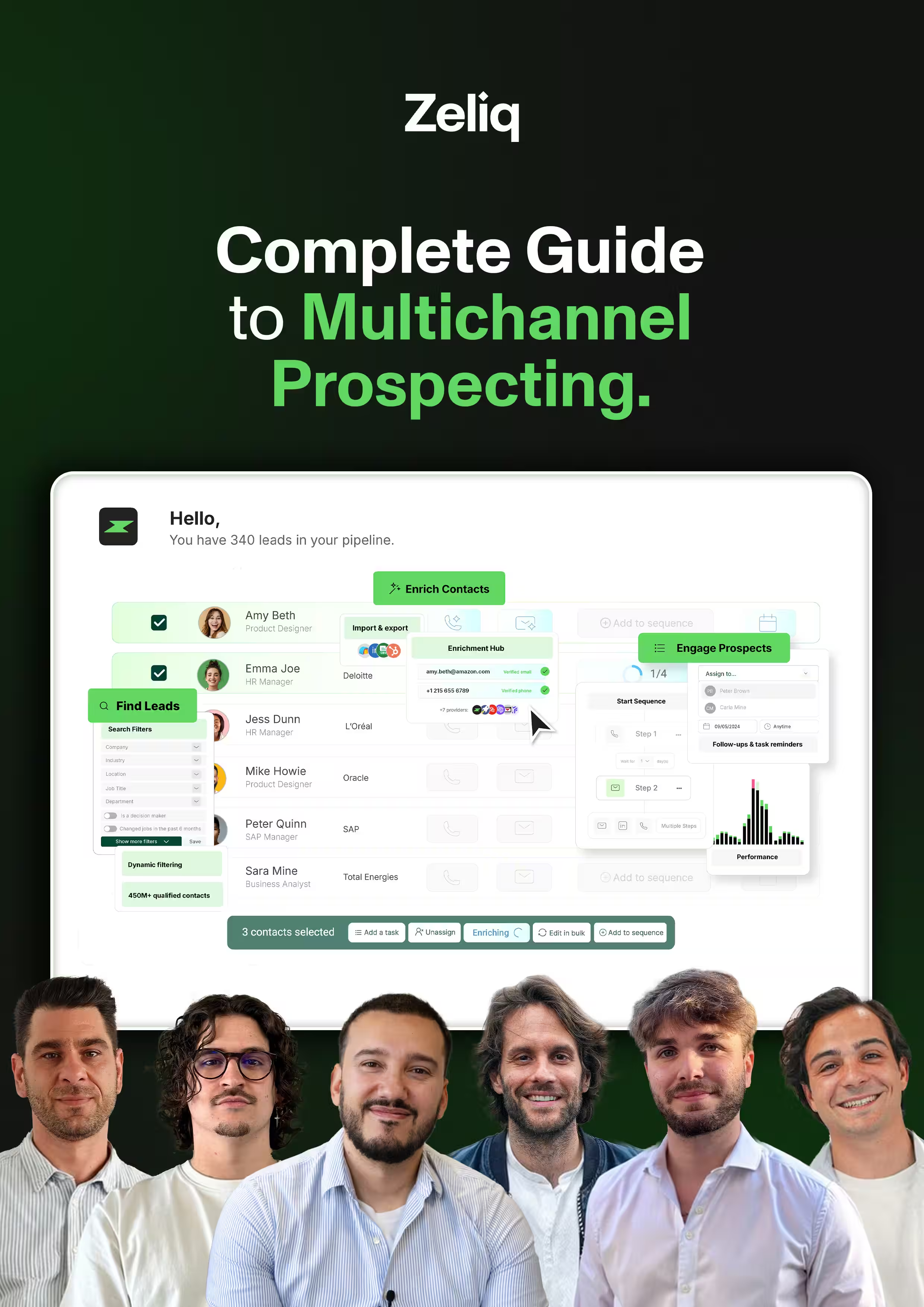
Zeliq offers a free account with limited credits to test the platform on a real campaign, combining a 450 million B2B contact database, waterfall enrichment, integrated email verification, and multichannel sequences. Free-tier credits let you enrich 20-50 leads to validate the workflow before deciding to scale.
11. Hidden costs of free
Cost 1: SDR time
30-45 seconds per lead manually vs 1-2 seconds with automated enrichment. For 1,000 leads: 8-12 hours manual vs 15-30 minutes automated. At $60,000 fully-loaded SDR salary, manual sourcing costs $290-430 per 1,000 leads.
Cost 2: Bounce rate
Free unverified emails bounce at 15-30% vs 1-3% on paid + verified. High bounce = mailbox reputation damage = future campaigns land in spam. The invisible cost of one bad campaign can dwarf months of paid tool savings.
Cost 3: Data staleness
Free lists (association directories, downloadable Excels, government filings) refresh every 6-12 months. Paid enrichment refreshes weekly. Difference: 20-30% of your free leads have moved companies or changed roles by the time you contact them.
Cost 4: Compliance risk
Free scraped lists rarely have documented suppression logic. In Europe, receiving a CNIL complaint on unopted-in contacts can result in significant fines: CNIL 2025 sanctions reached €486 million total, with individual B2B email cases including SOLOCAL Marketing Services at €900,000 for prospecting emails sent without sufficient legal basis. Paid GDPR-compliant vendors carry that risk on your behalf.
12. Legality: CAN-SPAM, GDPR, CCPA
US: CAN-SPAM (2003, updated periodically)
Permits B2B cold email without prior consent if: (1) subject line and headers accurate, (2) valid physical postal address in signature, (3) functional opt-out link, (4) honor opt-out within 10 business days. Full requirements in the FTC CAN-SPAM Act Compliance Guide for Business.
EU: GDPR (2018)
B2B cold email uses « legitimate interest » legal basis. Requires: (1) documented interest justification, (2) opt-out on every email, (3) respect suppression list of people who exercised their opposition right, (4) 3-year post-last-contact retention limit.
California: CCPA / CPRA
Similar to GDPR for California residents: right to know, delete, opt-out. B2B professional contacts have a partial exemption but campaigns targeting California should still include CCPA disclosures.
Free-list caveat
Free sources rarely include documented consent trails. If you build a free list from Chambers of Commerce, the members opted-in to be listed in the directory but not necessarily to receive your cold email. This grey area is a real legal exposure, proceed with clear opt-out, low volume, and personalized content that a court could construe as legitimate B2B outreach rather than mass marketing spam.
13. When free is enough vs when to switch
Free is viable when: solo founder or first SDR, < 200 outbound contacts/month, testing new market or ICP hypothesis, budget < $200/month, non-critical use case (research, one-off partnership outreach).
Switch to paid when: > 200 contacts/month, dedicated SDR full-time on outbound, campaigns generating revenue tied to deliverability, need for waterfall enrichment (85%+ match rate), need for GDPR-compliant sourcing documentation.
The switch cost is real: even mid-tier paid tools run $200-500/month. But at 500+ contacts/month, the manual time saved alone justifies the spend within 30 days.
14. Frequently asked questions
What bounce rate should I expect on a free lead list?
15-30% on raw unverified free lists, dropping to 3-5% after SMTP verification, and 1-3% after cross-vendor waterfall enrichment plus verification. A raw list scraped from LinkedIn or a Chamber of Commerce contains a mix of: (1) still-valid emails (60-70%), (2) role changes where the email routes to a different person (10-15%), (3) format-guess errors like john.smith@company.com when the real pattern is jsmith@company.com (10-15%), (4) invalid or catch-all domains (5-10%). Sending unverified means Gmail and Outlook see 15-30% hard bounces, which triggers reputation scoring drops and lands 2-3 weeks of future emails in spam. SMTP verification (via free tools like NeverBounce free tier, MillionVerifier trial, or ZeroBounce free credits) tests each address by pinging the mail server without actually sending; it filters obvious bounces down to 3-5%. Adding waterfall enrichment (Hunter → Snov.io → paid fallback) recovers the format-guess errors by cross-checking multiple pattern databases, dropping bounce to 1-3%. Rule of thumb: never send an outbound campaign above 500 recipients without at least the SMTP verification pass, even one bad batch can cost 4-8 weeks of deliverability recovery.
What GDPR risk do I take with a free lead list in Europe?
Real but manageable if you document legitimate interest, provide opt-out, and respect suppression requests within 30 days, the risk grows with volume and untargeted content. GDPR does not ban cold B2B email but requires (Article 6-1-f) that your « legitimate interest » outweighs the recipient’s privacy interest, judged case-by-case by the CNIL or equivalent regulator. A free list becomes risky in three scenarios: (1) mass generic campaigns without personalization suggest the interest is your commercial gain not a legitimate B2B connection, (2) failure to honor opt-out requests within 30 days is an automatic violation, (3) using non-B2B emails like personal Gmails contacted from a scraped list is a clear breach. CNIL fines for B2B cold email violations in 2024-2025 ranged from €20k for small businesses to €800k for repeated violators. Mitigation: (a) target only work emails (@company.com, not @gmail.com), (b) personalize each email so a regulator sees it as tailored B2B outreach, (c) send from a dedicated subdomain with functional unsubscribe, (d) maintain a suppression list you actually check before every send, (e) keep documented records of why each contact fits your legitimate interest (« VP Sales at SaaS company matches our ICP for sales tool »). Under those conditions, GDPR risk on free B2B lists is materially lower than the reputational risk of high bounce rates.
At what volume does a paid tool pay for itself vs free sources?
Around 200-300 unique contacts sourced per month, the paid tool time savings alone amortize the cost, above 500/month, the ROI on paid becomes overwhelming. Sourcing math: manual free workflow takes 30-45 seconds per verified enriched contact including LinkedIn scan, pattern email generation, SMTP verification, and CRM entry. At 40 sec × 200 contacts = 2.2 hours/month; × 500 = 5.6 hours; × 1000 = 11 hours. Fully-loaded SDR cost $60,000/year = $30/hour effective. So free-list sourcing labor: 200 contacts = $66/month, 500 = $168, 1000 = $335. A paid tool at $200-500/month sits below the labor cost as soon as you cross 500 contacts. Add the invisible costs (bounce recovery, staleness re-sourcing, compliance risk documentation) and the tipping point drops to 200-300 contacts. Above 1,000/month, no serious SDR team runs on free, the paid ROI is not just cost-competitive but revenue-generative (better match rate = more meetings = more pipeline). Free’s role at scale becomes: kickstart new categories or one-off partnership research, never the primary sourcing engine.
15. Conclusion: 3 actions to run
Test 2-3 free sources within 7 days. Pick one LinkedIn free-tier list + one directory (Chamber or association) that matches your ICP. Build a 100-lead sample. Measure sourcing time.
Layer free SMTP verification within 15 days. NeverBounce free tier + MillionVerifier trial cover 350 checks combined. Filter your 100-lead sample and log the bounce rate delta.
Compare paid enrichment ROI within 30 days. Use a free trial (Zeliq, Apollo, Lusha) on the same 100 leads. Measure match-rate delta, time saved, and quality delta before committing to a paid subscription.
Skip the free-list grind, start with 50 free verified leads
Zeliq combines 450 million B2B contacts, waterfall enrichment with integrated email verification, and multichannel sequences. Free account, credits included to test on your ICP. No credit card required.
Try for freeAnd if you want verified B2B leads without stitching 8 free sources together, try Zeliq for free: sourcing, enrichment, and multichannel sequences in one interface, no credit card required.