

B2B prospecting tools are software applications that help sales teams find, enrich, engage, and convert business prospects, typically organized as a stack of six layers: sourcing, enrichment, verification, sequencing, dialing, and CRM sync. In 2026, a professional-grade B2B prospecting stack runs $370-720 per SDR per month at mid-market vendor pricing, or $200-400 per SDR with all-in-one consolidation, per aggregated benchmarks across the top-10 SERP. This article maps the 6 stack layers, the recommended build order, cost benchmarks by team size, compliance guardrails, and 3 FAQ.
For a Head of Sales, RevOps engineer, growth manager, or founder assembling a B2B prospecting stack from scratch or auditing an existing one, this article gives the layer map, the build sequence, and the numbers.
On the agenda:
- What B2B prospecting tools do (6-layer stack model)
- The recommended build order (which layer first)
- Sourcing layer: databases and LinkedIn
- Enrichment layer: waterfall vs single-vendor
- Verification layer: SMTP + suppression
- Sequencing layer: multichannel
- Dialing layer: parallel and power dialers
- CRM sync layer: bidirectional
- Cost by team size (1 SDR to 20 SDRs)
- Compliance: CAN-SPAM + GDPR + LinkedIn ToS
- 3 FAQ (build order, cost per SDR, all-in-one vs best-of-breed)
Key takeaways:
- 6 stack layers: sourcing, enrichment, verification, sequencing, dialing, CRM sync
- Build order (cheapest → hardest gap first): CRM → sourcing → enrichment → verification → sequencing → dialing
- Cost per SDR: $370-720/month mid-market stitched stack, $200-400/month all-in-one
- Team scaling: costs compound linearly per seat; consolidate above 5 SDRs
- Compliance: FTC CAN-SPAM + GDPR (CNIL enforcement €486M in 2025) + LinkedIn ToS
- All-in-one break-even: consolidation typically saves 30-40% on tool budget above 3-5 SDRs
- Time saved: 30-45 sec per contact manually vs 1-2 sec automated, freeing 15-25 hours/SDR/month
1. What B2B prospecting tools do (6-layer stack model)
Modern B2B prospecting is not one tool but a stack. Each layer solves a distinct problem the previous one leaves open.
Layer 1, Sourcing: identify prospects matching an Ideal Customer Profile. Databases like ZoomInfo (420M+ contacts per vendor claim), Apollo (275M+ contacts per vendor claim), Cognism (EMEA-strong, phone-verified) provide raw searchable contacts. LinkedIn Sales Navigator provides graph-based sourcing that databases cannot match.
Layer 2, Enrichment: fill in missing fields (verified email, direct phone, title, seniority, tech stack, buying signals). Single-vendor enrichment reaches 55-70% match rate; waterfall enrichment across 3-4 vendors reaches 85-95%. See the B2B contact data deep dive.
Layer 3, Verification: SMTP-verify each email before send. Reduces bounce from 15-30% (raw) to 1-3% (verified). Protects sending domain reputation.
Layer 4, Sequencing: multichannel outbound (email + LinkedIn + phone) with delayed follow-ups. See multichannel prospecting guide.
Layer 5, Dialing: parallel dialers or power dialers accelerate SDR calling productivity 3-5×.
Layer 6, CRM sync: bidirectional sync between the prospecting stack and HubSpot CRM, Salesforce, or Pipedrive. Sequence events, replies, and outcomes land where sales reporting reads.
2. The recommended build order
The instinct is to buy the sourcing tool first (“we need a database!”). The higher-ROI sequence starts with the CRM and works outward:
Priority 1, CRM: without a CRM as system of record, every downstream layer generates data with no home. HubSpot CRM Free, Salesforce Essentials, or Pipedrive Starter cost $0-30/seat/month and unblock everything downstream.
Priority 2, Sourcing (database + LinkedIn Sales Nav): define who to target. Sales Nav’s graph search + one database subscription (Apollo, Cognism, Zeliq).
Priority 3, Enrichment: turn raw sourcing into workable data. Match rate on prospecting stack averages 60-90% depending on vendor + ICP.
Priority 4, Verification: gate the enriched output before send. Skipping this stage is the single most-common mistake, costing 2-4 weeks of degraded deliverability per bad batch.
Priority 5, Sequencing: multichannel outbound. Only add this once the previous 4 are stable, else garbage-in-garbage-out amplifies.
Priority 6, Dialing: last to add because phone volume comes late in most sequences. Add when phone-picked-up rate justifies parallel dialer efficiency.
3. Sourcing layer: databases and LinkedIn
Two distinct sourcing engines cover different use cases:
B2B databases: broad ICP search across millions of contacts with firmographic filters. Best for: US/Global enterprise sales, ABM lists, high-volume outbound. Common: ZoomInfo (US enterprise), Apollo (mid-market self-serve, free tier), Cognism (EMEA GDPR-strong), Zeliq (450M B2B contacts with waterfall enrichment built-in), Kaspr (France/Europe phones).
LinkedIn Sales Navigator: graph-based search on the LinkedIn professional network. Best for: relationship-anchored outreach, executive prospecting, niche ICP where firmographic data is not enough. Sales Navigator Core at $99.99/seat/month, Advanced at $169/seat/month per LinkedIn public pricing verified September 2026.
Combining both is common: databases source at scale, Sales Nav validates and finds high-value connections.
4. Enrichment layer: waterfall vs single-vendor
Enrichment turns raw contact rows into workable records with verified email, phone, title, and firmographic detail.
Single-vendor enrichment: 55-70% match rate typical. Simpler to integrate. Best for: teams doing < 5,000 enrichments/month or vendor perfectly aligned with ICP geography.
Waterfall enrichment: chain 3-4 vendors so a miss on vendor A cascades to B, then C. Aggregate match rate 85-95%. Cost 1.3-1.8× per matched contact but delivers 30-40 percentage points more coverage. Best for: teams doing > 5,000 enrichments/month or ICP spanning multiple geographies.
DIY waterfall build: 2-3 weeks engineering to orchestrate 3-4 vendor APIs. Waterfall-native platforms (Zeliq and similar) provide it as a single-endpoint service in 3-5 days integration.
5. Verification layer: SMTP + suppression
Verification is the layer most teams skip and later regret. Two sub-steps:
SMTP verification: each email pinged against the destination mail server without actual send. Filters catch-all domains, disposable addresses, and hard-bounce candidates. Reduces bounce from 15-30% (raw) to 3-5% (verified).
Suppression list check: cross-reference each contact against opt-out lists (yours and the vendor’s). Prevents sending to contacts who exercised their GDPR opposition right or CAN-SPAM opt-out.
Both together cut bounce to 1-3% and prevent regulatory exposure. Skipping verification is the single most common cause of degraded sending reputation.
6. Sequencing layer: multichannel
LinkedIn-only outreach converts at 1-3% reply rate. Adding email and phone escalation lifts to 5-15% depending on ICP and personalization.
Typical 10-day multichannel sequence: - Day 0: LinkedIn connect request - Day 3: Email if connection accepted - Day 6: LinkedIn DM if no email reply - Day 8: Phone call - Day 10: Breakup email
Sequence copywriting matters more than tool choice. See improve email open rates for the copy layer.
7. Dialing layer: parallel and power dialers
Two dialer patterns dominate:
Power dialer: sequential dialing with 1-3 second gap between calls. Increases SDR calls-per-hour from 15-25 to 40-60.
Parallel dialer: dial 3-6 numbers simultaneously, connect the first to answer. Increases calls-per-hour to 80-150. Compliance-sensitive (must handle TCPA and consent).
Both integrate with CRMs and log call outcomes automatically. Best for teams where phone is a primary channel (SDR calling into US mid-market or enterprise).
8. CRM sync layer: bidirectional
The end state of every prospecting cycle is a CRM record with enriched fields, sequence status, and outcomes. Bidirectional sync means:
- Prospecting tool pushes enriched contacts and sequence events into the CRM
- CRM changes (deal stage, opportunity status) sync back to the prospecting tool
Native CRM integrations of major prospecting tools cover HubSpot CRM, Salesforce, and Pipedrive. Zapier or n8n bridges fill gaps for niche CRMs.
Zeliq and the 6-layer prospecting stack
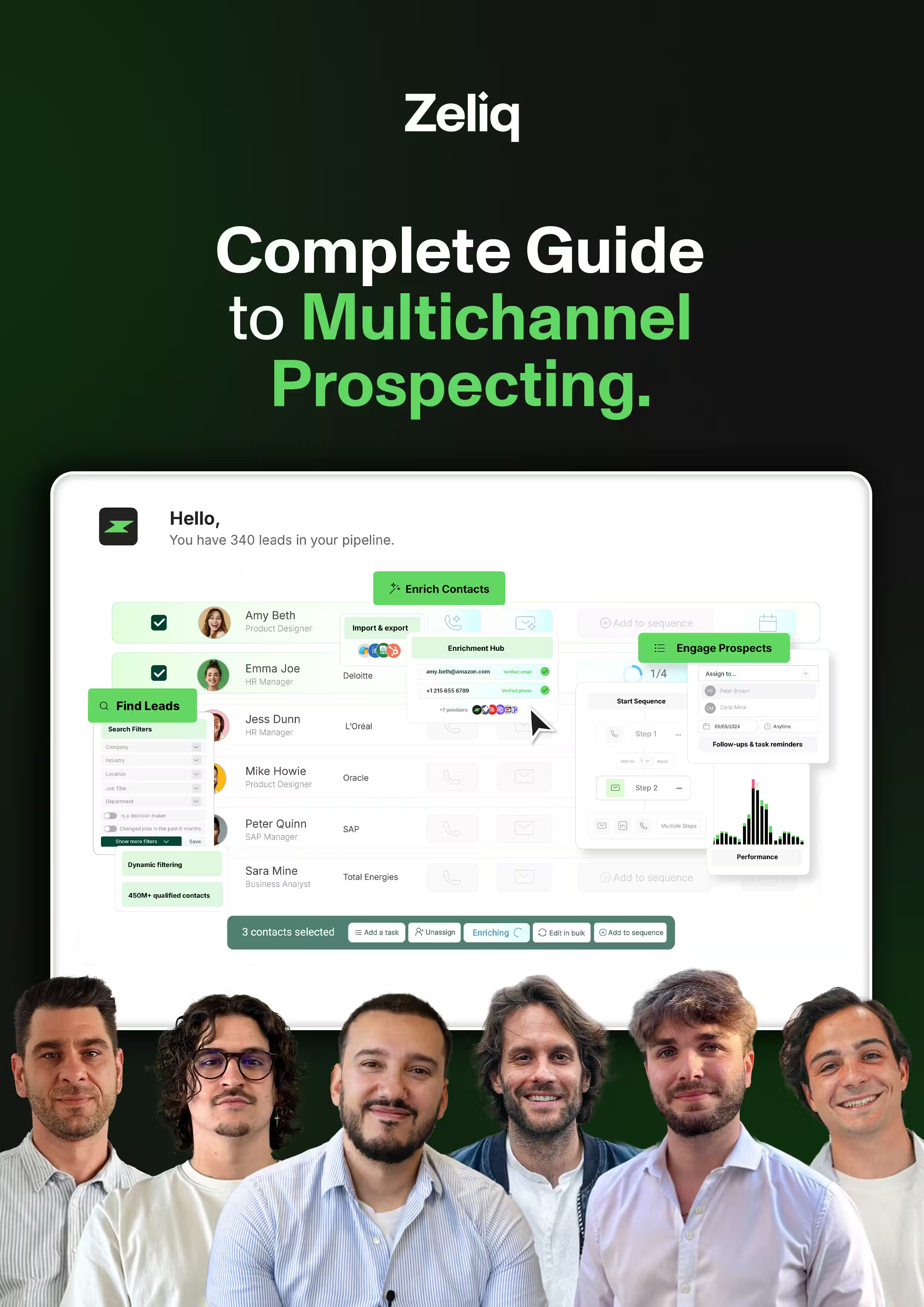
Zeliq combines the sourcing, enrichment, verification, and sequencing layers in a single interface: 450 million B2B contact database, waterfall enrichment across multiple sources with integrated verification, and multichannel sequences. One tool replaces 3-4 subscription layers, cutting stack cost 30-40% and integration debug hours. GDPR-native suppression list.
9. Cost by team size
Concrete math per SDR per month, mid-market vendor pricing:
Stitched stack (best-of-breed): - CRM seat: $50-150 - Sales Navigator Advanced: $169 - Database + enrichment: $200-400 - Verification: $0-50 (often bundled) - Sequencer: $100-200 - Dialer: $30-80 - Total per SDR: $549-1,049/month
All-in-one consolidated: - CRM seat: $50-150 - All-in-one prospecting platform (Zeliq, Apollo enterprise, or similar): $150-400 - Dialer: $30-80 - Total per SDR: $230-630/month
Team scaling (5 SDRs): stitched $2,745-$5,245/month vs consolidated $1,150-$3,150/month. Savings $1,595-$2,095/month.
At 10 SDRs: consolidated saves $3,000-$4,200/month. At 20 SDRs: $6,000-$8,400/month savings.
10. Compliance: CAN-SPAM, GDPR, LinkedIn ToS
US CAN-SPAM: FTC compliance guide requires accurate subject line + valid physical address in signature + functional opt-out + honor opt-out within 10 business days.
EU GDPR: legitimate interest basis + documented per ICP + opt-out + 3-year retention post-last-contact. CNIL 2025 sanctions hit €486M total, including SOLOCAL’s €900k for prospecting without sufficient legal basis.
LinkedIn Terms of Service: prohibits automated access without permission. Automation tools must operate within rate limits (~100 connection requests/week per account).
CCPA/CPRA: California disclosures for campaigns targeting California residents.
The pattern that scales: source through GDPR-compliant vendors, verify pre-send, honor opt-out within 30 days, document legitimate interest per ICP.
11. Common mistakes
Mistake 1: Skipping verification. 15-30% bounce = 2-4 weeks reputational damage. Non-negotiable layer.
Mistake 2: Building the sequencer before the database. Great copy on wrong prospects converts less than mediocre copy on right prospects.
Mistake 3: Single-vendor lock-in without evaluating alternatives. Vendors that lose data quality on your ICP can be swapped; annual lock-ins prevent this.
Mistake 4: No CRM sync. Sequence data trapped in the outreach tool = broken reporting = wrong quarterly forecasts.
Mistake 5: Aggressive LinkedIn automation. Fast wins turn into account restrictions in 30-60 days.
Mistake 6: Assuming all-in-one is always cheapest. Below 3 SDRs, stitched free tiers can beat all-in-one paid plans.
12. Frequently asked questions
What is the correct build order for a B2B prospecting stack?
CRM first, then sourcing, then enrichment, then verification, then sequencing, then dialing, in that order, because each layer depends on cleaned output from the layer above. Common failure mode: teams buy the sequencer first (“we need to send more emails!”) without a database or enrichment underneath, then automate sending to unverified data at scale, destroying deliverability in 2-3 campaigns. Correct sequence: (1) CRM as system of record ($0-150/seat) so every downstream event has a home, (2) sourcing tool to define who to target (database + Sales Nav, $200-400/seat), (3) enrichment layer to complete records (bundled or standalone, $100-300/seat), (4) verification before send (bundled or standalone, $0-50/seat), (5) sequencer for multichannel outbound ($100-200/seat), (6) dialer if phone is primary channel ($30-80/seat). Skipping backward is the pattern that produces “we bought Outreach but our list is bad” complaints. If budget is limited, get the CRM plus one all-in-one platform covering sourcing + enrichment + verification + sequencing (Zeliq, Apollo enterprise, similar), and delay the dialer until phone conversion justifies it. Consolidating layers 2-5 into one platform typically saves 30-40% on tool budget and eliminates integration debug across sourcing → sequencer → CRM path.
What is the total cost per SDR for a professional B2B prospecting stack?
$549-1,049 per SDR per month for stitched best-of-breed, dropping to $230-630 per SDR per month for all-in-one consolidation, before CRM seat and dialer. Stitched stack component costs: CRM $50-150, Sales Navigator Advanced $169, database + enrichment $200-400, verification $0-50 (usually bundled), sequencer $100-200, dialer $30-80. Total: $549-1,049/SDR/month. All-in-one platforms combining sourcing + enrichment + verification + sequencing into a single subscription typically run $150-400/seat/month; plus CRM $50-150 and dialer $30-80 gives $230-630/SDR/month. Team scaling shows the consolidation payoff: at 5 SDRs, stitched costs $2,745-$5,245/month vs consolidated $1,150-$3,150/month; savings $1,595-$2,095/month. At 10 SDRs, savings hit $3,000-$4,200/month, and at 20 SDRs $6,000-$8,400/month. Beyond direct tool cost, factor integration debug time: stitched stacks with 4-5 vendor APIs generate 5-15 hours per month of maintenance work per team, while all-in-one platforms cut that to near zero. Fully-loaded SDR hourly cost of $30-40 means integration debug is real money: 10 hours/month × $35 = $350/month/team of hidden cost. Consolidated typically wins on both direct cost and hidden integration cost above 3-5 SDRs.
All-in-one prospecting platforms vs best-of-breed stitched stack, which wins?
Best-of-breed wins below 3 SDRs where free tiers stack cheaply, all-in-one wins above 3-5 SDRs where consolidation savings compound across seats. Best-of-breed advantages: specialized vendors typically beat all-in-one on their specific layer (e.g., ZoomInfo’s US enterprise coverage > any all-in-one’s US coverage; Outreach’s sequencer > any all-in-one’s sequencer for enterprise use). Best when: team is small (<3 SDRs), each layer needs its category leader, engineering resources available for integration. All-in-one advantages: single subscription cost, single vendor relationship, single API surface for CRM sync, unified UX for SDRs (less tool switching). Best when: team is 3+ SDRs, mid-market ICP, no dedicated data engineering, speed-to-value prioritized over category-leader quality. Break-even math: all-in-one platforms save 30-40% on tool budget and 5-10 hours per SDR per month on integration. At 5 SDRs, that’s $1,500-$2,500/month tool savings + $875-$1,750/month labor savings, totaling $2,375-$4,250/month advantage for all-in-one. Below 3 SDRs, tool budget too small for savings to matter; best-of-breed with free tiers usually wins. Above 10 SDRs, all-in-one is nearly mandatory to avoid integration debug consuming a full RevOps engineer FTE.
13. Conclusion: 3 actions to run
Audit your current stack within 7 days. List each tool, seat count, cost per seat, real utilization. If more than 30% of seats are underused, consolidate.
Test one all-in-one platform’s free tier within 15 days. Zeliq, Apollo, or similar. Compare stitched-vs-consolidated on a 500-contact sample end-to-end (source → enrich → verify → sequence).
Reassess the stack within 30 days as team scales. Above 5 SDRs, consolidation typically saves 30-40% on tool budget and 5-10 hours/SDR/month on integration.
One platform for sourcing, enrichment, verification, and sequencing
Zeliq combines 450 million B2B contacts, waterfall enrichment with integrated verification, and multichannel sequences. One subscription replaces 3-4 stack layers, saving 30-40% on tool budget and 5-10 hours/SDR/month on integration debug. GDPR-native suppression included.
Try for freeAnd if you want to consolidate 4 stack layers into one interface and cut your tool budget 30-40%, try Zeliq for free: sourcing, enrichment, verification, and multichannel sequences in a single platform, no credit card required.