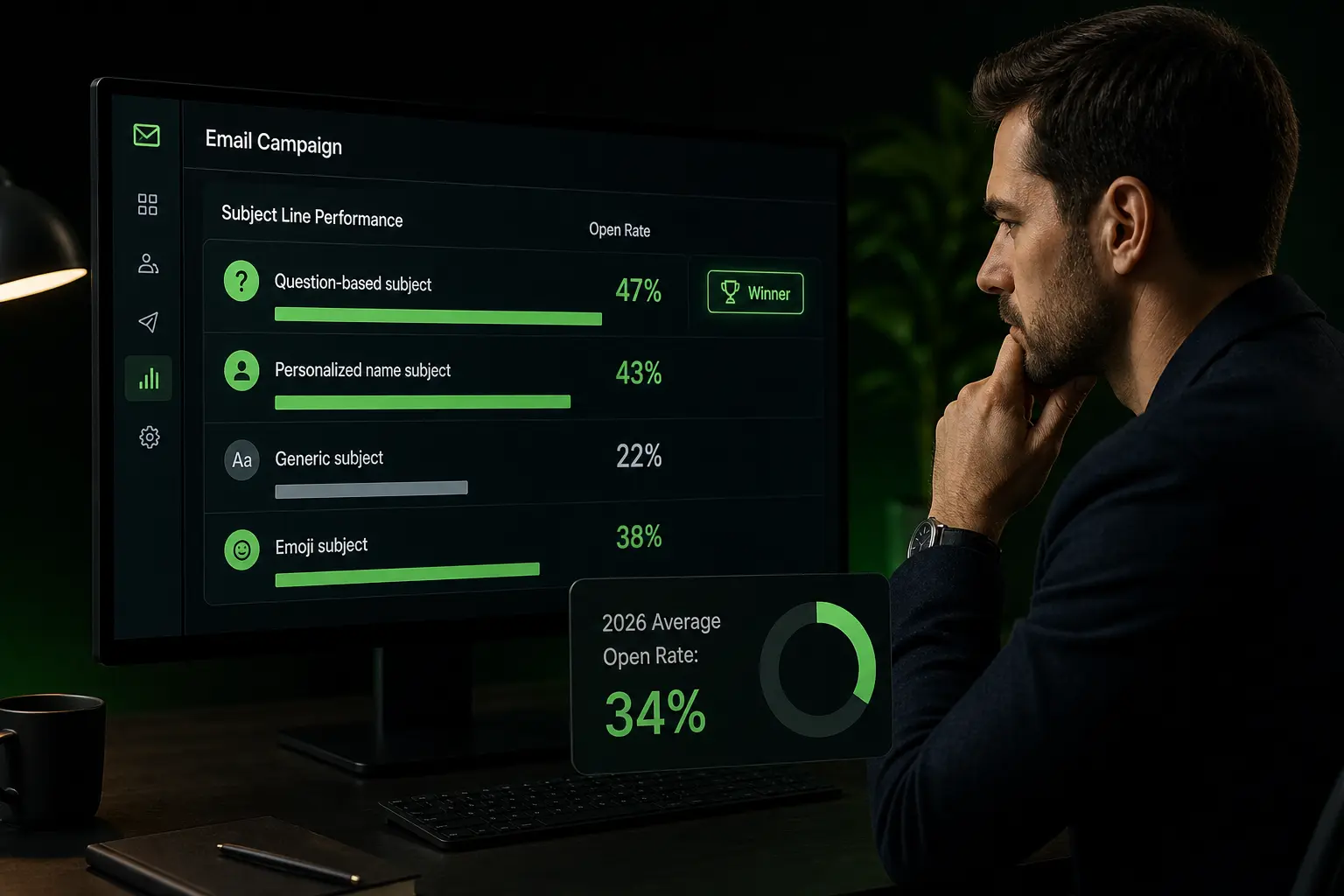

A well-written email that never gets opened is worth nothing. The subject line is the most decisive element of a send’s performance: per 2025-2026 studies of more than 5 million B2B emails, a subject line change alone can move an open rate from 20% to 50%. It is a no-cost, no-risk lever, provided you know the rules.
Yet it is also the part most often rushed at the last second, or worse, copy-pasted from a template. This guide gives the real 2026 market numbers, the formula of subject lines that get opens (length, capitalization, numbers, personalization), 40 examples sorted by use case, the list of spam triggers to avoid, and an A/B testing protocol to calibrate on your audience.
What you’ll find:
- Why the subject line matters so much: 2026 benchmarks
- The formula of a subject line that gets opened (length, format, words)
- 40+ examples sorted by use case
- The 7 mistakes that crush a subject line
- The words and patterns to avoid (spam triggers)
- A/B testing protocol and measurement
Why the subject line matters so much: the 2026 numbers
Several quantitative studies published in 2025-2026 have measured the real impact of the subject line on B2B cold email performance. The orders of magnitude are unambiguous.
- 44%: average open rate of a B2B cold email in 2026, all campaigns combined
- 40-60%: range of a good campaign
- 65%+: top performers
- 5-10%: good reply rate for a cold email
- 15%+: top performers on reply rate
The gap between an average campaign and the top quartile is massive. And that gap rests largely on the subject line: before the body, before targeting, it is the subject that decides whether the email gets opened. A subject change, with identical body, can double or triple the number of prospects who actually read the message.
The measured impact of subject line techniques
Three techniques produce a quantified lift in open rate.
| Technique | Measured lift | Source |
|---|---|---|
| Personalization by event trigger (hiring, funding…) | +42.4% open rate | 2026 cold email study |
| Including a number in the subject (“3 steps”, “40% gain”) | +113% open rate | 5.5M email study |
| All-lowercase vs Title Case | +21% open rate | 12M email study |
| Personalization name + company + pain | +30.5% reply rate | 2026 study |
These gains stack. A subject combining lowercase, a number and an event trigger can pass 54.7% open rate on a well-defined target, against 20-25% for a standard non-personalized subject line.
The open rate trap in 2026
A caveat is in order: since the launch of Apple Mail Privacy Protection (MPP) in 2021 and its mass adoption in 2024-2026, the measured open rate has been artificially inflated. Apple preloads tracking pixels to preserve user privacy, which counts as an open without anyone actually reading the message.
The consequence: the open rate has become a secondary metric. The reply rate is now the reference. Optimizing your subject line only on open rate can lead you to choose “clickable” phrasings that do not actually engage. A good subject line opens and sets up a reply.
The formula of a subject line that gets opened
Four parameters build a performing subject line in 2026.
Length: 6 to 10 words, or 36 to 50 characters
Studies converge on the optimal range. Above 7 words, open rate drops. Below 3 words, it can perform but requires very strong personalization to avoid looking like spam.
| Length | Behavior |
|---|---|
| 2 to 4 words | High performance if personalized (up to 46% open rate) |
| 5 to 7 words | Optimal zone, balances clarity and concision |
| 8 to 10 words | Acceptable, provided every word earns its place |
| 11+ words | Performance drops, mobile truncation guaranteed |
The mobile constraint is central: 60% of B2B emails are opened on mobile, and most clients truncate the subject line between 30 and 43 characters. Beyond that, the recipient only sees the beginning, which radically changes message perception.
Capitalization: all lowercase outperforms
Counterintuitive but documented: across 12 million cold emails analyzed, all-lowercase subject lines outperform Title Case by 21%. The explanation: lowercase makes the subject feel more personal, more human, less “marketing”. The recipient perceives a message from a colleague rather than a newsletter.
Obviously, the rule applies to prospecting emails to a single recipient. For a newsletter to 50,000 subscribers, classic capitalization remains appropriate.
Numbers: +113% open rate
A subject line containing a number gets on average 113% more opens than one without. The human brain is drawn to numbers in a sea of text: they create a visual anchor and promise concrete information.
Examples of high-performing numerical subject lines:
- “3 ways to boost your reply rate”
- “How {comparable company} doubled their meetings in 60 days”
- “5 minutes to cut your prospecting costs”
Personalization: event trigger over name alone
The first name in the subject line no longer works in 2026. B2B buyers have seen too many “{First name}, a quick question” to believe it. The personalization that works today rests on a real event trigger: hiring, funding round, product launch, role change, relocation, strategic announcement.
A subject built on an event trigger gets a 54.7% average open rate, compared to 12-15% for a generic subject line. Name-only personalization sits in between, around 25-30%.
Detect event triggers at scale
Zeliq enriches accounts with their news (hiring, funding, intent signals) to identify the moments when to reach each prospect. Explore B2B data enrichment.
40+ email subject line examples sorted by use case
Here is a library of subject lines to adapt, organized by sales scenario.
Cold first contact (15 examples)
- {first name}, idea for {specific benefit}
- quick question about {specific topic}
- {company} and {expected benefit}
- saw your post on {trigger}
- congrats on {news}
- {common contact’s first name} suggested I reach out
- {comparable company} did X, interested?
- 3 ways to {solve pain}
- common mistake on {topic}
- {first name}, 5 minutes for {benefit}?
- take on {relevant topic}?
- {topic} at {company}?
- {number}% {improvement} in {time}
- lessons from {topic}
- {first name}, am I wrong?
Follow-up after no reply (10 examples)
- {first name}, did I miss your reply?
- still on the table at {company}?
- one last note
- {concrete result from a comparable client}
- should I stop pinging?
- {first name}, off topic?
- bad timing, ping in 3 months?
- someone else at {company} to talk to?
- {new info} change things?
- parking this one, ok?
Subject 16 (“did I miss your reply”) and subject 18 (“one last note”) are among the most effective in follow-up. The first creates a mild doubt (“maybe I missed something”), the second triggers loss aversion (last chance).
Specific request (8 examples)
- contract to approve before Friday
- question on the {date} quote
- confirming our meeting on {date}
- action needed: {topic} by {date}
- document {name} to approve
- decision needed on {topic}
- {topic}: your call?
- blocker on {project}
These subjects are functional and clear. They do not seduce, they help the recipient prioritize in a crowded inbox. In a structured B2B setting, clarity often beats a hook.
Newsletter or content share (10 examples)
- 5 numbers on {topic} in 2026
- what we learned from {action}
- {number} mistakes to avoid on {topic}
- {industry} benchmark: {year} trends
- case study: {company} and {result}
- {number} minutes to understand {concept}
- unpacked: {recent news}
- new study: {main finding}
- {first name}, resource for you
- special edition: {hot topic}
Re-activating cold prospects (5 examples)
- since your last message
- been a while, {first name}
- {company} moved, you too?
- anything new since {date}?
- new version, interested?
The 7 mistakes that crush a subject line
Seven patterns come up constantly and cost on open rate, deliverability or trust.
ALL CAPS. Shouts, irritates, and triggers spam filters even in 2026. To avoid, except for one short justified accent word.
Multiple exclamation marks. Three “!!!” immediately signal spam. One can be acceptable in rare cases, never more.
Fake Re: or Fwd:. Adding a “Re:” to a first contact to fake a prior conversation is a burned technique. Recipients spot the trick, filters do too.
Obvious spam trigger words. “Free”, “urgent”, “win”, “100%”, “limited offer”, “click here”, “no obligation”, “guarantee”. One nuance: modern filters (Apple, Google, Microsoft) are content scoring models, not blocklists. An isolated word counts little if sender reputation is clean. A pattern (several triggers + excessive punctuation + suspicious sender) counts a lot.
Generic subjects. “Hello”, “Information”, “Following up”, “Presentation of our services”. None gives a reason to open. To redo.
Misleading subjects. Promising in the subject what the email does not deliver breaks trust for future sends. You get opened once, you close the door forever.
Excessive length. An 80-character subject truncates to 35 on mobile. You pay 80 characters of thought for the recipient to see 35. Cut.
Worked example: the impact of an A/B subject line test on a campaign
A US SDR team sends 10,000 cold emails per month to a B2B target (Marketing Directors at mid-market tech companies). Two subject line versions are tested on two sub-lists of 5,000 emails each.
Subject A (generic, Title Case): “Presentation of Our Prospecting Solution”
- Characters: 41
- Capitalization: Title Case
- Number: no
- Personalization: none
- Measured open rate: 22% (1,100 opens)
- Reply rate: 1.5% (75 replies)
Subject B (optimized, lowercase, with number, personalized): “{company} and 30% more meetings in 60 days”
- Characters: 43
- Capitalization: lowercase
- Number: yes (30%, 60 days)
- Personalization: prospect’s company
- Measured open rate: 48% (2,400 opens)
- Reply rate: 6% (300 replies)
Differential on the 10,000 monthly sends:
- Additional opens: 1,300
- Additional replies: 225
- At 30% reply-to-meeting conversion, that’s 67 additional qualified meetings per month on the same prospect base, with no extra spend
That is the gross ROI of a single subject change, tested on a homogeneous target. The strength of A/B testing is not so much finding the perfect subject as measuring what actually works on your audience, which never exactly matches the audience of public studies.
Spam triggers: what really matters in 2026
The classic image of “forbidden words” is obsolete. Gmail, Outlook and Apple Mail filters are today content scoring models weighting hundreds of signals: subject pattern, body pattern, text-to-image ratio, link presence, HTML quality, sender reputation, SPF/DKIM/DMARC alignment, recipients’ past behavior on similar emails.
In this context, a word like “free” in a plain-text B2B subject with good sender reputation has very low weight. What actually counts:
- Sending domain reputation (IP, history, complaints, unsubscribes)
- The global message pattern (subject + body + links + signature)
- Technical alignment (SPF, DKIM, DMARC properly configured)
- Recipient behavior (complaint rate, bounce rate, disengagement)
Optimizing your subjects only against a word blocklist is a wrong track in 2026. Working on the global quality of the sending setup is the real answer, which assumes a sending infrastructure built for deliverability rather than a homemade hack. That is the point of dedicated tools like Instantly, Mailshake, Smartlead, Lemlist or integrated multichannel prospecting platforms.
A/B testing protocol for subject lines
Testing a subject line without method produces uninterpretable numbers. The minimum 4-step protocol.
Step 1: isolate one variable. Test two subjects that differ on a single parameter (length, capitalization, presence of a number, personalization). If you change everything at once, you’ll know that B beats A without knowing why, so without being able to reproduce.
Step 2: minimum statistical volume. For an open rate gap to be significant, you need at least 500 sends per version, ideally 1,000. Below that, noise dominates the signal.
Step 3: homogeneous segment. Test on a coherent target (same persona, same sector, same company size). Comparing one subject across 500 startup CTOs and another across 500 enterprise CFOs tells you nothing.
Step 4: measure reply, not open. With Apple MPP, open rate has become unreliable. Reply rate is the metric of truth. A subject getting 60% open but 1% reply loses to a subject getting 35% open but 5% reply.
This protocol, applied over 4 to 6 weeks, builds a library of subjects validated on your specific audience, which becomes an asset of the sales team.
How Zeliq optimizes your subjects inside the sequence
Zeliq orchestrates your multichannel outreach sequences (email + LinkedIn) and cleanly measures the open rate, click rate and reply rate of each send. The platform lets you test several subject versions in parallel on the same target segment, with results tracking in real time. You see which subjects open, which subjects convert into replies, and you iterate on data rather than intuition. For a Business Developer, that is the difference between trying and learning. The database of more than 450 million professional contacts feeds these sequences with verified contact details, and multichannel orchestration combines email subject and LinkedIn message to multiply touchpoints. For more, see our B2B lead database and multichannel prospecting.
Subject lines that actually get opens
Zeliq measures the open and reply rates of your sequences to identify what works. Account created in 2 minutes, no credit card.
Try for freeWhat’s a good open rate for a B2B cold email?
The average open rate of a B2B cold email in 2026 is 44%, all campaigns combined. A good campaign sits between 40 and 60%, and top performers reach 65% and above. Caveat though: since Apple Mail Privacy Protection, these figures are artificially inflated. Reply rate (good between 5 and 10%, top at 15%+) is today the metric of truth, more reliable than open rate to measure a campaign’s real quality.
How many characters should an email subject line have?
The optimal range is 36 to 50 characters, roughly 6 to 10 words. The constraint comes mainly from mobile: most clients truncate the subject between 30 and 43 characters on smartphone. Beyond that, the recipient only sees the beginning. A study of 5.5 million emails showed that very short subjects (2 to 4 words) can hit 46% open rate, provided they are heavily personalized.
Should I put the recipient’s first name in the subject line?
The first name alone no longer suffices in 2026. B2B buyers have seen too many “{First name}, a quick question” to still believe it. The personalization that works today rests on a real event trigger (hiring, funding, launch, relocation) or on a precise prospect detail (company, sector, specific problem). This context-based personalization gets an average 54.7% open rate, against 25-30% for name-only personalization and 12-15% for a generic subject.
Zeliq and the email subject that opens
A good subject line won’t save a poorly targeted send. Zeliq combines 450 million B2B contacts filterable by precise ICP with calibrated multichannel sequences. Your subjects work on pre-qualified ground rather than a cold list.
See how Zeliq pre-qualifies the ground before the subject line
Conclusion: three actions to optimize your subjects this week
The subject line is the fastest lever to pull to improve a campaign’s performance. Three concrete actions.
- Audit your last 10 sent subjects: do they fit under 50 characters, are they in lowercase, do they contain a number or an event trigger? If most answer no, refresh your subject library this week.
- Set up an A/B test on your next campaign: two identical subjects except for one parameter (capitalization, or presence of a number), on at least 500 sends per version. Measure reply rate at 7 days.
- Build your internal library: keep the 10 subjects that get the best reply rates on your target, sorted by scenario (first contact, follow-up, meeting request). It is the fastest commercial asset to build and the most rewarding long-term.
To drive your sequences with clean reply rate measurement and test your subjects at scale, see Zeliq pricing.
And if you want every email subject line to target a pre-qualified prospect rather than a cold list, try Zeliq for free and combine 450 million enriched contacts with calibrated sequences.