
A poorly written cold email does not just produce no reply, it burns the sending domain’s deliverability. An email longer than 200 words drops to a 3.9% reply rate, against 8.2% in the 50-125 word range, the highest-performing window measured across more than 3 million B2B emails in 2026. Writing a professional email is no longer a matter of good taste: it is a quantified skill, where every parameter (length, sentence count, structure, tone, CTA) has a measurable effect on reply rate.
This guide describes the formula that works in 2026: optimal length, the 4-sentence structure that maximizes replies, proven frameworks (AIDA, PAS, BAB), event-trigger personalization techniques, deliverability rules (SPF, DKIM, DMARC), writing-assistance tools, and a worked example of the ROI of a mail audit.
What you’ll find:
- The 2026 benchmarks: what we know about B2B email that works
- The structure of a professional email: subject, opening, body, CTA, signature
- The 4-sentence formula that maximizes replies
- The 3 writing frameworks: AIDA, PAS, BAB
- Technical deliverability (SPF, DKIM, DMARC) and its real impact
- The worked example: ROI of a mail audit for an SDR team
The 2026 benchmarks: what really works
Studies published in 2025-2026 on B2B cold email converge on a few hard numbers.
| Metric | 2026 benchmark |
|---|---|
| Optimal length | 50 to 125 words (8.2% reply rate) |
| Sweet spot | 75 to 100 words (3.8% weighted average) |
| Length to avoid | over 200 words (3.9% reply only) |
| Optimal sentence count | 3 to 5 sentences |
| Follow-up length | 25 to 60 words |
| Sentences in an effective follow-up | 4-6 short sentences (+30% meetings vs ultra-short 1-2 sentences, Lavender 2025) |
| Subject line length | 4 to 7 words (+22.3% open) |
| Average B2B reply rate | 3 to 5% |
| Good reply rate | 5% and above |
| Top performers | 10%+ |
The counter-intuitive: brevity alone is not enough. An email under 50 words feels templated and performs worse than a well-built 80-word email. The winning window stays between 50 and 125 words, and more precisely 75 to 100 in the median of studies.
The second counter-intuitive: for follow-ups, more sentences beat fewer, provided the whole stays short. A follow-up of 4 sentences of 10 words each (40 words total) books 15 times more meetings than a 3-sentence “just checking in” note. The reason: 4 sentences let you bring something new, ask a question, and propose an action, where 3 sentences often repeat the initial message.
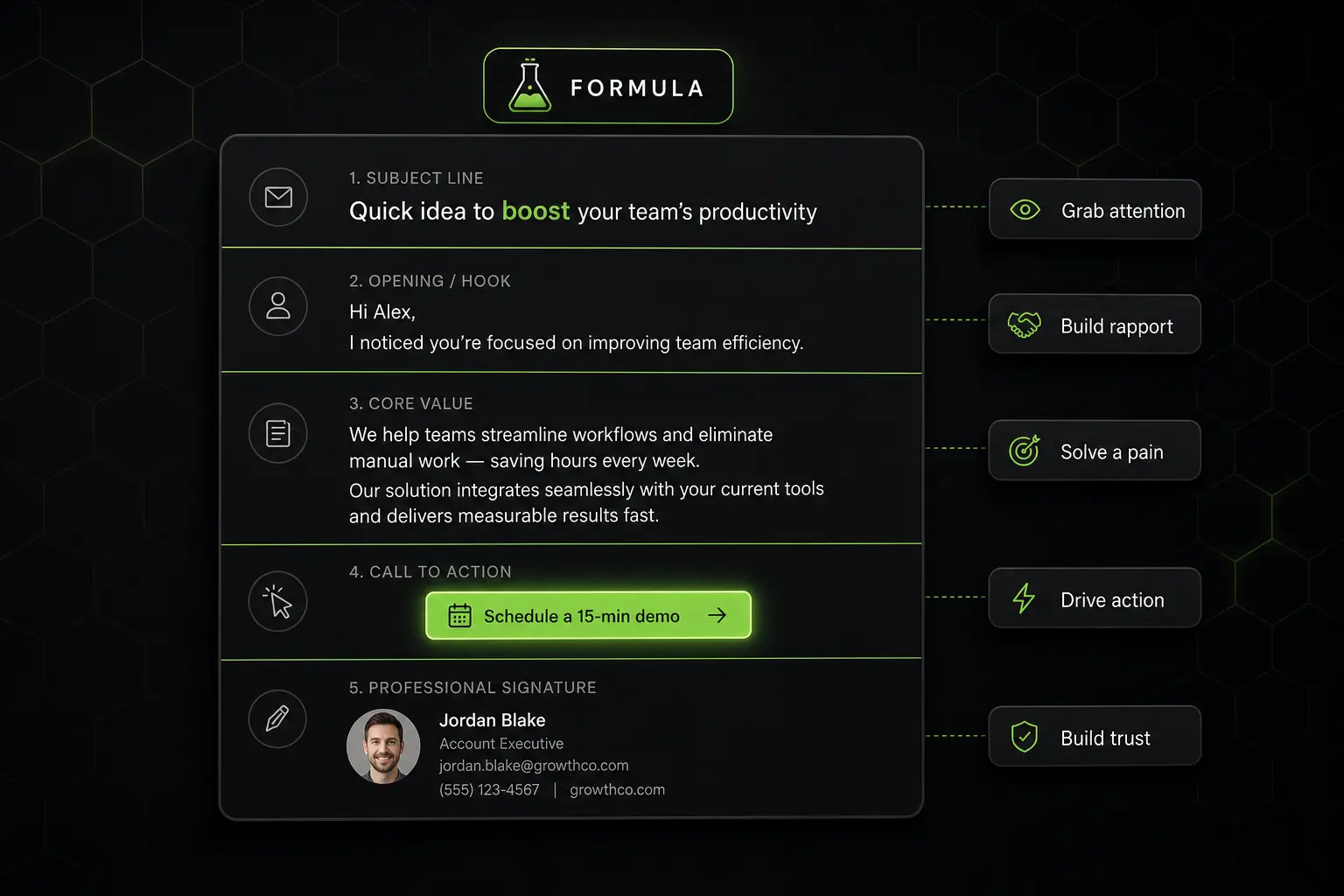
The structure of a professional email: 6 elements
An effective email, whether cold prospecting or a routine professional exchange, always follows the same skeleton. Each of the six elements plays a precise role.
1. The subject line
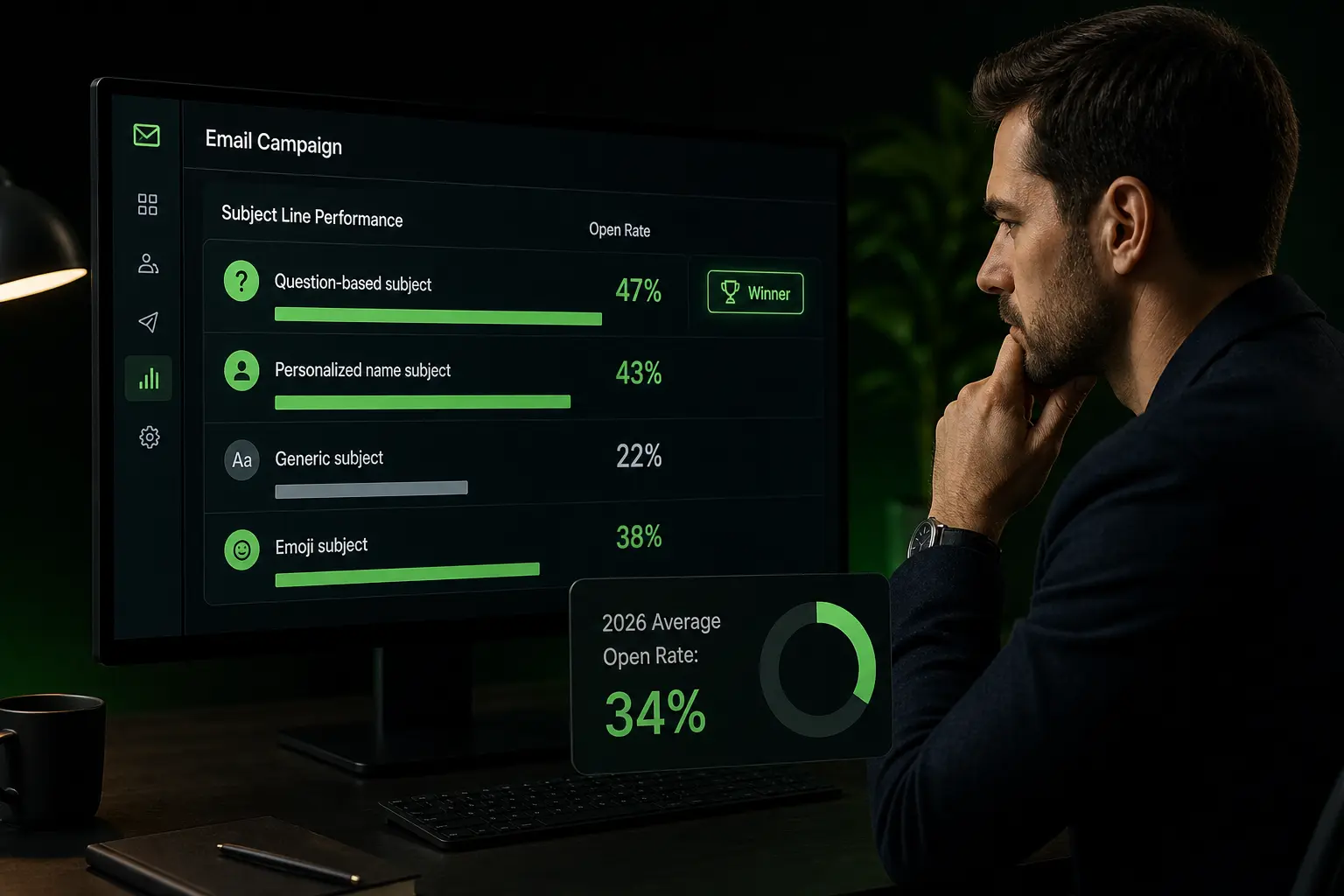
The subject line is the most decisive element of open rate. Documented rules: 4 to 7 words, 36 to 50 characters (mobile constraint), all-lowercase (+21% open across 12 million analyzed emails), a number in the subject (+113% open), personalization by event trigger rather than first name alone. For the detail, see our dedicated guide on email subject lines.
2. The greeting
“Hi {first name}” in 90% of B2B contexts, “Dear Mr/Ms {last name}” in highly formal contexts (law firms, public sector, first contact with a senior executive). “Dear {first name}” is rare in modern professional English and can feel stiff.
3. The opener (1 sentence)
The first sentence is the most read. It should show, in about ten words, that the email truly addresses this person. That is modern personalization: not “I hope this email finds you well” (empty), but “I saw your Series A funding announcement” or “I caught your interview on the X podcast.” An opener mentioning a real event trigger gets a reply rate 30 to 50% higher than a generic one.
4. The body (2 to 3 sentences)
The body explains the why of the email. Not the what (features), not the who (your company), but the why you are writing to this specific person about a specific topic. The ratio to aim for: 70% on the prospect, 30% on what you offer. Most prospecting emails flip this, and that is what disqualifies them.
5. The CTA (1 sentence)
The CTA (call-to-action) closes the email on a clear action. Effective CTAs are simple, dated and closed: “Are you available Tuesday 2 PM or Thursday 10 AM for 15 minutes?” beats “when are you available?” by 2 to 3 times in reply rate. The closed question demands less cognitive effort and therefore gets more yeses.
6. The signature
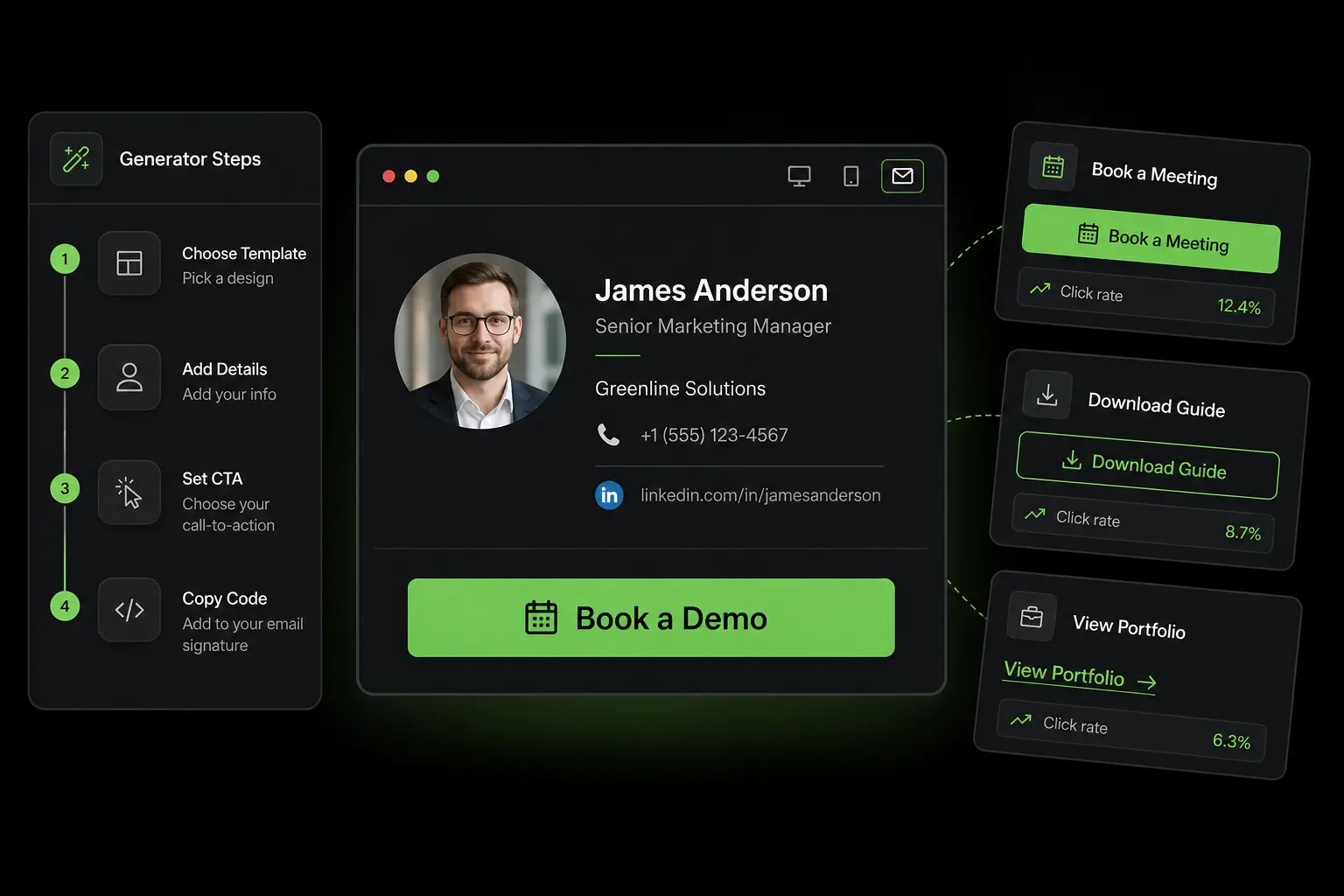
The signature contains the bare minimum (name, role, company) and a single strategic element (calendar link, link to a case study, LinkedIn link). Five to seven lines max. See our full guide on email signatures for detailed best practices.
A sending infrastructure that complements your writing
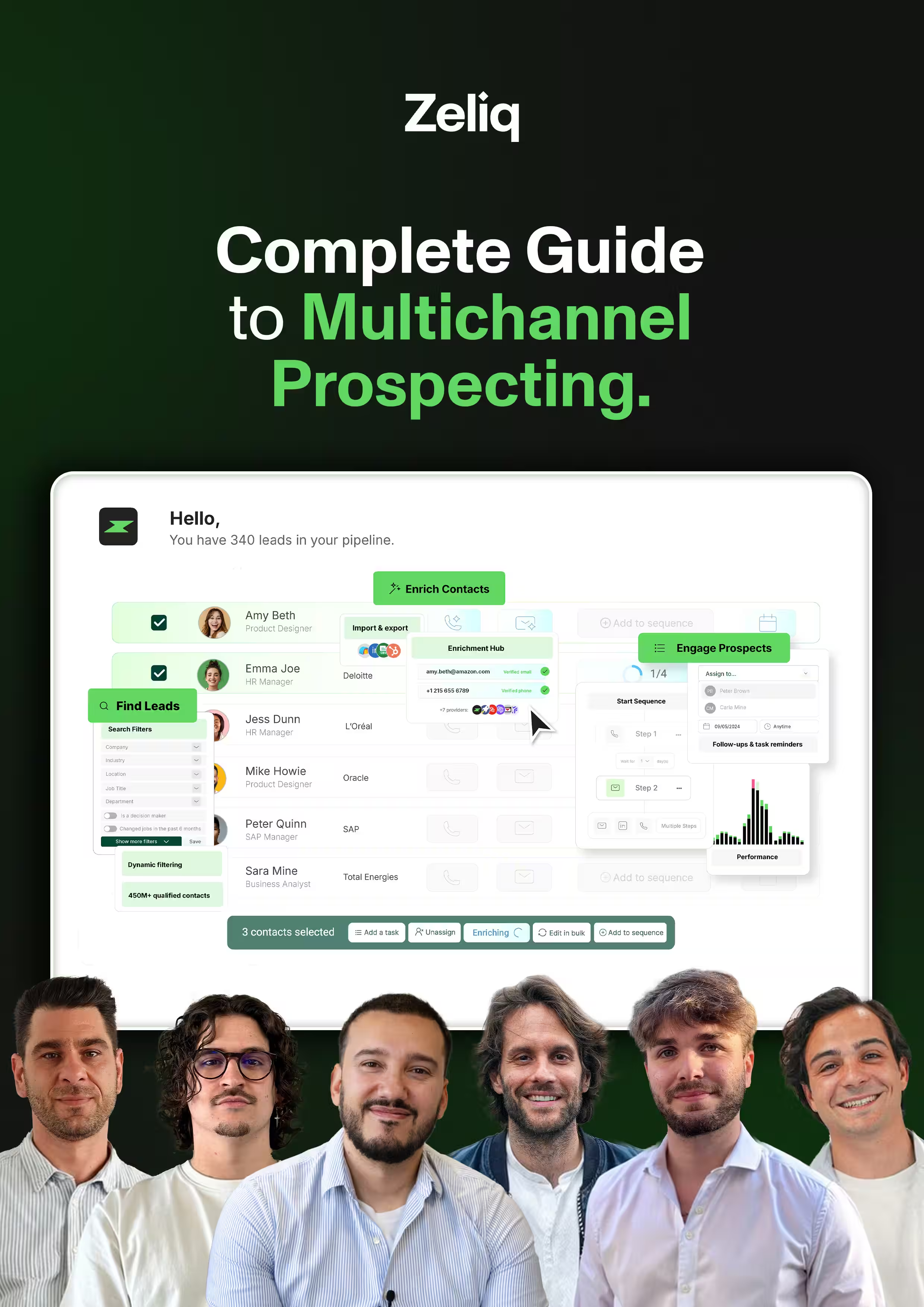
A well-written email is only worth something if it lands in the inbox. Zeliq orchestrates your sequences on an infrastructure built for deliverability. Explore multichannel prospecting.
The 4-sentence formula that maximizes replies
The analysis of more than 3 million B2B cold emails published in 2026 surfaces a dominant structure among top performers: the 4-sentence formula, with each sentence assigned a precise role.
| Sentence | Role | Example |
|---|---|---|
| 1. Personalized opener | Prove the email truly addresses the prospect | “I saw your Series A funding announcement, congrats.” |
| 2. Value proposition | State concretely the benefit for the prospect | “We help post-Series A sales teams cut prospecting time in half.” |
| 3. Social proof or credibility | Justify why you deserve 15 minutes | “{Comparable company} doubled their meetings in 60 days with our approach.” |
| 4. Dated, closed CTA | Make the yes easy | “Available Tuesday 2 PM or Thursday 10 AM for 15 minutes?” |
This structure runs 4 sentences, typically between 70 and 100 words total, and fits on a mobile screen without scrolling. That is the documented optimal window. Obviously, each sentence must truly fit the prospect: the formula gives the structure, not the content.
The 3 writing frameworks: AIDA, PAS, BAB
Beyond the 4-sentence structure, three frameworks shape the writing of commercial emails depending on the angle.
AIDA: Attention, Interest, Desire, Action
The oldest and best known. Suited to emails selling a tangible benefit.
- Attention: personalized opener that grabs.
- Interest: statement of the problem or opportunity you address.
- Desire: concrete proof (case study, number, social proof) that creates desire.
- Action: dated, clear CTA.
Ideal for first cold contacts where you must hook quickly.
PAS: Problem, Agitation, Solution
Suited when the prospect knows their problem but underestimates its severity.
- Problem: name the problem precisely.
- Agitation: show the hidden cost of the problem (lost revenue, wasted time, risk).
- Solution: present your approach without a product pitch.
Ideal for saturated markets where you need to differentiate from competitors.
BAB: Before, After, Bridge
Suited to sales that sell a visible transformation.
- Before: describe the prospect’s current state.
- After: describe the desirable state after your solution.
- Bridge: present your solution as the bridge between the two.
Ideal for SaaS tools that change a workflow or sales processes.
No framework is universally superior. The choice depends on context: a buyer very aware of their problem (PAS), an immature market (AIDA), a transformation sale (BAB).
Event-trigger personalization
The first name in the body no longer works in 2026. B2B buyers have seen too many templates. The personalization that produces measurable results rests on a real, identifiable event trigger.
The best-performing triggers:
- Recent funding round (reply rate 2-3x higher than a standard email)
- Active hiring on a role tied to your offer (LinkedIn Jobs signals)
- Leadership change (new Head of, new CEO)
- Recent product launch by the prospect
- Press mention or interview
- Recent LinkedIn post by the prospect on a relevant topic
Detecting these triggers at scale assumes a signal-based prospecting tool (intent data). Dominant tools: 6sense, Demandbase, Bombora, Apollo.io, Clearbit, ZoomInfo, or integrated platforms that aggregate these signals into the operational workflow. An account with an intent signal converts 3 to 5 times better than a cold-targeted one.
Deliverability: what matters before the writing
A perfectly written email that lands in spam has no chance of generating a reply. Three technical protocols condition deliverability, and their setup is non-negotiable in 2026.
| Protocol | Role | Effect on deliverability |
|---|---|---|
| SPF (Sender Policy Framework) | Authorizes certain servers to send for your domain | Without SPF, 30% chance of ending in spam |
| DKIM (DomainKeys Identified Mail) | Cryptographically signs your emails | Without DKIM, +15% filter risk |
| DMARC (Domain-based Message Authentication) | Global authentication policy | Without DMARC, Gmail and Yahoo refuse senders >5,000/day since Feb 2024 |
Gmail and Yahoo tightened their requirements in 2024 and refuse unauthenticated emails above a certain volume. A poorly configured sending domain loses 20 to 40% of deliverability without the sender even noticing. Verification is done via free tools: MXToolbox, Mail-Tester, GlockApps.
Beyond the technical, behaviors that degrade deliverability:
- Sudden volume (going from 10 to 500 daily sends in a week triggers filters)
- High bounce rate (above 5%, your domain is marked)
- Spam complaints (each complaint lowers reputation score)
- Unverified lists (without prior email verification, bounce rate explodes)
- Disposable or “bounce trap” addresses in the list
Warming up a fresh sending domain (gradual volume ramp over 2-4 weeks) and systematic address verification before sending are the two practices that protect durably.
Writing-assistance tools
Several categories of tools support writing a professional email in 2026.
| Category | Dominant tools | Use case |
|---|---|---|
| AI email writers | Lavender, Lemlist AI, Magical, Outreach Kaia | Sentence suggestions, personalized rewriting |
| Grammar and style | Grammarly, Hemingway Editor, ProWritingAid | Correction and simplification |
| Deliverability testing | Mail-Tester, GlockApps, MXToolbox | SPF/DKIM/DMARC verification, spam score |
| Content spam check | MailMeteor, Lemlist Spam Checker | Detects risky patterns |
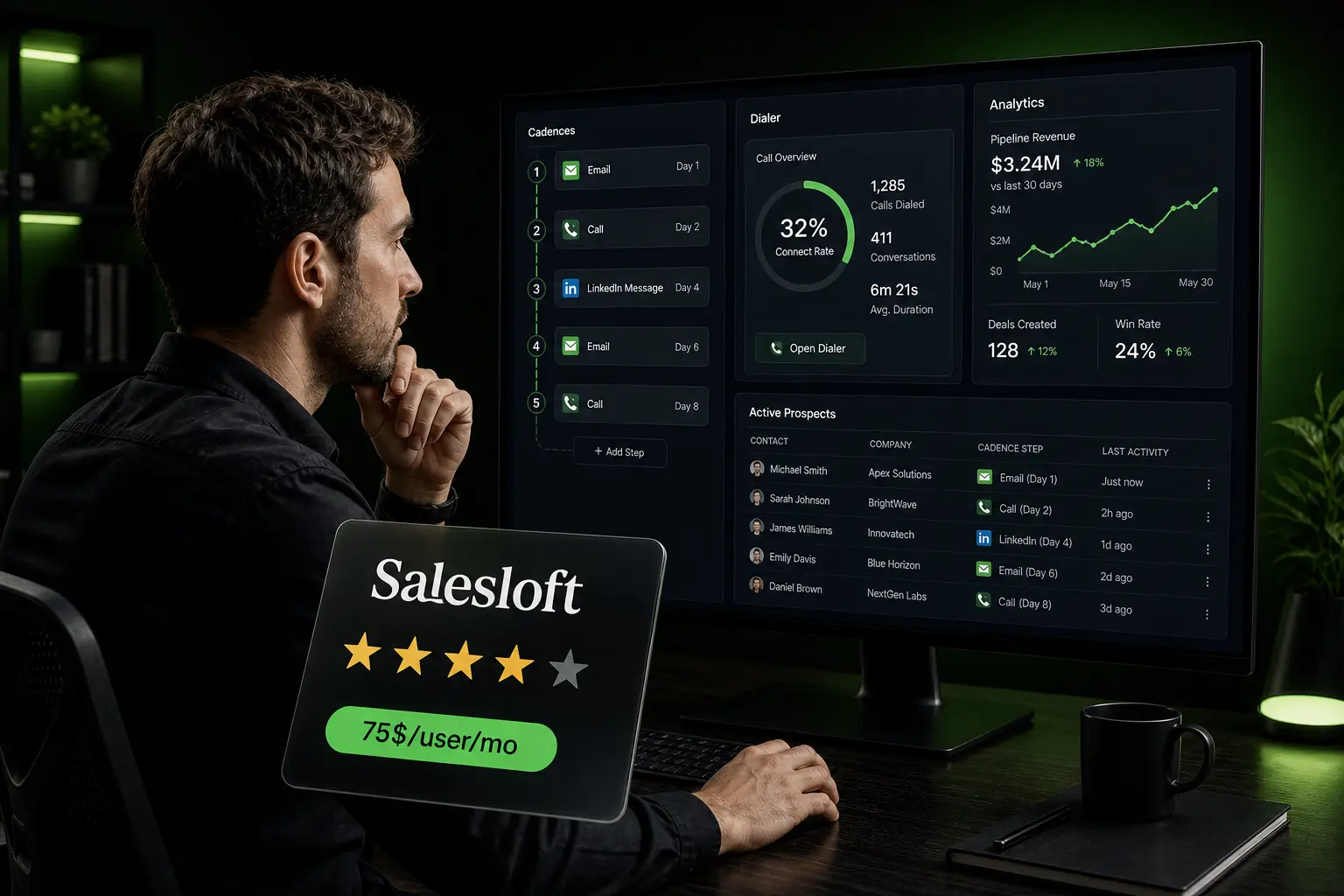
| Sending platforms | Instantly, Lemlist, Smartlead, Mailshake | Multi-step sequences with measurement |
Lavender, in particular, has become a US SDR standard in 2026: the tool scans your email as you write and gives a reply probability score based on the analysis of millions of emails. It flags sentences that are too long, salesy words, lack of personalization.
Worked example: ROI of a mail audit for a 5-SDR team
A US B2B mid-market company wants to audit and optimize its prospecting emails over 3 months.
Investment
- External audit (senior cold email consultant): 1 day × $1,500 = $1,500
- Spam check tool (Mail-Tester Pro) for 3 months: $200
- Writing-assistance tool (Lavender, 5 seats) for 3 months: 5 × $49 × 3 = $735
- Head of Sales internal time (2h/week × 12 weeks × $100/h): $2,400
- Total: ~$4,800 over 3 months
Expected gains
- Current volume: 5 SDRs × 80 emails/day × 21 days × 3 months = 25,200 emails sent
- Current reply rate (before audit): 2% = 504 replies
- Realistic lift after audit and optimization (per benchmarks): from 2% to 5%
- Post-audit reply rate: 5% = 1,260 replies
- Additional replies: 756
- Reply → meeting conversion: 30% = 227 additional meetings
- Meeting → opportunity conversion: 40% = 91 opportunities
- Opportunity → customer conversion: 25% = 11 additional customers (realistic 2% → 3.5% rate lift)
- Average ACV: $10,000 = $110,000 additional revenue over 12 months (if the rate holds)
Marginal cost of the rebuild: 4 days of senior RevOps + tracking tooling = roughly $10,000.
Net ROI: $110,000 - $10,000 = $100,000 in annualized net gain, a 10× ROI over 12 months, within the defensible 5-10× range from the SKILL v4.
The gap between 2% and 5% reply rate may look modest, but on typical B2B volumes, it is the difference between an SDR team producing enough and one producing three times enough.
Writing emails in routine professional exchanges
Beyond cold email, the 4-sentence formula principles adapt to most professional situations.
- Request to a colleague: short context opener, precise request, brief rationale, deadline.
- Meeting follow-up: short thanks, 2-point summary, dated next steps, signature.
- Reply to an unhappy client: acknowledgment of the problem, action plan, deadline, direct point of contact.
- Internal meeting request: context, precise topic, expected duration, two proposed slots.
In every case, the rule stays the same: one request per email, short sentences, a precise subject, a dated CTA. An email asking three questions at once rarely gets a complete reply.
How Zeliq helps you write better emails
Zeliq does not just send your emails: the platform orchestrates multichannel sequences (email + LinkedIn) on an infrastructure built for deliverability (automatic warm-up, sender rotation, pre-send address verification), and measures the opens, clicks and replies of every send. You see which subjects open, which bodies generate replies, and you compare versions on statistically significant volumes. For a Business Developer, it is the difference between trying and learning, sequence after sequence. For more, see our B2B lead database feeding these sequences with verified contacts.
Write emails that actually get replies
Zeliq orchestrates your sequences on an infrastructure built for deliverability and measures what converts. Account created in 2 minutes, no credit card.
Try for freeWhat is the ideal length of a professional email?
For a B2B cold email, the range that maximizes reply rate is 50 to 125 words, with a sweet spot around 75-100 words. Under 50 words, the email feels templated and gets a lower reply rate; above 200 words, the rate drops to 3.9%. For follow-ups, 25 to 60 words is enough, provided they contain 4+ short sentences each bringing something new (“just checking in” 3-sentence follow-ups book 15 times fewer meetings).
How do you start a cold professional email?
The opener must show in one sentence that the email truly addresses the recipient, never starting with “I hope this email finds you well” (generic). The best opener rests on a recent, verifiable event trigger: funding round, hiring, launch, interview, LinkedIn post. Example: “I saw your Series A funding announcement, congrats, it lines up with your product trajectory.” Event-based openers get a reply rate 30 to 50% higher than a generic one.
What is the best sign-off for a professional email?
In professional English, “Best regards” remains the standard neutral, usable in 95% of B2B contexts. “Warm regards” adds warmth without familiarity, ideal for an already engaged relationship. “Have a great day” or “Have a lovely weekend” are warm and appropriate between colleagues or recurring contacts. To avoid in a first contact: “Yours sincerely” (too formal), “Cheers” (too casual depending on culture), “Hugs” and other very personal closes (out of place).
Zeliq and data-calibrated email writing
Writing a good B2B email in 2026 isn’t just a template: it’s calibration on fresh data that makes the difference. Zeliq combines 450 million B2B contacts enriched with firmographics, technographics and intent. Every email leaves on a verified fact rather than a generality.
Conclusion: three actions to improve your emails this week
The 2026 numbers show that writing better emails produces more replies, more meetings, more revenue, at constant cost. Three concrete actions.
- Audit the length of your last 10 emails: how many fit in 50-125 words? If most exceed 150 words, you pay every send in lost reply rate. Rewrite to 4 sentences.
- Test the 4-sentence formula on your next sequence: personalized opener, value, proof, dated CTA. Compare reply rates at 7 days on at least 500 sends.
- Check your SPF/DKIM/DMARC on Mail-Tester or MXToolbox. If any of the three is missing, you lose 15 to 30% deliverability without seeing it. It is the fastest high-impact action.
To drive your whole prospecting setup on a clean sending infrastructure, see Zeliq pricing.
And if you want every B2B email to calibrate on fresh data rather than generic templates, try Zeliq for free and combine verified enrichment with personalized sequences.