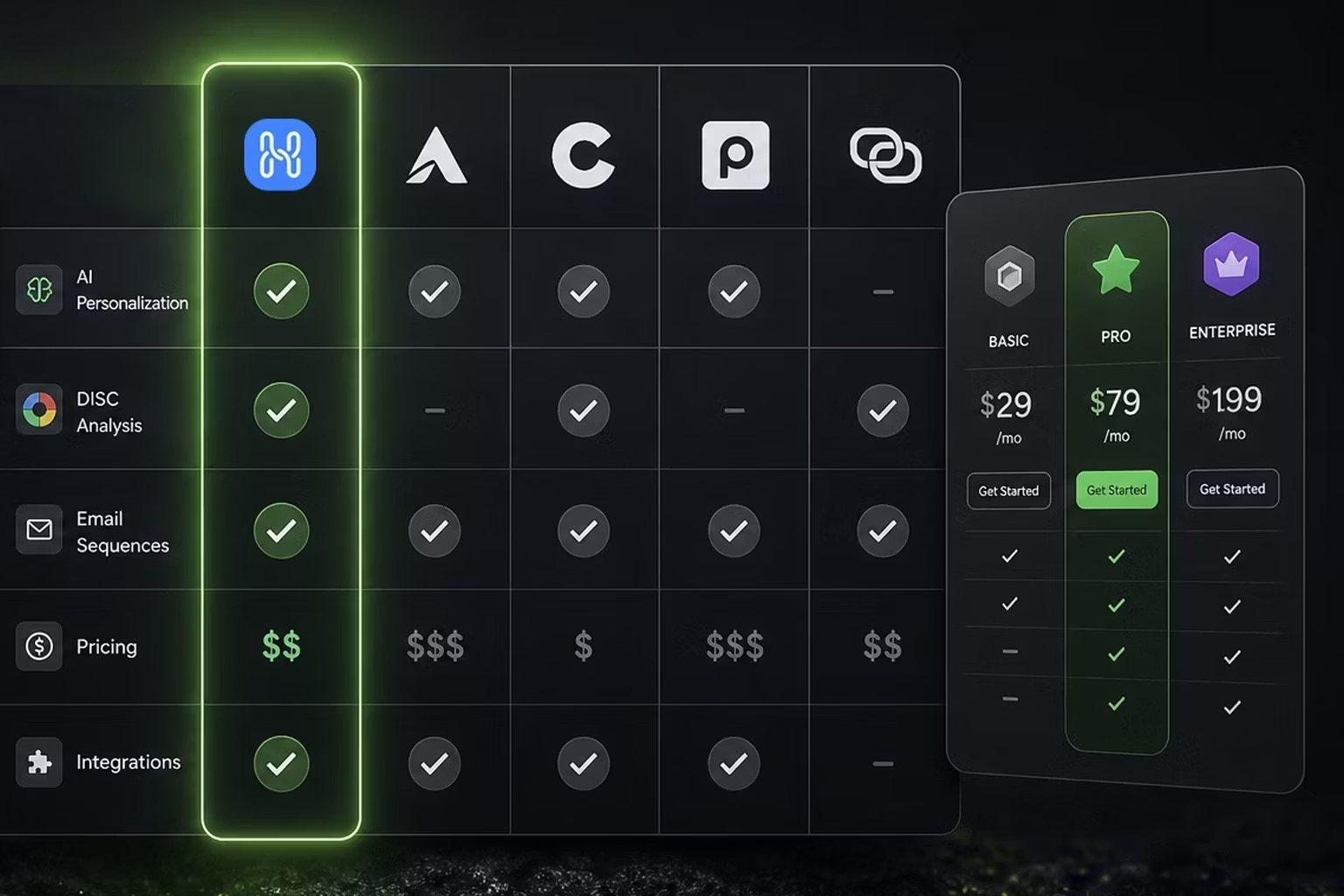

Humanlinker (often searched as “Human Linker”) is one of the most distinctive French sales prospecting tools of 2026. Launched in Montpellier and Paris, the startup bet on an angle barely exploited by its competitors: behavioral personalization through DISC analysis of the prospect. Where Apollo and Cognism aim to maximize the coverage of their database, Humanlinker aims to maximize message relevance by generating openers adapted to the recipient’s presumed psychological profile.
It is an approach that divides. To some, it is the future of prospecting in the era of inbox saturation. To others, it is pseudoscience dressed up as AI. Beyond the controversy, two concrete questions arise: does Humanlinker deliver on its promises in the field? And above all, who is it really for in 2026, at what price, and against which alternatives?
This guide presents Humanlinker factually: its real positioning post-MyProfilia acquisition, the detail of its features (DISC analysis, AI generation, contact database, omnichannel prospecting), its pricing, its integrations, its strengths and limits, and a comparison with its 5 main alternatives.
What you’ll find:
- What Humanlinker is in 2026 and the DISC question
- The 4 key features in detail
- Humanlinker pricing and the cost/value ratio
- Integrations and the ecosystem
- Strengths, limits and who should (or should not) buy Humanlinker
- Detailed comparison with 5 alternatives
Key takeaways
- Humanlinker is a French sales prospecting tool, based in Montpellier and Paris, betting on DISC behavioral analysis to personalize messages at scale.
- Database of ~700 million B2B contacts integrated, complemented by the MyProfilia acquisition (2024-2025) that expanded European coverage.
- DISC analysis classifies each prospect into one of 4 profiles (Dominant red, Influent yellow, Steady green, Conscientious blue) and automatically adapts message tone and arguments.
- Public pricing typically between $80 and $230/user/month depending on plan, with a limited free trial.
- Structural limit: DISC analysis remains a probabilistic estimate, and result quality depends as much on contact data reliability as on personalization, which keeps tools that combine database + verified enrichment + orchestration (Apollo, Zeliq) in the race.
What is Humanlinker in 2026
Humanlinker is a SaaS sales prospecting platform that presents itself as an “AI copilot for sales teams”. Founded in France with teams in Montpellier and Paris, the startup differentiated from the start on the behavioral personalization angle, rather than the race for contact volume.
Its founding hypothesis: B2B buyers now receive 50-100 prospecting messages per week, and the only way to stand out is to truly personalize, adapting not just to role and company, but also to the presumed communication style of the recipient. That is the DISC angle.
Post-MyProfilia positioning
Humanlinker acquired MyProfilia in 2024-2025, marking a strategic turning point. MyProfilia brought:
- An expanded B2B contact database (notably in Southern Europe)
- Complementary sector coverage (industries, services)
- Integration with HR and recruitment tools, opening an adjacent market
Post-acquisition, Humanlinker now positions itself as a complete platform combining prospecting database (~700M contacts), enrichment, DISC behavioral analysis and multichannel orchestration. Its positioning has converged with competitors like Apollo or Zeliq, while keeping DISC as a signature differentiator.
Humanlinker’s ideal target
Humanlinker mainly addresses:
- SDR/AE teams of 3 to 50 people that want to industrialize personalized prospecting
- B2B SaaS companies whose buyers receive many messages and where personalization truly creates the gap
- EMEA market, particularly France and Southern Europe where Humanlinker has its densest coverage
- Medium sales cycles (30 days to 6 months) where first-contact quality matters heavily
The 4 key features in detail
1. DISC prospect analysis
This is Humanlinker’s signature feature. The DISC method, theorized by William Moulton Marston in the 1920s, classifies individuals into 4 main behavioral profiles:
| Color | Profile | Characteristics | Recommended sales approach |
|---|---|---|---|
| Red | Dominant | Direct, fast, results-oriented | Bullet points, hard data, immediate ROI |
| Yellow | Influent | Sociable, optimistic, narrative | Storytelling, customer cases, social proof |
| Green | Steady | Patient, reliable, methodical | Structured process, security, reassurance |
| Blue | Conscientious | Analytical, precise, methodical | Technical details, data, sources |
Humanlinker estimates each prospect’s DISC profile from public signals: LinkedIn posts, job title, sector, background, vocabulary used. The tool then returns a color code in the prospect’s profile, with argument recommendations.
The important nuance: DISC analysis remains a probabilistic estimate, not a certainty. The method is useful as a directional cue (e.g. avoid long paragraphs with a Dominant profile), but should not be taken as absolute truth. Several academic studies question DISC’s predictive reliability, particularly when estimated remotely via digital signals.
2. AI-generated personalized messages
Humanlinker leverages DISC analysis to automatically generate openers and messages adapted to the recipient’s profile. Concretely, from a sequence brief, the AI produces several variants of the same message, each calibrated for a different DISC profile.
The benefit: real time savings for the salesperson, who no longer has to write 4 versions of each message. The limit: the quality of generated messages depends on the initial brief and on the accuracy of DISC analysis. A poor brief produces generic messages, and a mis-estimated DISC can yield an opener that misses.
3. Integrated contact database (~700M)
Post-MyProfilia acquisition, Humanlinker offers a database of ~700 million B2B contacts filterable on firmographic criteria (size, sector, geography) and functional (role, seniority). It is one of the largest volumes on the 2026 market, comparable to RocketReach or Apollo.
Coverage is particularly dense in France and Southern Europe, where some US competitors are weaker. It is a structuring argument for an EMEA team wanting to avoid double billing (one tool for the database + one tool for orchestration).
4. Omnichannel prospecting
Humanlinker combines email and LinkedIn in coherent sequences, with reply tracking and automatic follow-up pause. The scope is narrower than LGM (no LinkedIn voice messages for instance, no X integration), but sufficient for the great majority of B2B teams.
Orchestration remains less powerful than LaGrowthMachine on complex sequences, but more accessible: the learning curve is shorter, the interface more direct.
An alternative with integrated database and verified enrichment
Humanlinker bets on DISC; Zeliq bets on data reliability and multichannel orchestration. Explore the B2B lead database.
Humanlinker pricing and cost/value ratio
Humanlinker publishes a partially public pricing grid, with typical 2026 ranges:
| Plan | Target | Indicative price | Features |
|---|---|---|---|
| Free / Trial | Discovery | Free | Limited quota of searches and messages |
| Starter | Solo / micro-business | ~$80-100/user/month | Limited database, DISC included |
| Pro | SMB / SDR team | ~$140-180/user/month | Extended database, DISC + AI messages |
| Business / Enterprise | Large teams | Quote | All included + advanced integrations + SLA |
For a 5-SDR team on Pro plan, expect a monthly cost of $700-900, or $8,400 to $10,800 per year. That sits in the market’s middle range: pricier than Lemlist or Waalaxy, comparable to Apollo, cheaper than Salesloft or Outreach.
The cost/value ratio in practice
The question is not so much absolute price as the ratio between DISC added value and total cost. DISC analysis makes a real difference in ultra-saturated markets (US high-end SaaS B2B for instance); it brings less value in less competitive markets or segments where targeting and enrichment matter more than message tone.
For many EMEA teams, investing in data reliability and orchestration yields a higher ROI than investing in message sophistication. The rule of thumb: as long as your bounce rate stays >5% or your direct number coverage is <50%, optimize data first. Once data is clean, DISC can make sense.
Integrations and ecosystem
Humanlinker offers a solid but narrower ecosystem than US leaders:
| Integration | Depth |
|---|---|
| HubSpot | Native, bidirectional |
| Salesforce | Via connector, standard support |
| Pipedrive | Native |
| LinkedIn / Sales Navigator | Direct integration |
| Calendly, Cal.com | Meeting booking |
| Slack, Teams | Notifications |
| Zapier, Make | Generic connectors |
| Humanlinker API | Available on Business plan |
The ecosystem is narrower than Apollo or Salesloft but covers 80% of B2B team needs. Salesforce depth is notably weaker than on US enterprise platforms.
Strengths and limits of Humanlinker
Strengths
DISC analysis is differentiating. No direct competitor highlights behavioral personalization as much. For a team that wants to stand out in a saturated inbox, it is a real angle.
The solution is French and natively GDPR-compliant. No additional contractual mechanisms needed like with US tools.
The ~700 million contact database is one of the largest on the 2026 market, particularly dense in France and Southern Europe.
The interface is less complex than LGM or Salesloft, which reduces training time and lets a junior SDR team be productive quickly.
The price/scope ratio is in the upper-middle of the EMEA market, without being prohibitive.
Limits
DISC’s remote-estimation reliability remains debatable. Several studies relativize the precision of behavioral estimation from digital signals. To take as a cue, not a truth.
The sophistication of generated messages varies. A poor initial brief produces generic messages, despite DISC. Quality always depends on human understanding of the prospect.
Multichannel orchestration is less powerful than LGM on complex sequences (no AI LinkedIn voice messages, no X integration).
US and APAC coverage is less dense than US leaders (ZoomInfo, Apollo) on their native markets.
DISC can distract attention. For a team that has not yet optimized its data or targeting, investing in behavioral personalization is often a premature investment.
Comparison with 5 Humanlinker alternatives
| Tool | Positioning | Target | Indicative price | Differentiation vs Humanlinker |
|---|---|---|---|---|
| Apollo.io | 275M+ database + engagement | SMB to mid-market US/EU | $49-119/user/mo | Larger US coverage, intent data |
| Cognism | 70M database + EMEA enrichment | EU mid-market | Quote | Very EMEA-focused, strong compliance |
| LaGrowthMachine | Multichannel orchestration | Growth/SDR EU | $65-260/identity/mo | More powerful builder, AI voice |
| Lemlist | Cold email + LinkedIn | SMB FR/EU | $59-199/mo | More email-oriented, less complete |
| Zeliq | 450M database + enrichment + multichannel | SMB to mid-market EMEA | Quote | All-in-one, deliverability focus |
When to choose what
- Humanlinker: EU team in a saturated market wanting to test the DISC angle, already comfortable with basic prospecting
- Apollo.io: team wanting database + intent + engagement at controlled cost, comfortable with a US tool
- Cognism: EU enterprise team wanting the most GDPR-compliant database on the market
- LGM: team wanting very advanced multichannel orchestration with LinkedIn voice AI
- Lemlist: team focused on cold email + light LinkedIn, constrained budget
- Zeliq: SMB to mid-market EMEA team wanting all-in-one without stacking tools
Worked example: Humanlinker vs all-in-one alternative on 5 SDRs
A US B2B mid-market company of 5 SDRs compares Humanlinker Pro and an all-in-one alternative.
Option A: Humanlinker Pro
- Humanlinker Pro (5 users × $160/month): $800/month = $9,600/year
- Onboarding and training: ~$2,500 one-shot
- Complementary Sales Navigator (recommended): 5 × $99 = $495/month = $5,940/year
- Year 1 total cost: ~$18,000
- Year 2 cost: ~$15,500
Option B: all-in-one platform like Zeliq
- Integrated platform (database + enrichment + multichannel): ~5 × $85/month = $5,100/year
- No mandatory Sales Navigator
- Onboarding included or minimal
- Year 1 total cost: ~$5,300
- Year 2 cost: ~$5,100
Differential: ~$12,000 savings in year 1 for 5 SDRs, not counting time saved on stack management. Over 3 years: ~$30,000 savings.
The gap is justified if the team specifically values DISC analysis. Otherwise, the extra investment goes elsewhere (rep training, ABM, intent data tools).
How Zeliq positions itself against Humanlinker
Zeliq and Humanlinker share EMEA positioning and extensive base coverage (450M+ contacts for Zeliq, ~700M for Humanlinker). The difference plays out on personalization philosophy:
- Humanlinker bets on DISC behavioral analysis to adapt the message.
- Zeliq bets on data quality and deliverability so messages actually reach their target.
For a team wanting to secure data and sending first before investing in tone sophistication, Zeliq is often a better entry point. For a team that has already solved data and seeks a differentiating angle against numerous competitors, Humanlinker can complement usefully. See our B2B data enrichment and multichannel prospecting for the complete Zeliq stack.
For a Business Developer, it is the guarantee of a clean base before any personalization layer.
Prospecting that starts from reliable data
Zeliq finds, enriches and verifies your B2B contacts, then orchestrates your multichannel sequences. Account created in 2 minutes, no credit card.
Book a demoIs Humanlinker’s DISC analysis really reliable?
DISC analysis, as a theoretical method, has been documented since the 1920s but remains scientifically debated. Several academic studies relativize its predictive precision, particularly when estimated remotely through digital signals (LinkedIn posts, role, sector), as Humanlinker does. To take as a directional cue (e.g. avoid long paragraphs with a Dominant profile, favor social references with an Influent profile), not as an absolute truth. At high volume, real added value may exist; on an individual case, the risk of misreading the profile stays high. Best practice consists of using DISC as a complementary signal, not as a sole determinant of message strategy.
Humanlinker vs Apollo.io: which to choose?
The two tools overlap on B2B prospecting with integrated contact database + orchestration, but with different angles. Apollo.io is more volume- and data-oriented: dense US coverage, integrated intent data, more accessible price ($49-119/user/month), very productive interface. Humanlinker is more behavioral-personalization-oriented: native DISC analysis, AI generation of adapted messages, French GDPR compliance. For a team focused on the US market or maximizing volume at the best price, Apollo is often the right choice. For an EU team wanting to test the DISC personalization angle and operating in a saturated market, Humanlinker can be relevant. Both require structured prospecting database and rigorous targeting to deliver full potential.
What is the real cost of Humanlinker in 2026?
Humanlinker pricing sits typically between $80 and $230/user/month depending on the plan chosen (Starter, Pro, Business). The Pro plan at approximately $140-180/user/month is most common for an SDR team. For a 5-rep team, that represents an annual budget of approximately $8,400 to $10,800. Add to this Sales Navigator (~$99/user/month extra) and initial onboarding ($1,500 to $4,000 one-shot depending on format). The real total cost for a 5-rep team typically reaches $15,000 to $19,000 in year one. Annual commitment usually unlocks 10-15% discount.
Zeliq vs an isolated behavioral-intelligence tool
HumanLinker brings behavioral intelligence, but without a multichannel sequencer or integrated B2B database, it needs to be supplemented. Zeliq combines 450 million verified B2B contacts, behavioral enrichment and multichannel sequences in a single GDPR-first platform. You avoid stacking 3 tools.
See how Zeliq replaces the HumanLinker + sequencer + CRM stack
Conclusion: three questions to ask before buying Humanlinker
Humanlinker remains a relevant tool for EU teams wanting to experiment with behavioral personalization at scale. Three questions to ask before committing budget.
- Is your contact data already clean and your bounce rates under 5%? If not, optimize data first. Investing in DISC when your database is dirty means sophisticating a message that will not arrive.
- Are you really in a saturated prospecting message market? If your prospects receive 5 messages a week, tone matters less than targeting. If it is 50, then DISC can make sense.
- Are you ready to rigorously measure marginal DISC ROI over 6 months? The only way to know if the angle works for you is to compare a sample with DISC and a sample without, on comparable volume.
If any of the three answers is no, an all-in-one platform like Zeliq or Apollo covers 90% of the scope with better cost/result ratio. To compare concretely, see Zeliq pricing.
And if you want to centralize behavioral intelligence and multichannel prospecting in a single GDPR-first platform, try Zeliq for free and free your salespeople from stacking 3 tools.