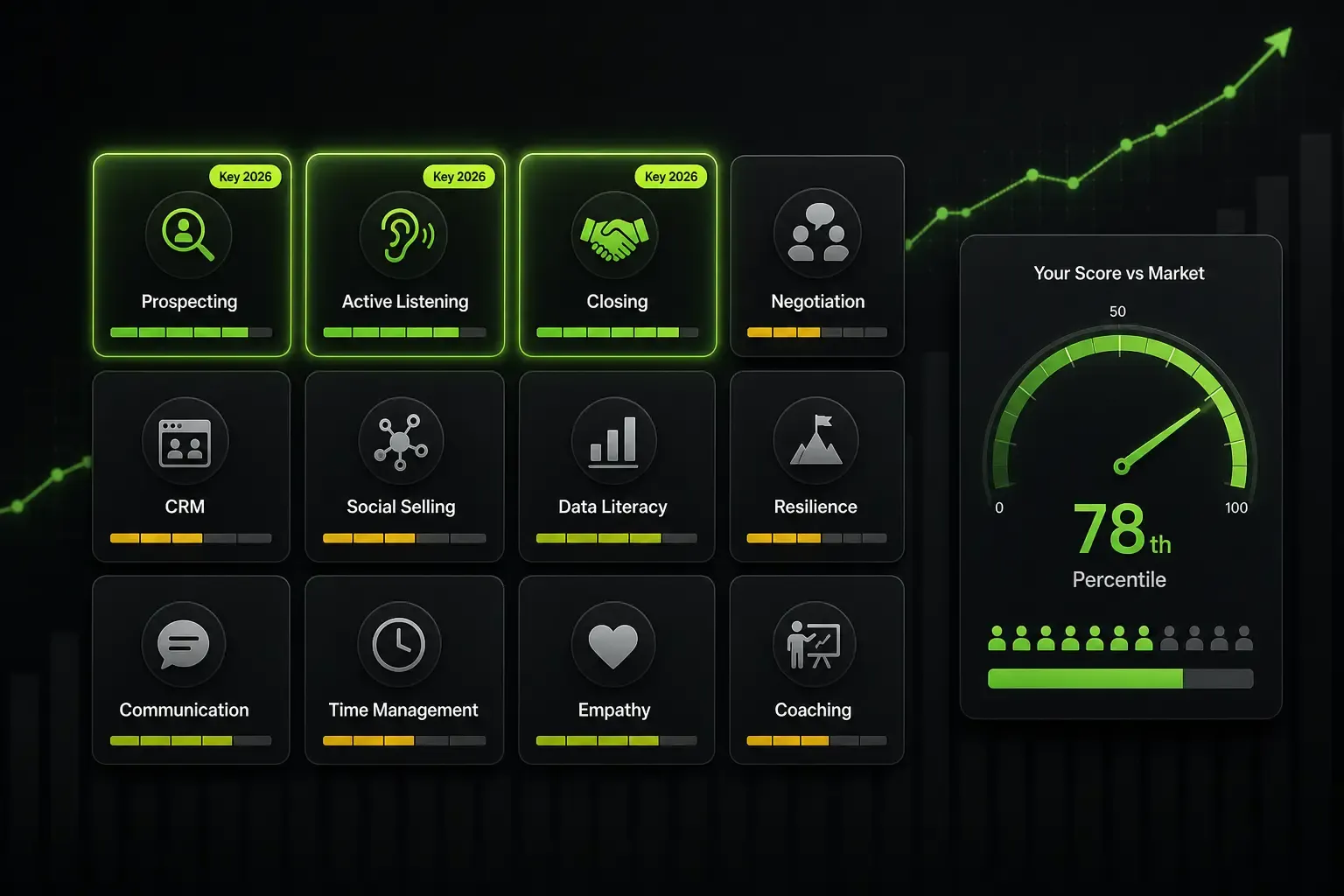

Why do two salespeople on the same team, with the same product, the same territory and the same base salary, produce results that can vary by 1 to 5? Not luck, not innate talent. A worldwide study of 1,004 sellers and sales managers (Highspot 2026) isolated five variables that systematically separate top performers from the average: consultative selling, active listening, prospecting discipline, coachability, and business acumen. None of them is innate. All of them develop.
But the sales role has also changed. Selling in 2026 no longer comes down to the historic four traits (resilience, communication, negotiation, closing). The arrival of intent data tools, conversation intelligence platforms and AI agents imposes a new family of technical and AI-native skills that many teams have yet to integrate.
This guide details the 12 key competencies of a high-performing salesperson in 2026, separating soft skills, hard skills and technical skills. It gives documented benchmarks (43:57 listen ratio, multi-threading +130%, social selling +18 points), compares qualification frameworks (BANT, MEDDPICC, SPICED), names the market tools, and ends with a worked example of training ROI.
What you’ll find:
- The 2026 numbers on what separates a top performer from an average rep
- The 4 soft skills to master (listening, empathy, resilience, communication)
- The 4 sales hard skills (prospecting, discovery, negotiation, closing)
- The 4 technical and AI-native skills (CRM, data, intent data, conversation intelligence)
- The qualification frameworks (BANT, MEDDPICC, SPICED)
- The costed training plan with measurable ROI
The 2026 numbers: what separates a top performer from an average rep
Before listing the skills, the benchmarks. Several quantitative studies published in 2025-2026 measured the performance gap between top quartile and average, with a focus on observable behaviors.
| Behavior | Top performers | Average | Source |
|---|---|---|---|
| Talk/listen ratio on calls | 43%/57% | 65%/35% | Gong 25,000+ calls |
| Pipeline-fill rate (social selling) | 65% | 47% | LinkedIn State of Sales |
| Contacts per account (deals >$50k) | 6 to 9 | 3 to 4 | Demandbase 2026 |
| Multi-threading lift on win rates >$50k | +130% | baseline | Demandbase 2026 |
| B2B buyer trust (general vs regular rep) | 87% (regular) | 43% (general) | Edelman Trust 2026 |
| Cold call → meeting rate (top quartile) | 6 to 10% | 2 to 3% | Cognism 204K calls |
The gap is built less on talent than on precise, measurable behaviors. A salesperson talking 65% of the time on a call learns nothing and books nothing. A salesperson prospecting one unique contact per $50k account halves their win rate. These behaviors change, provided you measure them.
That is also why 42% of Go-to-Market leaders declare prioritizing sales L&D in 2026, against 27% in 2023. The job has become too complex to rest on hiring great profiles alone; it demands structured investment in skill development.
The 4 soft skills to master
Selling remains, above all, a human relationship. Four soft skills make the durable difference.
1. Active listening
Active listening is the most underrated and most decisive skill in 2026. Analysis of more than 25,000 sales conversations by speech analytics tools (Gong, Chorus, Clari Copilot) gives the most precise marker of the craft: top performers run a 43%/57% talk/listen ratio, against 65%/35% for the average. In other words, the best listen more than they talk.
Concretely, active listening rests on three practices.
- Ask open questions that force the prospect to develop (“How are you handling this today?” rather than “Do you have this problem?”).
- Reframe what you hear before answering, to show understanding and defuse misunderstanding.
- Catch weak signals: hesitations, tone shifts, unsolicited keywords that reveal a real unspoken stake.
Active listening is measurable: record your calls (with consent) and calculate your ratio. It is the easiest indicator to objectify and correct.
2. Empathy
Sales empathy is the ability to put yourself in the prospect’s shoes and grasp their context, constraints and motivations without projecting your own. That is what turns a generic demo into a relevant conversation.
Empathy is not a posture, it is preparation work. Before a meeting, a good salesperson spends 10 to 20 minutes understanding the prospect’s role, sector, likely performance indicators, and buying cycle. During the meeting, they ask more questions than they pitch. After the meeting, they review what they learned about the prospect, not just what they managed to deliver.
3. Resilience
The sales job runs on a structural failure rate. One cold call in 25 leads to a meeting. One meeting in 4 leads to an opportunity. One opportunity in 3 turns into a customer. Without resilience, this failure rate burns energy before producing results.
Resilience can be learned. Three practices help:
- Decouple self-worth from outcome: a “no” is a signal about the situation, not a judgment on the person.
- Work in batches: chaining 30 calls in a focus block beats spreading them through the day to avoid the rumination effect.
- Measure the average, not the event: your conversion rate over 100 calls matters; the result of one call does not.
4. Clear communication
Clear communication matters in writing and in speech. In speech, it is the ability to explain a complex proposition in 30 seconds without jargon. In writing, it is the ability to draft a cold email that reads in 30 seconds and asks for a reply.
The documented benchmarks: a cold email of 50 to 125 words gets the best reply rate (8.2% on average). Beyond 200 words, the rate drops below 3%. Conciseness is a skill, not a personality trait.
The 4 sales hard skills
Beyond human qualities, four technical sales skills structure the craft.
5. Prospecting
Prospecting is the gateway skill. Without a flow of new qualified contacts, the salesperson depends on marketing leads and loses all autonomy. Modern prospecting combines three sub-skills:
- Targeting: precisely defining your ICP (Ideal Customer Profile) with firmographic criteria (size, sector, geography) and behavioral signals (intent).
- Multichannel: combining email, LinkedIn and phone in a coherent sequence. Multichannel alone moves a reply rate from 1-2% (email only) to 5-10% (combined).
- Persistence: 80% of B2B sales need 5 to 12 touchpoints, and 92% of reps give up before the 4th attempt. Follow-up discipline often matters more than first-message talent.
For more, see our guide on the Sales Development Representative role and multichannel prospecting.
6. Needs discovery
Discovery is the phase that turns an interested prospect into a qualified opportunity. It is the art of asking the right questions to surface the customer’s real problem, beyond the stated request. A buyer asking “how much does it cost?” almost always carries a deeper underlying question about ROI, implementation or risk.
Three frameworks structure discovery today (see the dedicated section below): BANT (Budget, Authority, Need, Timing), MEDDPICC (Metrics, Economic buyer, Decision criteria, Decision process, Paper process, Identify pain, Champion, Competition), and SPICED (Situation, Pain, Impact, Critical event, Decision).
7. Negotiation
Sales negotiation is not just about price. It is the ability to defend the value of your offer, handle objections, and find a deal that creates value for both sides.
A few documented principles:
- Never drop a discount without something in exchange (longer commitment, faster payment, references).
- Present the premium option first: 80% of buyers pick the middle option, so it should come after a high one.
- Understand the prospect’s BATNA (Best Alternative To a Negotiated Agreement), meaning what they will do if you do not sell.
8. Closing
Closing is the moment the salesperson asks for the decision. Many sales cycles fail at closing, not from rational refusal, but because the rep never asked.
Modern closing techniques avoid the manipulative classics (“if I give you 10% off, will you sign today?”). They rest on clarity of the next step: “To move forward, we need your sign-off on these 3 points by Friday, workable on your side?”. Firmness without aggression remains the best technique.
A skill that can be tooled: prospecting
Zeliq tools the most time-consuming sales skill: finding and engaging the right contacts. Explore multichannel prospecting.
The 4 technical and AI-native skills
This is the skill family that has evolved most in 2025-2026, and the one widening the gap between modern teams and those that have not updated.
9. CRM mastery
The CRM is the salesperson’s daily tool. Poor CRM hygiene (missing fields, desynchronized statuses, ghost opportunities) sabotages individual and team performance. The dominant CRMs remain Salesforce (enterprise leader), HubSpot (mid-market and SMB), Pipedrive (SMB and independents), Zoho CRM (pragmatic SMB) and Microsoft Dynamics 365 (Microsoft-native enterprises).
The skill is not just data entry: it includes the ability to exploit the CRM to drive your pipeline, prioritize accounts, and feed manager coaching with reliable data.
10. Comfort with data
A modern salesperson reads their own metrics. Reply rate, conversion rate, pipeline velocity, stage-to-stage transition, segment win rate: these metrics tell each rep where they lose deals and where their upside lies.
The minimum bar: knowing how to read a sales dashboard, spot a drift, formulate a hypothesis, and measure the effect of a change. Without this skill, the rep steers on gut feeling, and gut feeling regularly misleads.
11. Signal-based prospecting (intent data)
This is the skill that most cleanly separates 2026 teams from 2020 teams. Signal-based prospecting means prioritizing accounts by behavioral signals: active hiring on certain roles, funding round, product launch, leadership change, repeat website visits, content downloads, press mentions.
Dominant tools: 6sense, Demandbase, Bombora (third-party intent), Apollo.io (intent + database, $49-119/user/month), Clearbit (real-time enrichment), ZoomInfo (database + intent), and integrated multichannel prospecting platforms that aggregate these signals into an operational workflow.
An account with an intent signal converts 3 to 5 times better than a cold-targeted one. Learning to leverage these signals is now a skill in itself, on par with writing a cold email.
12. Conversation intelligence usage
Conversation intelligence refers to tools that record, transcribe and analyze sales calls. The leaders: Gong ($5,000+ platform fee + $1,200-1,600/user/year), Chorus (ZoomInfo, integrated), Clari Copilot, Mojo, Avoma. The skill is not the tool’s technical usage, it is the re-listen discipline: reviewing 2 to 3 calls a week, identifying what worked, what failed, and adjusting.
Teams adopting a conversation intelligence tool see their meeting booked rate progress by 15 to 30% within 6 months, per multiple vendor studies (to take with a grain of salt but reproduced in independent ones).
Qualification frameworks: BANT, MEDDPICC, SPICED
Qualification is the cross-cutting skill that determines whether a rep spends hours on opportunities that will close or on prospects that never will. Three frameworks structure modern practice.
| Framework | Best for | Components | Strength |
|---|---|---|---|
| BANT | Short cycles, simple sales | Budget, Authority, Need, Timing | Simple, fast to learn |
| MEDDPICC | Complex, enterprise sales | Metrics, Economic buyer, Decision criteria, Decision process, Paper process, Identify pain, Champion, Competition | Exhaustive coverage |
| SPICED | SaaS, modern cycles | Situation, Pain, Impact, Critical event, Decision | Focus on the trigger event |
BANT stays useful to quickly qualify an inbound lead or an outbound call. MEDDPICC has become the de facto standard in enterprise SaaS, because it forces identification of multiple decision-makers and the formal buying process. SPICED, popularized by Winning by Design, emphasizes the critical event that drives the buyer to buy now rather than in 6 months.
The skill is to choose the right framework by context, not to mechanically apply the same to every deal.
Multi-threading: the skill that flips big deals
A Demandbase 2026 study measured a massive effect on B2B deals over $50,000: multi-threading (contacting several decision-makers on the same account) boosts win rate by 130% compared with mono-threading (a single contact). On large deals, top performers work 6 to 9 contacts per account, against 3 to 4 for the average.
The logic is mechanical: in a complex sale, the decision involves 6 to 10 people on average. Having a single internal champion means depending on their availability, influence and tenure. Multiplying touchpoints diversifies risk and accelerates the decision.
Multi-threading is built with discipline: map decision-makers from qualification, plan a touchpoint per stakeholder in the account plan, track each relationship distinctly in the CRM.
Worked example: ROI of a training plan for a 6-SDR team
A US-based B2B mid-market company considers a 12-month sales training plan for 6 SDRs.
Investment
- External training (1 day/month × 12 months × $700/day): $8,400
- Conversation intelligence tool (Gong or equivalent): $5,000 platform fee + 6 × $1,400 = ~$13,400/year
- Head of Sales internal coaching time (4h/week × 48 weeks × $100/h): $19,200
- Total annual: ~$41,000
Expected gains (based on documented benchmarks)
- Lift in meeting booked rate of 15 to 25% (median of conversation intelligence studies)
- Reference volume: 6 SDRs × 30 current meetings/month × 12 months = 2,160 meetings/year
- With a 20% lift: 2,592 meetings/year, i.e. 432 additional meetings
- Meeting → opportunity rate: 40% = 173 additional opportunities
- Opportunity → customer rate: 25% = 43 additional customers
- Average ACV: $10,000 = $430,000 in additional annual revenue
Net ROI: 430,000 - 41,000 = $389,000 of net gain in year one, a 10x ROI.
These numbers are indicative and vary by context, but the order of magnitude is documented convergingly: structured training and tooling of salespeople produce double-digit ROIs.
How Zeliq accelerates skill development
Zeliq tools the most time-consuming sales skill: prospecting. The platform finds the right contacts in a database of 450 million profiles, enriches their details via waterfall enrichment querying more than 40 providers, and orchestrates multichannel email + LinkedIn sequences with open, click and reply tracking. The salesperson frees up time for higher-value skills (discovery, negotiation, closing) and learns through data: every sequence is measured, every gap between average and top quartile becomes visible.
For a Business Developer or a sales manager looking to industrialize prospecting without sacrificing relationship quality, the tool frees up exactly the time that allows better listening, better qualification, better negotiation.
Free up time for your high-value skills
Zeliq automates prospecting so your reps focus on the conversation. Account created in 2 minutes, no credit card.
Try for freeWhat are the 3 most important sales skills in 2026?
Per converging studies from Highspot, Gong and Demandbase published in 2026, the three most performance-predictive skills are: active listening (43:57 talk/listen ratio for top performers, against 65:35 for average), multichannel prospecting discipline (top quartile works 5 to 12 touchpoints per account where average stops at 3), and mastery of qualification frameworks (BANT, MEDDPICC or SPICED depending on the sale type). None is innate, all develop through deliberate practice and structured feedback.
How do you train a salesperson in 2026?
An effective training plan combines three elements. First, deliberate practice on targeted skills: pick one skill (listening, objection handling, multi-threading) and work it consciously for 4 to 6 weeks before moving on. Next, structured feedback: use a conversation intelligence tool (Gong, Chorus, Clari Copilot) to re-listen to 2-3 calls a week with the manager. Finally, measurement: track personal metrics (connect rate, reply rate, stage-by-stage conversion) and correlate practice changes with results. Without measurement, no durable learning.
What does a top-performing salesperson earn in the US?
Top quartile B2B salespeople in the US typically earn total compensation (base + variable) of $180,000 to $300,000 for an experienced AE in B2B SaaS, and $80,000 to $130,000 for a senior SDR. The top 10% can exceed these ranges in hyper-growth startups and high-ACV sectors (cybersecurity, fintech, healthtech). The compensation gap between top performer and average sits at 1.5x to 3x in organizations that structure their variable correctly.
Zeliq and sales productivity
The 2026 B2B salesperson spends 35% of their time on manual sourcing tasks. Zeliq combines 450 million B2B contacts, automatic enrichment and multichannel sequences in a single platform. Your teams free up 2 hours per day for high-value conversations.
Conclusion: three actions to develop your skills this week
Sales skills are actionable levers, provided you stop assuming they are innate. Three concrete actions.
- Measure your talk/listen ratio: record your next 3 calls (with consent), calculate your ratio. If you talk more than 50% of the time, you talk too much. The target is 43% for top performers.
- Map your top 5 opportunities: for each deal, list every identified decision-maker. If the list has fewer than 4 names on a deal above $50k, you are mono-threading. Multi-thread this week.
- Pick one skill to work on over 6 weeks: not three, one. Identify your measurable weak point (reply rate, transformation rate at a specific stage), and focus on it with a coach or peer for 6 weeks.
To tool your sales effort and free up time for high-value skills, see Zeliq pricing.
And if you want your salespeople to focus their time on selling rather than manual sourcing, try Zeliq for free and free up 2 hours daily with an all-in-one platform.