

Sales Development Representative: Role, Skills, Compensation and Career in 2026
The Sales Development Representative is the most hired sales role in B2B SaaS over the last decade, and still the entry door into a sales career in 2026. It is also one of the most misunderstood roles. People confuse it with a BDR, expect it to close revenue, or hire one when they actually need an Account Executive. Comp ranges, ramp expectations and SDR to AE ratios vary widely depending on the motion (PLG vs enterprise, inbound heavy vs outbound heavy).
This guide is built for three readers: SDR candidates trying to figure out if the job is for them, sales leaders hiring or rebuilding a team, and founders setting up their first outbound function. We cover the SDR definition, day-to-day work, required skills, KPIs, average US compensation in 2026, career path, tech stack, hiring and ramp, common mistakes, and what AI changes (and does not change) about the role.
What is a Sales Development Representative?
A Sales Development Representative (SDR) is a sales rep specialized in the top of the funnel. The mission is narrow on purpose: identify in market accounts and personas, reach out across channels, qualify the conversation, and hand a meeting to an Account Executive (AE). The SDR does not own quota on revenue closed. The SDR owns quota on meetings booked, opportunities accepted by the AE, and pipeline contribution.
The role exists because of a simple split. Closing a six figure deal and writing a cold email are two different jobs. They require different skills and different rhythms. Asking one person to do both ends with neither getting done well. Aaron Ross formalized that split at Salesforce in the 2000s and wrote it up in Predictable Revenue in 2011. The book is still the canonical reference and shaped how almost every B2B SaaS team is structured today.
What an SDR is not
An SDR is not a junior AE doing a stint before promotion. That framing wastes the role. A great SDR is a specialist in pipeline creation, not a closer in waiting. Some SDRs stay in the function for years and outperform AEs on comp because they generate massive pipeline.
An SDR is also not a marketing function. Marketing creates demand. The SDR captures and qualifies it. The reporting line sits inside sales, with KPIs aligned with revenue, not with content downloads.
SDR vs BDR vs AE vs ISR: how the roles compare
The titles overlap and vary across companies. Here is how to read them in 2026.
| Role | Owns | Typical activity | US base + OTE 2026 |
|---|---|---|---|
| SDR (Sales Development Rep) | Booked meetings, qualified opps for AE | Outbound + inbound, high volume sequences, qualif calls | $55k base / $75k to $95k OTE |
| BDR (Business Development Rep) | Same as SDR, often more outbound or net new accounts | Cold outbound, account research, ABM | $55k base / $75k to $95k OTE |
| ISR (Inside Sales Rep) | Full cycle on small to mid market deals | Inbound qualif, demo, close, sometimes outbound | $65k base / $110k to $140k OTE |
| AE (Account Executive) | Closed revenue, deal cycle from demo to signature | Demos, MEDDIC, negotiation, multi threading | $90k base / $180k to $260k OTE |
| AM (Account Manager) | Net retention, expansion on existing customers | QBR, upsell, cross sell, renewal | $90k base / $160k to $220k OTE |
SDR vs BDR
In practice, SDR and BDR are used interchangeably in most US companies. When there is a real distinction, it usually goes like this: SDR works inbound leads (MQLs, demo requests, content downloads) and a portion of outbound, while BDR works only outbound on net new ICP accounts that have never engaged. Some companies flip the definition. Always ask in the interview which way the team uses the labels.
SDR vs ISR
The Inside Sales Rep runs the full cycle on smaller deals (typically under $30k ACV). They prospect, demo, negotiate and close. The SDR stops at the meeting handoff. ISR is more common in SMB heavy SaaS. SDR plus AE is the standard split in mid market and enterprise.
SDR vs AE
The AE owns deal closure. They take the meeting the SDR booked, run discovery, demo the product, build the business case, multi thread, negotiate and close. AEs carry larger quotas (often $800k to $1.5M ARR per year in mid market) and earn substantially more on OTE. Most AEs were SDRs first.
What an SDR actually does day to day
A real SDR day in 2026 is a mix of focused outbound work, inbound triage and CRM hygiene. The split varies by motion (more inbound at PLG companies, more outbound at enterprise SaaS), but the building blocks are consistent.
Account research and list building (15 to 25 percent of the time)
The SDR starts from an ICP defined with the sales leader: company size, industry, geography, tech stack, hiring signals, funding stage. Tools include LinkedIn Sales Navigator, a B2B contact database, intent data providers, and the CRM. The output is a clean prospect list with the right personas (champion, decision maker, influencer) and contextual hooks (recent funding round, leadership change, job posting, product launch).
Skipping this step is the most common reason SDR programs fail. A great rep with a bad list is a bad rep on paper.
Multichannel sequences and outreach (40 to 50 percent)
Once the list is loaded, the SDR runs sequences that combine cold email, LinkedIn (connection request, view, message, voice note), and cold calls. A typical sequence runs 10 to 14 days with 8 to 12 touches across channels. The SDR writes the templates, personalizes the high value accounts manually, and lets dynamic variables handle the long tail.
Cold calls are not dead in 2026. Most teams still see them as the highest connect channel for senior buyers, especially when paired with a warm signal (someone who opened the email three times, viewed the LinkedIn profile, downloaded a piece of content). Block of two hours in the morning, headset on, dialer open.
Reply handling and qualification (15 to 25 percent)
Replies come in three flavors. Positive (the prospect wants to talk), negative (no, not now, wrong person) and neutral (asking questions, pushing back). The SDR triages them all. Positive replies turn into qualif calls of 10 to 20 minutes where the SDR validates two or three ICP criteria using a framework (BANT, MEDDIC, GPCT or a custom internal grid) and books the meeting on the AE calendar. Negative replies are tagged and the prospect is rotated out for 90 days. Neutral replies get a tailored response that moves the conversation forward.
Qualification matters more than booking volume. An SDR who books 25 meetings a month, of which 5 turn into opportunities, is worse than an SDR who books 12 meetings of which 8 turn into opportunities. AE time is the scarce resource.
Handoff to AE (10 to 15 percent)
A clean handoff is a written brief plus a verbal sync. The brief covers prospect role, account context, pain points surfaced, qualification answers, scheduled time and call link. The AE walks into the meeting prepared. Sloppy handoffs (no brief, no context, wrong time zone) destroy SDR to AE trust and ultimately the SQL acceptance rate.
CRM hygiene, reporting and learning (5 to 10 percent)
End of day routine: log every call, every reply, every step in the CRM. Update account stages. Review the day’s metrics. Read the manager’s feedback on the previous calls. Watch a recorded call from a top performer. Read the latest product release notes so the next pitch is current.
CRM hygiene is the unsexy part of the job. It is also what separates good SDRs from great ones. Bad data in the CRM means the leader cannot coach, the marketing team cannot nurture, and the next SDR who picks up the account three months later has no context.
Skills required: what makes a great SDR
The popular list (resilience, hustle, energy) is not wrong, but it is incomplete. The 2026 SDR job is more analytical and more technical than ten years ago. Here is what actually matters.
Resilience. Cold outbound has a 2 to 5 percent positive reply rate at best. That means 95 percent of the work produces silence or no. A rep who lets that get under their skin lasts six months. A rep who treats it as data lasts three years and gets promoted.
Copywriting. The SDR writes more than they speak. Clear subject lines, short paragraphs, one ask per email, no jargon, no “I hope this finds you well”. A great SDR can describe a product in one sentence the prospect would actually read.
Active listening. On a qualif call, the rep who talks 30 percent of the time and listens 70 percent finds the real pain. The rep who pitches for 15 minutes loses the meeting before it is booked.
Organization. A working SDR juggles 200 to 500 active accounts at any time, across different sequence steps, time zones, and intent stages. Without a system (CRM views, daily blocks, end of day cleanup) the work collapses.
CRM hygiene. Already covered. Repeat because it matters that much.
Data fluency. Reading a funnel report, A/B testing a subject line, segmenting a list by reply rate, knowing which sequence step performs worst. Modern SDRs are part analyst.
Curiosity about the buyer’s world. Reading the prospect’s industry news, understanding their KPIs, asking why a project would matter this quarter rather than next year. This is what turns a generic pitch into a relevant conversation.
SDR KPIs: how performance is measured
Good SDR programs track three layers of metrics. Activity, conversion, business impact. Drop any of the three and the picture is incomplete.
Activity metrics (volume)
- Touches per day across email, LinkedIn and calls (benchmark: 80 to 120)
- New prospects sequenced per week (50 to 100)
- Connect calls per day (15 to 25 dials, 2 to 5 connects)
- Sequences started per week (1 to 3 net new)
Activity is necessary but not sufficient. A rep hitting volume with bad lists and bad messaging produces nothing.
Conversion metrics (quality)
- Reply rate (5 to 10 percent for cold outbound is solid)
- Positive reply rate (15 to 30 percent of total replies)
- Meeting booked rate from positive reply (50 to 70 percent)
- Show rate (75 to 85 percent if calendar discipline is good)
- SQL acceptance rate by AE (60 to 75 percent of booked meetings)
The SQL acceptance rate is the most underrated KPI. It is the AE telling you the meeting was worth their time. A team with low SQL acceptance has a qualification problem, not a volume problem.
Business impact metrics
- Meetings booked per month (8 to 15 for SDRs, 12 to 20 for tenured reps)
- Pipeline generated per month ($150k to $500k depending on ACV and motion)
- Pipeline to OTE ratio (a healthy SDR generates 10x to 20x their fully loaded cost in pipeline)
- Closed won influenced (the deals that came from SDR sourced opps)
For a sales leader, the question is not “how many meetings did the SDR book” but “what is the dollar value of opportunities the AE actually accepts and how many of those close”.
US average compensation in 2026
US SDR comp varies by region, company stage and motion. The base salary plus OTE structure is universal: a fixed base (70 to 80 percent of OTE) and a variable component tied to meetings or pipeline. The numbers below reflect what we see in the US market in 2026 across SaaS companies.
National averages
| Level | Base | Variable | OTE |
|---|---|---|---|
| Junior SDR (0 to 12 months) | $50k to $60k | $15k to $25k | $65k to $85k |
| Mid SDR (12 to 24 months) | $55k to $70k | $20k to $30k | $75k to $100k |
| Senior SDR (24+ months) | $65k to $80k | $25k to $40k | $90k to $120k |
| Team Lead / Senior SDR Manager | $90k to $115k | $30k to $50k | $120k to $165k |
| SDR Manager (people leader) | $115k to $145k | $40k to $65k | $155k to $210k |
Regional adjustments
- Bay Area / NYC: +15 to +25 percent vs national average
- Boston / Seattle / Austin: +5 to +15 percent
- Remote (US national): aligned to national average, sometimes +5 percent for senior roles
- Tier 2 metros (Denver, Chicago, Atlanta): at or slightly below national
Stage adjustments
- Series A / B SaaS: tighter base ($45k to $55k) but higher equity
- Series C / D: aligned to national averages, with meaningful equity
- Public SaaS or pre IPO: aligned to national or +5 percent, equity smaller but liquid
Variable plan structure
A standard SDR variable plan in 2026 looks like this. Quota is set on meetings booked, qualified opportunities (SAOs), or pipeline dollars depending on the company’s reporting maturity. Threshold to start earning is typically 50 to 60 percent of quota. Accelerators kick in above 100 percent (1.25x to 1.5x multiplier on incremental attainment). Ramp period is 3 to 6 months without strict quota for new hires.
Career path: SDR to what?
The SDR role is the most common entry point into B2B sales. After 12 to 24 months in seat, a strong SDR has options.
Account Executive. The default path. The SDR moves into closing, takes a quota of $700k to $1.5M ARR per year and starts running the full deal cycle. This is where comp jumps. AE OTE is typically 1.8x to 2.5x SDR OTE.
Senior SDR or Team Lead. For reps who love top of funnel work or want to build management experience first. Team leads coach a small group of SDRs while still carrying a reduced quota.
SDR Manager. Pure people leader role. Manages 6 to 10 SDRs, owns hiring, ramp, coaching, performance. Common for reps who discover they like coaching more than carrying a number.
Sales Operations. SDRs who like data, tooling and process often move into RevOps or sales ops. They build the dashboards they wish they had as reps.
Account Manager. Less common direct path, but possible at companies where AM is a net new revenue role rather than pure renewal.
Customer Success. For SDRs who realize closing is not their thing but customer relationships are.
The realistic timing: 12 to 18 months as SDR, 12 months as senior SDR or AE in training, then full AE quota. A good ramp from new hire to fully productive AE is around 30 months total. Some go faster, most do not.
SDR tech stack in 2026
The modern SDR stack consolidates what used to be six or seven tools into a tighter set. Here is what most teams run.
- CRM: Salesforce, HubSpot, Pipedrive. Source of truth for accounts, contacts and opportunities.
- Sales engagement / sequence engine: the platform that runs multichannel outreach across email, LinkedIn and calls. Handles dynamic personalization, throttling, auto pause on reply.
- Dialer: native to the engagement platform or standalone (Aircall, Ringover, Orum). Power dialing for outbound calling blocks.
- B2B database: contact and company data, ICP filters, intent signals.
- LinkedIn Sales Navigator: account and lead search, saved lists, alerts on triggers.
- Intent data: third party signals on accounts in market right now (Bombora, G2 intent, Cognism intent, native intent in some platforms).
- Conversation intelligence: Gong, Chorus, Salesloft Conversations. Records calls, transcribes, surfaces coaching moments.
- AI generative tools: ChatGPT, Claude, or AI features baked into the engagement platform. Used for first draft personalization, account research summaries, reply suggestions.
A platform like Zeliq consolidates the B2B database, email finder and multichannel sequence engine into one workspace, which removes the friction of moving prospects between three tools. SDRs spend less time in tool admin and more time talking to buyers.
Want a stack built for SDR work?
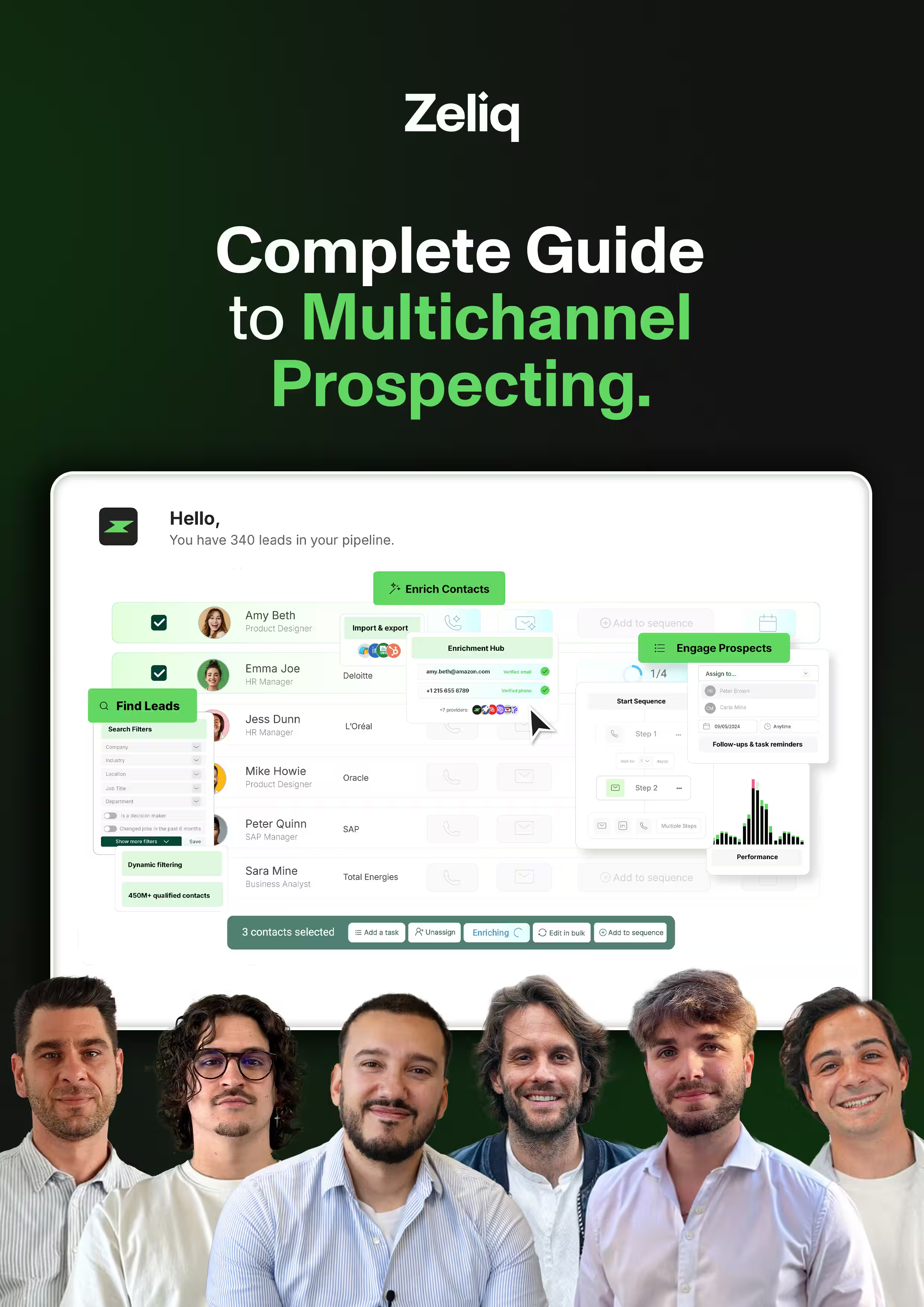
Zeliq combines a 450M+ contact database, waterfall enrichment across 40+ providers, and multichannel sequences (email, LinkedIn, calls) in one platform, with native sync to HubSpot, Salesforce and Pipedrive. See how Zeliq’s multichannel sequences work or browse the lead database.
Inbound vs outbound SDR
Some teams split the SDR function in two. Inbound SDRs (sometimes called MDRs, Market Development Reps) only handle leads that came in through marketing channels: demo requests, content downloads, free trial signups, webinar attendees. Outbound SDRs only run cold sequences against ICP accounts that have never engaged.
The split makes sense at scale (above 8 to 10 SDRs) because the work is genuinely different. Inbound is faster, higher conversion, requires speed to lead and quick qualification. Outbound is slower, lower conversion, requires research, patience and persistence. Mixing both for the same rep means inbound always wins (it converts faster) and outbound starves.
Below that scale, most SDRs do both. The split is 30 to 50 percent inbound and 50 to 70 percent outbound depending on how much demand marketing generates.
Hiring an SDR: profile, interview, ramp
For a sales leader or founder hiring their first SDR, three questions matter more than years of experience.
Can they hold a 10 minute conversation with a stranger that ends well? Test it in interview. Ask them to cold call you on a sample ICP and watch how they handle objection one, two and three.
Are they coachable? Give them feedback on a writing sample or a mock call mid interview and see if they incorporate it. Reps who argue with feedback in interview will argue with feedback for two years.
Do they care about the work? Ask them to walk through a sequence they wrote, or what they would change about an outreach email they recently received. The answer reveals whether they have a perspective or are just looking for a job.
30 / 60 / 90 day plan for a new SDR
- Days 1 to 30: product training, ICP deep dive, listening to 20+ AE calls, shadowing top SDR, soft pitch certification at day 30, first sequences live by day 21.
- Days 31 to 60: ramp quota at 50 percent, daily volume target met, weekly 1:1 with manager on pipeline, first qualified meeting accepted by AE.
- Days 61 to 90: ramp quota at 75 percent, full sequence ownership, contributing to template library, hitting activity targets consistently. Full quota at day 91.
SDR to AE ratios
The right ratio depends on motion and ACV.
- PLG / SMB / inbound heavy: 1 SDR per 2 to 3 AEs (1:2 to 1:3). The AE handles a lot of self serve flow, SDR augments with outbound.
- Mid market: 1:1 to 1.5:1. Each AE needs a dedicated SDR feeding pipeline.
- Enterprise / strategic: 2:1 to 3:1 SDR per AE. Each enterprise AE gets multiple SDRs working their named accounts.
Hiring an AE without an SDR (or an SDR without a clear AE to hand to) breaks the model.
Common mistakes that kill SDR performance
Generic messaging. “Hi {first name}, I’m with {company}, we help {role} do {value prop}”. The lowest performing template on the planet, still in use everywhere. Personalize on the company, the role, and one recent signal. Even one line of real personalization beats four lines of generic.
Quitting too early on a sequence. Most meetings book on touch 4 to 7. Reps who give up at touch 2 leave 60 percent of pipeline on the table.
Skipping qualification to hit meeting numbers. Booking a meeting with anyone who agrees to talk inflates the dashboard and tanks the SQL acceptance rate. The AE remembers.
One channel only. Email only is half the pipeline of email plus LinkedIn plus phone. The marginal effort of adding LinkedIn is small, the marginal pipeline is large.
No measurement of personal KPIs. A rep who does not know their own reply rate, meeting rate and SQL acceptance cannot improve. Weekly self review of the funnel is non negotiable.
Bad CRM hygiene. Already said it twice. Saying it three times.
What AI changes (and does not change)
AI has reshaped the SDR job since 2023. In 2026 it is built into almost every sales engagement platform.
What AI does well
Account research. Summarizing a company’s recent news, funding history, leadership changes, tech stack and likely pain in 60 seconds, instead of 20 minutes of manual digging.
First draft personalization. Producing a context aware opening line for an email or LinkedIn message based on the account’s news.
Reply suggestions. Drafting a tailored answer to a prospect’s reply that the SDR validates in 30 seconds.
Call coaching. Conversation intelligence that flags filler words, monologues, missed buyer questions, talk to listen ratios.
List scoring. Predicting which accounts in a list are most likely to convert based on intent and fit signals.
The productivity gain is real. A rep with AI tooling produces 3x to 5x the volume of a rep without, at similar or better quality, if the rep knows what they are doing. AI amplifies skill. It also amplifies bad work, which is why mass AI generated outbound is often worse than a smaller, hand crafted campaign.
What AI does not replace
Human qualification. Asking the right follow up question on a discovery call when the prospect says “we are looking at a few options”. AI cannot read silence, hesitation, or the unsaid concern.
Trust building. A buyer agreeing to take a meeting with a stranger is a small leap of trust. That leap happens between two humans, not between a buyer and a chatbot.
Strategic thinking on accounts. Deciding which six personas to multi thread inside a target account, who the real economic buyer is, how to time the outreach with a budget cycle. AI helps. The rep decides.
Resilience and persistence. AI does not feel discouraged after 50 no replies, but the rep does. Owning that emotional load is part of the job.
The SDR role is not disappearing. It is changing shape. Reps who learn to operate AI tools as a force multiplier earn more and stay relevant. Reps who use AI to spam at scale produce noise and get filtered out by buyers and by their own managers.
Frequently asked questions about the SDR role
Is SDR a good entry job into sales?
Yes. It is the most common, most documented and most coached entry path into B2B sales in 2026. The skills you build (cold outreach, qualification, CRM, multichannel sequencing) are the foundation of everything else in sales. A 12 to 24 month SDR stint is the standard launchpad to AE, manager, RevOps or CS.
How long should you stay in an SDR role?
12 to 24 months is the sweet spot. Less than 12 months and you have not seen a full cycle of ramp, plateau and breakthrough. More than 24 months without promotion at the same company is usually a signal that either the company has no career path or the rep is not yet ready. In both cases, time to make a move.
Do SDRs make good money?
In the US in 2026, yes. National OTE for a productive SDR is $75k to $100k, with senior reps and team leads pushing $120k to $165k. Bay Area and NYC pay above that. The path to AE typically doubles the OTE within 24 to 36 months.
Can AI replace SDRs entirely?
No, not in 2026. AI replaces the lowest leverage parts of the job (research, first drafts, reply suggestions, list scoring). It does not replace the human conversation, qualification judgment or trust building. The rep who pairs with AI well outperforms both an unaided rep and a fully automated AI agent. Companies who tried full AI SDR replacement in 2023 to 2025 mostly walked it back after seeing reply rates drop.
What is the difference between an SDR and a BDR?
In most US companies, none. The titles are used interchangeably. When there is a real distinction, it is usually that BDRs handle 100 percent outbound on net new accounts, while SDRs split their time between inbound leads and outbound. Always confirm in the interview.
What KPIs should a sales leader track for an SDR team?
Three layers. Activity (touches, calls, sequences), conversion (reply rate, meeting rate, SQL acceptance), business impact (pipeline generated, closed won influenced). Skip any layer and you cannot diagnose where performance is breaking.
Wrapping up
The Sales Development Representative role in 2026 is more analytical, more technical and more leveraged by AI than it was five years ago. The fundamentals have not changed: identify the right accounts, reach out across channels, qualify, hand off cleanly. Reps who treat the job as a craft (great copywriting, disciplined volume, sharp qualification, clean CRM) build the foundation for a long sales career and earn well doing it.
For sales leaders and founders building a team, the playbook is consistent: hire for coachability and curiosity, set up a real 30/60/90 ramp, get the SDR to AE ratio right for your motion, and give the team a stack that consolidates rather than fragments. The teams that get those four things right outperform the rest by a wide margin.
To equip an SDR team with a stack built around modern outbound (lead database, waterfall enrichment, multichannel sequences, CRM sync) in one platform, check Zeliq’s pricing or explore the platform from a sales leader angle.