

Inbound vs Outbound: Sales and Marketing Compared in 2026
Most “inbound vs outbound” debates are framed wrong. Founders treat it like a religion, sales leaders default to whichever motion shipped pipeline fastest at their last company. None of these reflexes survive contact with a real 2026 go-to-market plan.
Inbound and outbound are two distinct motions with different intent signals, time-to-pipeline, unit economics and team profiles. The right question is never “which one”, it is “what mix, when, for which ICP, with which CAC tolerance”.
This guide breaks down the real differences between inbound and outbound in both marketing and sales, the channels that belong to each, the metrics that matter, the team structures that work, and the allbound playbook the best operators run today.
Defining inbound and outbound, properly
The cleanest way to separate the two is to ask one question: who initiated the contact? If the prospect raised their hand first, it is inbound. If you reached out cold, it is outbound. Channel, content, persona and automation are downstream consequences.
Inbound, in marketing and sales
Inbound marketing pulls prospects toward your brand through content they choose to consume: SEO articles, podcasts, lead magnets, organic social, webinars, communities. The prospect lands on your site, downloads an asset or asks for a demo.
Inbound sales is what happens after the hand raise. A demo request comes in, a free trial signs up, a pricing page lead fills the form. An AE or SDR qualifies and closes. The prospect already knows your category and often your brand, so the sales conversation starts at “evaluation”, not “awareness”.
Outbound, in marketing and sales
Outbound marketing pushes a message to an audience that did not ask for it: display ads on cold audiences, paid social on lookalikes, ABM campaigns on a target account list, direct mail, cold sponsorships. The brand picks the audience, not the other way around.
Outbound sales is the same logic at the rep level: cold email, cold call, LinkedIn outbound, multichannel sequences. An SDR builds a list against an ICP, sends sequenced touches, books meetings for AEs. The prospect did not ask for the contact.
Why people confuse the two
Three traps cause most of the noise:
- Paid is not always outbound. Google Search ads on category keywords are inbound (you capture demand someone already has). Display retargeting on a cold audience is outbound.
- Free is not always inbound. A LinkedIn DM blast is outbound even when it costs nothing.
- A “warm” lead is not always inbound. A customer referral is inbound. A reactivation email to a stale CRM contact is outbound.
Key differences: 5 dimensions that matter
| Dimension | Inbound | Outbound |
|---|---|---|
| Direction of intent | Prospect to vendor | Vendor to prospect |
| Time to first pipeline | 6 to 18 months | 1 to 4 weeks |
| CAC profile | High up front, decreasing over time | Stable, scales linearly with effort |
| Volume control | Limited (you depend on demand) | Total (you choose who to contact) |
| Scalability | Exponential after the SEO compounding kicks in | Linear with reps and tools |
| ICP signal quality | Strong (intent is implicit) | Variable (depends on targeting accuracy) |
| Sensitivity to external factors | Strong (Google updates, AI search) | Moderate (deliverability, regulations) |
| Lead temperature at handoff | Warm to hot | Cold to lukewarm |
Two takeaways. First, the unit economics behave very differently over time. Inbound looks expensive in year one because you pay for content, SEO and brand before pipeline materializes. By month 18, cost per inbound MQL collapses because the same content keeps producing leads at near zero marginal cost. Outbound is the opposite: cost per SQL is roughly stable from week one to year five because every meeting still needs human work.
Second, the predictability profile inverts. Outbound is predictable from week one. Inbound is unpredictable for a year, then becomes the most reliable channel you have.
Inbound channels: where prospects find you
Inbound is a portfolio. Most strong inbound machines combine three to five channels, with one or two doing the heavy lifting.
SEO and content marketing. The largest inbound channel for B2B SaaS: pillar guides, comparison pages, product-led articles, glossary entries. Time horizon: 6 to 18 months. Best for categories with established search demand.
Lead magnets and gated content. Whitepapers, templates, calculators, benchmarks. Trades email for value. Works only when the asset is genuinely useful.
Organic social. LinkedIn posts from founders and operators, X threads. The fastest inbound channel to bootstrap when SEO has not kicked in.
Webinars and virtual events. Long-form content that captures email and intent at the same time. Best when co-hosted with a complementary brand.
Referrals and word of mouth. Often underweighted. The highest converting inbound channel, but hard to engineer.
Partnerships. Co-marketing with complementary tools, integration marketplaces, listings on review sites (G2, Capterra, Product Hunt).
Podcasts. Hosting your own or appearing on others. Slow to convert directly but strong on brand and on closing complex deals.
The mistake most teams make is to spread thin across all seven channels in year one. Pick two, execute them well, add a third when the first two compound.
Outbound channels: where you find prospects
Outbound is also a portfolio, but with tighter feedback loops. You can run an outbound test in two weeks and read the result.
Cold email. The volume backbone of B2B outbound. Lives or dies on three things: list quality, deliverability (warm domains, sending limits, copy that does not trigger filters) and personalization at scale.
Cold calling. Still the highest connect rate channel for high-ACV motions. With a dialer and a clean phone database, an SDR can run 60 to 100 dials a day.
LinkedIn outbound. Connection requests with notes, voice notes, video DMs. Best for senior personas who do not open cold emails but check LinkedIn daily.
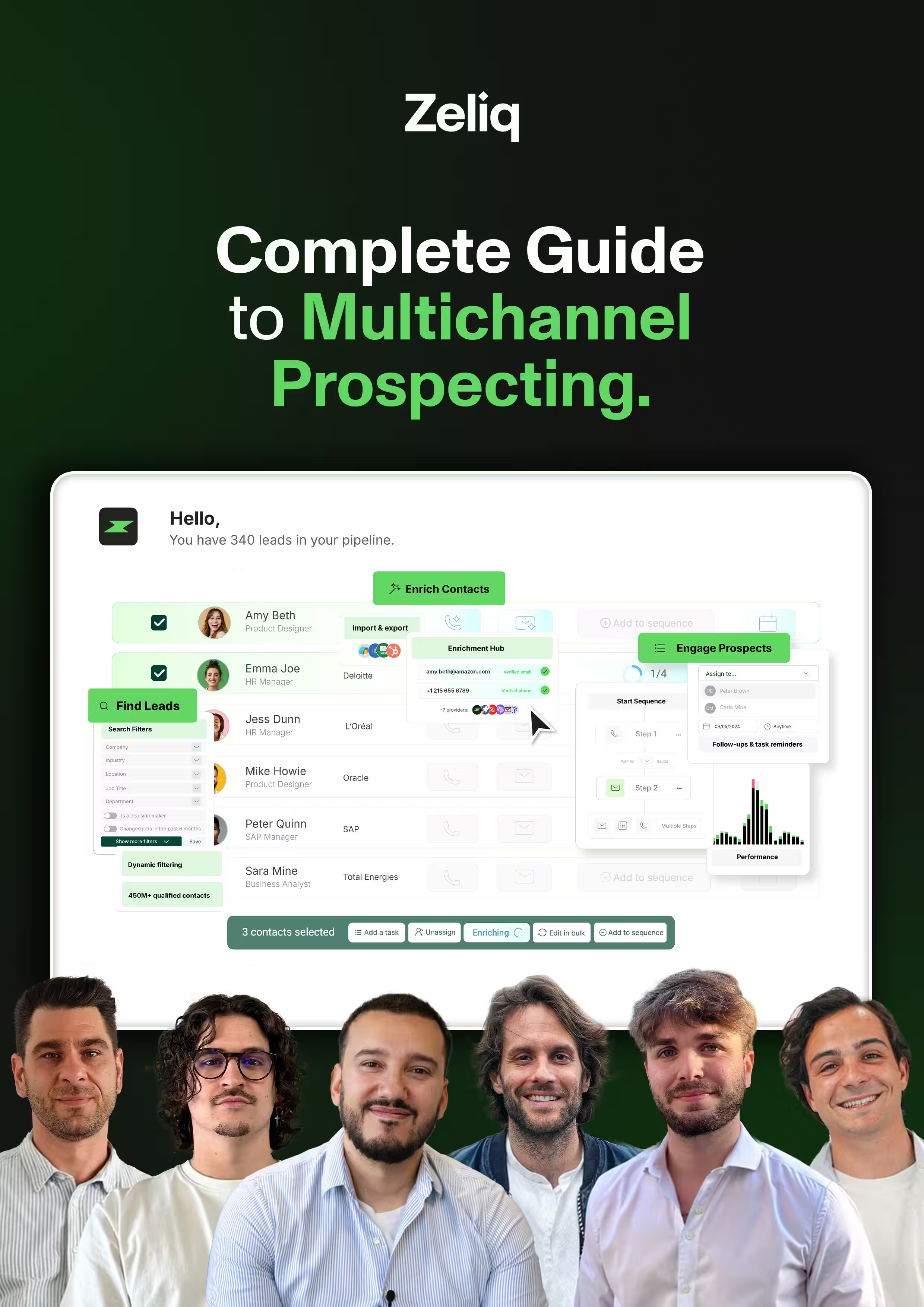
Multichannel sequences. The current standard. Email plus LinkedIn plus call plus voice DM, spread over 14 to 21 days. Multichannel sequences lift reply rates by 2 to 3 times versus single channel and reach prospects who only respond on one specific surface. Zeliq runs multichannel sequences natively, mixing email, LinkedIn and calls in the same cadence.
Paid intent. LinkedIn Ads on a target account list, Google Display retargeting on competitor searches, sponsorships of high-intent newsletters. You push the message, but the targeting is intent-led.
Account-based marketing (ABM). Tier 1 ABM is the most concentrated form of outbound: 50 to 200 named accounts get coordinated email, LinkedIn, ads, direct mail and sales touches over 90 days. High cost per account, high conversion when the list is right.
Field events. Sponsoring or hosting events for a tight ICP. Heavy investment, but unmatched on complex enterprise deals.
A 5k ARR motion with 100k accounts in TAM lives or dies on cold email plus calls. A 200k ARR enterprise motion with 800 accounts lives or dies on ABM plus field.
Comparison table: cost, speed, scale, signal
| Dimension | Inbound | Outbound | Best motion at |
|---|---|---|---|
| Cost to start | High (content, SEO, automation, brand) | Moderate (list, tools, 1 SDR) | Outbound at sub 1M ARR |
| Time to first meeting | 3 to 6 months | 1 to 2 weeks | Outbound at any stage when speed matters |
| Cost per qualified meeting | Decreasing, eventually low | Stable, mid range | Inbound at scale |
| Volume control | Low | High | Outbound when forecast pressure is high |
| Signal quality | High (implicit intent) | Variable | Inbound for late-stage funnel |
| Scalability ceiling | Very high once compounding | Linear with headcount | Inbound for enterprise growth |
| Brand contribution | Strong (content, SEO, podcast) | Weak (cold touches do not build brand) | Inbound for category leadership |
| ICP coverage | Limited to who searches | Total within TAM | Outbound for new categories |
Channel mix recommended by ARR stage
| Stage | Suggested mix | Logic |
|---|---|---|
| Pre-seed and seed (sub 1M ARR) | 70 to 80 percent outbound, 20 to 30 percent founder-led inbound (LinkedIn, podcast guesting) | Pipeline now, not in 18 months. Founder LinkedIn replaces SEO that is too slow. |
| Series A (1 to 5M ARR) | 50 to 60 percent outbound, 30 to 40 percent inbound (SEO, content), 10 percent events | Outbound still drives volume. Inbound starts compounding. |
| Series B (5 to 20M ARR) | 30 to 40 percent outbound (ABM-led), 50 to 60 percent inbound, 10 percent partnerships | Inbound takes over volume. Outbound gets sniper-style on top accounts. |
| Scale (20M+ ARR) | 20 to 30 percent outbound (enterprise ABM), 60 to 70 percent inbound, 10 percent field | Brand and SEO now dominant. Outbound exists for enterprise tier 1. |
Channel mix recommended by ICP density
ICP density is the variable most teams ignore. It changes the answer more than ARR stage does.
- Dense ICP (over 50k accounts in TAM, broad horizontal SaaS): Inbound is the only motion that scales without melting CAC. Outbound runs on a small subset (top accounts, ABM).
- Medium ICP (5k to 50k accounts): Both motions work. Hybrid is the rule.
- Narrow ICP (under 5k accounts, vertical SaaS, enterprise): Outbound and ABM dominate. Inbound exists mainly to support outbound (sales enablement content, social proof) rather than to generate volume.
A founder who overlays this table onto their own ARR and ICP density already has a smarter mix than most teams currently arguing about inbound versus outbound.
When inbound wins
Inbound dominates in five clear scenarios:
- High search volume in your category. If buyers are typing “best X tool” or “Y software for Z industry” thousands of times a month, SEO is your best CAC lever. One AI-voice generation SaaS brand proved this by ranking #1 organically for a competitor-alternative keyword, outperforming their own paid ads campaign in the same category.
- Long evaluation cycle with strong education needs. Buyers who need to understand the problem before buying read content for weeks. The brand that writes the best content gets the shortlist.
- Horizontal product, broad ICP. When TAM is too large to outbound exhaustively, inbound is the only motion that scales.
- Lower ACV, higher volume. Below 10k ARR, the math on a full SDR rarely works. Inbound and product-led growth take over.
- Long-term brand play. When the goal is category leadership, inbound and content win because they compound. Outbound never compounds.
When outbound wins
Outbound dominates in five equally clear scenarios:
- Pipeline urgency. Recently funded, missed the quarter, opening a new geography. Outbound delivers meetings in weeks.
- Narrow, named ICP. When you can list every account in TAM on a Google Sheet, outbound and ABM are surgically efficient.
- High ACV. Above 30k ARR, the unit economics of an SDR plus an AE on a small set of accounts crush any other motion.
- No search demand yet. New categories, new technical jargon, blue-ocean problems. Nobody searches for what you sell, so you have to go and tell them.
- Late-stage motions where intent data is the hand raise. When a target account triggers an intent signal (G2 visit, competitor research, hiring signal), outbound on that signal converts at multiples of cold outbound.
A solid lead database is the multiplier on every one of these scenarios: outbound only works if the underlying contact data is verified, fresh and filterable on the signals that matter for your ICP.
See multichannel sequences in action
If outbound is the right motion for you right now, the lever that matters is sequence quality. A clean cadence (email, LinkedIn, call) on a verified list converts 3 to 4 times better than a single-channel blast. Zeliq lets a small team run multichannel sequences from one platform without juggling four tools. Try multichannel sequences with Zeliq
Allbound: the hybrid motion the best teams run
The smartest operators in 2026 do not run inbound and outbound as separate machines. They orchestrate them into a single funnel, often called allbound. The principle: every signal feeds every motion.
Three patterns that work
Intent data plus outbound. Tools detect when a target account visits your pricing page, researches a competitor, or hires for a role that triggers your ICP. The SDR runs a personalized sequence that references the signal directly. Reply rates land 3 to 5 times above cold outbound.
Inbound retargeting outbound. A prospect visits the blog, downloads a guide, comes back twice in a week. The SDR sends a contextual cold email that references the asset consumed. The prospect reads it as helpful follow-up, not cold outreach.
Content-driven outbound. The SDR opens with a piece of original content (a benchmark, a template, a podcast) from marketing. The cold email becomes a value-first pitch with a CTA to book a meeting.
Why allbound beats either pure motion
A pure inbound team caps at the size of search demand. A pure outbound team caps at the size of the SDR org. Allbound uses inbound to qualify prospects (they self-identify as in-market) and outbound to compress the cycle (reach the prospect at the right moment with the right context). The compounding factor is the data layer: a clean CRM with intent signals and verified contacts feeds both motions, exactly what the growth marketing and revenue operations workflows enable when marketing and sales share the same prospect data.
Metrics by motion
Different motions, different metric sets. Reporting them on the same dashboard is the only way to know what is actually working.
Inbound metrics
- Organic traffic by intent (informational, commercial, branded).
- Visitor to MQL conversion rate.
- CPL inbound (cost per MQL). Drops over time.
- MQL to SQL conversion. Below 20 percent means the form fills are unqualified.
- Pipeline sourced inbound and inbound CAC payback.
Outbound metrics
- Activity volume. Emails, calls, LinkedIn touches per SDR per day.
- Reply rate and positive reply rate. Cold email reply rate above 8 percent is good. Positive reply above 2 percent is the real number.
- Meeting booked rate per 1000 touches sent.
- Show rate. A leak between booked and held meetings means qualification is too loose.
- Outbound CAC (SDR plus tools plus AE allocation, divided by closed-won) and pipeline sourced outbound.
Cross-motion metrics
- Win rate by source. Inbound usually wins at higher rates because intent is implicit. Track the gap.
- Sales cycle by source. Inbound cycles should be faster. If they are not, your inbound is not actually qualified.
- CAC payback and LTV to CAC by source. The numbers that tell you where to invest the next dollar. Healthy LTV to CAC is above 3.
Team structure: BDR vs SDR, RevOps, content
The two motions need different humans.
BDR (Business Development Rep). Outbound focused. Builds lists, runs sequences, books meetings on cold accounts. Comp tied to meetings booked plus pipeline created.
SDR (Sales Development Rep). Often inbound focused, sometimes hybrid. Qualifies demo requests, free trials, MQLs. Comp tied to qualified meetings and SQLs.
The BDR vs SDR split varies by company. The clearer split is outbound rep versus inbound rep, regardless of title. Mixing both on the same comp plan leads to reps cherry-picking inbound and ignoring outbound. Separate the queues if both motions run at scale.
Content lead or SEO owner. The single most leveraged hire on the inbound side. One strong content lead beats five generalist marketers.
RevOps. The connective tissue. Owns the data model, routing rules, attribution dashboard and tool stack. Without RevOps, inbound and outbound report on different numbers.
Founder. In early stage, the founder runs LinkedIn outbound, personal brand, podcast guesting and the first ABM list. This is the founders playbook before there is a sales team. Once a sales leader is hired, the motion gets formalized.
Tools stack: what you actually need
A workable B2B stack in 2026, by motion:
Inbound stack: CMS (Webflow, WordPress), SEO suite (Ahrefs, Semrush), marketing automation (HubSpot, Customer.io), webinar tool (Livestorm, Zoom), analytics (GA4, Mixpanel), reverse IP and intent (Albacross, 6sense).
Outbound stack: B2B contact database with verified emails and phones, sales engagement platform for multichannel sequences, dialer (Aircall, Ringover), LinkedIn automation, CRM, intent and signal layer (G2 buyer intent, hiring data, technographics).
Shared layer: CRM as single source of truth, data warehouse for attribution, Slack for handoffs.
The shared layer matters more than any single tool choice. A team running inbound and outbound on two disconnected stacks will lose a third of its data and most of its attribution. If you are evaluating tools, the Zeliq vs Apollo comparison walks through the real trade-offs on data quality, sequence reliability and pricing.
Common mistakes
Five mistakes that quietly burn pipeline and budget:
- Treating inbound and outbound as identities. They are tactics, not religions. The right answer is almost always both.
- Starting inbound too early. A pre-seed team spending 30k on SEO before product-market fit is buying traffic for a product that may not exist in 12 months. Outbound first, then inbound.
- Running outbound on unverified data. Bounce rates above 5 percent kill the sending domain in two weeks.
- Measuring in silos. When marketing reports MQLs and sales reports meetings, nobody reports closed-won by source, and the wrong KPIs get optimized.
- Under-staffing one side. Half an SDR does not produce half the outbound pipeline. There are minimum thresholds below which the motion is not viable.
What inbound and outbound mean for your pipeline
Inbound and outbound are two ways to produce the same thing: a qualified meeting with a buyer who fits your ICP. They differ on speed, cost, scale and signal quality, and the right mix depends on your ARR stage, ICP density, ACV and runway. The best teams do not pick one. They orchestrate both, instrument them in a shared CRM, and let the data decide where the next dollar goes.
If you are at a stage where outbound is the bottleneck (early ARR, narrow ICP, pipeline pressure), the lever is sequence quality on a verified database. If you are scaling and want to tighten how the two motions connect, the same logic applies at a larger scale.