.avif)

Go-to-Market Strategy: The Founder’s Most Important Document (2026 Guide)
Every founder writes a business plan. Few write a real go-to-market strategy. The result is predictable: a deck full of TAM numbers, a vague “we sell to mid-market”, and a sales team that ships activity instead of revenue. By 2026, with capital tighter and AI rewriting how outbound, content and demand work, the gap between teams that have a written GTM and teams that improvise has become the difference between hitting plan and missing by 40%.
This guide is the document we wish every founder, CMO, CEO and RevOps lead read before they hire their first SDR. It covers what GTM strategy actually is (and isn’t), the components that matter, the GTM motions on the table in 2026, how to pick the right one, what a real GTM plan contains, common mistakes, current trends, examples, and a 90-day sprint to build or rebuild yours.
What is a go-to-market strategy?
A go-to-market strategy is the operating system that turns a product into revenue. It answers four questions in writing, with enough specificity that a new VP Sales hired tomorrow could execute against it on Monday:
- Who are we selling to (ICP, segments, personas, buying committee)?
- What are we selling them (value proposition, positioning, pricing, packaging)?
- How do we acquire and convert them (channels, sales motion, marketing engine)?
- What does success look like (metrics, targets, time horizons)?
A GTM strategy is not a marketing plan. A marketing plan describes campaigns, content and channels in service of demand. A GTM strategy describes the whole system: product, pricing, sales, marketing, customer success, the org chart that delivers them, and the economics that make the whole thing work.
It is also not a business plan. A business plan answers “is this a real business?” with market size, financials and a roadmap. A GTM strategy answers “how exactly do we get the next 100, 1,000, 10,000 customers?” with channels, motions and unit economics.
Why GTM is the founder’s most important document
Most early-stage failure is not product failure. It is GTM failure. The product works for someone, but the founder cannot articulate who that someone is, why they should buy now, what they should pay, and how they should hear about it. The team scales spend before it scales clarity, and burns through the round.
A written GTM forces the founder to make tradeoffs in writing. It forces a single ICP instead of three. A single primary motion instead of “we’ll do PLG and outbound and channel”. A pricing model that matches the motion. Once on paper, it becomes the artifact that aligns the next ten hires, the board, and the customer-facing teams.
The components of a go-to-market strategy
A complete GTM rests on eight components. Skip one and the others become guesswork.
Ideal Customer Profile (ICP). A precise description of the type of company most likely to buy, get value fast, retain, and expand. Industry, size, geography, tech stack, growth stage, trigger events. “B2B SaaS” is not an ICP. “Series A B2B SaaS companies, 30 to 150 employees, US or Western Europe, with a sales team of 5 to 20 reps, using HubSpot or Salesforce” is.
Value proposition. The single sentence that explains why your ICP should care. Pain you solve, outcome you deliver, why you and not the alternative.
Positioning. Where you sit in the prospect’s mental map. Category, frame of reference, competitive alternatives, primary differentiator. Positioning is what you choose to be known for.
Pricing and packaging. What you charge, how you charge it, and how the tiers map to who is buying. Per seat, per usage, per outcome. Free, Pro, Enterprise. Annual contracts vs monthly. The pricing model has to fit the motion: PLG cannot run on quote-only pricing, enterprise cannot run on credit-card-only checkout.
Channels. How buyers discover you. Inbound (SEO, content, community), outbound (cold email, cold call, LinkedIn), paid (search, social, retargeting), partner (resellers, integrations, marketplaces), events, PLG (the product itself).
Sales motion. How a buyer goes from aware to closed. Self-serve checkout, low-touch sales-assist, full enterprise cycle with SDR, AE, SE and procurement.
Marketing engine. The system that produces demand: brand, content, demand gen, product marketing, lifecycle, community. The job is to make the right buyer arrive at the right channel with the right context.
Target metrics. The numbers that say it is working. CAC, payback period, LTV, LTV/CAC, NRR, time to first value, win rate, sales cycle, MQL to SQL to closed-won conversion.
The six GTM motions on the table in 2026
A “motion” is the dominant way you bring a product to market. Most companies use one as primary and a second as supporting. Trying to run three at once before product-market fit is the most common GTM mistake.
Product-Led Growth (PLG)
The product itself acquires, activates and converts users. Free trial or freemium, self-serve onboarding, in-product upgrade. Sales team focuses on expansion in mid-market and enterprise tiers. Works when the user is the buyer (or strongly influences them), the product delivers value in minutes, the price point fits a credit card, and the market is large.
Sales-Led Growth (SLG)
A staffed sales team owns the funnel. SDRs source pipeline, AEs close it, sales engineers handle technical evaluation. Marketing supplies inbound MQLs and brand. Works when the buyer is not the user, the price point requires a procurement process, the product needs implementation, or the market is concentrated and high-value.
Account-Based Marketing (ABM)
A focused subset of SLG. A finite list of named accounts (50, 200, 500) treated as a market of one. Marketing and sales jointly orchestrate multi-threaded campaigns, custom content, executive briefings, signal-based outreach. Works for enterprise products with six- and seven-figure ACVs and a small TAM.
Channel / partner-led
Resellers, system integrators, agencies and platform partners (HubSpot Solutions Partners, AWS, Salesforce ISVs) carry the load. You arm them, they sell to their book. Works when partners already own the buyer relationship and your product completes their offer.
Marketplace
Listing on AWS Marketplace, GCP Marketplace, Salesforce AppExchange, HubSpot Marketplace. Useful for enterprise procurement (companies with committed cloud spend), distribution to platform users, and shortened legal cycles. Rarely a primary motion, often a powerful supporting one.
Hybrid (PLG plus sales)
The 2026 default for scaling SaaS. Self-serve at the bottom of the market, sales-assisted in mid-market, full enterprise motion at the top. Two pricing tiers funnel into two operating models, which means two playbooks, two compensation structures, two sets of metrics. Hard to run, but the most efficient way to cover a wide market once PMF is in place.
How to choose your GTM motion
Five questions decide it. Answer them honestly, on paper, before you commit a quarter of headcount.
Question 1: Who is the buyer, and is the buyer also the user? If user equals buyer and the product delivers value alone, PLG is on the table. If the buyer is two layers above the user, SLG or ABM.
Question 2: What is your average contract value (ACV)? Under 5,000 USD ACV: PLG or hybrid. 5,000 to 50,000 USD: SLG or hybrid. Above 50,000 USD: SLG or ABM. Below 1,000 USD ARR you almost certainly cannot afford a sales team, even in low-cost geos.
Question 3: How dense is your ICP, and how big is the SOM? Under 1,000 named accounts in your serviceable market: ABM. 1,000 to 50,000: SLG or hybrid. Above 50,000: PLG or inbound-led.
Question 4: How long is the sales cycle? Under 14 days: PLG fits. 30 to 90 days: hybrid or SLG. 6 to 18 months: ABM with executive engagement.
Question 5: What is your ARR target and runway? A team that needs to add 5M ARR in 12 months on 6M of cash cannot run SLG with a 9-month ramp on every AE. The math has to close: pipeline coverage, ramp time, win rate, and ACV must produce the plan inside the runway.
If your answers conflict (large TAM, low ACV, long cycle, complex buyer), the motion has to compromise. That is the conversation to have with your board now, not in month nine when the bookings miss.
What a real GTM plan contains
A GTM plan is not a 60-slide deck. It is a working document, 10 to 20 pages, that the leadership team revisits every quarter. The structure that holds up:
1. Problem statement. The job-to-be-done you address, in the buyer’s words. Where it hurts today, what they currently use, why those alternatives fail.
2. Market sizing (TAM, SAM, SOM). Total addressable market, serviceable addressable market, serviceable obtainable market. Sized bottom-up (companies in your ICP times realistic ACV) not top-down (Gartner number times 1%).
3. ICP and personas. The firmographic and technographic criteria of the company. The personas inside the buying committee: economic buyer, champion, end user, technical evaluator. What each cares about, where each spends time, what each fears.
4. Value proposition. One-liner, paragraph version, deck version. Tested with 10 to 20 prospects before it ships.
5. Positioning canvas. Category, frame of reference, primary differentiator, three proof points. April Dunford’s template works fine.
6. Pricing and packaging. Tiers, included features, list price, discount policy, contract length. Mapped explicitly to motion and ICP segment.
7. Distribution channels. Each channel with: target persona, hypothesis, expected CAC, expected payback, owner, monthly investment.
8. Sales process. Stages, criteria for stage progression, expected conversion at each stage, sales cycle assumption, win rate assumption.
9. Marketing engine. Brand pillars, content pillars, demand-gen plays, lifecycle programs. Quarterly themes, not perpetual.
10. Org and headcount. The team that delivers it: PMM, demand gen, growth, SDR, AE, CSM. With ratios and hiring plan.
11. Success metrics. Targets for the next 4 quarters, with leading indicators reviewed weekly and lagging indicators reviewed monthly.
This document, kept current, is the most leveraged artifact in a B2B company. Treat it that way.
GTM by company stage
The GTM that gets you to PMF is not the GTM that gets you to 10M ARR, and is not the GTM that gets you to 100M.
Pre-PMF. No motion yet. The CEO, the founding engineer and one early hire are the GTM team. The job is to find one ICP segment willing to pay, by talking to 200 prospects, closing 10, and learning which 10 actually love the product. Do not hire SDRs. Do not run paid. Do not write 30 SEO posts. Do founder-led sales until repeatability is real.
Find-PMF. Maybe 1M to 3M ARR. The founder still closes deals. Add one AE who can carry the founder’s pitch and one growth marketer who can run inbound experiments. Document what works as it works. Pricing is still moving. Positioning is still moving. That is fine.
Scale (3 to 30M ARR). PMF is locked in for one segment. Now build the playbook: hire SDR plus AE pods, formalize ICP into firmographic filters, codify the messaging, instrument the funnel, build the demand engine. This is where most companies pick a primary motion (PLG, SLG, hybrid) and double down. Resist the urge to open a second motion until the first is repeatable.
Expand (30M+). Adjacent segments, new geographies, second product. Each adjacency is its own mini-GTM with its own ICP, motion and metrics. Channel partners, marketplace listings, vertical teams. The GTM doc becomes federated: a master plus one per segment.
If you are stuck because what worked at 5M is breaking at 15M, the answer is rarely effort and almost always GTM segmentation. The mid-market motion that closed 30K USD ACV deals will not close 200K USD enterprise deals without a different team, deck and process. Splitting the motion is the unlock.
Want better outbound inside your GTM?
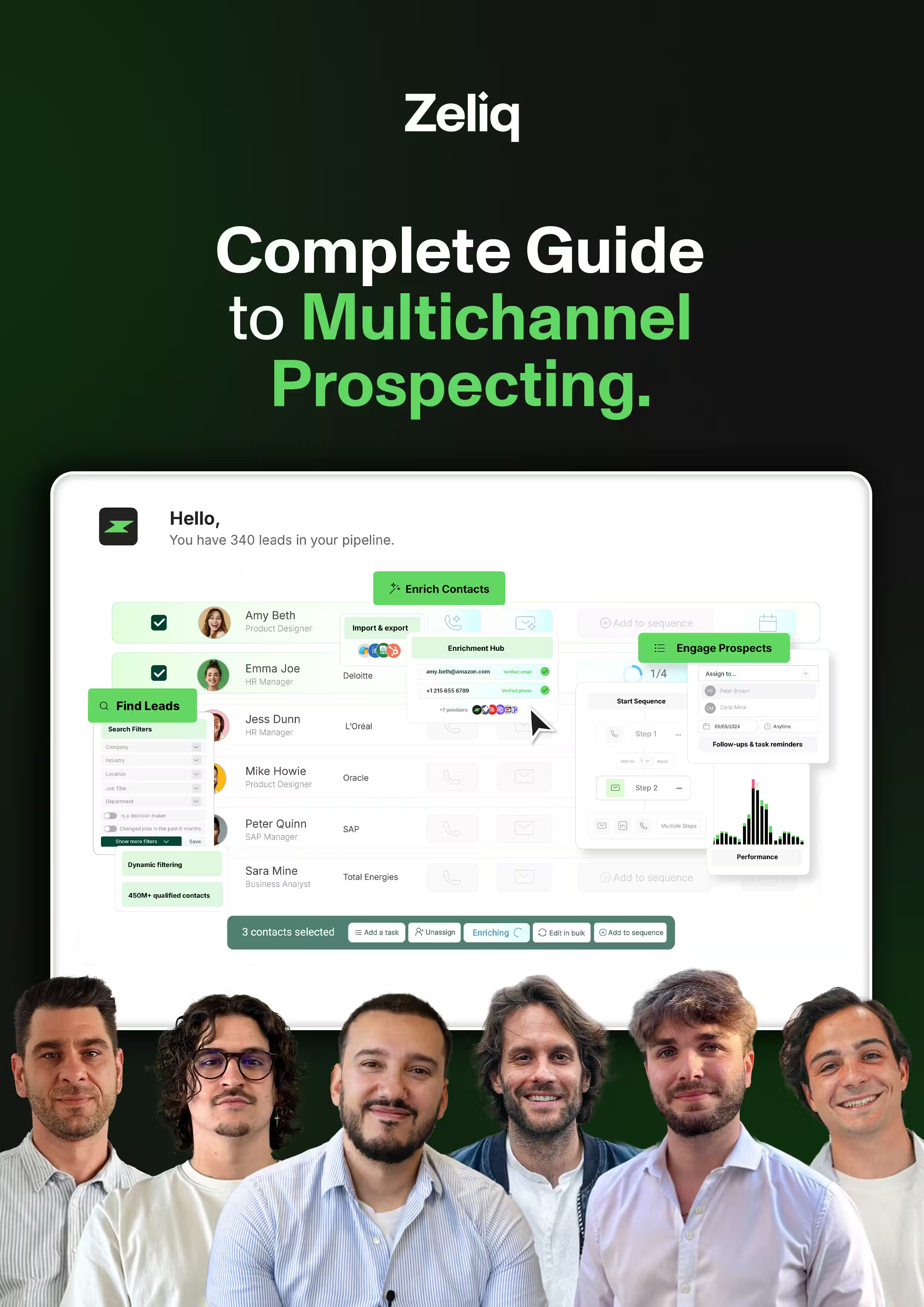
Outbound is a pillar of every motion that is not pure PLG. ABM lives on it. SLG lives on it. Hybrid uses it to seed the enterprise tier. The hard part is not “doing outbound”, it is doing it without four tools and three weeks of setup. Zeliq combines a 450M+ contact lead database, waterfall enrichment with verified emails and direct numbers, and multichannel sequences (email, LinkedIn, calls) inside a single workspace. If the outbound layer of your GTM is held together with duct tape, it is the cheapest place to upgrade. See how it fits a founder-led or RevOps-led setup.
The most common GTM mistakes
After reviewing dozens of founder-led GTM plans, the same mistakes repeat. Five worth flagging:
1. Boil-the-ocean ICP. “We sell to all companies that need productivity software.” When the ICP is everyone, no positioning sticks, no channel wins, no message converts. The fix is brutal narrowing: pick the segment where you already have three happy customers, and ignore the rest for two quarters.
2. Weak positioning. Generic category language (“the leading platform for sales teams”), no clear frame of reference, no differentiator a buyer can repeat to a colleague. Buyers do not buy what they cannot describe to their boss. April Dunford’s positioning canvas in one afternoon beats six months of brand work.
3. Wrong channel for the motion. Running a 30K ACV B2B SaaS on TikTok ads. Running a 200 USD per month tool on outbound to enterprise. Channel must match motion, motion must match ACV, ACV must match buyer. Misalignment shows up as bad CAC.
4. Premature scale. Hiring three SDRs before one founder-led repeatable cycle exists. The SDRs miss quota, you fire them, the team blames “outbound doesn’t work”. Outbound did not fail. The motion was not yet ready to scale.
5. No ICP discipline. Sales accepts any logo that pays. Six months later, half the book is off-ICP, churns at 25%, eats CSM time, and drags down NRR. The fix is upstream: kill off-ICP deals at qualification, even when they would close.
2026 GTM trends worth tracking
Five shifts that are reshaping how GTM gets executed this year.
AI-led PLG. AI-native products are compressing time-to-value from days to seconds. Sign up, see output in 30 seconds, hit a usage wall in 5 minutes. Activation is now an LLM problem, not a feature-tour problem. Companies that win will instrument activation against signals (real workflows completed, not feature clicks).
RevOps centrality. RevOps moved from spreadsheet-keepers to GTM architects. They own attribution, forecasting, ICP scoring, sales tooling, and increasingly the data model that the whole GTM rides on. The best founders now hire RevOps before VP Marketing.
Signal-based outbound. Sequence-the-list outbound is dying. Sequence-the-signal is rising: hiring data, funding events, tech-stack changes, job changes, intent data, podcast appearances. Reps run smaller lists with higher relevance, fueled by intent platforms and AI research.
Community-led growth. Slack groups, Discord servers, niche LinkedIn networks, peer roundtables. Buyers trust peers more than vendors. Companies that staff a community lead and run real (not “engagement-bait”) communities buy themselves an unfair top-of-funnel.
Dark social attribution. Most B2B influence happens in places marketers cannot track: LinkedIn DMs, Slack chats, podcasts, peer Slacks. Last-touch attribution lies. Best-in-class teams now triangulate self-reported attribution (“how did you hear about us?”) with multi-touch models, and stop killing channels just because the spreadsheet does not credit them.
Four GTM examples worth studying
Notion (PLG). Free product, viral templates, community-driven marketing, paid sales motion built on top once enterprise demand emerged. Lesson: PLG is not “no sales team”. It is “sales team enters the funnel where the user has already self-qualified”.
Snowflake (enterprise). Heavy AE motion, deep field marketing, premium positioning, cloud marketplace distribution. Lesson: in enterprise, GTM is field-led and platform-distributed. Not a contradiction.
HubSpot (inbound). Built the inbound playbook by living it: content, SEO, free tools, freemium product. Hybrid motion bolted on once mid-market demand outgrew self-serve. Lesson: a defensible content moat, compounded over years, becomes a CAC advantage no competitor can copy on a 12-month plan.
Outreach (SLG). Strong outbound motion targeting other sales teams, expert content, fast field marketing. Lesson: when your buyer is a sales leader, the sales team is your most credible marketing channel. Demonstrate the product by using it on them.
How to build (or rebuild) your GTM in 90 days
A 90-day sprint that works for a series A or for a 30M ARR company resetting after a missed plan.
Days 1 to 15: research and decisions. Re-interview 20 best customers and 10 lost deals. Write the ICP from data, not gut. Pick one primary motion. Draft the positioning canvas. Decide pricing direction.
Days 16 to 30: write the document. Produce the 10 to 20 pages described above. Get sign-off from CEO, head of sales, head of marketing and head of product. This is non-negotiable: a GTM no one signs off is a GTM no one executes.
Days 31 to 60: instrument and ship. Stand up the metric stack (CRM hygiene, attribution, funnel reporting). Launch the first three plays per channel. Hire or reassign roles. Kill the channels and segments the new doc rules out.
Days 61 to 90: review and iterate. Look at leading indicators weekly. At day 90, hold a formal GTM review: what is hitting plan, what is not, what we change next quarter. Update the document. Ship v1.1.
A 90-day cycle that runs every quarter is the rhythm that keeps GTM alive. A GTM written once and never revisited is a GTM that decays.
The team that runs the GTM
A scaled GTM org by 2026 looks roughly like this:
- Product Marketing Manager (PMM). Owns positioning, messaging, launches, sales enablement.
- Demand Generation. Owns paid, lifecycle, programs, MQL volume.
- Content / SEO. Owns inbound traffic, brand authority, organic pipeline.
- SDR / BDR. Owns top-of-funnel outbound, qualifies into AE.
- Account Executive (AE). Owns the close.
- Sales Engineer (SE). Owns technical eval (in mid-market and enterprise).
- Customer Success Manager (CSM). Owns retention, expansion, advocacy.
- RevOps. Owns the data model, the tooling, the forecasting, the GTM architecture.
Pre-5M ARR you do not have all of these, and that is fine: the founder plays PMM, the first marketer plays demand-gen plus content, one SDR plus one AE covers sales, the founder plays CSM. The structure above is the destination, not the starting line.
For a deeper look at how this maps to roles, see Zeliq’s pages for founders and sales leaders.
Measuring GTM: the metrics that matter
Six numbers a CEO, CMO and RevOps lead should know cold:
1. CAC payback. Months to recover the fully-loaded acquisition cost of a customer. Healthy SaaS sits at 12 to 18 months. Above 24 in mid-market is a red flag.
2. LTV / CAC. Lifetime value over acquisition cost. Above 3 is healthy. Below 1.5 means the unit economics will not scale.
3. Net Revenue Retention (NRR). Revenue from existing customers, year over year, after upsell, downgrade and churn. Above 110% is good. Above 120% is excellent. Below 90% means the bucket has a hole and you cannot pour fast enough.
4. Time to first value (TTFV). Minutes, hours or days from sign-up to first measurable value moment. The best leading indicator of activation, retention and expansion combined.
5. Win rate. Of qualified opportunities, what percentage close. Below 15% in SLG suggests qualification is loose. Above 35% suggests AEs may be cherry-picking.
6. Pipeline coverage. Open pipeline divided by quarter quota. 3x is the floor for a healthy SLG team. Below 2x going into a quarter is an early warning to fix today.
These six are the dashboard. Everything else (MQLs, demos booked, replies, opens) is leading indicator detail underneath them.
FAQ
Is GTM strategy the same as marketing strategy? No. Marketing strategy is one input into GTM. GTM also covers product packaging, pricing, sales motion, channel mix, customer success and the org chart. Marketing is a function. GTM is a system.
Do early-stage startups need a written GTM? Yes. Especially early-stage. The risk is not over-engineering, it is making implicit assumptions that diverge across the founding team. Five pages of decisions written down beats 30 pages of polish.
How often should we update the GTM? Light review every quarter. Full rewrite once a year, or any time a major input changes (new product line, new geography, motion change, big competitive shift).
PLG or SLG: which scales faster? PLG scales faster top-of-funnel but caps lower if the buyer needs a procurement process. SLG scales linearly with headcount but reaches enterprise revenue PLG cannot. The best 2026 motion is hybrid: PLG to seed users, sales to convert and expand.
Who owns the GTM strategy? The CEO, supported by a CRO or VP of GTM if one exists. Marketing, sales and product feed it. RevOps instruments it. CS protects it. But ownership sits with the CEO until the company is large enough for a CRO to inherit it.
Make your GTM ship pipeline
A go-to-market strategy is only worth the revenue it produces. The document forces clarity. The motion forces execution. The metrics force iteration. Treat it like product: ship a v1, instrument it, iterate on signal, do not let it gather dust.
When you are ready to wire the outbound layer of that strategy, start a free trial or explore Zeliq pricing to see how a unified find, enrich and engage stack fits a modern GTM.