

Business Development in 2026: Strategy, Roles, Salaries, KPIs
You lead a GTM team, you just took a Business Development Manager role, or you are a founder trying to build your first growth engine, and the same questions keep coming back. What does business development actually cover today? Where does it stop and where does sales begin? Which channels work in 2026, and what does a real business development plan look like? Most online content blurs the lines between marketing, sales and business development, and ends up confusing more than helping.
This guide sets clear definitions, walks you through a modern business development strategy, separates BD vs sales vs partnerships, maps the roles (BDR, BDM, Head of BD, VP BD), gives indicative US salary ranges, and covers the 2026 stack including AI workflows for signal-based outreach and partner intelligence.
You will find inside:
- A working definition of business development and a clean comparison with sales, marketing and partnerships.
- The scope of BD: new market entry, partnerships, key accounts, M&A pipeline.
- A 6-step business development process from ICP to deal handoff.
- The role ladder, key skills and US salary ranges in 2026.
- KPIs, stack, common mistakes and how AI is reshaping the function.
What is business development? (Definition)
Business development is the function that drives strategic growth by opening new revenue paths beyond the direct sales motion. It builds new markets, structures partnerships, qualifies and develops key accounts, and feeds the broader pipeline that sales then closes. In its purest form, business development is about creating opportunities at scale, not closing them one by one.
In practice, the function covers three things:
- Identifying and entering new markets (vertical, geographical or segment).
- Structuring partnerships (technology, channel, strategic alliances) that generate sourced or influenced revenue.
- Developing strategic accounts that the standard sales motion would not unlock in time.
That is the strict, scale-up definition. In startups, BD often overlaps significantly with sales: a founding BD might run cold outreach, close mid-sized deals and chase partnerships in the same week. The line only gets drawn cleanly once the company hits a scale where specialization pays off, typically beyond Series A or B.
BD vs sales vs marketing vs partnerships
Four functions, four horizons, four metrics. The line between them is not academic, it changes how you hire, budget and measure performance.
| Function | Horizon | Main scope | Core metric |
|---|---|---|---|
| Marketing | Long term (demand, brand) | Awareness, content, demand gen | MQLs, share of voice, traffic |
| Business development | Mid term (channels, partnerships, new markets) | Strategic growth opportunities | Sourced/influenced pipeline, partner ARR |
| Partnerships | Mid term (specific lane within BD) | Tech, channel, co-sell deals | Partner-sourced revenue, attach rate |
| Sales | Short term (closing) | Opportunities, negotiation, signature | Win rate, ASP, sales cycle |
Two common mistakes flow from confusing these functions. First, asking BD to chase quotas like a sales team destroys the long-cycle, strategic nature of the work. Second, asking sales reps to “do BD” pushes them away from closing, the activity they were hired for, and produces both bad partnerships and missed quota.
BD vs sales: the cleanest test
When in doubt, use this test. If the activity primarily closes a deal in the current quarter, it is sales. If it primarily builds a deal flow that will close in 2 to 6 quarters, it is BD. A BDR booking demos is sales-adjacent, more demand gen. A BD person negotiating a co-sell agreement with a SI partner is BD. A field AE running a contract negotiation is sales. The handoff between BD and sales is therefore one of the most important interfaces to design.
Why business development matters more in 2026
The B2B buying landscape has shifted in three concrete ways that elevate BD from a “nice to have” to a core function.
Ecosystem play has become the rule. Modern B2B buyers expect their tools to plug into their existing stack out of the box. A SaaS that does not integrate with the buyer’s CRM, CDP, data warehouse, billing tool or workflow platform loses deals before they reach the negotiation phase. Building and maintaining a strong integration footprint is BD territory, not engineering territory alone.
The API economy creates new go-to-market motions. Product-led growth, partner-led growth, and ecosystem-led growth coexist with traditional outbound. A scale-up in 2026 typically runs at least three GTM motions in parallel, and the orchestration of those motions sits in the BD function.
Channel partnerships are back. After a decade where direct outbound dominated, the saturation of cold channels (email deliverability tightening, LinkedIn fatigue) and the rise of system integrators in regulated industries (FSI, healthcare, public sector) have made channel partnerships strategically important again. Programs that share revenue with implementation partners, MSPs or category resellers can contribute 20 to 40% of pipeline at scale.
The combined effect is that BD is no longer a back-office function. In 2026, the maturity of a B2B company is partly measured by the quality of its BD playbook.
The scope of business development
BD is a broad umbrella. To make the function operational, split it into five concrete sub-scopes that you can staff and measure independently.
New market entry. Bringing the product to a new vertical (FSI, healthcare, manufacturing), a new geography (EMEA expansion, US entry, APAC), or a new segment (SMB to mid-market, mid-market to enterprise). Requires market sizing, ICP refinement, localization (product, pricing, messaging), and a launch playbook with first reference customers.
Strategic alliances. Long-term partnerships with companies that share part of your value chain: technology vendors whose product completes yours, advisory firms whose recommendations carry weight, or industry bodies that legitimize your category. Rarely produce direct revenue in quarter one, but they reshape competitive dynamics over 12 to 24 months.
Channel partnerships. Resellers, system integrators, MSPs or referral partners who distribute your product. Channel motions require explicit margin design, partner enablement (training, demo environments, co-marketing), and a clean rules-of-engagement document to avoid conflict with the direct sales team. Resources for sales leaders often dig into the cost structure of these motions.
Key accounts and named accounts. A small list of strategic accounts that justify a custom approach. Each account gets a dedicated account plan, a multi-stakeholder map, a 6 to 12 month engagement plan and a named sponsor on your side. This is where account-based marketing tools and tactics live in 2026.
M&A and inorganic pipeline. For mature companies, BD also feeds the M&A engine: surfacing targets, building early relationships, and structuring partnerships that may evolve into acquisitions. A Head of BD or VP BD responsibility, not a BDR one.
The 6-step business development process
A clean BD motion in 2026 follows six steps, regardless of whether you are working partnerships, key accounts or new market entry.
1. ICP and market mapping. Define your ideal partner or account profile with the same rigor you would apply to a sales ICP. For partnerships: tech stack, deal sizes handled, customer overlap. For key accounts: industry, company size, buying triggers. Then build the map: who are the 50, 200 or 500 targets that fit. Without this map, BD becomes networking in a vacuum.
2. Partner / prospect identification. Combine databases (firmographic, technographic), industry directories, partner ecosystems and event lists to build the working list. Waterfall enrichment becomes a sourcing tool, not just an outbound prep tool: you enrich with contact data, recent funding, hiring signals and tech stack changes, then sort by likelihood to engage.
3. Outreach. BD outreach differs from sales outreach in three ways. The cadence is longer (8 to 12 touchpoints over 60 to 90 days versus 4 to 6 over 14 to 21 days). The angle is collaborative rather than transactional: mutual exploration, a meeting between leadership teams. And the channels weight more toward LinkedIn, warm intros and events. That said, a high-quality cold email remains a legitimate BD entry point.
4. Qualification. Once a conversation is open, qualify quickly: mutual fit, timing, right sponsor on their side, what a pilot looks like. BD-grade qualification borrows from BANT and MEDDIC but adds two dimensions: strategic alignment over 12 to 24 months, and the partner’s ability to commit resources (not just sign a contract).
5. Structuring the deal. Where BD diverges most from sales. You design a partnership agreement (margin share, co-marketing budget, joint roadmap), a pilot scope (one customer, one quarter, defined success metrics), or an enterprise master agreement. Legal, finance and product teams get involved.
6. Handoff and follow-through. Once the deal is signed, BD hands off to the operating teams: partner manager, customer success, alliance manager, sales for direct revenue. A clean handoff document, a joint kickoff and a 30/60/90 day review cycle determine whether the partnership produces revenue or dies in a desk drawer.
How do you structure a business development plan that actually works?
A business development plan that works fits on two pages and answers six questions: what is the target market (vertical, geography, segment), which BD motions will you run (alliances, channel, key accounts, M&A pipeline), what is the resource plan (headcount, budget, tooling), what are the milestones for the next four quarters, what are the 4 to 6 KPIs, and who is accountable for what. Anything longer than two pages turns into a slide deck nobody reads.
Business development roles and the BD career ladder
The function is staffed differently depending on company stage. Below is the typical ladder from entry to VP, plus the variations you will see in startups versus scale-ups.
Business Development Representative (BDR). Entry-level role: research accounts, build target lists, run cold outreach across email, LinkedIn and phone, hand off qualified opportunities to the AE. Sometimes split BDR (outbound) / SDR (inbound), but the line blurs in most modern teams. Daily reality: 50 to 100 touchpoints, 8 to 15 meaningful conversations, 2 to 5 qualified meetings booked per week.
Business Development Manager (BDM). Owns a defined territory or partnership portfolio. Sources, qualifies and develops opportunities to a more advanced stage than a BDR, often co-selling with an AE on strategic deals. In some structures, the BDM also closes mid-sized partnerships directly.
Head of Business Development. Owns the overall BD strategy: which markets, which partnerships, which key accounts. Manages a team (typically 3 to 15 people), designs the playbook, reports to the CRO, COO or CEO. Requires deep market understanding, C-level negotiation, and a track record of structuring deals that produce revenue. The dedicated business developer hub on Zeliq covers the tactical end of this role.
VP Business Development. At enterprise scale, peer to the CRO and the Chief Strategy Officer. Corporate development, large strategic partnerships, M&A pipeline, ecosystem strategy. Compensation includes significant equity. Exists in scale-ups beyond Series C and at enterprise scale.
Startup BD. In a startup of 5 to 30 people, BD is almost always owned by a founder, augmented by one or two generalist hires. The discipline matters as much as in a scale-up, but the structure is more fluid. Founders should still write a one-page plan with ICP, target accounts and KPIs. Resources for founders walk through this in more detail.
Key skills across the BD ladder
Seven skills compound across a BD career: relationship building (a useful network maintained over years), negotiation (deals that create value for both sides), market analysis (reading a TAM and timing a segment), executive presence (holding your own in a C-level room), copywriting (cold outreach that gets a reply), strategic thinking (the partnership that compounds over 24 months), and operational rigor (pipeline hygiene, CRM discipline, follow-through). None of these are learned in a classroom: they sharpen with prospect contact, pipeline reviews, and lost-deal debriefs.
Business development salaries in the US (2026 indicative ranges)
The ranges below reflect typical OTE (on-target earnings) for the US market in early 2026, weighted toward major metros (SF Bay Area, NYC, Boston, Austin). They combine base salary plus variable, before equity. Variation comes from segment (SMB vs enterprise), industry (FSI and healthcare typically pay 10-20% more), geography, and whether the company is private or public.
| Role | Junior (0-2y) | Mid (3-5y) | Senior / Lead (5+y) |
|---|---|---|---|
| BDR / SDR | $60-80K OTE | $80-110K OTE | $110-140K OTE (Senior BDR / Team Lead) |
| Business Development Manager | $100-130K OTE | $130-180K OTE | $180-240K OTE |
| Account Executive | $120-160K OTE | $160-230K OTE | $230-350K+ OTE |
| Head of Business Development | n/a | $200-280K OTE | $280-400K+ OTE |
| VP Business Development | n/a | n/a | $350K-600K+ OTE + equity |
| Key Account Manager / Strategic Accounts | $110-150K OTE | $160-220K OTE | $220-320K OTE |
Variable compensation typically represents 30 to 50% of OTE for revenue-carrying roles (AE, KAM, BDM with quota) and 25 to 40% for BDR/SDR roles. Equity grants are meaningful at scale-up and pre-IPO companies, often adding 20 to 60% to the realized package over a 4-year vesting period for VP-level hires.
The KPIs of business development in 2026
A focused BD function tracks 6 to 8 KPIs. More than that becomes noise.
Pipeline contribution (sourced and influenced). Volume of pipeline generated by BD, split between sourced (BD opened the account from cold) and influenced (BD touched the account meaningfully, even when marketing or sales sourced it first). A healthy BD team contributes 25 to 50% of total pipeline depending on the GTM motion.
Partnership ARR. Recurring revenue directly attributable to partnership programs. Track it separately from direct sales ARR to avoid double counting. In a mature SaaS, partnership ARR can represent 15 to 30% of total ARR.
Partner-sourced revenue percentage. Share of new logo revenue brought in by partners versus direct sales. A target of 25 to 40% over three years is typical when channel is a strategic priority.
Expansion ARR. Recurring revenue added from existing customers via upsell and cross-sell. Shared metric with Customer Success and Account Management. Expansion is where the highest-margin growth comes from.
Net Revenue Retention (NRR). Combined renewal, expansion and churn metric on the installed base. Above 110% is healthy expansion. Above 130% is best-in-class. Below 90% signals a churn problem that no amount of new logo acquisition can offset over time.
Partner activation rate. Share of signed partners that have actually generated revenue in the last quarter. A program with 50 signed partners and only 5 actively producing pipeline is a list, not a program. Above 40% activation is healthy.
Time to first partner-sourced deal. Below 90 days is excellent. Above 180 days suggests the partner enablement plan is too thin.
What is the most important KPI in business development?
There is no universal answer, but if you must pick one early in the function’s life, track BD-sourced pipeline in dollar value per week, segmented by motion (channel, alliance, key accounts, new market). It is the leading indicator that tells you whether the BD engine is actually building deal flow or just generating activity. Revenue follows pipeline with a lag of 2 to 6 quarters in most B2B SaaS.
How Zeliq supports modern business development outreach
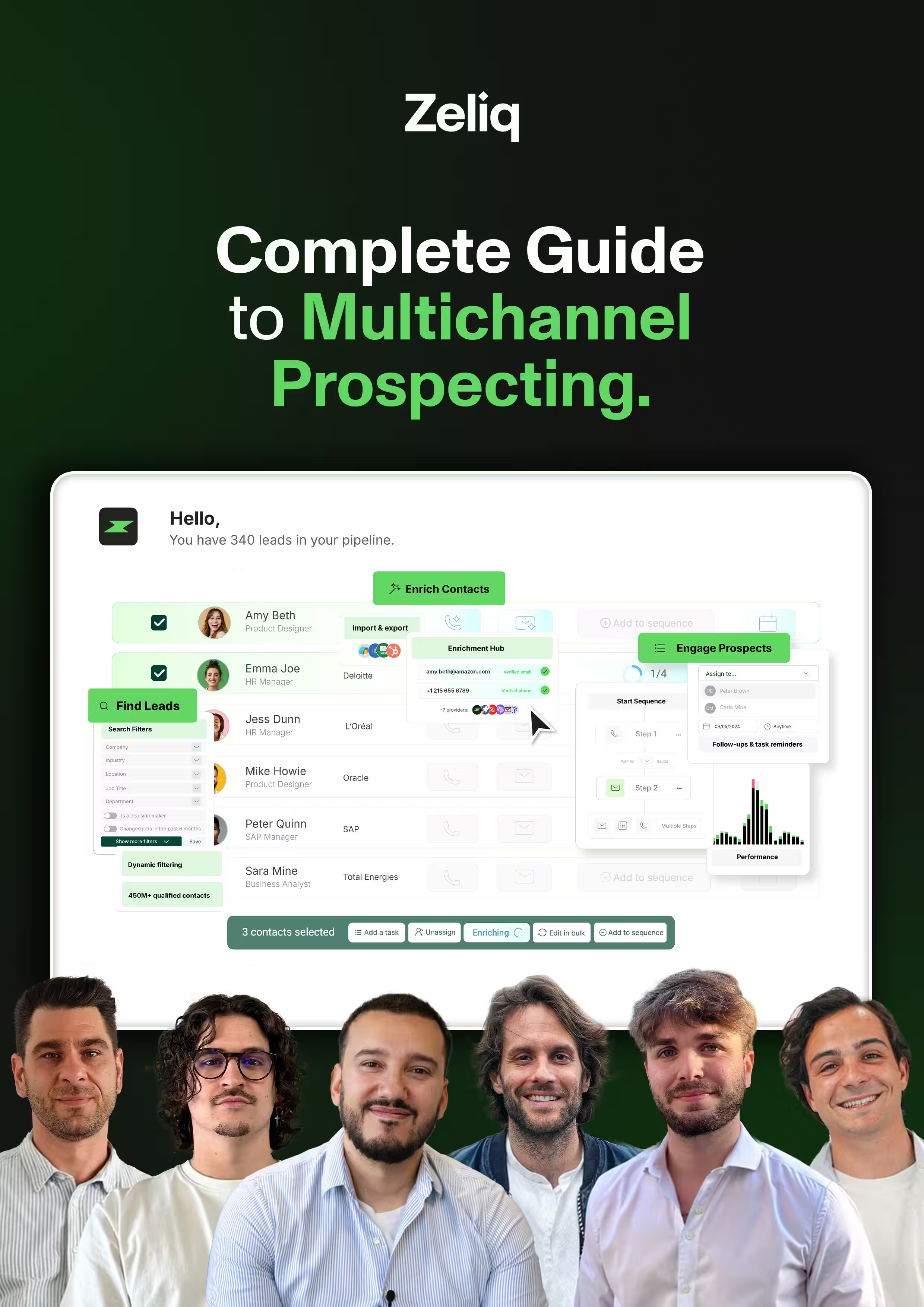
Zeliq unifies a B2B contact database, waterfall enrichment (verified emails and direct phone numbers via 40+ providers), and multichannel sequencing into a single platform. BD teams identify ICP accounts, get clean contact data on the right stakeholders, and run cadences across email, LinkedIn and call without switching tools. Book a Zeliq demo →
The 2026 business development stack
A modern BD stack rests on five categories. Each can be a standalone tool or part of an all-in-one platform, and the right setup depends heavily on company stage.
B2B contact and account database. Source of truth on companies and stakeholders: firmographics, technographics, signals. Selection criteria: geographic coverage, freshness, granularity of filters, GDPR/CCPA compliance. Leading platforms index 400 to 500 million contacts globally. Zeliq, for instance, provides access to a B2B lead database of 450M+ contacts usable for both sales and BD prospecting.
Data enrichment. Recovery of verified emails, direct phone numbers and firmographic data. The 2026 standard is waterfall enrichment: multiple providers queried in cascade to maximize match rates. Best-in-class systems hit 75 to 85% email coverage and 50 to 65% direct phone coverage on a clean ICP list. Zeliq’s B2B data enrichment runs in cascade across 40+ providers to maximize contact rates.
Multichannel sequencing. Orchestration of email, LinkedIn and phone touchpoints in a calendar-based cadence. Required features: native personalization at scale, A/B testing, inbox warming and deliverability, CRM bi-directional sync. Zeliq’s multichannel prospecting is built around this orchestration.
Intent and signal data. Tools that capture buying signals (website visits, recent funding, executive hiring, competitor mentions in job postings, tech stack changes) and surface accounts likely to engage. Standard layer in mid-market and enterprise BD in 2026.
CRM and PRM. The CRM remains the system of record (Salesforce, HubSpot, Pipedrive dominate). For channel-heavy motions, a dedicated Partner Relationship Management tool sits on top to manage partner portals, deal registration, and co-marketing programs.
Browser extension layer. A modern BD workflow involves saving leads from LinkedIn, company websites and press articles in real time. A native browser extension that captures a lead in one click removes friction and keeps the BD database fresh.
Common business development mistakes to avoid
Five recurring patterns trip up BD teams of all sizes.
Confusing BD with sales. When BD reps are measured purely on closed revenue, they default to short-cycle deals and drop the strategic work. Measure BD on pipeline created and partnership ARR, not just on signed contracts in the current quarter.
Treating partnerships as a one-time signature. A signed partnership is the starting line, not the finish line. Without active partner enablement (training, joint marketing budget, regular reviews), 70 to 80% of signed partnerships produce zero revenue.
Spreading thin across too many channels. A BD team running channel, alliances, ABM and M&A pipeline simultaneously with three people delivers mediocre results everywhere. Sequence the motions: start with one, hit a credible baseline, then add the second.
Ignoring the handoff. A perfectly sourced opportunity that gets stuck in handoff between BD and sales becomes a lost opportunity. Document the handoff process, define the criteria, and instrument it in the CRM.
Vanity metrics. Logos in a partner list, meetings booked at a trade show, LinkedIn connections accepted: none of these are KPIs. Pipeline contribution and partnership ARR are the only metrics that survive a board review.
AI and business development in 2026
AI has reshaped BD in three durable ways. The capability gap is no longer about access to AI (the tools are commoditized), it is about how well teams use it.
Signal-based outreach. AI models ingest dozens of signal sources (funding, hiring, press, social posts from decision-makers, technology changes in job postings, ad spend shifts) and surface in real time the accounts most likely to engage. A BD team running signal-based outreach in 2026 typically gets 3 to 5x the meeting rate of a team running static ICP lists.
Partner intelligence. AI maps the partner ecosystem: which companies are likely to want a co-sell relationship, which integrations would close the biggest deals, which advisors carry weight in a vertical. No longer a manual research project, but a continuously updated graph that BD leaders can query.
Personalization at scale. Generative AI produces personalized cold messages at near-manual quality, using enriched context (role, company, recent news). The right reflex in 2026 is no longer to write every message by hand: write an excellent sequence brief, let the model handle per-prospect personalization, and spend the saved time on conversations and deal structuring.
The point of AI in BD is not to replace the BD person. It is to free their time from research and copy work, so they can spend more hours on the activities that compound: senior conversations, deal structuring, and partnership design.
For teams looking to ground their business development in clean operational mechanics, the broader revenue operations playbook covers how BD, sales and CS interlock under a single revenue engine.
Conclusion: BD is a long game played quarterly
Business development is not a magic engine. It is a long-cycle function that builds deal flow, partnerships and market entry plays over 12 to 36 months. The teams that win are the ones that pick a focused playbook, instrument it with a clear KPI set, and run it with rigor through pipeline reviews and partner enablement, quarter after quarter.
The concrete action to take this week: write the two-page BD plan for the next four quarters. ICP, motions, headcount, KPIs, owners. Share it with your CRO or CEO, get one round of feedback, and start running. Iteration on a real plan beats perfection on a plan you never ship.
If your BD function needs to upgrade its outbound and account-research mechanics, give Zeliq a try to unify lead database, waterfall enrichment and multichannel sequencing in one platform.