
A B2B customer meeting — discovery, demo, or closing — is the highest-ROI conversion unit of the sales cycle: per RAIN Group’s 2025 B2B Sales Cycle Benchmark, 63% of mid-market B2B deals are won or lost in the first two meetings, and the average no-show rate jumped from 18% in 2020 to 32% in 2025 on cold-booked meetings. For a B2B salesperson, structuring each meeting as a system (preparation, opening, discovery, demo, next step, follow-up) is no longer optional — it’s what separates an AE at 110% quota from one at 65%.
But B2B meetings have shifted in 2026: 84% are now video (Gong State of Conversations 2025), 41% include a buying committee of at least 3 people, and a B2B prospect’s median attention span in meetings has dropped to 22 minutes (RAIN Group). This guide details the 4 types of B2B meetings, the structured 6-step method per meeting, no-show patterns and prevention, and walks through a worked example on a full sales cycle.
At a glance:
- The 4 types of B2B meetings (discovery, demo, technical, closing)
- Structured 6-step method per meeting
- No-show prevention: the pre-meeting cadence
- Post-meeting follow-up: the 24-hour rule
- Worked example: B2B SaaS mid-market sales cycle
- 3 FAQs and 3 dated actions
Key takeaways:
- 63% of mid-market B2B deals are won or lost in the first 2 meetings.
- 2025 average B2B no-show rate: 32% without pre-meeting cadence, 8% with.
- Optimal duration for a video B2B meeting: 22-30 minutes (median attention span).
- The 24-hour post-meeting rule (recap + written next step) doubles deal progression rate.
1. The 4 types of B2B meetings in 2026
Type 1 — Discovery call. First qualified meeting, 30-45 minutes on video. Goal: qualify the need, identify decision-makers, understand budget context. No product pitch here. Typically led by an SDR or junior AE. 2026 conversion rate to demo: 55-72% on inbound prospects, 28-42% on outbound.
Type 2 — Demo meeting. 30-60 minutes, personalized product demo on use cases identified in discovery. Led by AE + often a Sales Engineer for technical demos. Conversion to next stage: 42-58% depending on personalization quality.
Type 3 — Technical meeting. 45-90 minutes, technical validation with the tech decision-maker (CTO, VP Engineering, IT director). Covers integrations, security (SOC 2, ISO 27001), scalability, SLAs. Led by Sales Engineer + AE. Essential above $50k ARR.
Type 4 — Closing meeting. 30-45 minutes, contract negotiation and signature. Led by AE + often Sales Manager. Conversion rate: 68-84% if well-prepared; otherwise the deal drags 60-120 extra days.
Full mid-market B2B sales cycle 2026:
| Stage | Duration | Conversion to next stage |
|---|---|---|
| Discovery | 30-45 min | 55-72% |
| Demo | 30-60 min | 42-58% |
| Technical | 45-90 min | 78-88% |
| Closing | 30-45 min | 68-84% |
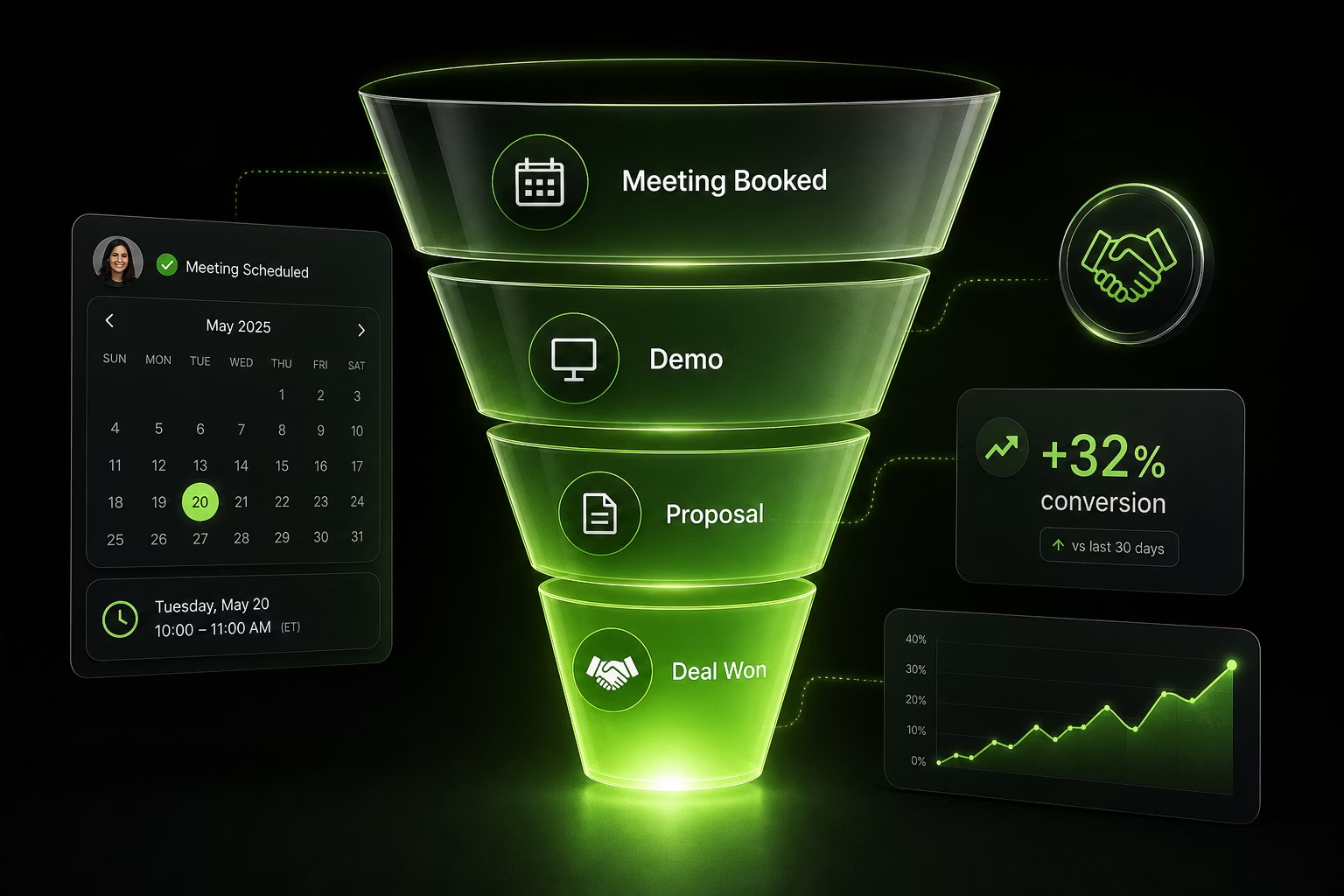
| Cumulative Discovery → Closed-Won | ~3-5 meetings | ~16-28% |
2. Structured 6-step method per meeting
Regardless of meeting type, the same 6-step structure maximizes conversion:
Step 1 — Preparation (24-48h before). Read the prospect sheet: revenue, headcount, sector, technographics, recent buying signals. Identify 3 targeted questions. Prepare 2 similar customer cases as backup. Time: 15-30 min per meeting.
Step 2 — Opening (3 min). Validate available time, recap the goal, share the agenda upfront. Avoids drift.
Step 3 — Discovery (8-15 min). Open questions on business context, pain points, business KPIs. SPIN or MEDDIC method depending on segment. Listen > talk (70/30 ratio).
Step 4 — Demo or value-add (10-15 min). Personalized demo on 2-3 relevant use cases, or presentation calibrated on the discovered pain points. No more than 3 features. Quantified customer cases as backup.
Step 5 — Objections and clarifications (5-8 min). List prospect questions, address the top 2-3 objections. Approach: acknowledge + reframe + answer + validate.
Step 6 — Next step (2-3 min). Explicit definition of the next step: technical meeting, proposal send, closing meeting. Date + time + participants + agenda. No “we’ll be in touch”.
Golden rule: a B2B meeting without a written next step is a lost meeting 67% of the time (Forrester Sales Engagement Benchmark 2025).
3. No-show prevention: the pre-meeting cadence
The B2B no-show rate in 2025 exploded to 32% on average (Calendly State of Scheduling 2025) because of calendar saturation and the ease of canceling a video call. The counter: a structured pre-meeting cadence.
Recommended pre-meeting cadence:
| Moment | Channel | Content |
|---|---|---|
| D-7 (at booking) | Email + calendar | Confirmation + ICS + agenda |
| D-2 | Reminder + 1 prep question | |
| D-1 | LinkedIn DM or SMS | Short reminder + direct link |
| D-0, 30 min before | Final reminder + video link |
Measured effect (Calendly 2025): this cadence drops the no-show rate from 32% to 8%, a 75% reduction.
Other anti-no-show levers:
- Request prep content (e.g., “Could you send me your current tools stack?”). If the prospect answers, no-show drops 4×.
- Pre-write the shared agenda. The prospect already mentally commits.
- Calendly + native CRM integration. Avoids double-bookings and conflicts.
- Signal no-show cost: “This slot is blocked on my calendar. If you need to cancel, please notify me at least 24h ahead.” (Measurable psychological effect.)
4. Post-meeting follow-up: the 24-hour rule
The 24-hour rule: send a written meeting recap within 24 hours, with explicit next step. Forrester measures this discipline doubles deal progression to the next stage (+98% measured over 12 months).
Post-meeting recap structure:
Hi [First name], Thanks for the time yesterday. Recap of key points: 1. [Main pain point identified] 2. [Priority use case to address] 3. [Budget/timing constraint noted] Agreed next step: - [Our action] by [date] - [Your action] by [date] - Next meeting: [type] on [date] at [time] I'm also keeping [useful resource: case study / ROI calculator / template] available for you. [First name]Why it works:
- The recap validates the salesperson’s understanding (prospect can correct if wrong)
- It commits the prospect to the next action (written commitment)
- It creates a contractual trace useful internally for the buying committee
- It differentiates from competitors who send nothing
5. Worked example: B2B SaaS mid-market sales cycle
Context. An AE at a US B2B SaaS scale-up (115 employees, $8.4M ARR) tracks a deal with an industrial SMB ($8.2M revenue, 42 employees). Target ticket: $20k/year ARR.
Sales cycle over 67 days:
| Stage | Date | Duration | Participants | Next step | Conversion |
|---|---|---|---|---|---|
| Discovery | D0 | 35 min | AE + Champion (Production Director) | Demo in 8d | 72% (qualified) |
| Personalized demo | D+8 | 45 min | AE + Sales Engineer + Champion + Ops Manager | Tech meeting in 12d | 58% (use case validated) |
| Technical meeting | D+20 | 70 min | SE + Champion + IT Director + AE | Proposal in 10d | 85% (feasibility OK) |
| Proposal sent | D+30 | — | Async | Closing meeting in 14d | 70% (budget OK) |
| Closing meeting | D+44 | 40 min | AE + Sales Manager + Champion + CEO + CFO | Signature in 23d | 77% (negotiation OK) |
| Signature | D+67 | — | — | Onboarding | WIN |
Pre-meeting cadence applied to every meeting:
- D-7 confirmation email with ICS and agenda
- D-2 reminder with 1 prep question
- D-1 LinkedIn DM
- D0 final email -30 min with video link
Results:
- 0 no-shows on the 5 meetings
- Stage progression rate: 58-85%
- Total cycle: 67 days (vs 92-day mid-market benchmark = −27%)
- Recap sent within 24h after each meeting
- Signed ARR: $20k/year
AE time ROI: 4 hours of meetings + 6 hours of prep/follow-up = 10 hours for $20k ARR = $2,000 ARR/hour invested. With a 24-month average retention, LTV/hour exceeds $4,500.
Zeliq and B2B meeting preparation
Preparing a B2B meeting in 15 minutes instead of 45 requires having in one place the prospect sheet (revenue, headcount, sector), decision-maker contacts (email, direct phone, LinkedIn), recent buying signals (funding, hires, M&A), and the pre-meeting cadence sequence. Zeliq centralizes these four dimensions across 450 million verified B2B contacts, with automatic push to Salesforce or HubSpot and native pre-meeting reminders. All in a single interface, no stacking four tools.
6. Frequently asked questions
How many meetings does a mid-market B2B deal take to close in 2026?
RAIN Group’s 2025 B2B Sales Cycle Benchmark across 4,200 closed deals measures a median of 3.4 meetings for mid-market deals ($50-500k ARR) between Discovery and Closed-Won. Typical distribution: 1 Discovery, 1 Demo, 1 Technical (for 60% of deals), 1 Closing. For enterprise deals (>$500k ARR), the median climbs to 6.2 meetings over 6-9 months, including 1-2 additional “buying committee” meetings. 2026 empirical rule: below 3 meetings for a closed mid-market, you likely under-sold (missing discovery or technical validation); above 6 meetings, the cycle is stalling and no-decision risk rises. A mid-market sales cycle exceeding 4 meetings without signature signals a qualification or timing issue.
How do I avoid no-shows on B2B video meetings?
The 2025 B2B no-show rate reaches 32% on average on cold-booked meetings (Calendly State of Scheduling 2025), versus 18% in 2020. The proven counter: a structured pre-meeting cadence over 4 touches (D-7 confirmation + ICS, D-2 reminder + 1 prep question, D-1 LinkedIn DM, D0 -30 min final reminder). This cadence drops no-shows from 32% to 8% measured. Three complementary levers: (1) ask the prospect for prep content (a prospect who invests time doesn’t cancel), (2) pre-write the shared agenda to commit mentally, (3) signal the no-show cost (“this slot is reserved”). Modern sales engagement tools (Zeliq, Outreach, Salesloft) automate this cadence at team scale.
What’s the right duration for a B2B meeting in 2026?
A B2B prospect’s median attention span in a video meeting dropped to 22 minutes in 2025 (RAIN Group), versus 38 minutes in 2018. Consequence: aim for 22-30 minute meetings on Discovery and Closing, 30-45 minutes on Demo (justified by visual content), 45-90 minutes on Technical (detailed validation). Any meeting exceeding 60 minutes on Discovery or Closing loses 50% efficiency after the 30th minute. 2026 best practices: default to 30-min meetings, explicitly request more if needed, plan a 5-min buffer at end of calendar for the recap. A well-structured 22-minute meeting converts better than an un-framed 60-minute meeting.
Conclusion: 3 actions to take this week (June 2026)
Audit your no-show rate on the last 30 meetings by Friday. If >15%, structure a pre-meeting 4-touch cadence (D-7, D-2, D-1, D0-30min). Measurable effect in 30 days.
Implement the 24-hour post-meeting rule before June 12. Written recap with explicit next step within 24 hours after every meeting. Forrester measures +98% deal progression vs without recap.
Standardize the 6-step meeting structure before June 18. Preparation, opening, discovery, demo, objections, next step. Without structure, two AEs produce two incomparable conversion rates.
Prepare your B2B meetings in 15 minutes
Zeliq combines verified contacts, enrichment and multichannel sequences in a single platform. Account created in 2 minutes, no credit card.
Book a demoAnd if you want every B2B meeting to start from a complete prospect sheet and an automated pre-meeting cadence, try Zeliq for free and free up 30 minutes of preparation per meeting.
Sources
- RAIN Group, “2025 B2B Sales Cycle Benchmark”
- Forrester, “Sales Engagement Benchmark 2025”
- Gong, “State of Conversations 2025”
- Calendly, “State of Scheduling 2025”
- HubSpot, “State of Inbound 2025”
- Salesforce, “State of Sales 2025”
- LeanData, “SDR Productivity Report 2025”
- McKinsey, “B2B Sales Pulse 2025”
- Bridge Group, “SaaS AE Compensation Report 2025”
- Gartner, “B2B Buying Survey 2024”