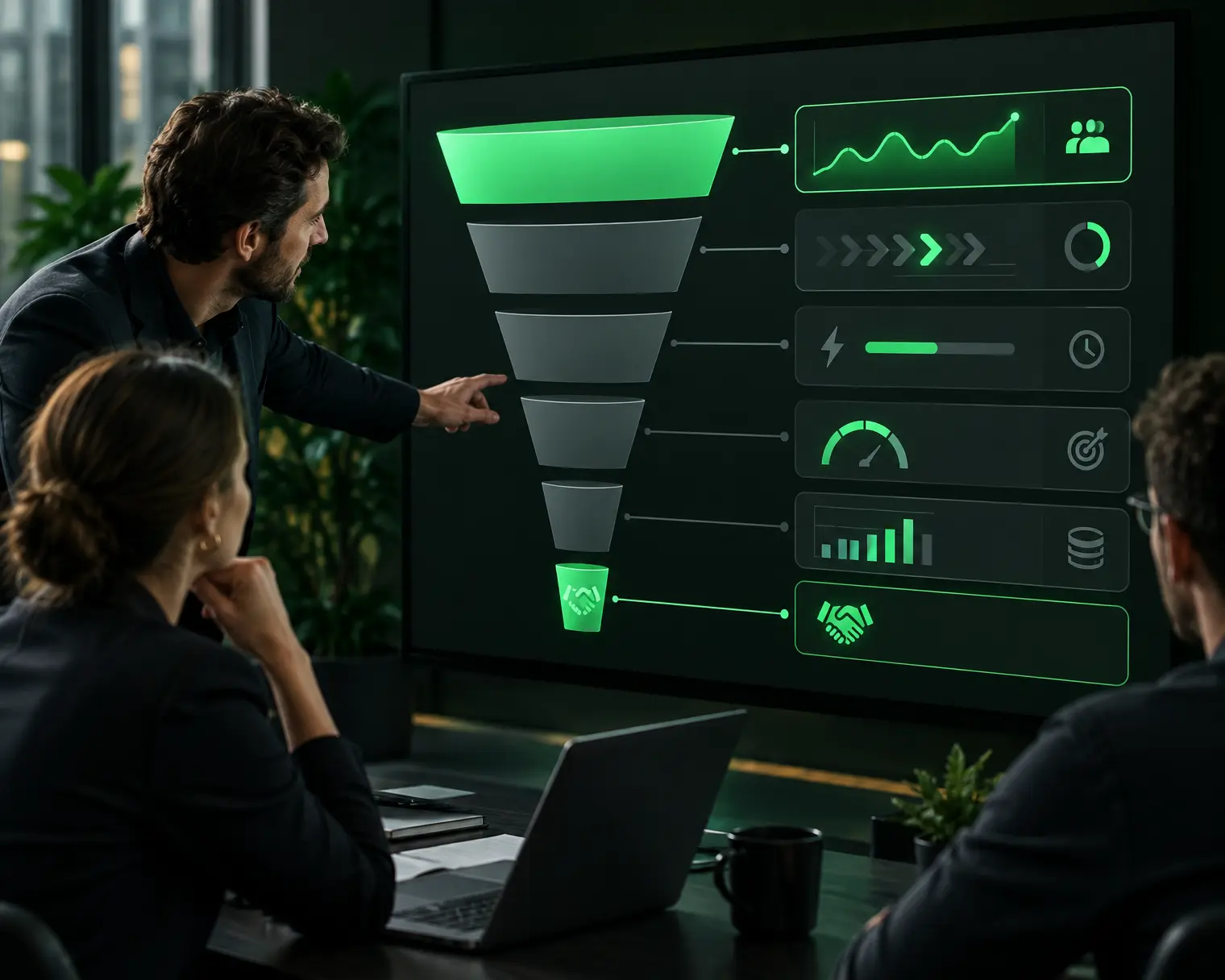
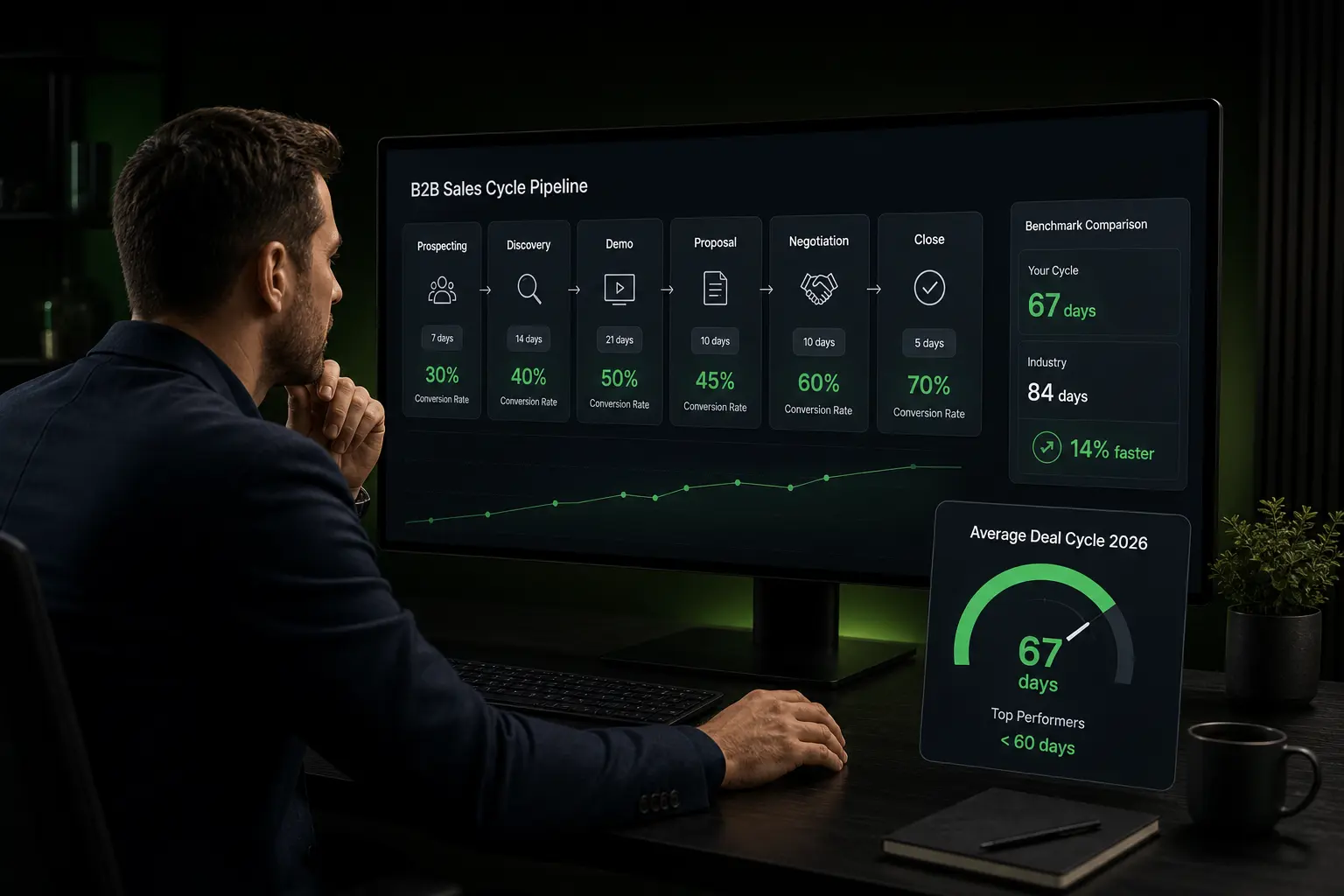

A B2B sales cycle is the complete sequence of stages a prospect moves through between the first qualified contact and contract signature, measured in days and structured around 5 to 7 pivot stages (discovery, demo, technical, proposal, negotiation, closing). Per RAIN Group 2025 B2B Sales Cycle Benchmark, the median B2B mid-market sales cycle in 2026 is 92 days, versus 68 days in 2019, a 35% increase in 6 years. The primary driver: buying committee growth (median 6.8 people on deals above $100k per Gartner).
For an AE or VP Sales, mastering the sales cycle is no longer a question of individual sales talent. It’s a system: measured duration per stage, conversion rates between stages, stalling signals, follow-up mechanisms. Poorly managed, the cycle extends 30-50% and no-decision rate reaches 60%. Well managed, it shortens 20-30% and average margin per deal climbs 12 to 18%. This guide details the structure of a 2026 B2B sales cycle, benchmarks by segment, stalling signals, and walks through a worked example on a mid-market B2B SaaS.
At a glance:
- Strict definition of the B2B sales cycle
- The 6 pivot stages and their conversion rates
- 2026 duration benchmarks by segment (SMB, mid-market, enterprise)
- The 5 stalling signals and their counter-measures
- Worked example: mid-market B2B SaaS at $8M ARR
- 3 FAQs and 3 dated actions
Key takeaways:
- Median mid-market B2B duration 2026: 92 days (RAIN Group)
- Enterprise (>$500k ARR): 6 to 9 months
- Median buying committee on deals above $100k: 6.8 people
- No-decision rate: 40-60% on un-piloted enterprise deals
- Median reduction after methodology rollout: −20 to −30%
1. Strict definition: what a B2B sales cycle is
The B2B sales cycle designates the sequence of days, interactions and stages that turns a qualified prospect into a signed customer. Three structuring clarifications:
Clarification 1: the cycle starts at qualification, not first contact. An identified but unqualified prospect doesn’t enter cycle measurement. The start is when the prospect accepts a first discovery meeting, or crosses a documented intent-data threshold.
Clarification 2: the cycle ends at signature, not onboarding. Post-sale (onboarding, expansion, renewal) belongs to the customer lifecycle, not the sales cycle in the strict sense. Conflating the two skews commercial KPIs.
Clarification 3: duration is measured in business days, not calendar days. A deal signed in 60 calendar days is actually ~43 business days. RAIN Group, Forrester and Gartner benchmarks are published in calendar days unless otherwise specified.
Distinguish the sales cycle from:
- Marketing funnel (TOFU/MOFU/BOFU): covers Acquisition → Lead → MQL → SQL. The sales cycle starts only at SQL.
- Customer journey: also covers post-sale (onboarding, expansion, churn). Broader than the sales cycle.
- Pipeline velocity: composite KPI (# opportunities × average ticket × conversion rate ÷ cycle duration) where cycle duration is one variable.
Per Forrester State of B2B Sales 2025, 84% of mid-market sales teams now measure their sales cycle by stage, vs. 41% in 2020. Measurement maturity conditions pilotage maturity.
2. The 6 pivot stages and their conversion rates
The B2B mid-market sales cycle 2026 structures around 6 pivot stages with measured conversion rates:
| # | Stage | Typical duration | Conversion to next stage |
|---|---|---|---|
| 1 | Discovery | 30-45 min, 7-14 days to confirm | 55-72% |
| 2 | Personalized demo | 30-60 min, 7-21 days after discovery | 42-58% |
| 3 | Technical meeting | 45-90 min, 7-14 days after demo | 78-88% |
| 4 | Proposal | 0 min (async), 7-14 days for reply | 60-75% |
| 5 | Negotiation | 2-4 meetings over 14-30 days | 65-80% |
| 6 | Closing & signature | 7-21 days | 70-85% |
Cumulative Discovery → Closed-Won: 16% to 28% depending on initial sourcing quality. This rate determines the profitability of the outbound model.
Strategic reading:
- The demo stage is where the most volume drops out of pipeline (42-58% conversion). A poorly personalized demo silently kills the deal.
- The technical stage converts best (78-88%) because the interested prospect mobilizes their IT team. Bad sign if not requested.
- The negotiation stage is under-trained in 73% of sales programs (Vantage Partners 2025). An untrained AE leaves 12-18% of margin on the table.
Variation by segment:
- SMB (<$10M revenue): only 4-5 stages (often no separate technical meeting), 30-45 day cycle
- Mid-market ($10-250M revenue): 5-6 stages, 60-120 day cycle
- Enterprise (>$250M revenue): 6-8 stages (procurement, legal separated), 6-9 month cycle
3. 2026 duration benchmarks by segment
Consolidated source: RAIN Group 2025 B2B Sales Cycle Benchmark + Forrester State of B2B Sales 2025, on 4,200 closed deals.
| Segment | Average ARR ticket | Median duration | Buying committee | Stages |
|---|---|---|---|---|
| SMB | $5-25k | 30-45 days | 2-3 people | 4-5 |
| Mid-market | $25-100k | 60-92 days | 4-7 people | 5-6 |
| Enterprise | $100-500k | 6-9 months | 8-15 people | 6-8 |
| Strategic | >$500k | 9-18 months | 12-20+ people | 7-10 |
2019-2026 evolution:
- SMB: 28 days → 35 days (+25%)
- Mid-market: 68 days → 92 days (+35%)
- Enterprise: 5.2 months → 7.4 months (+42%)
- Strategic: 8.1 months → 13.2 months (+63%)
The extension is massive and hits every segment. Three structural causes:
- Buying committee growth: median moved from 5.4 to 6.8 people on deals above $100k since 2020 (Gartner)
- Procurement reinforcement: 71% of companies above 500 employees have IT procurement involved starting at $50k ARR (vs. 38% in 2019)
- Alternative multiplication: median number of alternatives evaluated per deal moved from 3.2 to 5.7 (G2 Buyer Behavior Report 2025)
An AE who doesn’t measure their cycle by segment doesn’t pilot, they endure.
4. The 5 stalling signals and their counter-measures
A cycle exceeding its sector benchmark by more than 30% is stalling. Five observable signals:
Signal 1: no written next step after a stage. A deal without a written next-meeting date in the CRM stalls 67% of the time (Forrester Sales Engagement Benchmark 2025). Counter-measure: 24h post-meeting rule (recap + written next step).
Signal 2: participant multiplication. When the buying committee jumps from 3 to 7 people in 30 days, procurement and legal have arrived. Counter-measure: structure a “champion enablement kit” (one-pager, ROI calculator, security trust center) that the champion can forward internally without depending on the AE.
Signal 3: silence > 14 days. Beyond 14 days without interaction, close rate drops 38% (RAIN Group). Counter-measure: multichannel follow-up cadence (email + LinkedIn + call) with “are we continuing?” template.
Signal 4: scope redefinition by the prospect. When the prospect asks “and do you also do X and Y?”, the need is no longer clear. Counter-measure: return to initial discovery, verify the topic hasn’t drifted, qualify or abandon.
Signal 5: unannounced executive escalation. When a VP or C-level suddenly appears in the conversation, it’s a signal of budget validation or blocking objection. Counter-measure: pre-brief the Senior AE or VP Sales for an executive-level intervention at the next meeting.
A mature sales team measures these 5 signals continuously and has a playbook for each. Without playbook, deals stretch and lose.
Zeliq and B2B sales cycle acceleration
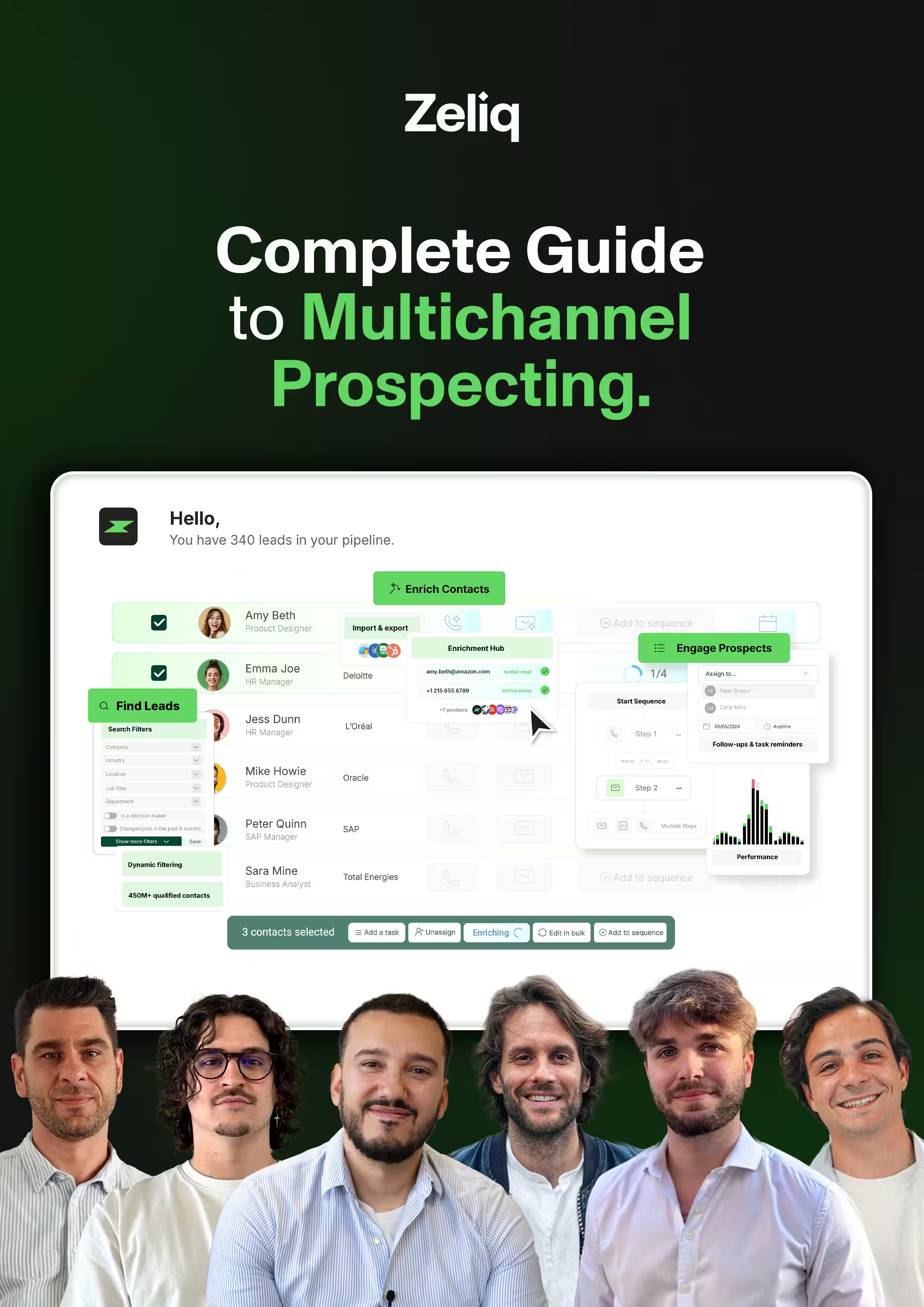
Cutting a B2B sales cycle by 30% requires combining precise sourcing, verified enrichment, multichannel sequences and CRM tracking in a single workflow. Zeliq centralizes these four functions across 450 million B2B contacts with verified enrichment and integrated multichannel sequences. Your AEs spend less time hunting contacts and more time closing.
5. Worked example: mid-market B2B SaaS at $8M ARR
Context. A US B2B SaaS scale-up (115 employees, $8.4M ARR) observes in January 2026:
- Average sales cycle duration: 124 days (vs. 92-day mid-market benchmark)
- No-decision rate: 38% of stage-3+ deals never close
- Discovery → Closed-Won conversion: 11% (vs. 16-28% benchmark)
- 4 Senior AEs, 6 SDRs
VP Sales diagnosis in February 2026:
| Stage | Current duration | Benchmark | Gap |
|---|---|---|---|
| Discovery → Demo | 18 days | 7-14 days | +30% |
| Demo → Technical | 24 days | 7-14 days | +71% |
| Technical → Proposal | 19 days | 7-14 days | +36% |
| Proposal → Closing | 41 days | 14-30 days | +37% |
| Closing → Signature | 22 days | 7-21 days | +5% |
Identified causes:
- No written next step in 64% of deals after the demo
- No “champion enablement kit” → champion struggles internally
- Manual follow-up cadence, forgotten 38% of the time
- No Senior AE pre-briefing on deals with C-level
Corrective actions launched March 2026:
- Mandatory 24h post-meeting rule in Salesforce (manager validation before stage change)
- Champion enablement kit created (one-pager + ROI calculator + trust center)
- Automated multichannel cadence deployed (Zeliq + Salesloft)
- Quarterly AE coaching on negotiation (SPIN + MEDDIC)
6-month measured results (September 2026):
| KPI | Before (Jan 2026) | After (Sept 2026) | Change |
|---|---|---|---|
| Average cycle duration | 124 days | 89 days | −28% |
| No-decision rate | 38% | 21% | −17 pts |
| Discovery → CW conversion | 11% | 18% | +64% |
| Deals closed/quarter | 28 | 41 | +46% |
| ARR signed/quarter | $475k | $695k | +46% |
Total investment: ~$36k over 6 months (training, tools, internal time). 6-month ROI: $220k additional ARR × 24-month LTV = ~$440k incremental value, a 12.2× ROI on investment.
Beyond the figure, the structural effect: the team gains predictability (cycle duration standard deviation halved), improving forecast quality and investor confidence.
What’s the average length of a B2B sales cycle in 2026?
The median B2B mid-market sales cycle ($25-100k ARR ticket) in 2026 is 92 days, versus 68 days in 2019, a +35% increase in 6 years (RAIN Group 2025 B2B Sales Cycle Benchmark). For SMB (<$25k ARR), expect 30-45 days. For enterprise ($100-500k ARR), 6 to 9 months. For strategic deals (>$500k ARR), 9 to 18 months. The extension stems from three causes: buying committee growth (median 6.8 people on deals above $100k per Gartner), systematic procurement involvement starting at $50k ARR (71% of companies above 500 employees), and alternative multiplication (median moved from 3.2 to 5.7 alternatives evaluated per deal per G2). An AE who doesn’t measure their cycle by segment endures this inflation rather than pilotage it.
How do I shorten the B2B sales cycle?
Four documented levers. (1) 24-hour post-meeting rule: send a written recap with explicit next step within 24h after every meeting. Forrester measures +98% deal progression to the next stage. (2) Champion enablement kit: provide the internal champion with a one-pager, ROI calculator and trust center ready to share. Reduces internal validation time by 30-50%. (3) Automated multichannel follow-up cadence (email + LinkedIn + call): avoids silences > 14 days which drop close rate 38%. Tools: Zeliq, Salesloft, Outreach. (4) Negotiation coaching on SPIN + MEDDIC: an untrained AE leaves 12-18% of margin on the table and extends the cycle 15-25%. Combined, these 4 levers shorten the cycle 20-30% within 6 months on most mid-market teams.
What’s the difference between sales cycle, pipeline, and marketing funnel?
Three distinct concepts not to confuse. The marketing funnel (TOFU/MOFU/BOFU) covers lead acquisition through SQL qualification: marketing’s playing field. The sales cycle starts at SQL (first qualified meeting) and ends at signature: sales’ playing field (AE, sales manager). The pipeline is the inventory of in-progress opportunities at a moment T, at different sales-cycle stages: it’s the pipeline-velocity snapshot (# opportunities × average ticket × conversion rate ÷ cycle duration). Conflating the three skews measurement: a marketer who measures their funnel through closed-won over-attributes inbound; a salesperson who measures their pipeline including unqualified leads artificially inflates their forecast. 2026 commercial maturity requires measuring all 3 separately with documented handoff between marketing and sales.
Conclusion: 3 actions to take this week (June 2026)
Measure your cycle’s average duration per stage by Friday. Export your last 50 closed deals from the CRM, calculate the average duration between each stage. If the gap to sector benchmark exceeds 30%, you have a priority pilotage issue.
Implement the 24-hour post-meeting rule before June 12. Written recap with explicit next step within 24 hours after every meeting, mandatory in the CRM before any stage change. Forrester measures +98% progression to the next stage.
Deploy an automated multichannel follow-up cadence before June 18. Zeliq, Salesloft or Outreach industrialize email + LinkedIn + call over 14-21 days. Without cadence, 38% of follow-ups are forgotten on average (LeanData 2025), and no-decision rate mechanically rises.
Shorten your B2B sales cycle
Zeliq combines verified contacts, enrichment and multichannel sequences in a single platform. Account created in 2 minutes, no credit card.
Try for freeAnd if you want your sales cycle to move from artisan effort to measured commercial system, try Zeliq for free and industrialize sourcing, enrichment and multichannel engagement in a single interface.