

Understanding types of companies is not just a business school exercise. For B2B sales and marketing teams, it is a practical framework that determines who you target, how you approach them, and what message you lead with.
A Fortune 500 corporation and a 15-person SaaS startup may operate in the same industry, but their buying process, budget authority, procurement requirements, and decision timelines are completely different. Treating them the same in your outreach is the fastest way to produce pipeline that does not close.
This guide covers the main company classification systems, what each type means in practice, and how B2B teams can use these categories to build sharper ICPs, better segments, and more effective prospecting strategies.
Types of Companies by Legal Structure
Legal structure determines how a company is owned, taxed, and held liable. It shapes how decisions are made, who controls budget, and how formal the procurement process tends to be.
Sole Proprietorship
The simplest business structure: one person owns and operates the business, with no legal separation between the individual and the entity. Sole proprietors include freelancers, consultants, and independent professionals.
B2B implication: Decision-making is immediate, the owner is the buyer, and the budget is personal. Sales cycles are short, but deal sizes are typically small and price sensitivity is high.
Partnership
A business owned and operated by two or more people who share profits, losses, and liability. Partnerships are common in professional services (law firms, consulting practices, accounting firms) and some agency models.
B2B implication: Budget decisions often require partner consensus. Identifying the right partner and understanding internal dynamics is more important than in single-owner businesses.
Limited Liability Company (LLC)
The LLC is one of the most common structures for small to mid-size businesses, particularly in the US. It separates personal assets from business liabilities while offering flexibility in how profits and taxes are handled.
B2B implication: LLCs span a wide range of sizes and sophistication. Some have formal procurement; many do not. Budget authority is usually concentrated in a small leadership team or a single owner.
Corporation (C-Corp and S-Corp)
Corporations are legally independent entities, separate from their owners. C-corporations (standard corporate structure) are the default for larger companies, VC-backed startups, and any company planning to raise institutional capital. S-corporations offer pass-through taxation with corporate structure, capped at 100 shareholders.
B2B implication: Corporations have more formal buying processes: multiple approvers, legal review, procurement involvement, and longer timelines. Identifying the economic buyer, the champion, and the technical evaluator matters more in these accounts.
Nonprofit Organization
Nonprofits operate to serve a public or community purpose rather than to generate profit for owners. They include charities, foundations, associations, educational institutions, and healthcare organizations.
B2B implication: Nonprofits have budget, but it is grant-driven or donation-driven rather than revenue-driven. Procurement timelines can be long and heavily process-oriented. Pricing conversations often focus on cost justification rather than ROI.
Types of Companies by Size
Company size is the most commonly used classification in B2B targeting, and for good reason: size is a reliable proxy for budget, decision-making complexity, and sales cycle length.
Startups (Typically 1-50 Employees)
Startups are early-stage businesses, usually VC-backed or self-funded, moving fast and operating with lean teams. They prioritize speed, flexibility, and tools that scale with them.
Key B2B characteristics: - Founder or C-suite is the buyer in most cases - Budget is constrained but can move quickly if the value is clear - Short sales cycles, low tolerance for complex onboarding - High churn risk if the company does not grow or pivot - Strong word-of-mouth if you deliver results
SMBs (Small and Medium-Sized Businesses, 50-500 Employees)
SMBs represent the largest segment by number of companies. They have enough scale to have dedicated teams but not enough to have fully formal procurement. Decision-making involves two to five people, typically a department head and one or two executives.
Key B2B characteristics: - Mid-level managers often drive evaluation, but sign-off sits with leadership - Sales cycles are moderate: two weeks to two months - Price sensitivity is higher than enterprise; ROI clarity matters - Less tolerance for long implementations or heavy professional services requirements - High volume of accounts, making outbound efficiency critical
Mid-Market (500-5,000 Employees)
Mid-market companies are the sweet spot for many B2B SaaS and services businesses. They have serious budget, real operational complexity, and enough scale to generate significant contract value, but they are not as slow or process-heavy as enterprise.
Key B2B characteristics: - Multiple stakeholders in the buying committee: champion, economic buyer, IT, legal - Formal procurement involvement on contracts above certain thresholds - Sales cycles of two to six months - Often underserved by enterprise vendors (too expensive) and growing beyond startup tools - Expansion revenue potential is significant if initial implementation succeeds
Enterprise (5,000+ Employees)
Enterprise companies have large budgets, complex needs, and long buying cycles. Deals are won or lost in the political dynamics of the buying committee as much as in the product comparison. Legal and procurement involvement is standard.
Key B2B characteristics: - Six to eighteen month sales cycles for new vendor relationships - Formal RFP processes in many cases - Multiple decision-makers, each with different priorities - Security, compliance, and integration requirements that must be met before evaluation proceeds - High contract values and strong expansion potential once embedded
Types of Companies by Business Model
Business model classification determines how a company creates and delivers value, and who its customers are. For B2B teams, this shapes the value proposition, the messaging angle, and the competitive landscape.
B2B (Business-to-Business)
B2B companies sell products or services to other businesses. This includes SaaS platforms, professional services firms, logistics providers, component manufacturers, and wholesale distributors. B2B buying is more rational, more process-driven, and involves more stakeholders than consumer buying.
B2C (Business-to-Consumer)
B2C companies sell directly to individual consumers. Retail, e-commerce, media, and consumer apps are typical examples. B2C companies are B2B targets when the product or service helps them acquire, retain, or monetize their own customers.
B2B2C (Business-to-Business-to-Consumer)
B2B2C companies sell through another business to reach the end consumer. Both brands may be visible in the transaction. Software that banks white-label for their customers, or platforms that food delivery apps use to manage their restaurant networks, are examples of B2B2C models.
Marketplace
Marketplaces connect multiple buyers and sellers on a single platform. They monetize through transaction fees, subscriptions, or listing fees. Examples include procurement platforms, freelance marketplaces, and industry-specific exchanges.
B2B implication: Marketplace businesses often have complex stakeholder maps (both supply-side and demand-side relationships) and platform-specific procurement concerns around data and vendor management.
Types of Companies by Sector and Industry
Industry classification tells you what a company does and who it competes with. Two systems are widely used in B2B prospecting:
NAICS (North American Industry Classification System)
NAICS codes classify businesses based on their primary economic activity. The system uses six-digit codes organized from broad category (first two digits) to specific subsector (all six digits). For example, 511210 is software publishers; 541611 is management consulting services.
NAICS codes are used in US government databases, procurement systems, and many B2B data platforms. They are useful for precise industry targeting when filtering prospecting lists.
SIC (Standard Industrial Classification)
SIC codes are an older four-digit classification system still widely used in financial data, regulatory filings, and certain prospecting databases. Many data providers offer both SIC and NAICS, and they are largely interchangeable for targeting purposes.
B2B implication: Industry codes let you filter prospecting lists by precise vertical rather than broad category, enabling hyper-specific outreach that references the prospect’s actual business context.
How Company Type Shapes Your ICP
Your Ideal Customer Profile (ICP) should use all three classification systems, not just one.
A well-constructed ICP might read: “Series B to Series D SaaS companies (size), headquartered in the US or UK (geography), in the HR tech or sales tech vertical (industry), targeting mid-market B2B customers (business model), with headcount between 50 and 500 and an active SDR or sales ops function.”
That definition is actionable because it uses: - Legal and funding stage as a signal of procurement maturity and budget availability - Size to predict sales cycle length and deal complexity - Industry to identify the specific pain points and competitive dynamics - Business model to ensure your solution is relevant to how they generate revenue
ICPs built on a single dimension (industry only, or size only) produce lists that are technically correct but commercially imprecise.
How to Use Company Classification in B2B Prospecting
Filter Prospecting Lists by Company Type
Modern B2B data platforms let you filter by company size, industry, legal status, funding stage, technology used, and growth signals simultaneously. Use these filters to build a list that matches your ICP on multiple dimensions at once, not just one or two criteria.
The tighter the filter, the smaller the list, and the higher the conversion rate. Working 200 accounts that are a perfect fit outperforms working 2,000 accounts that are a vague fit.
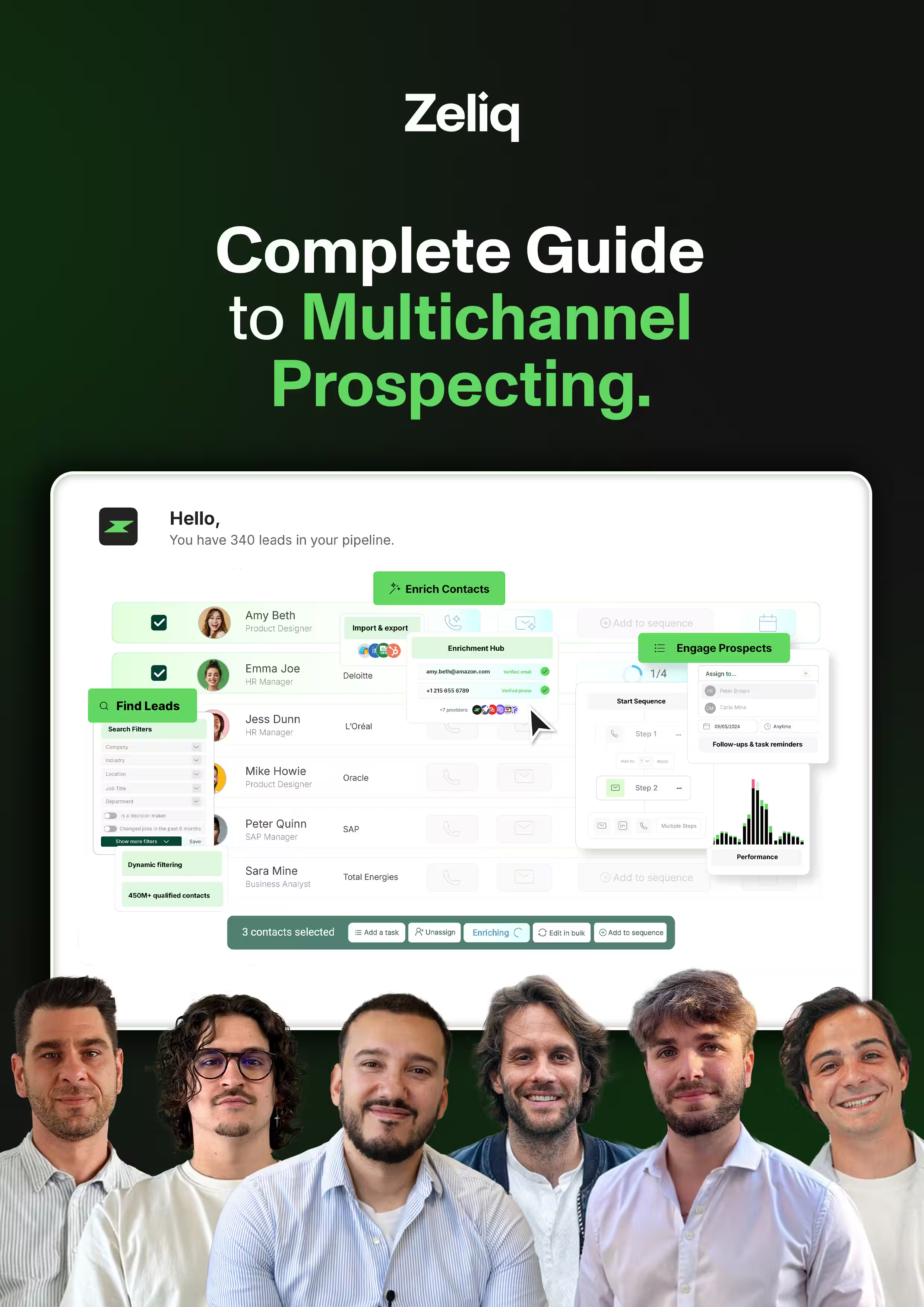
Zeliq’s B2B contact database lets you filter and enrich contact lists by company size, industry, country, and technology stack, with verified emails and phone numbers available directly from the interface.
Adapt Your Messaging to Each Company Type
The same product requires a different value proposition for each company type. For a startup, lead with speed and self-service. For a mid-market company, lead with the ROI model and the implementation timeline. For an enterprise, lead with security, compliance, and the customer roster.
Personalization at the company-type level is the most efficient form of personalization because it does not require individual research: it requires segment-level intelligence.
Use Size and Structure to Predict the Buying Committee
Company size predicts stakeholder complexity. At a 10-person startup, you are talking to the founder. At a 300-person mid-market company, you are talking to a VP with a director champion and a CFO who signs off on budget. At an enterprise, you are navigating a six-person buying committee with a procurement team reviewing the contract.
Knowing this before you reach out tells you: who to target first, how many contacts to engage in parallel, and how long to expect the process to take.
Score Leads Using Company-Level Data
Lead scoring models that incorporate company-type signals are more accurate than those built on behavioral data alone. Weight accounts higher when: company size is in your target range, the industry matches your top-performing verticals, recent growth signals suggest budget availability, and the tech stack indicates they use tools that integrate with yours.
Zeliq’s data enrichment automatically adds firmographic and technographic signals to your prospect records, so your scoring model has the data it needs to rank accounts accurately.
Common Mistakes When Using Company Classification in Targeting
Targeting by size alone. A 500-person company in a government-regulated utility sector has a completely different buying process than a 500-person SaaS company. Size without industry context produces lists that look right but underperform.
Ignoring legal structure signals. A founder-led LLC and a corporation with a procurement function need completely different sales approaches. If you treat them the same, you will show up with the wrong pitch and the wrong timeline expectation.
Over-segmenting too early. New teams often create too many micro-segments before they have enough data to know which segments convert. Start with two or three well-defined company types, validate conversion rates, then expand.
Not revisiting ICP definitions. As your product evolves and your customer base grows, the types of companies you serve best change. Revisit your ICP definition every six months against closed-won data, not just against assumptions made at launch.
Filter, enrich, and target B2B companies by size, industry, and tech stack in one platform.
Try Zeliq for free