

A B2B sales process is a repeatable sequence of stages that turns a cold account into a signed contract. It starts the moment a rep identifies a potential opportunity and ends when the customer renews, expands, or churns. Everything in between is what we call the B2B sales process steps.
Without a defined process, your pipeline is a guessing game. With one, it becomes a predictable engine. Research shows that teams who condense their process from seven bloated stages to three focused ones, while compressing their timeline from 12 weeks to 3, can nearly double win rates from 19% to 37%. That is not about working harder; it is about working in the right order.
This guide covers the seven core B2B sales process steps, how to define stages that reflect how your buyers actually buy, the most common pipeline mistakes, and how to optimize every stage for speed and conversion.
The 7 Core B2B Sales Process Steps
1. Prospecting and Account Targeting
Prospecting is the foundation of a healthy pipeline. It is not just about generating volume; it is about identifying the accounts and contacts most likely to convert given your Ideal Customer Profile (ICP).
Modern prospecting goes beyond cold list imports. Strong B2B teams use enriched databases to filter by industry, company size, revenue, tech stack, and growth signals. They look for intent signals: leadership changes, recent funding rounds, new product launches, or job postings that indicate budget and urgency.
The output of good prospecting is not a big list. It is a focused list of qualified accounts with verified contacts, ready to enter a structured outreach sequence.
2. First Outreach and Initial Contact
The goal of first contact is not to sell. It is to earn the next conversation. Whether via cold email, LinkedIn, phone, or a warm referral, a strong opening message does three things: it shows you understand the account’s context, it introduces one specific piece of value, and it makes the next step frictionless.
A personalized, professional opening sets the tone for the entire relationship. The medium matters less than the relevance: an email that references a recent company announcement will always outperform a generic template, regardless of the channel.
Map out a multichannel sequence before you start: which touchpoints, in which order, over how many days. This is what separates structured outreach from spray-and-pray.
3. Lead Qualification
Before investing hours in a deal, qualify it. Frameworks like BANT (Budget, Authority, Need, Timing) and MEDDIC (Metrics, Economic Buyer, Decision Criteria, Decision Process, Identify Pain, Champion) exist for one reason: to help you distinguish real opportunities from pipeline noise.
Qualification means assessing: - Is there a genuine, urgent need for your solution? - Is the contact you are speaking to the decision-maker, or do you need to get higher? - Is there realistic budget and a credible timeline? - Are there competing vendors already in play?
Deals that skip qualification create pipeline bloat. Your CRM fills with accounts that will never close, forecasting becomes unreliable, and your best reps waste time on long shots while fast-moving deals go cold.
4. Discovery Call and Needs Analysis
Discovery is the most underinvested step in most B2B sales processes. Done right, it gives you everything you need to win: the prospect’s real pain, their success criteria, their internal politics, and their timeline.
A structured discovery call uses open-ended questions to surface concrete challenges, not surface-level symptoms. You are not asking what features they want. You are asking what breaks if the problem stays unsolved, who else it affects, and what a successful outcome looks like in 12 months.
Discovery also maps the buying committee. Research shows that deals with three or more contacts engaged close 2.4x faster than single-threaded deals. Identify your champion, the economic buyer, and any technical evaluators early. Each one has different criteria; tailor your messaging accordingly.
5. Solution Presentation and Demo
The presentation is where discovery pays off. If you have done step 4 properly, you are not showing a product. You are showing a solution to specific problems this specific team has, with specific outcomes they care about.
Avoid feature dumps. Structure your demo around the prospect’s stated priorities, referencing the language and context from discovery. Show one or two power moments that directly address the pain, then leave time for questions.
Timing matters more than most reps realize. Proposals that arrive within 24 hours of the demo close 35% faster than those that take longer. Buyer attention is at its peak right after the demo. Delays push you into competition with the next vendor they are evaluating.
6. Objection Handling and Negotiation
Objections are not rejections. They are questions in disguise. The most common ones in B2B orbit budget, ROI, integration complexity, risk, and timing. Each one has a root cause that is worth uncovering before answering.
A useful approach: clarify before you respond. “When you say the price is too high, is that relative to your current solution, or relative to a competitor’s quote?” This turns a blanket objection into a specific problem you can actually address.
Negotiation in B2B is rarely just about price. It often involves contract length, onboarding scope, SLAs, payment terms, or a phased rollout. Define what you can flex on before the negotiation starts, so your reps are not improvising concessions that erode margin or set bad precedents.
7. Close, Contract, and Handoff
Closing is the natural result of a process well executed. If discovery was thorough, the demo was relevant, objections were addressed, and a champion is bought in, the close should not require high-pressure tactics.
This stage includes final stakeholder validation, legal review, contract signature, and the handoff to the customer success or onboarding team. The handoff is not a formality; it is the first impression of what it is like to be a customer. A clean, documented handoff preserves trust and reduces churn.
In subscription businesses, this is also where expansion revenue starts. Post-sale relationships feed referrals, case studies, and upsell opportunities. Structure the handoff accordingly.
How to Define Your B2B Sales Stages
Match Your Stages to How Buyers Actually Buy
The most common mistake in pipeline design is building a process around how your team sells rather than how your buyers decide. A five-stage process that maps perfectly to your internal workflow but ignores the buyer’s evaluation steps will leak deals you could have won.
Start by mapping the buyer journey: awareness of the problem, active evaluation, selection, approval, and commitment. Your sales stages should have a clear counterpart at each point. This alignment is what gives reps a reliable read on where a deal really is, not just where they hope it is.
Attach a Clear Exit Criterion to Each Stage
Every stage needs a specific condition that must be met before a deal advances. Not “we had a good call,” but “decision-maker confirmed budget and agreed to a demo.” Not “they seem interested,” but “champion sent the RFP internally.”
Exit criteria eliminate the two biggest pipeline problems: stalled deals that look active but are not, and premature advances that inflate close probability. When conditions are observable and shared across the team, forecasting becomes reliable and coaching becomes concrete.
Tie Each Stage to Specific Sales Actions
A well-defined stage is useless without a corresponding playbook. For each stage, document the actions expected from the rep: which questions to ask, which materials to send, which stakeholders to engage, and what the next step should be by the end of the interaction.
This transforms your pipeline from a tracking tool into a working plan. Reps know exactly what to do to move a deal forward. Managers can coach against a shared standard. New hires onboard faster.
Keep the Total Number of Stages Small
The research consistently shows that simpler processes outperform complex ones. Aim for five to seven stages for most B2B sales motions. More than that creates cognitive load, inconsistent usage, and data you cannot trust.
If your process has twelve stages, merge any that do not have a distinct exit criterion or required action. Complexity does not equal rigor; it usually means the process was designed to please everyone in the room.
Why Your B2B Sales Process Steps Matter
B2B Decisions Involve Multiple Stakeholders
The average B2B purchase now involves six to ten decision-makers, each with their own criteria, timeline, and risk threshold. A structured process gives your reps a framework for managing multi-stakeholder deals without losing the thread.
Defined stages map to defined stakeholders: who to reach out to first, when to involve the economic buyer, when to bring in a technical resource. Without this, deals stall at informal checkpoints because no one knows whose approval is needed next.
Pipeline Visibility Requires a Shared Language
When every rep defines “negotiation” differently, your pipeline data is meaningless. A defined process creates a shared vocabulary across the team, making pipeline reviews, deal coaching, and forecast calls productive rather than aspirational.
Management can identify where deals are statistically most likely to stall, allocate support resources, and spot coaching opportunities by stage rather than by gut feel.
Qualification Gates Protect Your Close Rate
Every stage in a well-designed process acts as a filter. Deals that do not meet the qualification criteria for stage two never make it to stage three, where they would consume demo time, legal resources, and management attention before dying quietly.
Strict qualification early in the process is what makes your close rate meaningful. A 40% close rate from a qualified pipeline is a different business than a 40% close rate from a poorly filtered one; the second team is just burning twice the resources to get the same output.
Common Mistakes in Managing B2B Sales Stages
Too Many Stages, Too Little Logic
A pipeline with fifteen stages is not more precise; it is more confusing. When reps are unsure which stage a deal belongs in, they default to wherever feels safe. The result is inaccurate data, inconsistent pipeline hygiene, and forecasts that the business cannot act on.
Every stage must earn its place. If you cannot define what changes between stage six and stage seven, merge them.
Jumping to Demo Before Qualifying
Showing the product before understanding the need is the most expensive shortcut in B2B sales. It produces demos that miss the mark, proposals that do not reflect the buyer’s priorities, and objections that should have been surfaced weeks earlier.
The fix is simple: qualification gates the demo. No confirmed budget range, no established pain, no agreed-on timeline? The demo does not happen yet. This discipline feels slow in the moment and saves months of wasted effort.
Letting Deals Age in Place
A deal that has not moved in three weeks is not a pipeline asset; it is a liability. Stale deals distort your forecast, obscure your real conversion rates, and prevent reps from focusing on winnable business.
Set time-in-stage alerts for every stage. If a deal exceeds its expected duration without activity, it needs a deliberate decision: re-engage with a new angle, downgrade to a lower stage, or close it as lost. A clean pipeline is a usable pipeline.
Confusing Activity with Advancement
Sending three emails is not the same as advancing a deal. A discovery call scheduled is not the same as a discovery call that produced a confirmed pain and an agreed next step. Conflating activity with progress leads to false confidence and inflated close predictions.
In your CRM, separate tasks and logged activities from stage advancement events. Stage changes should require a deliberate input, tied to an exit criterion, not automatic logging of a sent email.
How to Optimize Each B2B Sales Stage
Target the Right Accounts Before You Reach Out
Optimization starts before the first touchpoint. Use your ICP to define the firmographic and behavioral signals that predict a good fit, then only work accounts that match. Narrowing the top of the funnel raises the quality of every downstream stage.
The best-performing teams use intent data, trigger signals, and enriched contact profiles to prioritize accounts where the timing is right, not just where the fit is theoretical.
Standardize Without Scripting
Playbooks give reps a framework; they do not replace judgment. Build talk tracks, email templates, and discovery question banks that give structure to each stage, but train reps to adapt them based on the prospect’s communication style, knowledge level, and pace.
Rigid scripts produce robotic interactions. Flexible frameworks produce consistent results.
Measure Stage-to-Stage Conversion Rates
The formula is simple: divide the number of deals that advanced to stage N+1 by the number that entered stage N. Do this for every stage, track it monthly, and segment by rep, segment, and product line.
This tells you exactly where your process breaks down. If 70% of demos never produce a proposal, the demo is the problem, not the prospect pool. If proposals close at 25% when your benchmark is 40%, the issue is likely in how proposals are scoped and delivered.
Remove Friction at Every Handoff
The transitions between stages are where deals die. A discovery call that ends without a booked demo. A demo that ends without a proposal committed. A proposal that sits for two weeks waiting for internal approval.
Design each stage to end with a clear next step confirmed in the room: date, format, and participants agreed before anyone hangs up. This single habit, applied consistently, will shorten your cycle faster than any tool.
Tools That Support Each Sales Stage
CRM for Pipeline Visibility
Your CRM is the backbone. It centralizes every account, contact, deal, and interaction in one place, and it is where your stage definitions live operationally. A well-configured CRM gives managers real-time pipeline visibility, surfaces stuck deals, and provides the data needed for accurate forecasting.
The most important CRM configuration decision is the one no one talks about: what triggers a stage change. Make it explicit, make it observable, and make it consistent.
Prospecting Tools for Pipeline Input
B2B prospecting platforms let you find and enrich accounts that match your ICP at scale. Filters for industry, company size, location, revenue, and tech stack let you build targeted lists rather than broad ones. Automatic enrichment of emails, phone numbers, and LinkedIn profiles eliminates the manual research that slows prospecting down.
The output is a prioritized, verified account list that enters your sequences ready to engage, not requiring three hours of prep per account.
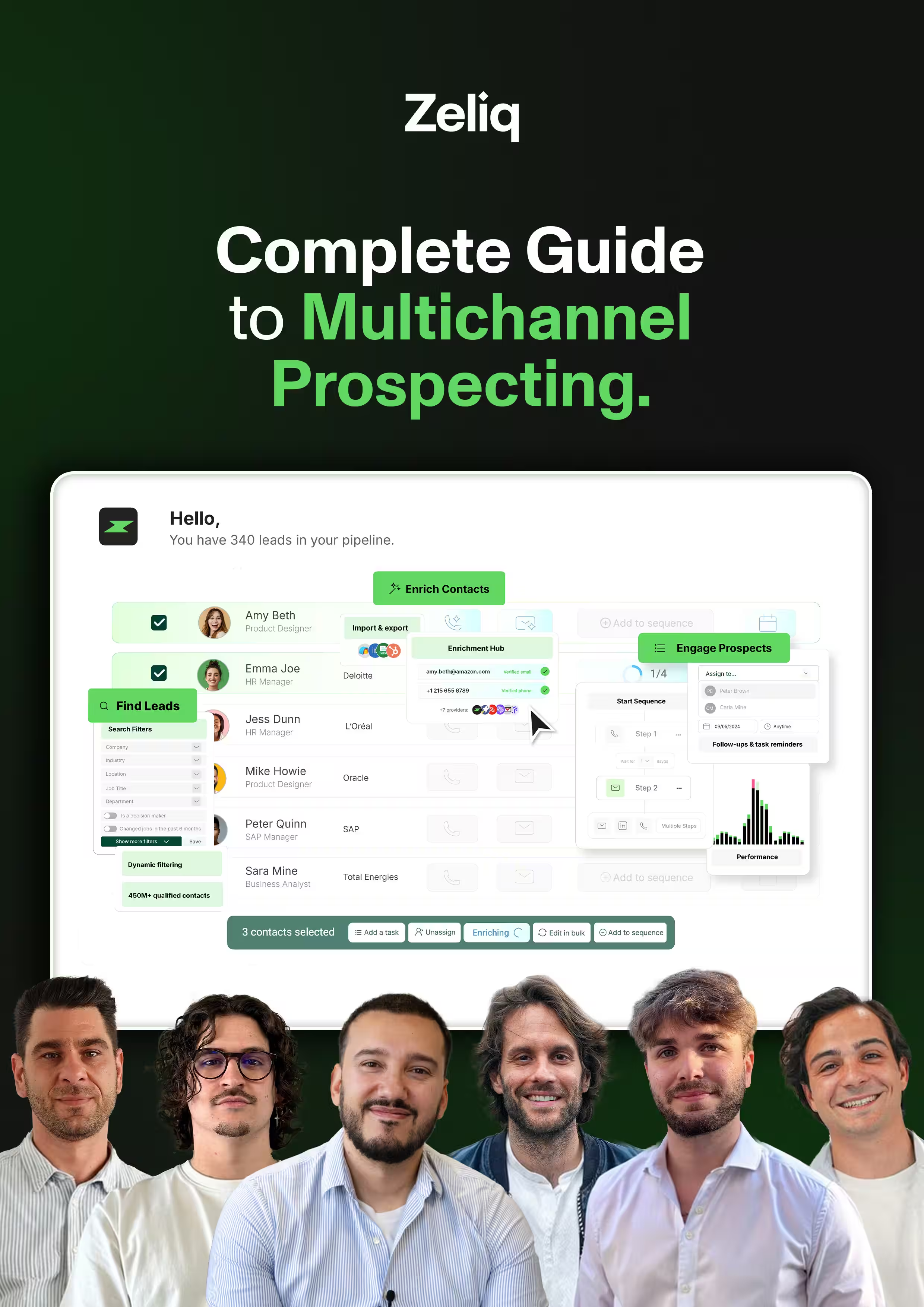
Zeliq’s contact data platform lets you build and enrich prospect lists directly from your browser, with verified emails and phone numbers available for your entire ICP.
Sales Engagement Platforms for Sequence Execution
Sales engagement tools automate the orchestration of your multichannel sequences: emails, calls, LinkedIn touches, and internal tasks, in the right order, at the right cadence. They ensure no follow-up is forgotten and no prospect falls through the gap between two stages.
When integrated with your CRM, they close the loop between activity (what happened) and advancement (what changed). Reps spend less time on admin and more time on the conversations that move deals.
Zeliq’s multichannel prospecting sequences let you build and execute outreach flows directly alongside your contact data, keeping prospecting and engagement in one workflow.
Analytics Tools for Cycle and Conversion Tracking
Reporting tools turn pipeline data into coaching data. Average days per stage, win rate by rep and segment, deal velocity by source or ICP fit: these metrics answer the question every revenue leader needs answered, which is “where exactly are we losing, and why?”
Pair stage-level analytics with activity data to separate reps who are busy from reps who are effective. The insight drives targeted coaching, not generic feedback.
Aligning B2B Sales Process Steps with Your GTM Strategy
Connect Prospecting, Qualification, and Close as One Motion
The cleanest sales processes treat prospecting, qualification, and closing as a single continuous motion rather than three handoffs between three different functions. The messaging from the first cold email should echo through discovery, demo, and proposal. Buyers experience consistency; reps maintain context.
This requires alignment on ICP, messaging, and success criteria across SDRs, AEs, and CS. When everyone works from the same definition of a good account and a good outcome, the process runs faster and wastes less.
Prioritize Accounts with the Strongest Signals
Not all accounts are equal. Use lead scoring based on firmographic fit, behavioral intent (product page visits, content downloads, webinar attendance), and timing signals (budget cycles, competitive displacement, leadership change) to rank accounts by likelihood to close.
Reps who work from a scored and prioritized list convert at higher rates than those who work from an unsorted inbox. The leverage is not more activity; it is better targeting.
Build Multichannel Follow-Up Into the Process
No B2B deal closes in a single thread. Buyers respond to different channels at different stages: LinkedIn early, email mid-funnel, phone when urgency is established. A structured multichannel follow-up sequence built into each stage ensures consistent presence without requiring reps to improvise coverage.
Define by stage which channels are active, at what frequency, and with what type of content. Early stages: educational and value-led. Later stages: specific, proof-heavy, decision-facilitation.
Centralize Data, Execution, and Forecasting
The most effective sales organizations run from a single source of truth: account data, enriched contacts, active sequences, stage history, and performance metrics all in one environment. This eliminates the version control problems that slow teams down and the blind spots that produce forecast surprises.
Platforms like Zeliq combine data enrichment, prospecting, and multichannel engagement in one place, so the distance between “identifying an account” and “running a personalized sequence” is measured in minutes, not days.
Build a faster, cleaner B2B sales process with verified contact data and multichannel sequencing in one platform.
Try Zeliq for free