
RocketReach and Lusha are two of the most recognized names in B2B contact data. Both help sales and recruiting teams find verified emails and phone numbers. But they are built around different strengths, and choosing the wrong one for your use case means paying for data your team will not use effectively.
This comparison cuts through the marketing copy. We look at what each tool actually does well, where each one falls short, and what the decision should come down to based on your team’s real workflow, market, and motion.
RocketReach vs Lusha: Positioning and Core Use Case
RocketReach: High-Volume Contact Search and Bulk Lookup
RocketReach positions itself as a large-scale contact discovery engine. Its database covers over 700 million individual profiles and more than 60 million company profiles, built from aggregated public sources. The platform is optimized for:
- High-volume prospecting: bulk export of contact lists filtered by role, company, location, or industry
- Recruiting workflows: finding candidates across a wide range of seniority levels and functions
- US-first coverage: particularly strong for US-based contacts, with broader but thinner international coverage
- Lookup workflows: searching for a specific contact or batch of contacts rather than running ongoing ICP-based campaigns
RocketReach is the right choice when your primary need is volume: getting a large number of contacts quickly without requiring that every record be deeply verified.
Lusha: Verified Data Quality and Sales-First Experience
Lusha prioritizes data freshness and verification over raw database size. It covers over 100 million business profiles, with a sharper focus on keeping that data current. The platform is particularly strong on:
- Direct phone numbers: Lusha is consistently cited in user reviews for the quality and freshness of its mobile numbers, which is critical for call-heavy sales motions
- LinkedIn extension experience: a clean, fast extension that surfaces contact data directly from LinkedIn profiles without friction
- GDPR compliance: more transparent data sourcing and compliance controls, making it a better fit for European market outreach
- Small and mid-size team UX: faster setup, transparent pricing, and less configuration overhead than enterprise-oriented platforms
Lusha is the right choice when your team prioritizes call connection rates and data integrity over contact volume.
Data Quality: The Comparison That Actually Matters
Email: “Found” vs “Verified”
Both tools find emails. The meaningful distinction is between an email that was found (retrieved from aggregated sources) and one that is verified (confirmed deliverable through a real-time check).
RocketReach has broad coverage but accuracy varies by source. Some records are current; others have not been refreshed. Bounce rates on RocketReach exports tend to be higher than on platforms with stricter verification, particularly for contacts who have changed roles or companies.
Lusha applies more rigorous verification to its database, which is reflected in generally lower bounce rates. The tradeoff is smaller dataset size: you will find fewer contacts overall, but a higher proportion of those you do find will have accurate, deliverable emails.
What this means for your team: if email deliverability and sender reputation are priorities (they should be for any team running outbound at scale), the verification quality of Lusha’s data tends to produce better results than RocketReach’s volume advantage.
Phone: Direct Lines vs General Numbers
This is where the gap between the two tools is most visible in practice.
Lusha is consistently rated higher for direct mobile and direct-dial numbers, which is the phone data that actually matters for sales outreach. Getting through to a mobile number or direct line means reaching the decision-maker directly. Getting a company switchboard means starting over.
RocketReach provides phone data but with more variability in whether the numbers are direct lines or general company contacts. For US-based contacts, coverage is reasonable. For European markets, the quality drops more noticeably.
What this means for your team: if your motion is call-heavy (SDR teams making high volumes of outbound calls), Lusha’s phone data will produce better connection rates.
Geographic Coverage
RocketReach is strongest in the United States. International coverage exists but thins out as you move into less-aggregated markets (Southern Europe, Southeast Asia, Latin America).
Lusha performs comparably in the US and has invested more in European data quality, partly driven by its GDPR compliance commitments. For teams with significant European outreach, Lusha’s data tends to be more reliable.
Search and Filtering: Building Usable Lists
Both platforms offer contact and company search with filters. The practical difference is in how granular and how reliable those filters are.
RocketReach offers strong filtering for role, seniority, company, location, and industry, along with bulk export capabilities. It is well-suited for list-building at volume: defining broad criteria and extracting a large batch of contacts.
Lusha offers similar filters with a more polished interface and tighter integration between search results and its extension. The list-building experience is slightly more friction-free for individual lookups.
Neither tool provides advanced ICP signals such as technographic data, intent signals, or trigger-based filtering (recent funding, hiring patterns, leadership changes) without significant workaround. This is a gap that more purpose-built prospecting platforms are designed to fill.
LinkedIn Extension: Field Productivity
Both tools have LinkedIn browser extensions that surface contact data directly from LinkedIn profiles.
Lusha’s extension is consistently rated higher in user reviews for speed, design, and data quality. It surfaces direct numbers and emails from profile pages and search results with minimal clicks, and the data it returns tends to be more accurate.
RocketReach’s extension covers more surfaces (including web pages beyond LinkedIn) but is rated lower for overall UX and data freshness in user reviews.
Important for both tools: LinkedIn’s terms of service prohibit automated scraping of contact data from its platform. Extensions that extract data from LinkedIn profiles technically operate in a gray area. Be aware of this when deploying either tool at scale on LinkedIn.
CRM and Integration
CRM Sync
RocketReach integrates with Salesforce, HubSpot, and a range of other CRMs, with native connectors for contact push and basic sync. Configuration can require more technical setup for teams that need custom field mapping or deduplication logic.
Lusha also integrates with Salesforce, HubSpot, and other platforms. Its CRM integrations are generally rated as easier to set up and more reliable for smaller teams that do not have a dedicated RevOps function to manage the connection.
For enterprise teams with complex CRM governance (custom objects, strict field mapping, golden record logic), neither tool competes with purpose-built data enrichment platforms. Both require workarounds for advanced enrichment workflows.
Outreach Tool Integration
Both platforms connect to major outreach tools (Salesloft, Outreach, Instantly, etc.) via direct integrations or Zapier. The quality of these integrations matters: a contact found in your data tool should flow cleanly into your sequence without manual re-entry.
Compliance: What to Check Before Deploying
GDPR
Lusha has been more transparent about its GDPR compliance posture, publishing clearer documentation on data sourcing, individual rights handling, and opt-out mechanisms. For teams operating in the EU or outreaching to EU-based contacts, this matters operationally and legally.
RocketReach is also GDPR-aware but has historically been more opaque about its data sourcing practices. Teams with EU outreach should verify current compliance documentation before committing to a contract.
Team Permissions and Data Governance
For enterprise teams with compliance requirements, assess: which users can export data, what audit trails exist for data access, and how opt-out and DNC (do not contact) lists are managed. Both tools offer basic team management, but neither is purpose-built for complex data governance at enterprise scale.
Pricing: How to Compare Honestly
Both tools publish pricing, but the comparison is only meaningful at the cost-per-usable-contact level, not the list-price level.
RocketReach pricing starts at lower tiers but scales with lookup volume. The value proposition is that you get more contacts per dollar. The catch is that a higher percentage of those contacts may be outdated or unverifiable, which means your actual cost per working contact is higher than it appears.
Lusha pricing is higher on a per-credit basis but the data quality means fewer wasted credits on bad emails and bounced sends. For teams where deliverability and connection rate matter, the effective cost per successful outreach is competitive with RocketReach.
The right comparison is not entry price. It is cost per meeting booked, which factors in: data accuracy, email deliverability, phone connection rates, and time spent cleaning and verifying.
Which Tool to Choose: Decision Framework
| Scenario | Recommended Tool |
|---|---|
| High-volume US-focused list building | RocketReach |
| Call-heavy motion, direct dial quality matters | Lusha |
| EU market outreach, GDPR compliance priority | Lusha |
| Individual LinkedIn-based prospecting | Lusha |
| Bulk export for large campaigns | RocketReach |
| Small team, fast setup, transparent pricing | Lusha |
| Recruiting at scale, US market | RocketReach |
When Zeliq Becomes the More Complete Option
Both RocketReach and Lusha are point solutions: they find and enrich contact data, but they stop there. You still need a separate tool to build sequences, manage multichannel outreach, and track engagement. That means managing multiple subscriptions, moving data between tools, and accepting the data loss and friction that comes with every handoff.
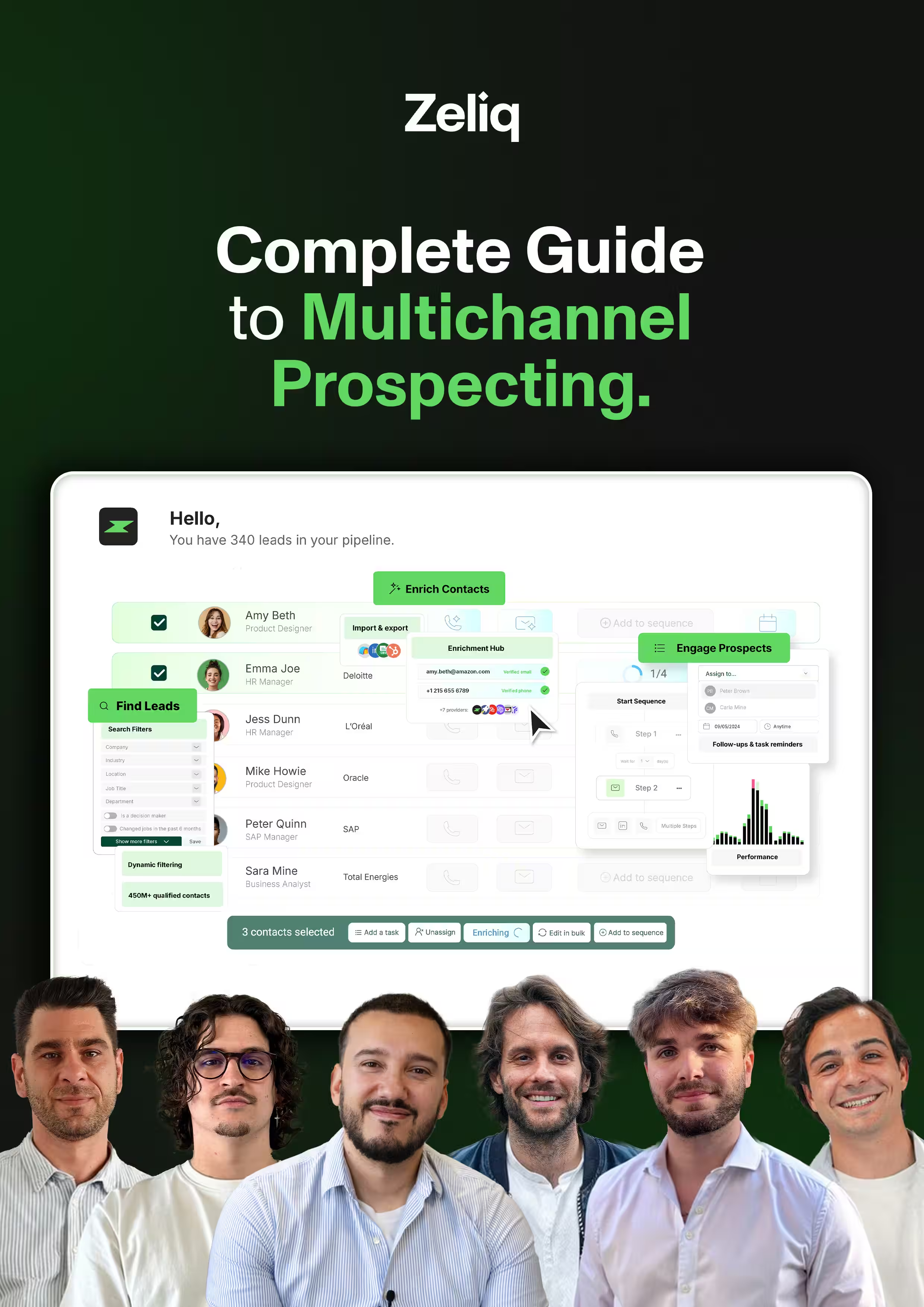
Zeliq is built as an integrated platform: ICP search, contact enrichment (email and phone), LinkedIn prospecting via browser extension, and multichannel sequences live in the same environment.
For teams whose bottleneck is the fragmentation between their data tool and their outreach tool, Zeliq removes that friction:
- Find and enrich contacts from a searchable B2B database with verified emails and phones
- Prospect directly from LinkedIn and push contacts into sequences without leaving the browser
- Run multichannel sequences (email, LinkedIn, phone) from the same platform where you found the contact
- Enrich existing lists from your CRM or CSV without a separate enrichment vendor
The decision between RocketReach, Lusha, and Zeliq is ultimately a question of workflow: if your team needs a pure contact lookup tool and already has a strong outreach stack, either of the first two may serve you well. If you are building or rebuilding your prospecting motion and want fewer tools in the chain, Zeliq is worth evaluating.
Common Mistakes in This Comparison
Choosing on database size. 700 million profiles sounds impressive until you discover that 30% of the contacts in your export have moved on from the companies they were listed under. Database size is a marketing number; verified coverage on your specific ICP is what matters.
Ignoring phone data if your motion includes calls. Teams that default to email-only because phone data “never works” often have this problem because they are using the wrong data source. Lusha’s direct dial quality is meaningfully better than most alternatives.
Comparing entry-level pricing. The free or low-cost tier of both tools exists to acquire users, not to power a real outreach motion. Compare at the volume your team actually needs, and factor in the cost of the sequences and CRM tools you will need alongside it.
Not testing on your actual ICP first. Run a sample test on 50 to 100 contacts in your target market before committing to an annual contract. The tool with better coverage on your specific ICP may not match the general market averages.
Skip the tool sprawl. Find contacts, enrich data, and run multichannel sequences in one platform.
Try Zeliq for free