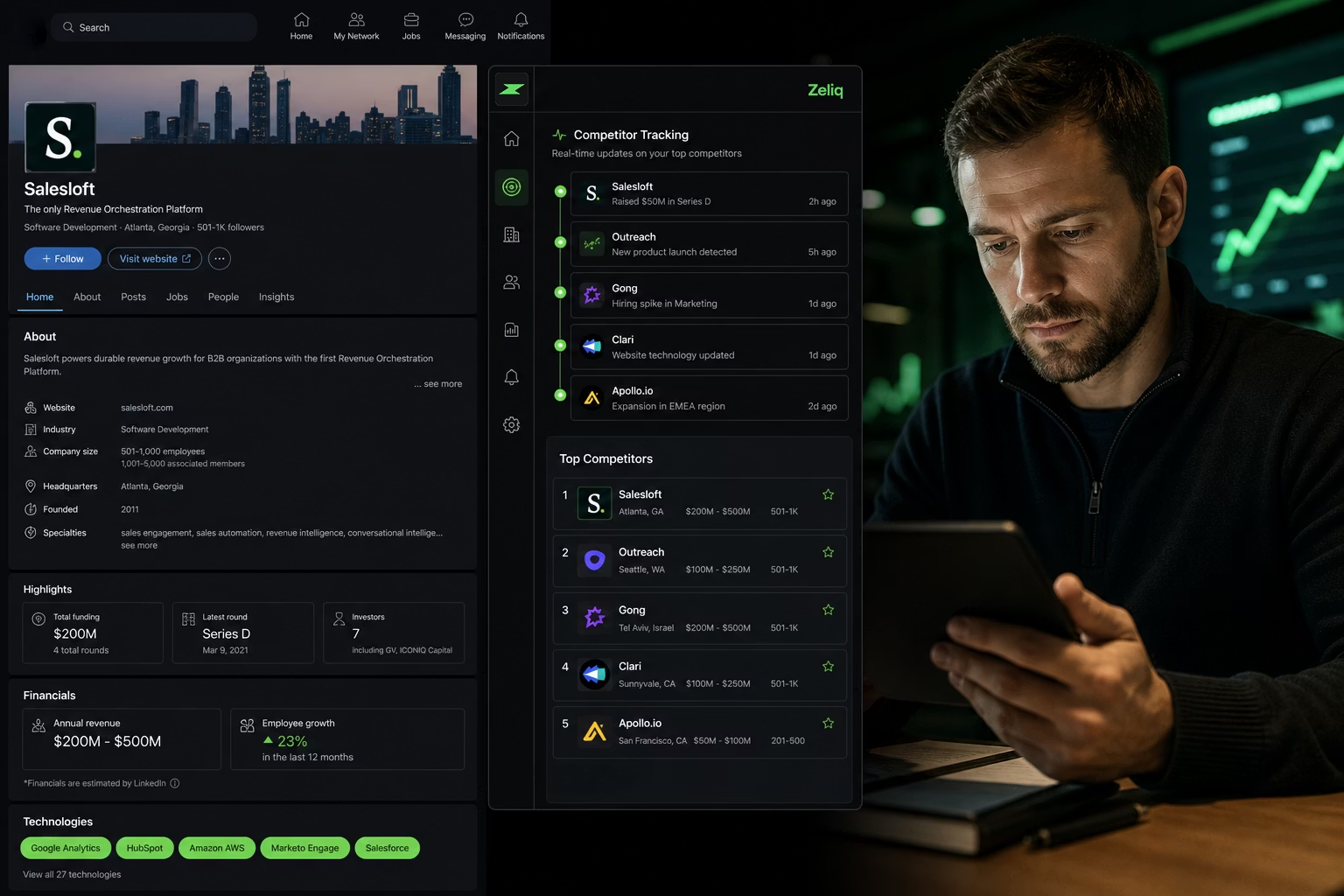

B2B competitive intelligence in 2026 is the continuous process of collecting, analyzing and distributing information about your market environment (competitors, customers, suppliers, sector signals) to make faster and more relevant commercial decisions. Per Crayon State of Competitive Intelligence 2025, 68% of B2B deals involve at least one direct competitor, yet the average sales team self-rates only 3.8 out of 10 on competitive preparedness. The gap between properly-tooled teams and the rest now measures in pipeline won or lost.
For a B2B sales rep, Head of Sales, Marketing Manager or founder, this guide details the strict definition of competitive intelligence, distinguishes the 3 tooling levels (beginner, intermediate, advanced), lists the 6 key sources to monitor, explains how to organize weekly intelligence cycles and how to turn collection into concrete commercial decisions.
At a glance:
- Strict definition of B2B competitive intelligence
- The 6 key sources to monitor in B2B 2026
- 3 tooling levels: from free to enterprise CI platforms
- How to structure a weekly intelligence cycle
- 3 frequent mistakes to avoid
- 3 FAQs and 3 dated actions
Key takeaways:
- Intelligence cycle: collect → analyze → distribute → decide
- 6 main sources: LinkedIn, press releases, financial reports, trade media, official registries, professional networks
- 68% of B2B deals involve a competitor (Crayon State of CI 2025)
- 40% of tech providers projected to use CI platforms by 2026 (Gartner Market Guide 2025), up from ~10% before
- 3-5 priority axes recommended, never more than 10 competitors tracked simultaneously
1. Strict definition: what is B2B competitive intelligence in 2026?
Competitive intelligence (also known as market intelligence or sales intelligence) is the structured process of collecting, analyzing and distributing information about an organization’s external environment, for the purpose of improving commercial performance. Three structuring clarifications:
Clarification 1: CI is not illegal espionage. It feeds exclusively on public or semi-public sources (websites, press releases, social media, official registries, sector databases). It excludes non-consented scraping, access to private data and industrial espionage. The legal line is clear and crossing it exposes to lawsuits.
Clarification 2: CI ≠ classic market analysis. Market analysis produces point-in-time studies. CI is a continuous flow, essentially real-time or near-real-time, fed by alerts and short analysis cycles. Conflating the two leads to intelligence delivered too late to be actionable.
Clarification 3: CI produces decisions, not reports. A CI process that ends in a weekly PowerPoint never read is a resource waste. Useful CI produces at minimum one commercial decision per week: positioning adjustment, account re-engagement, pricing modification, updated sales battlecard.
2. The 6 key sources to monitor in B2B 2026
Source 1: LinkedIn (gold mine of B2B intelligence)
LinkedIn has become the pivot channel of B2B intelligence. Three signal types to observe: (1) job postings reveal investment directions (a competitor massively hiring SDRs signals an aggressive outbound strategy), (2) executive posts unveil strategic priorities and communication tone, (3) comments under posts of customers and competitors expose perceived strengths and weaknesses in the market. Sales Navigator amplifies this intelligence by allowing you to track an account list and receive alerts on key changes.
Source 2: Press releases and company announcements
Fundraisings, partnerships, appointments, financial results, product launches: press releases are verified and dated information that structures your competitive chronology. Sources to monitor: investor websites of public competitors, platforms like PR Newswire, Business Wire, or sector hubs (TechCrunch, The Information, Pitchbook News).
Source 3: Financial reports and public databases
For public companies, quarterly and annual reports (10-K in the US, equivalent in EU) give a direct signal on strategy. For non-public US companies, OpenCorporates, SEC EDGAR and state business registries provide access to published filings, shareholder changes and financial indicators. This is often the most underused source by sales teams.
Source 4: Trade media and sector newsletters
Depending on your sector, identify 5 to 10 specialized media to follow daily: The Information, Pitchbook News, SaaStr for international B2B tech; relevant verticals for industry, healthcare, fintech. Newsletters like The Information, Lenny’s Newsletter, Stratechery condense essentials for fast reading.
Source 5: Professional networks and events
Conferences, trade shows and meetups are concentrated intelligence sources: agendas, speakers, topics covered reveal dominant sector trends 6-12 months ahead. Following replays and post-event summaries lets you capture this information without having to physically attend each event.
Source 6: Official registries and sector databases
SEC EDGAR for US public companies, Companies House for UK, BODACC for France, and equivalent registries allow you to monitor company creations, statutory modifications, insolvency procedures. For some sectors (finance, health, energy), regulated sector databases are essential (FDA, FCA, OFCOM, etc.).
3. The 3 tooling levels in 2026
Beginner level: Google Alerts + shared spreadsheet
Cost: free. Volume: 2 to 5 competitors tracked. Setup: 2 hours.
Create Google Alerts on competitor names, their key products and your sector keywords. Compile results in a shared Google Sheets with simple categorization (date, source, type, action to take). Sufficient for an SMB or solo founder starting out.
Intermediate level: dedicated CI tool + aggregator
Cost: $50 to $500/month. Volume: 10 to 30 competitors tracked. Setup: 1-2 weeks.
Typical tools: Meltwater, Mention, Talkwalker for social listening; Feedly Pro for news aggregation. Allows centralizing several sources, creating smart alerts and sharing dashboards with the sales team. Relevant for a B2B scale-up with 5-20 reps.
Advanced level: CI platform or dedicated AI
Cost: $15,000 to $40,000/year (Crayon State of CI 2025). Volume: 30 to 100+ competitors. Setup: 1-3 months.
Typical tools: Crayon (enterprise monitoring leader), Klue (battlecards and deal-level intel), Kompyte (mid-market automated tracking). Per Gartner Market Guide 2025, 40% of tech providers will use these platforms by 2026, vs ~10% before. Relevant for B2B companies beyond 50 reps or with a complex sales cycle.
Industrialize your B2B intelligence and intent signals
Zeliq combines 450 million verified contacts, intent-signal enrichment and multi-channel sequences triggered by business events. Account created in 2 minutes, no credit card.
Book a demo4. How to structure a useful weekly intelligence cycle
CI that doesn’t produce a decision is dead weight. Here’s a weekly ritual that structures collection and forces action:
Monday morning (15 min): alert triage. Open sources, mark as “to process” only information that can trigger a commercial action in the week. Everything else goes to archives.
Tuesday (30 min): team analysis. Short meeting with SDRs and AEs: present the 3-5 notable signals, debate implications. Clear decision per signal: immediate action, follow-up, or ignore.
Wednesday-Thursday: commercial actions. Each SDR/AE integrates decisions into their prospecting sequences: approach of flagged accounts, pitch adjustment, re-engagement of prospects affected by market events.
Friday (10 min): feedback loop. Measure how many signals of the week produced a booked meeting or influenced a deal. Adjust sources and alert frequency if too much noise or too little relevant signal.
Golden rules:
- Focus on 3 to 5 priority axes linked to commercial decisions. Beyond that, you drown the team.
- Track maximum 10 competitors simultaneously. Beyond, analysis becomes superficial.
- Define a distribution format: weekly written brief (Notion, email), shared dashboard, or real-time alert depending on urgency.
5. The 3 frequent mistakes to avoid
Mistake 1: confusing intelligence with collection. Accumulating PDFs, articles and screenshots without analyzing or distributing them produces a useless folder. CI has value only in the analysis and decision that flow from it.
Mistake 2: too many sources, no hierarchy. Following 50 competitors and 100 media guarantees burnout of the intelligence officer and absence of actionable signal. The 80/20 rule: 5 main sources produce 80% of the value.
Mistake 3: intelligence disconnected from prospecting. Siloed CI, disconnected from CRM and SDR sequences, never influences pipeline. Intent signals (hiring, fundraising, LinkedIn post) must directly trigger personalized prospecting sequences via your orchestration platform.
6. Frequently asked questions
What is B2B competitive intelligence?
B2B competitive intelligence is the structured process of collecting, analyzing and distributing information about an organization’s external environment, with the goal of improving commercial performance. It differs from classic market analysis by its continuous (vs point-in-time) nature and its action (vs descriptive) orientation. Per Crayon State of Competitive Intelligence 2025, 68% of B2B deals involve at least one direct identified competitor, making CI essential to prepare commercial battles. It feeds exclusively on public or semi-public sources (sites, press releases, social media, official registries) and excludes any access to private data or non-consented scraping. Mature CI produces at minimum one actionable commercial decision per week.
What tools are best for B2B competitive monitoring?
Tool choice depends on your volume of tracked competitors and your maturity. Beginner level (free, 2-5 competitors): Google Alerts + shared Google Sheets. Intermediate level ($50-500/month, 10-30 competitors): Meltwater, Mention, Talkwalker for social listening, Feedly Pro for news aggregation. Advanced level ($15,000 to $40,000/year, 30-100+ competitors): Crayon (enterprise leader), Klue (battlecards and deal-level intel), Kompyte (mid-market automated tracking). Per Gartner Market Guide 2025, 40% of tech providers will use these platforms by 2026, vs ~10% in prior years. The decisive criterion isn’t the tool but usage discipline: 15 minutes per day with Google Alerts produces more value than a $30,000 platform never opened.
How do you set up a competitive intelligence process?
Three principles for weekly CI that produces decisions. (1) Limit scope: 3 to 5 priority axes directly linked to commercial decisions, maximum 10 tracked competitors. Beyond, analysis becomes superficial. (2) Structure a weekly ritual: Monday morning alert triage (15 min), Tuesday team analysis with SDRs/AEs (30 min), Wednesday-Thursday commercial actions, Friday feedback loop measuring how many signals produced a meeting or influenced a deal. (3) Connect CI to prospecting: integrate intent signals (hiring, fundraising, LinkedIn post) directly into CRM and SDR sequences via the orchestration platform (Zeliq, Salesloft, Outreach). Siloed CI produces no ROI. CI connected to pipeline transforms signals into qualified meetings and won deals.
Conclusion: 3 actions to take this week (June 2026)
List your 5 priority intelligence axes by Friday. Direct competitors, target segments, emerging technologies, intent signals sought. Without hierarchy, CI produces noise and no signal.
Configure Google Alerts on these 5 axes before June 12. Free action, 1 hour of setup, solid base to start. Compile results in a shared Google Sheets with your sales team.
Install a weekly analysis ritual before June 20. 30 minutes on Tuesdays with your SDRs/AEs to decide which commercial actions to trigger based on the week’s signals. Without this discipline, CI remains a cost and not an investment.
And if you want to transform your intelligence signals into measurable pipeline, try Zeliq for free: 450 million B2B contacts database, intent-signal enrichment and multi-channel sequences triggered by business events, no credit card required.
Sources
- Crayon, “State of Competitive Intelligence 2025”
- Gartner, “Market Guide for Competitive and Market Intelligence Platforms 2025”
- Klue, “Top Competitive Intelligence Tools for B2B Tech 2026”
- Autobound, “Competitive Intelligence Tools 15 Compared 2026”
- Salesmotion, “Best Competitive Intelligence Tools for Sales Teams 2026”
- Contify, “11 Best Competitive Intelligence Tools 2026”
- ZoomInfo, “12 Best Market Intelligence Tools 2026”
- BookYourData, “31 Best Sales Intelligence Tools in 2026”
- MarketBetter, “Best Competitive Intelligence Tools for Sales Teams 2026”
- BounceWatch, “Best Company Monitoring Tools for B2B Sales 2026”