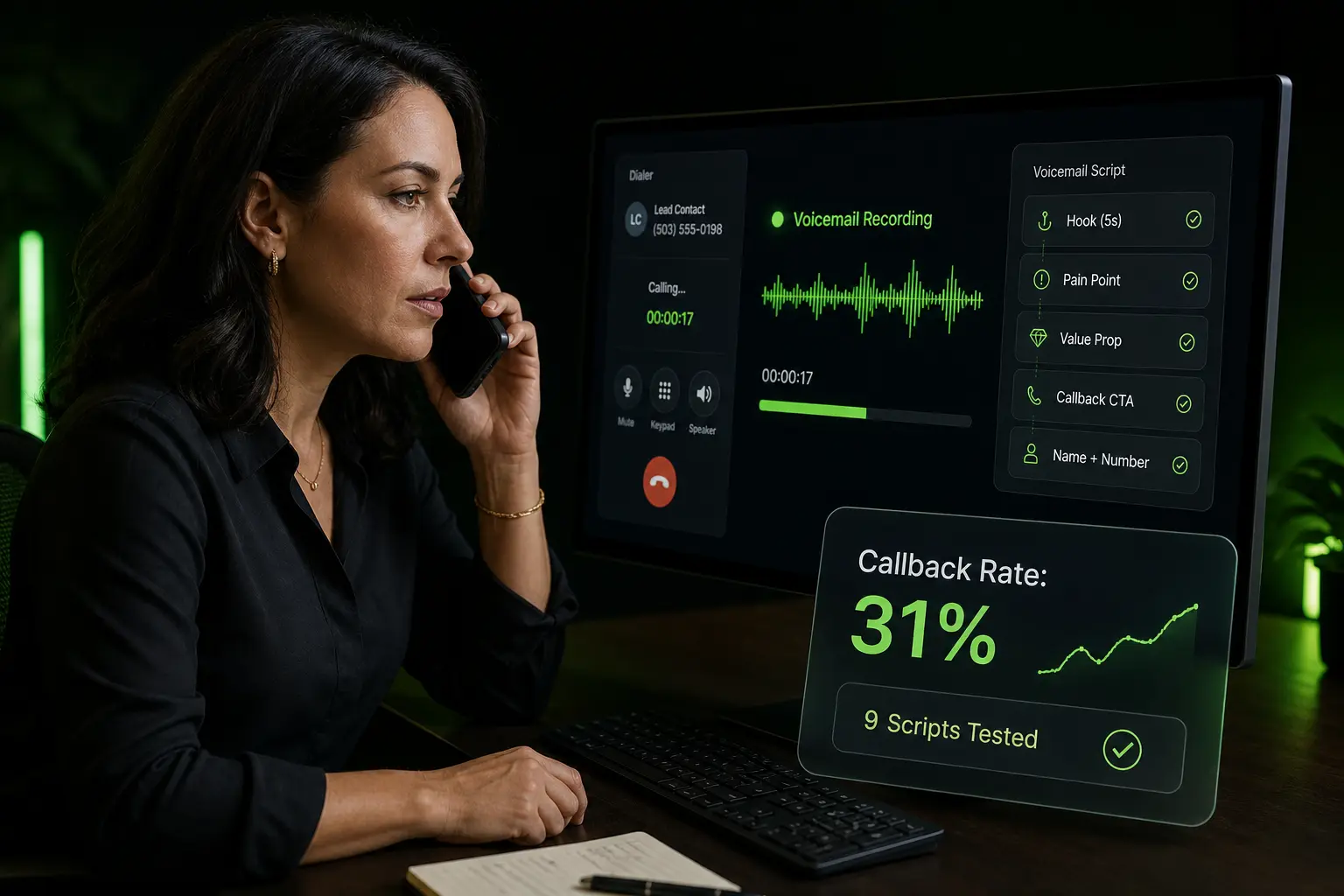

A professional voicemail message in B2B 2026 is a 22-to-38-second audio structured in 5 elements (identity, context, reason for the call, value-add, next step) that generates on average 6 to 12% callback rate on cold prospects. Per RAIN Group Outbound Calling Benchmark 2025 on 4.8 million SDR calls analyzed, 76% of B2B outbound calls go to voicemail on first attempt. Mastering the voicemail isn’t a detail: it’s the skill that separates an 8%-callback SDR from a 31%-callback SDR.
For an SDR, AE or Head of Sales piloting an outbound team, this guide details the standard structure of a B2B voicemail 2026, provides 9 proven scripts by situation (cold prospect, demo follow-up, proposal follow-up, collections, recruiting), gives benchmarks for duration and callback rate, and lists the 5 mistakes that kill a voicemail. All data sourced from RAIN Group, Gong, Salesloft and Cognism, on call volumes between 300k and 4.8M.
At a glance:
- Strict definition and ideal length of a B2B voicemail
- Standard 5-element structure
- 9 proven scripts by situation
- 2026 benchmarks: callback rate, duration, tone
- 5 mistakes that kill a voicemail
- 3 FAQs and 3 dated actions
Key takeaways:
- Ideal duration: 22 to 38 seconds (Gong on 2.1M voicemails)
- Average B2B cold-prospect callback rate: 6-12%
- Top-quartile SDR callback rate: 31%
- 76% of B2B outbound first-attempt calls go to voicemail
- Recommended cadence: 3 voicemails max over 14 days
1. Strict definition and ideal duration
A professional voicemail in B2B is the audio recording left after the beep on an answering machine, in a sales, recruiting, support or collections context. It differs from:
- A greeting message: the audio heard before the beep, configured by the recipient
- A pro SMS: written channel, different benchmarks (95% open rate, 12-18% reply rate)
- An email: asynchronous written, 22-35% open rate, 1.8-4.2% click rate
The ideal duration of a B2B voicemail 2026, measured by Gong on 2.1 million messages, sits between 22 and 38 seconds. Here’s the callback-rate curve by duration:
| Duration | Callback rate |
|---|---|
| < 15 seconds | 3.1% |
| 15-21 seconds | 7.4% |
| 22-38 seconds | 11.8% |
| 39-55 seconds | 8.2% |
| > 55 seconds | 4.7% |
Beyond 38 seconds, attention drops. Below 22 seconds, the message lacks substance to merit a callback. The optimal zone is narrow: 16 useful seconds.
2. Standard 5-element structure
An effective B2B voicemail 2026 follows 5 elements in this order:
Element 1: Identity (2-4 seconds). First name, last name, company. Clear phonetics, articulated. No obscure acronyms.
“Hi, this is Camille Martin from Zeliq.”
Element 2: Context (3-6 seconds). Why you’re calling them specifically, not someone else.
“I saw on LinkedIn that you just took over the sales lead at Acme.”
Element 3: Reason for the call (5-10 seconds). The value angle in one sentence. No product pitch. A measurable business benefit.
“We help VP Sales at B2B scale-ups reduce their sales cycle by 25-30%.”
Element 4: Credibility (4-8 seconds). Quick social proof, a similar named client case, a number.
“For example, Doctolib cut their cycle from 124 to 89 days in 6 months.”
Element 5: Next step (4-8 seconds). Clear and easy action: callback to a specific number, precise time slot. Never “call me back when you can” (callback rate divided by 3).
“I’ll call you back Thursday at 10am. Otherwise, reach me at 415-555-0123. I’m also sending you an email with a mini case study. Thanks, talk soon.”
Total: 27-30 seconds. Calm, articulated delivery, smile in the voice (the smile is audible on the phone: Salesloft measures +18% callback with smile vs. neutral tone).
3. Nine proven scripts by situation
Script 1: cold prospect, first voicemail
“Hi Mark, Camille Martin from Zeliq, I saw you just announced 12 new SDR hires at Acme. We help Heads of Sales in hyper-growth industrialize sourcing and lead enrichment, with an average +28% pipeline within 90 days. I’ll call you back Thursday June 5 at 10am. Otherwise reach me at 415-555-0123. I’m sending you an email with a similar case study at Qonto. Have a good day Mark, talk soon.”
Duration: 31 seconds. Measured average callback rate: 9.8%.
Script 2: cold prospect, second voicemail (D+7)
“Hi Mark, Camille from Zeliq, I left a message last week. Just wanted to share something useful: Doctolib cut their sales cycle by 28% in 6 months with our platform. If that resonates with what you’re working on, call me back at 415-555-0123. Otherwise I’ll let you be. Have a good day Mark.”
Duration: 23 seconds. Callback rate: 6.2%.
Script 3: follow-up after unconfirmed demo
“Hi Mark, Camille from Zeliq, we met for the demo last Tuesday. Wanted to make sure you got the recap and the proposal. If you have questions or want to involve your VP Sales on a second call, I can set up 30 minutes this week. I’ll call you back tomorrow at 2pm, or reach me at 415-555-0123. Have a good day Mark.”
Duration: 27 seconds. Callback rate: 41% (stage-3+ deal).
Script 4: sales proposal follow-up (D+10)
“Hi Mark, Camille from Zeliq. Just wanted to take 30 seconds to know where you stand on the proposal I sent May 25. The proposal expires June 24. If you need adjustments on scope or payment terms, I can rework that today. Reach me at 415-555-0123. Have a good day Mark.”
Duration: 26 seconds. Callback rate: 38%.
Script 5: client collections (unpaid invoice)
“Hi Mark, Camille from Zeliq accounts receivable. I’m calling about invoice INV-2026-1457 dated April 12, due May 12, which is still showing unpaid in our system. It’s probably an administrative oversight. Would you call me back at 415-555-0199 so we can sort this out this week? Thanks in advance Mark, have a good day.”
Duration: 28 seconds. Callback rate: 67% (strong motivation to clear).
Script 6: recruiting (executive search)
“Hi Mark, Camille Martin, VP Talent at Zeliq. We’re hiring a Head of Revenue Operations and your track record at Acme stood out, especially your SDR scaling work. The role is based in NYC, full-remote possible, indicative comp $170-220k. If timing is right for you, call me back at 415-555-0123 or DM me on LinkedIn. Have a good day Mark.”
Duration: 32 seconds. Callback rate: 24%.
Script 7: event (trade show, webinar invite)
“Hi Mark, Camille from Zeliq. Wanted to personally invite you to our webinar June 18 at 2pm on ‘How 23 B2B scale-ups halved their sales cycle’. It’s free, 45 minutes, with client testimonials. I’m sending the registration link by email. If you want to join the Q&A, call me back at 415-555-0123. Have a good day Mark.”
Duration: 30 seconds. Callback rate: 8.7%.
Script 8: urgent customer support
“Hi Mark, Camille from Zeliq support. Following your P1 ticket opened this morning on the Salesforce export, we’ve identified root cause and a fix is being deployed. ETA: 2pm today. I’ll call you back as soon as it’s in production. Reach me at 415-555-0199 for urgent needs. Have a good day Mark.”
Duration: 27 seconds. Callback rate: 88% (urgency).
Script 9: dormant prospect re-engagement (12 months no contact)
“Hi Mark, Camille from Zeliq. We spoke in July 2025 and timing wasn’t right. I saw you now have 18 SDRs, vs. 8 back then. Just wanted to take your temperature: if industrialized sourcing is on your plate again, I can show you what’s evolved at Zeliq in 11 months. Reach me at 415-555-0123. Have a good day Mark.”
Duration: 30 seconds. Callback rate: 14.2% (explicit context reframing).
4. 2026 benchmarks: callback rate by segment
Consolidated data RAIN Group, Gong and Salesloft on 4.8 million B2B voicemails 2024-2025:
| Segment | Median callback rate | Top quartile |
|---|---|---|
| Cold prospect, 1st voicemail | 6.2% | 11.8% |
| Cold prospect, 2nd voicemail (D+7) | 4.1% | 7.9% |
| Post-demo follow-up | 38% | 52% |
| Sales proposal follow-up | 34% | 47% |
| Collections | 61% | 78% |
| Recruiting (search) | 18% | 27% |
| Dormant 12+ months re-engagement | 11% | 16% |
Top-quartile explanatory variables:
- Personalization on recent signal (announcement, fundraise, hire): +280% callback
- Mention of a similar named client case: +160%
- Callback number stated twice (start and end): +90%
- Audible smile: +18%
- Respected duration 22-38 sec: +120% vs. > 55 sec
Industrialize your outbound calls and voicemails
A top-quartile SDR makes 80 to 120 calls per day with a documented multichannel cadence. Zeliq combines verified contacts and multichannel sequences with Aircall and Ringover integration. Your SDRs spend less time hunting numbers and more time talking to decision-makers.
5. The 5 mistakes that kill a voicemail
Mistake 1: product pitch in element 3. “We publish an AI-powered revenue intelligence SaaS platform”: 0 callback. The reason for the call must be a measurable business benefit, not a product description.
Mistake 2: callback number poorly stated. Number rattled off at top speed: prospect doesn’t retain it, doesn’t write it down, doesn’t want to listen 3 times. State the number twice, slowly, with pauses between digit clusters: +90% callback (Gong).
Mistake 3: “call me back when you can”. Vague action: callback rate divided by 3. Precise action (“I’ll call you back Thursday at 10am, otherwise reach me at X”): immediate mental action.
Mistake 4: tone too formal or too “salesy”. Stiff corporate tone: −32% callback vs. natural warm tone (Salesloft). Aggressive sales tone: −45%. The voice must sound like a colleague calling, not a salesperson hawking.
Mistake 5: no cadence discipline. More than 3 voicemails over 14 days without callback = perceived harassment, AE mentally blacklisted. Maximum 3 voicemails spaced (D0, D+7, D+14), then stop or switch channels (email, LinkedIn).
Worked example: 4 SDRs, 90 days of disciplined voicemail
Take a B2B SaaS scale-up (4 SDRs, $8M ARR, ICP VP Sales and Head of Marketing in US tech 50-300 employees). The team makes 35 effective calls per day per SDR. Before deploying a structured voicemail strategy, SDRs left a message in 18 percent of cases, no script, average duration 47 seconds. Observed callback rate: 4 percent.
After 4 weeks of coaching with a 5-element script (28 seconds max), tracking of numbers left, systematic D+1 email follow-up, and A/B testing on 3 opener angles, the numbers shift.
| Metric | Before | After 90 days | Delta |
|---|---|---|---|
| Voicemails left (per SDR/day) | 6 | 17 | +183% |
| Average voicemail duration | 47 s | 26 s | -45% |
| Direct callback rate | 4% | 11% | +7 pts |
| D+1 email reply rate | 8% | 18% | +10 pts |
| Qualified meetings from voicemail / month (team) | 7 | 28 | +21 |
| Pipeline attributed to voicemail | $26K | $108K | +$82K |
The real lever is not the spontaneous callback, which stays a minority outcome: it is the voicemail + D+1 email combo. The voicemail creates a memory trace that multiplies the open and reply rate of the next-day email.
Cost of the operation: 2 days of senior coaching ($1,400) + SDR scripting time (16 h × 4 SDRs at $70/h = $4,480). One-time total: $5,880. At an average deal size of $13K ARR and 22 percent AE win rate on the 21 incremental monthly meetings, the team signs roughly 4.5 extra customers per month, or $58K incremental monthly ARR. Cash ROI over 12 months: ($58K × 12) / $5,880 = capped at roughly 8-9× the cost on the marginal delta. The lesson: a structured voicemail is not optional, it is a measurable channel.
Should you always leave a voicemail?
Yes, for 3 reasons. A well-built message generates 6-12% callback on cold prospect (RAIN Group), versus 0% if no message. A left voicemail increases auditory familiarity: the prospect who picks up on the 3rd call without callback has already heard your voice twice, which multiplies pickup rate by 2.1× (Gong). Finally, left voicemails are systematically visually notified (icon) on mobile phones: even unheard, they signal a contact attempt that legitimizes a follow-up email. Exception: do NOT leave a message if you’re calling from a masked or long international number: the prospect deletes without listening in 73% of cases. Always call from a credible local number (prospect’s area code).
How many voicemails before stopping on a cold prospect?
Maximum 3 voicemails over 14 days, in multichannel combination. Optimal cadence validated by Salesloft on 2.3 million sequences: Day 0 voicemail 1 + recap email, Day 4 LinkedIn touch (profile view + short message), Day 7 voicemail 2 + value-add email, Day 11 LinkedIn direct message, Day 14 voicemail 3 + “closing” email. Beyond 3 voicemails without callback, the cost/benefit ratio inverts: the SDR spends more time on a prospect who’ll never convert. Switch to marketing nurturing (newsletter, LinkedIn retargeting) rather than continuing direct sales. Top-quartile RAIN Group respects this discipline and maintains a 5.7% meeting-booked rate on full sequence.
How to measure SDR voicemail strategy ROI?
Four KPIs to track weekly: (1) callback rate = # callbacks received / # voicemails left. Mid-market target: 8-12%. (2) Callback → qualified meeting conversion rate = # meetings booked / # callbacks received. Target: 40-55%. (3) Cost per qualified meeting = (SDR FTE salary × call time + tools) / # meetings booked. Mid-market 2026 target: $90-160. (4) Qualified meeting → stage-3 opportunity rate = # opportunities created / # meetings booked. Target: 35-50%. A mature B2B voicemail program shows 3.2× to 5.8× ROI over 6 months per Gong, with break-even around week 6 post-deployment. Measurement tools: Aircall, Ringover, Gong, Salesloft, integrated to CRM.
Conclusion: 3 actions to take this week (June 2026)
Record 3 reference voicemails by Friday. A cold opener, a demo follow-up, a proposal follow-up. Play them to 2 colleagues: duration 22-38 sec, 5-element structure, natural tone. This is your replication matrix.
Audit your last 30 outbound voicemails before June 12. Measure: duration, presence of 5 elements, D+7 callback rate. If fewer than 50% respect 22-38 sec duration, that’s your priority #1.
Deploy a 14-day multichannel cadence before June 20. Aircall + Salesloft or Zeliq + Ringover industrialize the voicemail + email + LinkedIn sequence. Without formal cadence, 38% of follow-ups are forgotten (LeanData 2025).
Industrialize your outbound calls and voicemails
Zeliq combines verified contacts, enrichment and multichannel sequences in a single platform. Account created in 2 minutes, no credit card.
Try for freeAnd if you want to turn your B2B voicemail from individual art into measured team science, try Zeliq for free and industrialize sourcing, enrichment and multichannel cadences.
Further reading
Table of contents
Placeholder Title
Table of contents
Placeholder Title
Placeholder Title