.webp)

A B2B sales proposal in 2026 is a 4-to-8-page document structured in 7 mandatory sections (executive summary, client context, value proposition, scope, timeline, pricing, terms) that the buyer must be able to read in under 4 minutes before making their internal decision. Per Forrester State of B2B Buying 2025, 62% of sales proposals sent by mid-market B2B vendors are rejected on form before even being read on substance. The #1 reason: excessive text density, reading time above 8 minutes, no executive summary.
For an AE, Account Executive or founder doing prospecting, mastering proposal format isn’t optional. A poorly structured proposal loses 18 to 28% of close rate (RAIN Group Sales Proposal Benchmark 2025) and extends the sales cycle by an average 21 days. A well-built proposal, conversely, reaches 47% close rate on deals above $25k ARR. This guide details the standard structure, provides a complete worked example for a B2B SaaS at $24k/year, and lists the 6 mistakes to avoid.
At a glance:
- Strict definition of a B2B sales proposal
- The 7 mandatory sections and their order
- Worked example for a B2B SaaS at $24k/year
- The 6 mistakes that kill a proposal
- 3 tools to industrialize writing
- 3 FAQs and 3 dated actions
Key takeaways:
- Format: 4-8 pages, reading < 4 minutes, executive summary mandatory on page 1
- Average B2B mid-market close rate 2026: 47% on deals > $25k ARR (RAIN Group)
- 62% of B2B proposals rejected on form before reading substance (Forrester)
- Average drafting time: 3.8h without template, 47 min with template (Salesforce Sales Productivity 2025)
- Recommended tools: PandaDoc, Proposify, Qwilr
1. Strict definition: what a B2B sales proposal is
A B2B sales proposal is the contractual document sent by the vendor to the prospect after discovery, demo and technical scoping phases, formalizing: the proposed solution, scope, timeline, pricing and terms. It differs from:
- A quote: exclusive focus on price and quantities, 1-2 pages, generally triggered after the sales proposal is accepted on substance
- A technical proposal: focus on the technical solution without commercial dimension, often written by a Solutions Engineer as a complement
- An MSA (Master Services Agreement): legal document signed after acceptance of the sales proposal, formalizing general terms
A sales proposal combines these three dimensions (technical, legal, commercial) in a readable format for a non-specialist decision-maker. Its quality directly conditions the close rate.
Per Forrester State of B2B Sales 2025 on 4,200 deals analyzed, 84% of buying committees read the sales proposal in under 6 minutes on first pass. The page-1 executive summary is therefore decisive: if it doesn’t convince, the rest of the document won’t be read.
2. The 7 mandatory sections and their order
A B2B mid-market sales proposal 2026 must follow 7 sections in this precise order:
| # | Section | Target length | Goal |
|---|---|---|---|
| 1 | Executive summary | 150-250 words | Sell in 90 seconds |
| 2 | Client context | 200-300 words | Prove understanding |
| 3 | Value proposition | 300-450 words | Articulate ROI |
| 4 | Detailed scope | 400-600 words | Frame deliverables |
| 5 | Timeline | 150-250 words | Provide predictability |
| 6 | Pricing | 200-350 words | Structure the deal |
| 7 | Terms & next steps | 150-250 words | Facilitate decision |
Section 1: Executive summary. Three key elements: (1) the business problem identified in 1 sentence, (2) the proposed solution in 2-3 sentences, (3) the expected ROI quantified with time horizon. This is the only section every member of the buying committee will systematically read.
Section 2: Client context. Reformulate the prospect’s current situation with the figures collected in discovery (size, pain points, constraints, deadlines). A good section 2 proves active listening. A generic section 2 signals to the prospect that they face a rushed AE.
Section 3: Value proposition. Articulate the move from current state to target state with quantified ROI: direct savings, productivity gains, revenue increase. Forrester measures that proposals with quantified ROI convert 2.3× better than proposals with qualitative promises.
Section 4: Detailed scope. List precisely what’s included, what’s NOT included (very important to avoid future disputes), deliverables, milestones, client-vs-vendor responsibilities.
Section 5: Timeline. Week-by-week or month-by-month calendar with key milestones (kickoff, configuration, production launch, training, UAT, go-live).
Section 6: Pricing. Detail the pricing structure: unit price, volume, total amount, payment terms, multi-year escalator if applicable. Always present price after value, never before.
Section 7: Terms & next steps. Proposal validity (typically 30 days), MSA referenced, signature process (DocuSign, PandaDoc), envisaged kickoff date.
3. Complete worked example: B2B SaaS at $24k/year
Here’s an integral sales proposal example for a B2B SaaS vendor selling a revenue intelligence platform at $24k/year to a 80-employee scale-up.
Section 1: Executive summary
Acme SaaS currently loses 38% of pipeline before signature due to lack of stage-by-stage piloting in its sales cycle. Our RevenueIQ platform gives you, in 21 days, stage-by-stage visibility, an at-risk-deals alerting mechanism, and automated coaching for your 6 AEs. Projected ROI: +$180k in signed ARR over 12 months for a $24k investment, a 7.5× year-one return.
Section 2: Client context
Acme SaaS, B2B scale-up 80 employees, $4.2M ARR, 65% YoY growth. Sales team: 6 AEs, 3 SDRs, 1 VP Sales. Current median sales cycle: 124 days (vs. mid-market benchmark 92 days). No-decision rate on stage-3+ deals: 38%. Current piloting: Salesforce + weekly Excel. Frustration expressed in discovery: “we see deals fail without understanding which signal we missed”.
Section 3: Value proposition
RevenueIQ plugs into your existing Salesforce via SSO and brings three capabilities:
- Stage-by-stage piloting: average duration per stage, stage-to-stage conversion rate, stalling deals alerted on the 14th day of silence (vs. 38% forgotten today)
- Automated AE coaching: voice analysis of Aircall calls, key-verbatim identification, talk/listen ratio scoring
- Probabilistic forecast: Monte Carlo on open deals, 80%/90%/95% confidence interval instead of a single point estimate
Expected 12-month ROI, based on 14 similar scale-up deployments:
| Benefit | Quantification | 12-month value |
|---|---|---|
| Cycle reduced from 124 → 89 days (−28%) | +12 deals/year extra | +$144k ARR |
| No-decision −17 pts (38 → 21%) | +3 deals saved/year | +$36k ARR |
| Total additional revenue | . | +$180k ARR |
Annual RevenueIQ investment: $24k. Net ROI: 7.5× over 12 months.
Section 4: Detailed scope
Included:
- Native Salesforce connector (configuration + tests by our dedicated CSM)
- Aircall connector for voice analysis (24h calls/month included)
- 12 named users (6 AEs + 3 SDRs + 1 VP + 2 admin)
- 3 training sessions (kickoff, mid-deployment, D+60)
- Support 8am-6pm CET, P1 SLA < 2h
Not included:
- HubSpot or other CRM migration (Salesforce only)
- More than 24h of calls/month ($0.13/min overage)
- Custom development > 10h (separate quote)
Section 5: Timeline
| Week | Milestone |
|---|---|
| W1 | Kickoff + Salesforce configuration |
| W2 | Aircall configuration + UAT testing |
| W3 | Initial training + open 12 accounts |
| W4-W5 | Parallel period Excel + RevenueIQ |
| W6 | Go-live, Excel abandoned |
| W7-W12 | Weekly CSM follow-up, adjustments |
| W13 | Quarterly Business Review |
Section 6: Pricing
| Line | Detail | Amount (excl. tax) |
|---|---|---|
| Licenses (12 users × $2,000) | Annual | $24,000 |
| Setup | One-time, waived | $0 |
| Initial training | 3 sessions, included | $0 |
| Annual total | . | $24,000 |
Payment terms: 50% at signature, 50% at D+60 (go-live). 12-month commitment, auto-renewal with 60-day notice. Year-2 escalator: +5% max.
Section 7: Terms & next steps
Proposal validity: 30 days from June 4, 2026. MSA available at acme-revenueiq.com/msa. Signature via DocuSign. Envisaged kickoff: week of June 22, 2026. Reference AE contact: Camille Durand (camille@revenueiq.com / +1 415 555 0123).
This template fits on 6 PDF pages with airy layout. Readable in 3 min 40 by a Head of Sales, in 5 min by a CFO who wants to verify section 3 and section 6.
Zeliq and the industrialization of sales proposals
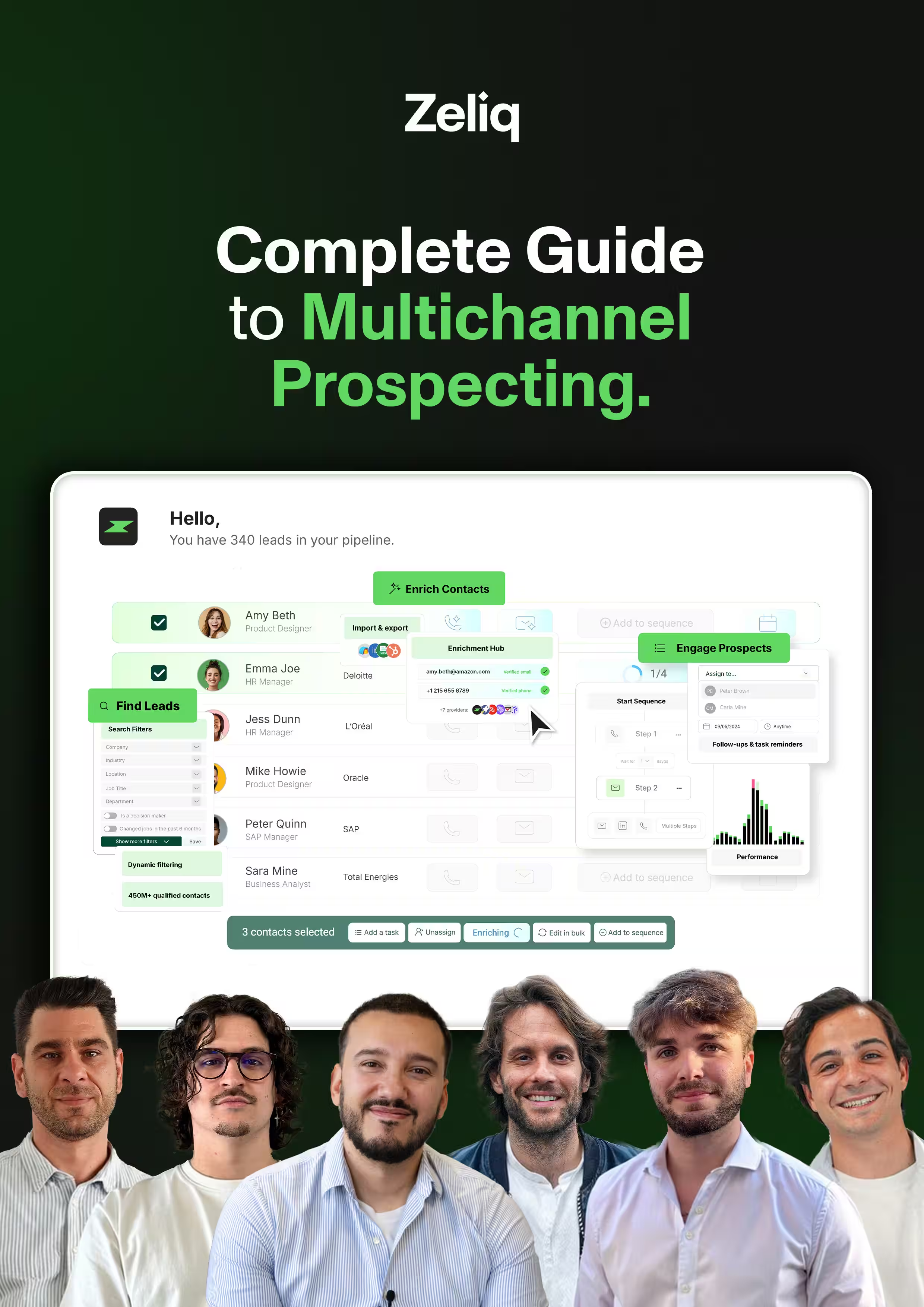
A B2B sales proposal converts best when it lands on the right prospect, at the right moment, with sharp context. Zeliq cross-references a 450 million B2B contacts database with real-time buying signals (funding, hiring, launches) and automated ICP qualification, so your AEs ship customized proposals instead of generic templates. In practice, your AE triggers an enriched pre-pitch sequence, the proposal lands in a warm engagement window, and reply rates climb measurably.
4. The 6 mistakes that kill a sales proposal
Mistake 1: no page-1 executive summary. The proposal starts directly with context or solution. 84% of B2B decision-makers only read page 1 on first pass (Forrester). Without summary, the proposal is mentally rejected before page 3.
Mistake 2: ROI not quantified. Generic phrase “you’ll gain productivity”: 0 additional conversion. Quantified ROI (“+$180k ARR over 12 months for $24k investment, i.e. 7.5×”): 2.3× higher conversion (Forrester).
Mistake 3: price presented before value. Section 6 (pricing) placed in section 2 or 3: close rate divided by 1.8 (RAIN Group). Always present price after value proposition and scope.
Mistake 4: no “not included” section. Listing only what’s included exposes you to scope disputes and execution conflicts. Explicitly mentioning exclusions protects the relationship.
Mistake 5: vague timeline. “Production launch within 3 months”: 0 predictability. Week-by-week timeline with milestones: signal of operational mastery, accelerates signature by 9 days on average (Gartner).
Mistake 6: no proposal validity date. Without expiration date, the prospect can drag for 6 months without pressure. 30-day validity: motivation to decide, ability to follow up cleanly at D+25.
Industrialize your sales proposal drafting
A hand-drafted sales proposal takes 3h 48min on average (Salesforce 2025). With a structured template and enriched prospect data via Zeliq, you drop to 47 minutes. Zeliq combines verified B2B enrichment on 450 million contacts and multichannel prospecting to feed your pipeline with qualified deals.
5. Three tools to industrialize drafting
PandaDoc (from $35/user/month). Library of reusable blocks, native e-signature, reading analytics (who opened, how long, which page). Ideal for 20-200 employee scale-ups.
Proposify (from $49/user/month). Sector templates (SaaS, agency, consulting), internal approval workflow, native Salesforce and HubSpot integrations. More oriented towards agencies and consulting firms.
Qwilr (from $49/user/month). Interactive web format (vs PDF), embedded video, dynamic ROI calculator, fine-grained analytics. Relevant when the sales proposal must feel like an immersive presentation.
For teams with fewer than 5 AEs, a Google Docs template + DocuSign signature largely suffices. Tool sophistication is never the determining factor: it’s the quality of section 1 and section 3.
What’s the ideal length for a B2B sales proposal?
Per Forrester State of B2B Buying 2025, the ideal B2B mid-market sales proposal is 4 to 8 pages for a deal between $10k and $100k ARR. Beyond 8 pages, full-read rate drops to 12% and signature delay extends by 14 days. Below 4 pages, the prospect perceives a lack of seriousness and scoping. For enterprise deals (> $250k ARR), 10 to 15 pages are acceptable because the buying committee counts 10+ people with different validation needs (procurement, legal, security, finance). Practical rule: the page-1 executive summary must be readable in 90 seconds, and the full proposal in under 6 minutes. Beyond that, close rate drops 18 to 28%.
Should general terms be included in the sales proposal?
No, generally not in the body of the proposal. General Terms (MSA or T&Cs) should be referenced in section 7 with a link to a public URL (e.g. acme.com/msa) or attached as a separate PDF annex. Including full T&Cs in the body of the sales proposal adds 4 to 12 extra pages and kills the read rate. DocuSign or PandaDoc signature systematically includes T&Cs referenced in the legal value of the agreement. Exception: if the prospect is a large account with strict procurement (formal RFP), a separate MSA is negotiated upstream and the sales proposal then limits itself to the SoW (Statement of Work) signed under the MSA. Always have the legal wording validated by your law firm or in-house Legal Counsel.
How do I follow up on a sales proposal without seeming pushy?
Three spaced follow-ups, each with added value. Follow-up 1 at D+5: short email “would you like me to organize a 20-min call to answer your questions on the proposal?”. 38% reply rate on average. Follow-up 2 at D+12: email with a similar case study in PDF (1 page), proves relevance. 24% reply rate. Follow-up 3 at D+22: email “Hi Mark, the proposal expires on X. Would you like me to propose a new kickoff date?”. Forces a binary decision. 18% reply rate. Never follow up more than 3 times without prospect signal: beyond, it’s perceived harassment and the AE is blacklisted. If no reply after 3 follow-ups, switch to marketing nurturing (newsletter, content) rather than continuing direct sales.
Conclusion: 3 actions to take this week (June 2026)
Audit your last 5 sales proposals sent by Friday. Measure: number of pages, page-1 executive summary presence, quantified ROI, validity date, signed/sent ratio. If fewer than 3 out of 5 have a quantified executive summary, that’s your priority #1.
Build a master template Google Doc before June 12 incorporating the 7 mandatory sections with target lengths. Forrester measures that teams standardizing their format move from 31% to 47% close rate on average within 6 months.
Deploy a reading-tracking tool before June 20. PandaDoc, Proposify or Qwilr will tell you page-by-page how long the prospect spends. A prospect who spends 90% of time on section 6 (pricing) signals a budget objection: immediate action required.
Industrialize your sales proposal drafting
Zeliq combines verified contacts, enrichment and multichannel sequences in a single platform. Account created in 2 minutes, no credit card.
Try for freeAnd if you want to turn your sales proposals into a signing machine, try Zeliq for free and industrialize sourcing, enrichment and follow-ups in a single interface.
Further reading
Table of contents
Placeholder Title
Table of contents
Placeholder Title
Placeholder Title