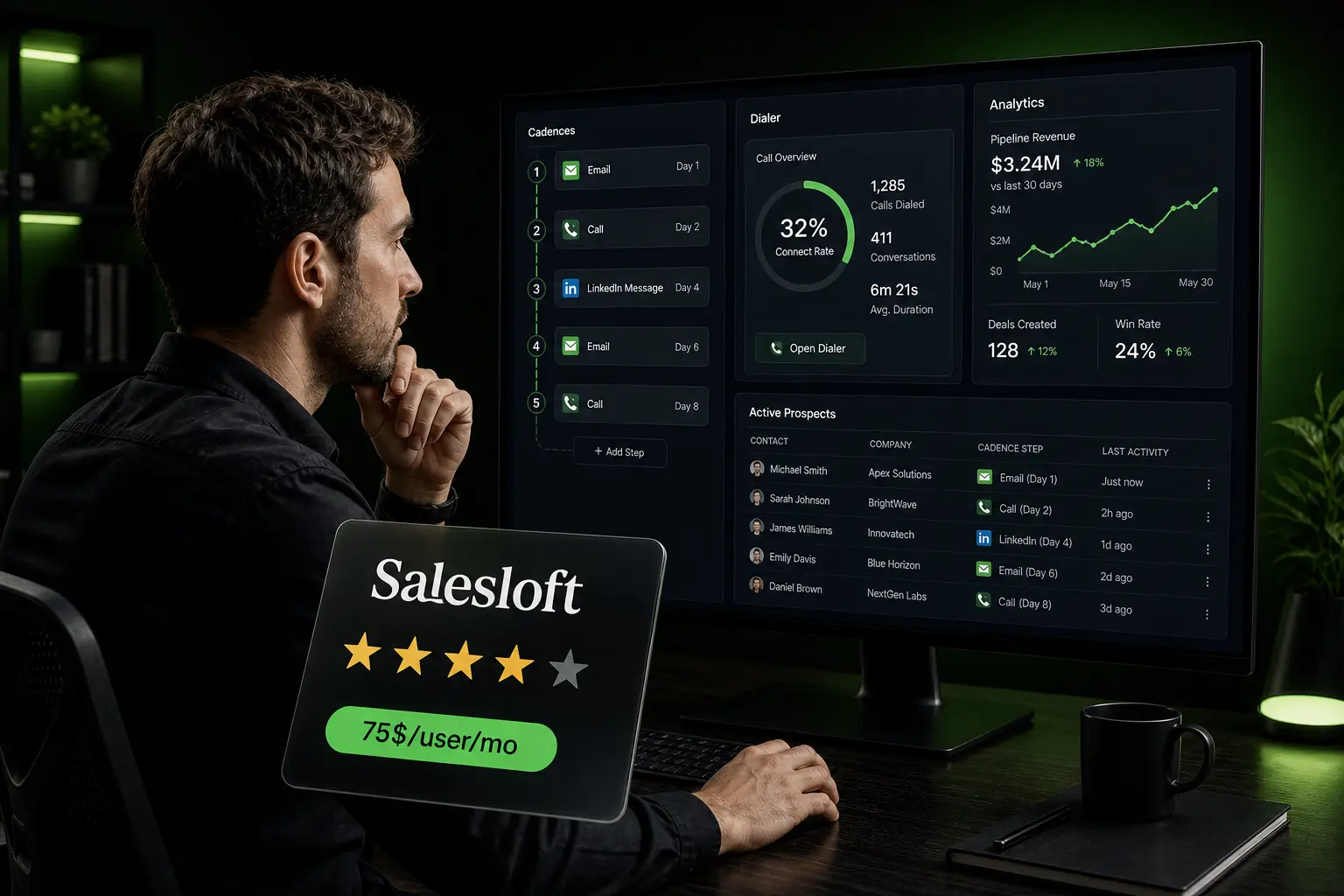

Salesloft is one of the longest-standing sales engagement platforms on the market, and one of the most complete in 2026. Founded in 2011 in Atlanta, it has become the de facto standard for US B2B SaaS sales teams that want to industrialize their outbound. Its merger with Clari, closed on December 3, 2025, has reinforced its enterprise positioning by integrating revenue forecasting with sales engagement.
But Salesloft is also expensive, complex, and its pricing is never published. For many B2B teams, especially in Europe and outside enterprise, the question becomes: is Salesloft worth its price, and what are the real alternatives?
This guide presents Salesloft factually: its real positioning in 2026 post-merger, the detail of its modules (Cadence, Conversations, Rhythm, Pipeline), the negotiated 2026 pricing observed on the market, its CRM integrations, its AI ecosystem, its strengths and limits, and a detailed comparison with its 5 main alternatives (Outreach, Apollo.io, HubSpot Sales Hub, Lemlist, Zeliq).
What you’ll find:
- What Salesloft is in 2026 and how to position the Clari merger
- The 4 modules in detail: Cadence, Conversations, Pipeline, Rhythm
- 2026 Salesloft pricing and observed negotiation techniques
- CRM integrations and the ecosystem
- Strengths, limits and who should (or should not) buy Salesloft
- Detailed comparison with 5 alternatives
What is Salesloft in 2026
Salesloft is a sales engagement platform, meaning a tool that centralizes and structures a team’s outbound sales activity. It addresses three needs simultaneously: orchestrating multichannel sequences (email + phone + LinkedIn + SMS), recording and analyzing calls and demos, and feeding revenue forecasting.
The tool’s positioning has evolved significantly since 2023:
- 2011-2020: pure Cadence platform (outbound sequences), direct Outreach competitor
- 2020-2023: expansion into conversation intelligence (Costello acquisition in 2020, integration of Gong-equivalent features)
- 2023-2025: native AI integration, launch of Rhythm as an intelligent orchestration layer
- December 2025: merger with Clari, leading revenue forecasting platform, under the unified commercial name Predictive Revenue System
The Clari-Salesloft merger is one of the most strategically important moves in the B2B SaaS market this decade: it creates a player capable of covering the entire Revenue Cycle, from first outreach to revenue forecasting, something only Salesforce did with its ecosystem (Pardot + Sales Cloud + Tableau).
Salesloft’s ideal target
Salesloft is designed for structured sales teams from mid-market to enterprise:
- Typical SDR/AE headcount: 15 to 500+ salespeople
- Geographic market: North America (50% of revenue), Europe (25%), rest of world (25%)
- Sectors: B2B SaaS (80%), professional services, fintech, manufacturing
- Sales cycle: medium to long (30 days to 18 months)
- Target ACV: $20,000 to $500,000+
A US SMB of 5 SDRs with a short cycle will find Salesloft disproportionate, both in implementation complexity and cost.
The 4 modules in detail
Salesloft is organized around 4 complementary modules, each of which can be purchased or not depending on tier.
Cadence (sequence orchestration)
This is the historical module, the core of Salesloft. It allows building structured outbound sequences that automatically chain emails, calls, LinkedIn messages and SMS, with logical conditions based on prospect actions.
Notable features:
- Visual builder: sequence construction as a logical schema
- Built-in A/B testing on subjects, bodies and timing
- Skip-day intelligence: automatic pauses based on holidays and timezones
- Personalization tokens dynamically linked to the CRM
- Shared templates to harmonize team best practices
It is the module that built Salesloft’s reputation: very powerful, mature, but with a non-trivial learning curve.
Conversations (call analysis)
Conversations is the conversation intelligence module, added in 2020-2021 to compete with Gong. It automatically records calls and demos, transcribes them, and surfaces insights:
- Automatic keyword detection: mentions of competitors, buying signals, objections, amounts
- Automatic coaching: flagging passages where the rep talks too much, does not listen, or asks closed questions
- Library of best calls shared in the team
- Topic tracker: tracking themes addressed by buyers
It is a competitor module to Gong and Chorus. Performance comparable to Gong on sales coaching, slightly behind on product analytics (where Gong still dominates).
Pipeline and opportunities
The Pipeline module structures opportunity tracking:
- Pipeline view filterable by AE, stage, amount, close date
- Forecasting integrated (strengthened by the Clari merger)
- Risk signals: automatic identification of drifting deals
- Multi-threading tracker: tracking multiple contacts per account
It is the module that has been most enriched by the Clari merger, and which forms the core of the new Predictive Revenue System positioning.
Rhythm (AI orchestration)
Rhythm is the newest module (launched late 2023), positioned as an intelligent orchestration layer above the other modules. It works as an assistant that tells each rep, at the start of the day, which actions to prioritize:
- Which prospects to call first (based on intent signals)
- Which sequences to follow up (based on optimal timing)
- Which deals require urgent attention (based on risk signals)
It is Salesloft’s AI investment, and is now central to the commercial pitch.
An alternative that includes prospect data
Salesloft orchestrates engagement but does not provide contacts. Zeliq integrates a database of 450M+ B2B contacts and their verified enrichment. Explore the B2B lead database.
2026 Salesloft pricing: what we observe
Salesloft does not publish its pricing on its website, which is a signal in itself: the commercial policy rests on quote-based negotiation. Here are the ranges observed on the market in 2026:
| Tier | Included modules | List price | Negotiated price (typical) |
|---|---|---|---|
| Essentials | Cadence only | ~$125-150/user/mo | $80-100/user/mo |
| Advanced | Cadence + Conversations + Pipeline | ~$150-165/user/mo | $110-130/user/mo |
| Premier | All modules + Rhythm + Clari forecast | Quote | $180-250/user/mo |
To these prices typically add:
- Initial platform fee: $5,000 to $25,000 depending on team size
- Dialer module (telephony): $25-40/user/mo additional
- Implementation: $5,000 to $30,000 one-shot
- Premium support: ~10% of annual contract
For a team of 10 reps in Advanced tier, the typical total annual cost ranges from $17,000 to $35,000, excluding implementation. For 50 reps, it easily exceeds $100,000 annually.
Salesloft negotiation: what works
Experienced buyers typically obtain 35 to 45% discount on list prices, depending on several factors:
- Timing: end of Salesloft fiscal quarter (April, July, October, January) maximizes discounts
- Multi-year commitment: a 2-year commitment unlocks an extra 15-20%
- Volume: above 50 seats, discounts reach 50-60%
- Active competition: presenting a parallel Outreach or Apollo quote often unlocks 10-15% additional negotiation
CRM integrations and the ecosystem
One of Salesloft’s strong arguments is its integration ecosystem, particularly deep on Salesforce and HubSpot.
| CRM | Integration depth |
|---|---|
| Salesforce | Native, bidirectional real-time, custom objects supported |
| HubSpot | Native, bidirectional, object association support |
| Microsoft Dynamics 365 | Native via connector, standard support |
| Pipedrive | Via Zapier or third-party connector, limited |
| Zoho CRM | Via API, custom configuration |
Beyond CRMs, Salesloft natively integrates with:
- LinkedIn Sales Navigator: list import, synchronized sequences
- ZoomInfo, Cognism, Apollo: on-demand enrichment
- Calendly, Chili Piper: meeting booking from sequences
- Slack, Microsoft Teams: notifications and alerts
The ecosystem is one of the exit barriers: a team with 18 months of Salesloft history has a lot to reconfigure to migrate.
Strengths and limits of Salesloft
The strengths
Cadence maturity. It is one of the oldest and most solid sequence platforms on the market. Everything is thought through: smart pauses, conditional logic, A/B testing, shared templates.
The Salesforce ecosystem. If you are on Salesforce, Salesloft is probably the most integrated and reliable option on the market. Real-time bidirectionality avoids classic friction.
The Clari merger. For teams that want a unified Predictive Revenue System (engagement + forecast), Salesloft + Clari are now unbeatable on scope.
Managerial coaching. The Conversations module + Cadence reporting give managers a powerful tool to steer, coach and identify best practices.
The limits
Price. Salesloft is one of the most expensive sales engagement tools on the market. For an SMB or bootstrapped team, the cost is often prohibitive.
Complexity. Deployment typically takes 4 to 12 weeks, requires sustained training, and needs a dedicated Sales Ops to fully leverage the platform.
No prospecting database. Unlike Apollo, ZoomInfo or Zeliq, Salesloft does not provide contacts. You must bring your own lists or buy them elsewhere.
Lock-in. Integration depth and feature richness create strong lock-in: exiting Salesloft after 12-24 months of use is a project in itself.
US enterprise focus. Commercial orientation and support are heavily North America-focused, which can weigh on European or APAC teams.
Comparison with 5 Salesloft alternatives
Here are the 5 most relevant alternatives in 2026, with their positioning.
| Tool | Positioning | Target | Indicative price | Strength vs Salesloft |
|---|---|---|---|---|
| Outreach | Direct competitor, same scope | Mid-market to enterprise | $130-170/user/mo | UI often judged smoother |
| Apollo.io | Engagement + integrated database | SMB to mid-market | $49-119/user/mo | Includes 275M+ contacts, cheaper |
| HubSpot Sales Hub | CRM + engagement | SMB to mid-market | From $50/user/mo | Native CRM integration, cheaper |
| Lemlist | Cold email + LinkedIn first | SMB | $59-199/user/mo | Very small-team-oriented, accessible price |
| Zeliq | Database + multichannel engagement | SMB to mid-market | Quote | Includes 450M+ contacts, EMEA focus |
When to choose what
- Salesloft / Outreach: enterprise team 50+ reps, already on Salesforce, budget $100,000+/year
- Apollo.io: mid-market team 10-50 reps, need for integrated database + engagement
- HubSpot Sales Hub: team already on HubSpot, medium sales cycle, need for unified CRM + engagement
- Lemlist: small SMB team focused on cold email, constrained budget
- Zeliq: SMB to mid-market team in EMEA, need for database + engagement, deliverability focus
Worked example: Salesloft vs all-in-one alternative on 10 reps
A US B2B mid-market company of 10 reps compares Salesloft Advanced and an all-in-one alternative (Zeliq or Apollo).
Option A: Salesloft Advanced + external database
- Salesloft Advanced (10 seats × $120/mo negotiated): ~$14,400/year
- Platform fee: ~$10,000 one-shot
- Dialer (10 × $30): $3,600/year
- External database (ZoomInfo Lite or Cognism Lite): ~$13,000/year
- Implementation and training: ~$8,000 one-shot
- Year 1 total cost: ~$49,000
- Year 2 cost: ~$31,000
Option B: all-in-one platform like Zeliq or Apollo
- Integrated platform (database + enrichment + engagement): ~10 × $80/mo = $9,600/year
- Implementation: included or minimal (~$1,000)
- No platform fee
- Year 1 total cost: ~$10,600
- Year 2 cost: ~$9,600
Differential: ~$38,000 savings in year 1, ~$21,000 in year 2. Over 3 years: ~$80,000 savings for a 10-rep team. Without counting internal time saved on implementation and training.
Obviously, the differential is justified if the SMB can do without Salesloft’s specific features (advanced Conversations, Rhythm AI, deep Salesforce integration). For an enterprise 50+ team needing advanced coaching and Clari forecasting, the Salesloft premium may be warranted.
How Zeliq positions itself against Salesloft
Zeliq covers a scope comparable to Salesloft on multichannel engagement, but with two structuring differences: the integrated database (450M+ professional contacts, waterfall enrichment via 40+ providers) and the EMEA focus (denser European coverage, native GDPR compliance, local support).
For a European B2B SaaS team of 5 to 50 reps, Zeliq offers a compromise that avoids both Salesloft’s complexity and the limit of SMB tools focused purely on cold email. For a Business Developer, it is the unification of contact search, enrichment and sending in a single interface, without stacking 3 tools.
Find your prospects and reach them without heavy machinery
Zeliq brings together contact database, enrichment and multichannel sequences in an integrated platform. Account created in 2 minutes, no credit card.
Try for freeWhat is the real cost of Salesloft in 2026?
Negotiated list prices observed on the market in 2026 typically range from $80 to $250/user/month depending on tier (Essentials, Advanced, Premier). Add an initial platform fee of $5,000 to $25,000, an optional dialer at $25-40/user/month, and implementation fees of $5,000 to $30,000 one-shot. For a 10-rep team in Advanced tier, expect an annual total budget of $17,000 to $35,000. Buyers typically negotiate 35-45% discount on list prices at the end of Salesloft fiscal quarter (April, July, October, January).
Salesloft or Outreach: which to choose?
Salesloft and Outreach are the two main enterprise sales engagement platforms, and 80% of their features overlap. The difference plays out mainly on user experience (Outreach often judged smoother), ecosystem (Salesloft more integrated with Salesforce, Outreach with HubSpot and Microsoft), and AI roadmap (Outreach invested earlier on Kaia, Salesloft has taken the lead since the Clari merger). For teams already on Salesforce, Salesloft is often the default choice. For teams on Microsoft Dynamics or Series B/C wanting a modern UI, Outreach has a slight edge. Both are expensive and complex; for an SMB team, looking at Apollo, HubSpot or Zeliq often makes more sense.
What’s the difference between Salesloft and a CRM?
Salesloft is a sales engagement platform, not a CRM. A CRM (Salesforce, HubSpot, Pipedrive) is the system of record for storing contacts, opportunities and sales history. Salesloft is the tool that orchestrates prospecting and engagement actions on these contacts (sequences, calls, measurement). The two tools work together: the CRM is the source of truth, Salesloft is the action layer. Salesloft therefore does not replace a CRM, it plugs into it. This architecture also explains why Salesloft alone is never enough: you need a CRM as a complement, and ideally a B2B data source to feed prospecting lists.
Zeliq vs Salesloft + separate enrichment
Salesloft is a capable multichannel sequencer, but without an integrated B2B database it requires a separate enrichment tool (Apollo, ZoomInfo, etc.). Zeliq combines 450 million verified B2B contacts and multichannel sequences in a single GDPR-first platform. You avoid two subscriptions and CSV-export friction.
Conclusion: three questions to ask before buying Salesloft
Salesloft remains an excellent tool for structured, well-equipped enterprise sales teams. Three questions to ask before committing budget.
- Do you have at least 15-20 full-time reps? Below that, Salesloft’s cost-benefit ratio becomes unfavorable against mid-market alternatives.
- Are you already on Salesforce and do you have a dedicated Sales Ops? Salesloft delivers maximum value in this ecosystem; otherwise, its ROI drops significantly.
- Do you have an existing B2B data source? Salesloft does not provide contacts. Without ZoomInfo, Cognism or equivalent in parallel, you are only buying half the necessary stack.
If any of the three answers is no, look at integrated alternatives (Apollo, HubSpot Sales Hub, Zeliq) before signing. To compare concretely, see Zeliq pricing.
And if you want to combine verified enrichment and multichannel sequences in a GDPR-first platform without paying two subscriptions, try Zeliq for free and access 450 million contacts from day one.