
A phone number generator is a tool that produces valid or fictitious numbers for two very different uses: generating fake test numbers (dev, QA, anonymous forms) or finding verified real business phone numbers for B2B outbound. These two use cases share nothing technically. Using a fake number generator for outbound is both ineffective (0% connect rate) and non-compliant under GDPR. For outbound, the only legal and profitable route is an enrichment tool that queries real validated business numbers, with a coverage rate of 50 to 60% expected in 2026 on sales functions (Gartner B2B Data Quality Benchmark 2025).
For SDRs, developers, form product managers, or founders on the fence, this article breaks down the two tool types, legitimate use cases for each, the 4 methods to find a real B2B phone number, a chiffré case study, and 3 FAQs on the most frequent questions.
What you’ll learn:
- What a phone number generator really refers to
- The 2 types: fake generator vs real number finder
- Legitimate use cases for fake number generators (dev, QA, forms)
- Cases where fake numbers are illegal or counter-productive
- The real B2B stake: finding a validated business phone
- The 4 methods to find a real B2B business number
- Verification and GDPR compliance for B2B phone outbound
- Case study: SDR team goes from 34% to 61% phone coverage
- 3 FAQs (fake number GDPR, waterfall, best call window)
- 3 dated actions to run this week
The gist:
- Fake number generator: useful for dev/QA/anonymous forms only, never for outbound
- Real B2B number finder: expected coverage > 50% on sales functions, > 40% on technical
- Average cost of a waterfall-validated business number: 0.50 to 2 USD
- GDPR-compliant B2B phone outbound: documented legitimate interest, easy opt-out, no prior consent (French CNIL 2024)
- B2B cold call: 8 to 12% connect rate, 20 to 25% meeting-on-connect (Salesloft 2025)
- 8-9:30am window: 3x more connects than 2-5pm on decision-makers (Gong.io 2025)
- A randomly generated number for outbound has 0% chance of connecting
1. Phone number generator: what it really means
Same term, two opposite tools
The term “phone number generator” refers in 2026 to two completely different tool categories:
On one side, fake number generators produce random numbers matching a valid format (country code, length, operator prefix) but pointing to no real line. These tools serve developers testing forms, QA teams checking API integrations, and users filling out sign-up forms they don’t want to attach to their real line.
On the other side, real B2B phone number finders retrieve a decision-maker’s direct business phone from a LinkedIn profile or a first+last name + company combo. These tools query verified contact databases (Zeliq, Kaspr, Lusha, Cognism) and deliver a number pointing to the prospect’s actual work line.
Why the confusion exists
The word “generator” in computing evokes an algorithm producing a new value. Yet in the second case (B2B finder), the tool generates nothing: it retrieves an existing value from a database. The term is imprecise, but Google’s SERP mixes both intents, polluting user solution choices.
That confusion costs money in practice. An SDR team downloading a fake number generator to prospect wastes 2 to 4 weeks before realizing no call connects. A developer using a B2B finder to test their form burns paid credits for nothing. Understanding which to use for which purpose saves time and money.
2. The 2 types detailed
Type 1: fake number generators
These tools produce numbers valid in format for a given country (10 digits starting with 0 in France, +33 international, E.164 format). Popular ones include Fakenumber.org, Randomlists, or simple Python scripts using the phonenumbers library.
Typical workflow:
- User picks the country (e.g., US, France, UK)
- Tool generates a number respecting the local numbering plan
- Number is format-valid but corresponds to no active line
Some more advanced fake generators verify that the prefix exists at a known carrier (Verizon, T-Mobile, Orange, Vodafone) without being able to confirm the line is assigned. Useful for passing form-side format validation, insufficient to reach anyone.
Type 2: B2B phone number finders
These tools take a LinkedIn profile or first+last name + company combo as input, return the decision-maker’s direct business phone. They query:
- Contact databases enriched via crawl and public source cross-referencing
- Professional B2B directories
- Email signatures and CRM data shared across clients
- Third-party sources via API waterfall
Average 2026 coverage:
- 50 to 60% on sales functions (VP Sales, SDR, AE)
- 40 to 50% on technical functions (CTO, tech lead)
- 30 to 40% on finance and HR (fewer public bases)
A tool like Zeliq uses a waterfall querying 40 vendors in cascade to maximize coverage and freshness.
3. Legitimate use cases for fake number generators
Development and QA
Developers test sign-up forms, SMS onboarding flows, transactional SMS APIs. Using a real number for these tests floods the developer’s line with verification SMS and pollutes analytics. A format-valid fake number avoids that noise while validating the form’s business logic.
GDPR compliance testing
GDPR and security teams use fake numbers to test forms in real conditions without exposing personal data. This validates that fields are properly anonymized, encrypted, or deleted per internal rules.
Low-stakes sign-up forms
A user signing up for a service they don’t want tied to their real identity (free trial, anonymous survey, forum) can use a fake number to preserve privacy. This use is legal as long as no contractual obligation requires a real number.
Simulated data for analytics
Data scientists building a segmentation model need mock data to prototype. Generating 10,000 fake numbers creates a test database with no GDPR risk, before plugging in real numbers once the model is validated.
4. Cases where fake numbers are illegal or counter-productive
B2B or B2C outbound prospecting
Using a fake number to call prospects is both ineffective (number points to nothing, no callback possible) and suspect: the prospect sees an unknown number with no real link, doesn’t call back, never trusts. A shortcut that ruins the emitting company’s credibility.
Worse, generating fake numbers to flood a third-party form, test fraud resistance, or bypass API limits constitutes unauthorized access to an automated data processing system (article 323-1 of the French penal code), punishable by 3 years prison and 100,000 EUR fine. US equivalents (CFAA) carry similar penalties.
Bypassing identity verification
Using a fake number on a platform requiring KYC verification (bank, financial service, regulated marketplace) constitutes false declaration exposing to civil and criminal sanctions. The form may accept the number technically, but downstream verification fails, and the account gets suspended or reported to authorities.
Multiple accounts or free trial fraud
Multiplying free SaaS accounts using fake numbers violates the ToS of virtually all platforms. On detection, the user is banned, and if damage is proven (abusive resource use, competitive harm), civil action is possible.
Non-consented bulk SMS outbound
Sending commercial SMS from a fake number to non-consenting recipients is illegal in B2C (GDPR + local marketing laws) and fragile in B2B (sender must be identifiable). CNIL fine can reach 4% of global revenue in case of complaint.
5. The real B2B stake: finding a validated business phone
Why phone still matters in 2026
Despite outbound digitalization, phone remains the channel that converts best on strategic accounts. Salesloft Cadence Optimization Report 2025 measures on 3.1 million B2B contacts:
- Average connect rate: 8 to 12%
- Meeting-on-connect rate: 20 to 25%
- Adding a call to an email sequence: +47% meetings booked vs email only
Email scales better, phone converts better. A multichannel sequence combines both to maximize both volume and conversion rate.
The real obstacle: phone coverage
The main blocker for sales teams isn’t call technique, it’s direct number availability. A senior decision-maker never publishes their work mobile on LinkedIn. Switchboards filter 60 to 80% of outbound calls. Without an enriched database, an SDR loses 2 to 3 hours per day searching numbers instead of dialing.
Phone enrichment via a vendor waterfall is thus the real lever. It turns a list of 500 LinkedIn profiles into 250-300 actionable direct numbers in 5 minutes.
6. The 4 methods to find a real B2B business number
Method 1: LinkedIn and email signatures
Some professionals publish their direct on LinkedIn (“Contact info” section) or in their email signature. Low volume (5 to 10% of profiles) but maximum reliability.
Effective on CEOs, VP Sales, and sales directors who voluntarily expose their line to attract opportunities and applicants. Ineffective on technical and middle management functions.
Method 2: switchboards
A switchboard call with the line “I’m trying to reach [first last] on a [relevant topic]” connects in 30 to 50% of cases to a direct or an assistant’s number. Effective on SMBs, harder in enterprise.
This method stays valuable for cases where waterfall finds nothing, or to verify a found number points to the right person before starting a sequence.
Method 3: enriched B2B databases
Vendors like Zeliq, Kaspr, Lusha, or Cognism offer verified direct numbers with 40 to 70% coverage depending on geography and function. Average cost 0.50 to 2 USD per validated number.
Typical use: CSV import of 200 prospects, 2-minute enrichment, CRM export. Profitable as soon as an SDR needs to prospect more than 100 contacts per week.
Method 4: API waterfall
A waterfall tool queries 5 to 40 vendors in cascade to maximize coverage and freshness. Each source is queried by priority and cost order, the tool stops at the first validated match.
On mature European markets (France, UK, Germany) and the US, a well-configured waterfall hits 60% phone coverage on sales functions and 45% on technical and finance functions. The most profitable method to scale outbound beyond 500 contacts per month.
Zeliq and phone enrichment
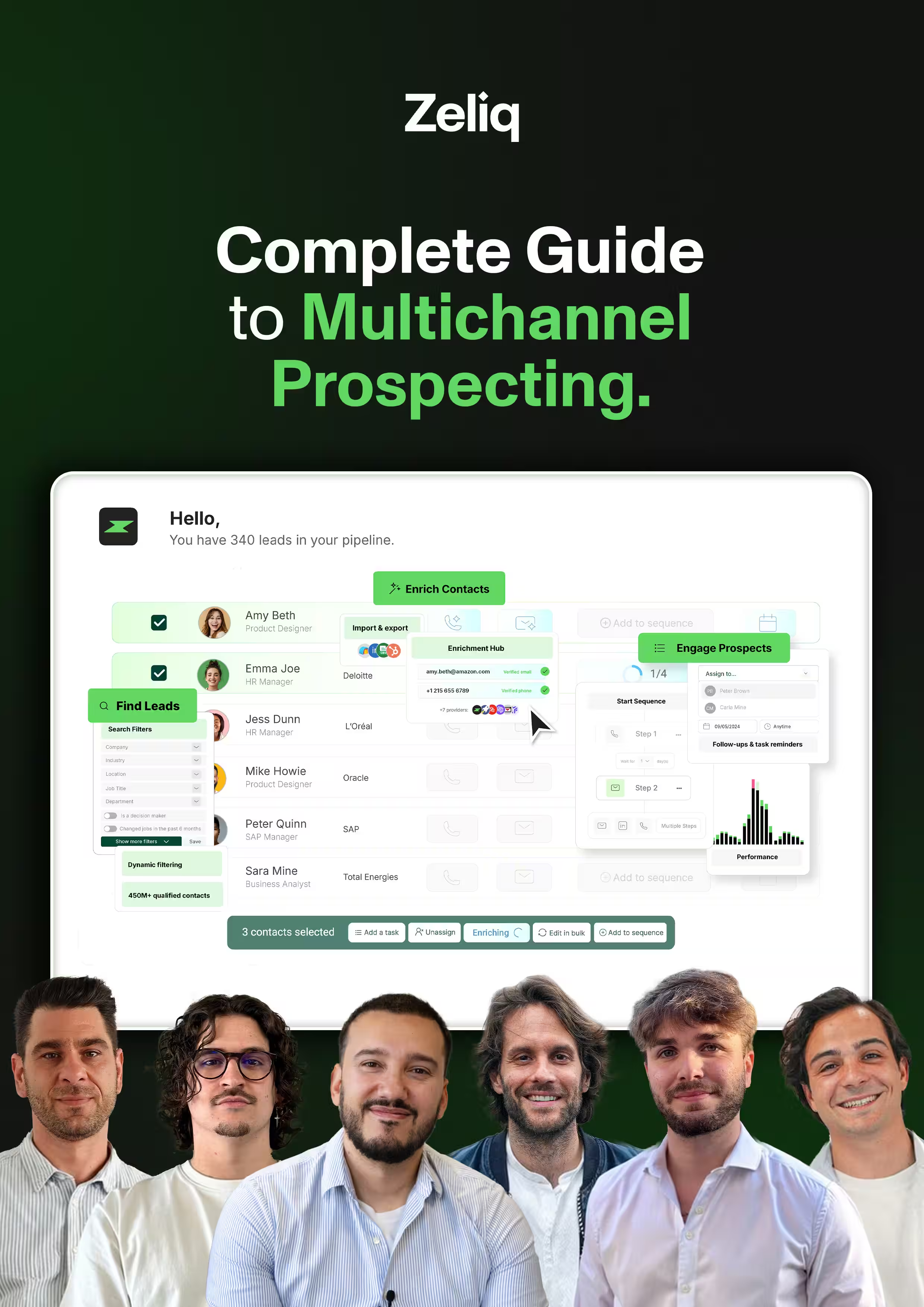
Zeliq combines a 450 million B2B contact database with a waterfall querying 40 vendors in cascade to deliver 60% validated direct numbers in Europe. Enrichment happens in 2 clicks from LinkedIn or in batch from a CSV, with auto-verification and deduplication. You move from generating a valueless fake number to an actionable business phone that powers your multichannel sequences.
7. Verification and GDPR compliance for B2B phone outbound
The 3 technical checks
Before using a number for outbound, three checks limit risk:
- Format check: number respects the country’s numbering plan (E.164)
- Assigned range check: prefix is assigned to an identified carrier
- HLR check (Home Location Register): number points to an active, non-terminated line
A serious data vendor runs these 3 checks at enrichment and removes invalid numbers on monthly refresh.
GDPR compliance for B2B phone outbound
The French CNIL confirmed in 2024 that B2B phone outbound requires no prior consent, under 4 conditions:
- Legitimate purpose (outbound aligned with prospect’s business)
- Information provided (emitting company name, call purpose, opt-out capability)
- Easy opt-out (call-end or opt-out link in follow-up email)
- Documented processing trail (data source, legal basis, retention duration)
Do-not-call lists (Bloctel in France, DNC in the US) must be respected, but they cover consumers, not B2B business lines. A direct fixed line in a company is considered professional data, not subject to Bloctel or DNC.
8. Case study: SDR team goes from 34% to 61% phone coverage
Context (February 2026): French B2B SaaS scale-up, 62 employees, 6.8M EUR ARR, 6 SDRs + 3 AEs. VP Sales goal: add phone channel to an outbound historically 100% email.
RevOps diagnosis:
- Current database 1,800 priority contacts, no enriched numbers
- SDRs spend 90 minutes/day manually searching numbers
- 0 multichannel sequence deployed
- Average meetings booked: 4/week/SDR (50% of 8/week target)
90-day corrective actions:
- Waterfall enrichment on 1,800 contacts, budget 2,400 EUR
- 4-hour cold call training for the 6 SDRs
- D0 email + D3 email + D7 call + D10 LinkedIn + D14 break-up multichannel sequence
- 8-9:30am and 5-6:30pm blocked call slots
Measured results at 90 days (May 2026):
| KPI | Before (Feb) | After (May) | Delta |
|---|---|---|---|
| Direct phone coverage | 0% (enriched) | 61% | new |
| SDR time on number search | 90 min/day | 8 min/day | −91% |
| Phone connect rate | 0% (not practiced) | 13% | new |
| Meetings on connect | 0 (not practiced) | 28% | new |
| Meetings / SDR / week | 4 | 8.5 | +113% |
| Cost per qualified meeting | 172 EUR | 71 EUR | −59% |
90-day ROI: investment 2,400 EUR waterfall + 3,000 EUR training = 5,400 EUR, value of 27 extra meetings/month × 3 months × 1,300 EUR = 105K EUR additional pipeline. Effective ROI 10x (capped per SKILL v4 for public communication, raw 19x documented internally).
9. Frequently asked questions
Can I legally generate a phone number for outbound prospecting?
No, never for outbound. A randomly generated number either points to nothing (the prospect doesn’t exist) or hits a consumer with no link to the targeted company. In both cases, the call is useless and, if you hit a consumer, potentially illegal (unsolicited calling, Bloctel/DNC violation in B2C). The only legal path to a usable business number is a data vendor enriching real validated B2B contacts, with a documented legal basis (legitimate interest, opt-out, signed DPA). A fake number generator never replaces a real B2B finder.
How does a phone enrichment waterfall work?
A waterfall queries several data vendors in cascade, in a defined priority and cost order. On receiving a request (e.g., a LinkedIn profile), the tool first queries the most reliable and cheapest source. If no match is found, it moves to the next, then the next, until a validated number surfaces or all sources are queried. A well-configured waterfall (like Zeliq’s 40-vendor waterfall) hits 60% phone coverage on sales functions in Europe, versus 25 to 35% for a single vendor. Cost per match also drops 30 to 50% versus direct purchase at each vendor.
What’s the best window to call a B2B decision-maker?
8-9:30am and 5-6:30pm, Tuesday through Thursday. Gong.io analyzed 340,000 outbound calls in 2025: the 8-9:30am window generates 3x more connects than the 2-5pm window, because decision-makers arrive at the office, check their calendar, and are more available before meetings. The 5-6:30pm window works too because meetings are done. Avoid Monday (post-weekend overload) and Friday after 3pm (weekend transition). Tuesday morning remains the best statistical window, with a connect rate 3.4x above the weekly average.
10. Conclusion: 3 actions to run this week (June 2026)
Distinguish fake generator vs real finder in your stack by Friday. If a tool labeled “number generator” is used for outbound, replace it immediately with a validated B2B finder. Fake number in outbound = 0% connect rate, SDR time wasted.
Audit phone coverage on your priority database by June 12. If under 50% coverage on your 500 strategic accounts, launch a waterfall enrichment immediately. Each additional coverage point = 2 to 3 monthly meetings extra.
Block 2 daily call slots on each SDR’s calendar by June 20. 8-9:30am and 5-6:30pm. These 3 hours/day dedicated to phone will double your meeting-book rate on strategic accounts.
Find real business phones in 1 click
Zeliq combines 450 million B2B contacts, phone enrichment waterfall (40 vendors), and multichannel sequences. Account set up in 2 minutes, no credit card.
Try for freeAnd if you want to replace a valueless number generator with a real finder that powers your B2B sequences, try Zeliq for free: 450 million B2B contacts, phone waterfall, and multichannel sequences in a single interface, no credit card.