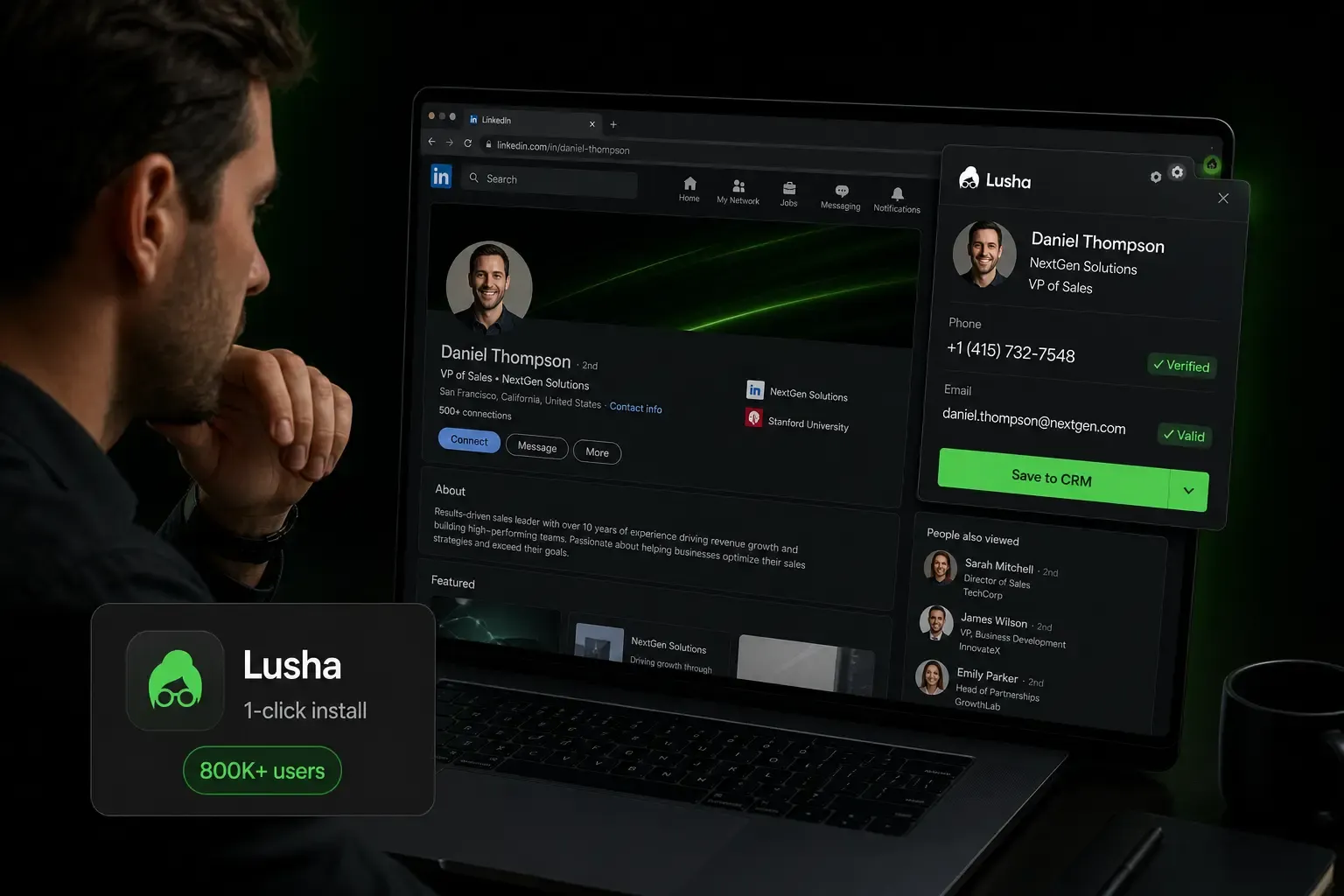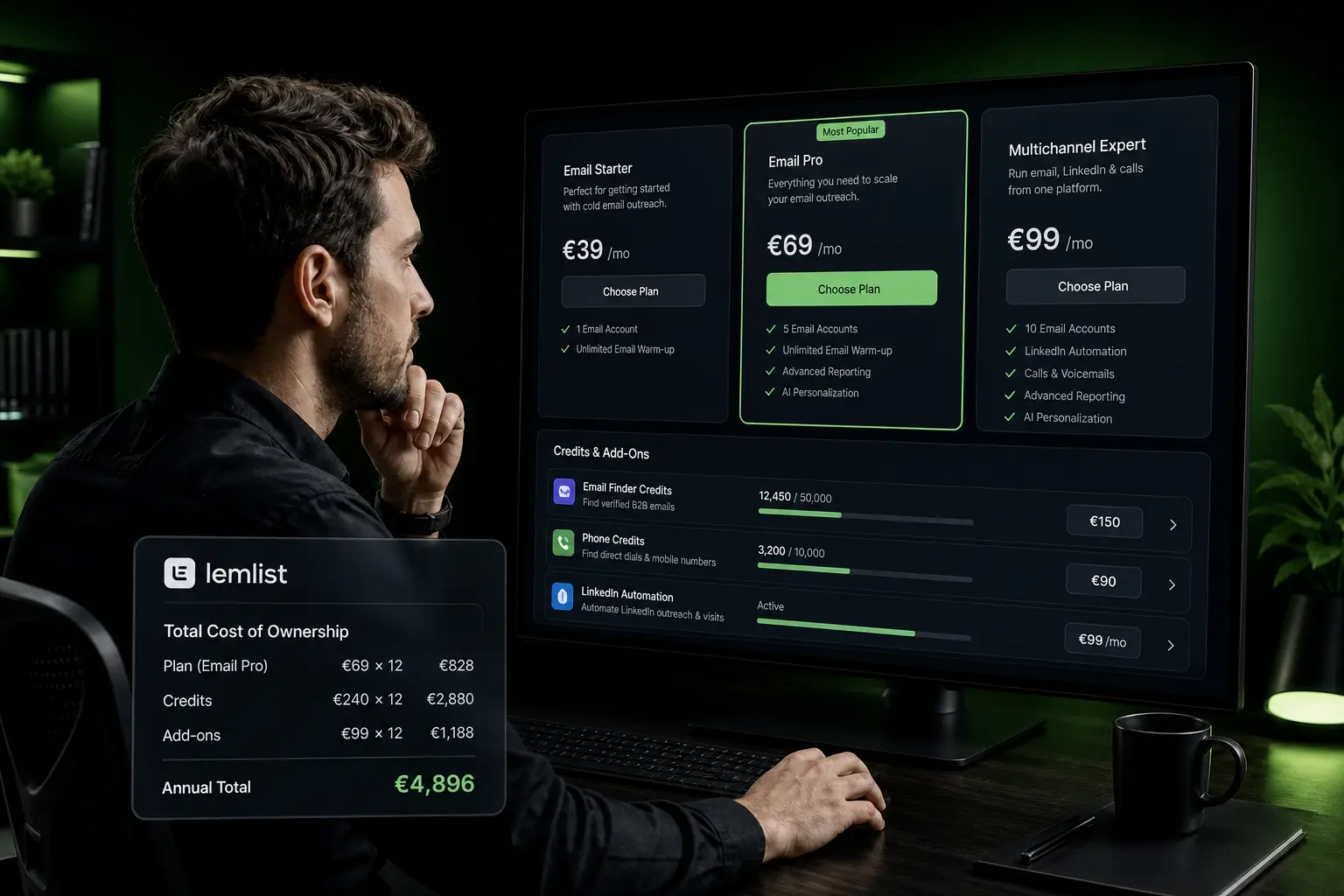


Lusha pricing in 2026 is organized around five plans: Free, Starter, Pro, Premium and Scale. At the time of this review in July 2026, Lusha displays temporary annual-billing promotions: Starter at $37.45 per month, Pro at $45.45 per month and Premium at $259.95 per month. The corresponding non-promotional prices shown on the same page are $49.90, $69.90 and $399.90. Because the page is marked as a summer sale, these amounts should be treated as a current snapshot rather than permanent list prices.
The subscription price is only one part of the calculation. Lusha uses credits for contact data and several workflow actions. A verified email costs 1 credit, a phone number costs 5 credits, and revealing both can cost up to 6 credits. API searches, Workspace exports, AI enrichment and signals can consume additional credits. A useful pricing comparison must therefore measure the cost per usable contact and the cost of the complete prospecting workflow, not just the monthly subscription.
This guide explains the current plans, included seats, annual credit pools, rollover rules, potential hidden consumption and total cost for a five-SDR team. It also compares Lusha with other data providers and all-in-one platforms using public information and a reproducible evaluation method.
Editorial disclosure: Zeliq publishes this comparison and competes with Lusha. The objective is not to present Zeliq as the automatic winner, but to make the pricing mechanics testable. Lusha can be a strong choice for teams that primarily need contact data, while a platform combining data, waterfall enrichment and multichannel execution may be more economical when it replaces several tools.
On the agenda:
- The five current Lusha plans and their included seats
- What Free, Starter, Pro, Premium and Scale actually unlock
- How emails, phone numbers, API calls, exports and signals consume credits
- How monthly and annual credit allocation differs
- A realistic TCO model for a five-SDR team
- How to compare Lusha with Cognism, Kaspr, Apollo, Zeliq and Hunter
- A reproducible benchmark instead of a fabricated customer case
Key takeaways:
- Free: $0, 40 credits per month and one seat
- Starter: currently $37.45 per month billed annually, 4,800 credits per year and one seat
- Pro: currently $45.45 per month billed annually, 7,200 credits per year and two included seats
- Premium: currently $259.95 per month billed annually, 40,800 credits per year and five included seats
- Scale: custom credits, custom seats and negotiated pricing
- Contact data: 1 credit for an email, 5 for a phone number and up to 6 for both
- Important: annual prices are promotional at the time of review, and Lusha documentation contains conflicting information on API eligibility and annual renewal rollover
1. Lusha pricing plans overview 2026
The five public plans at a glance
Lusha now presents five plans rather than the four-tier structure found in older reviews. The following table reflects the annual-billing view displayed in July 2026.
| Plan | Current displayed price | Credits | Included seats | Best initial fit |
|---|---|---|---|---|
| Free | $0 | 40 per month | 1 | Product and data-quality test |
| Starter | $37.45/month billed annually during the current promotion; $49.90 displayed before discount | 4,800 per year, granted upfront | 1 | Solo user needing bulk enrichment and intent topics |
| Pro | $45.45/month billed annually during the current promotion; $69.90 displayed before discount | 7,200 per year, granted upfront | 2 | Small team needing integrations and more advanced workflows |
| Premium | $259.95/month billed annually during the current promotion; $399.90 displayed before discount | 40,800 per year, granted upfront | 5 | Five-person team, shared administration and higher-volume data usage |
| Scale | Custom quote | Custom annual pool | Custom | Larger organizations with SSO, advanced compliance and negotiated volume |
Taxes, regional pricing and optional credit or seat additions may change the checkout total. The safest practice is to save a screenshot or PDF of the exact checkout configuration used for budget approval.
Progression of features across tiers
The plan progression is no longer limited to contact reveals. Lusha combines data, filters, recommendations, enrichment, email sequences, signals and Workspace functions.
- Free: verified emails and phones, basic and advanced filters, company data, automated email sequences, call recordings and AI insights
- Starter: adds contact and company lookalikes, bulk enrichment, an AI assistant and five buying-intent topics
- Pro: adds two included seats, CSV enrichment, signals, webhooks and broader workflow capabilities
- Premium: adds five included seats, advanced team management, credit allocation and higher-volume intent results
- Scale: adds custom seat and credit volumes, SSO, 25 buying-intent topics, advanced compliance, dedicated success and priority support
Point to verify before purchase: Lusha's pricing page currently lists API among the Pro benefits, while its credit documentation says API keys are available to administrators and managers on Premium and Scale. Ask the vendor to confirm API access, endpoints and rate limits in writing for the exact plan you are considering.
Free plan mechanics
The Free plan includes 40 credits per month and one seat, with no credit card required. Since an email costs 1 credit and a phone number costs 5, the monthly allowance can theoretically unlock:
- 40 email addresses only;
- 8 phone numbers only;
- 6 complete email-and-phone profiles, with 4 credits remaining.
Unused Free credits reset at the next billing cycle and do not roll over. The Free plan is useful for a controlled test, but it is not designed to support a regular SDR production target.
2. Lusha free plan detailed
Included features on the Free plan
The Free plan is broader than many older Lusha pricing articles suggest. It provides access to the prospecting platform and extension, company data, search filters, contact reveals within the 40-credit allowance and basic engagement capabilities.
- One user seat
- 40 credits refreshed monthly
- Email and phone reveals
- Basic and advanced filters
- Company information
- Automated email sequences
- Call recordings and AI insights
Feature availability can still vary by region, account version or rollout stage. Verify any workflow that is essential to your process inside the account before buying.
Who the Lusha Free plan fits
Free is relevant for three use cases:
- a sales leader testing coverage on a small sample of target accounts;
- a founder who needs only a few contact details each month;
- a RevOps team validating extension behavior, data fields and export logic before a paid rollout.
It is not a realistic production plan for a full-time SDR. A single complete profile can consume 6 credits, so the monthly pool may be exhausted after only six contacts.
Free plan limits vs Starter and Pro
The first meaningful upgrade is Starter rather than Pro. Starter raises the annual pool to 4,800 credits and adds bulk enrichment, lookalikes, the AI assistant and intent topics. Pro is designed for a small team, with two included seats and 7,200 annual credits.
| Dimension | Free | Starter | Pro |
|---|---|---|---|
| Included seats | 1 | 1 | 2 |
| Credit allocation | 40/month | 4,800/year upfront | 7,200/year upfront |
| Bulk enrichment | Limited or unavailable depending on workflow | Included | Included |
| Lookalikes and AI assistant | Not listed as core Free benefits | Included | Included |
| Team deployment | Single-user test | Single-user production | Two-user team |
3. Pro and Premium plans detailed
Pro plan features and target
Pro currently displays at $45.45 per month billed annually during the promotion. It includes two seats and a shared annual pool of 7,200 credits. That pool equals 600 credits per month on average across the account, although the annual allocation is granted upfront.
At the standard platform rate, 7,200 credits can unlock approximately:
- 7,200 emails only;
- 1,440 phone numbers only;
- 1,200 complete email-and-phone profiles.
For two SDRs, that last scenario averages 50 complete profiles per rep per month. Pro can therefore fit a targeted, account-based motion, but it may be too small for high-volume phone-first prospecting.
Premium plan features and target
Premium currently displays at $259.95 per month billed annually during the promotion and includes five seats plus 40,800 credits granted upfront. It also adds stronger administration, credit allocation and higher-volume signal usage.
The annual pool can theoretically unlock 40,800 emails, 8,160 phone numbers or 6,800 complete email-and-phone profiles. Divided across five SDRs, that is about 113 complete profiles per rep per month.
Premium is the most direct public-plan fit for a five-person team. However, teams processing more than roughly 100 complete contacts per SDR per month should model the shortfall before signing.
Rollover credits mechanic
Lusha distinguishes between monthly and annual subscriptions:
- Monthly plans: unused credits roll over up to twice the monthly allowance.
- Annual plans: the full annual credit pool is granted at the start of the contract and does not reset each month.
- Free: unused credits do not roll over.
There is a documentation inconsistency regarding annual renewal. One Lusha help page says unused annual credits reset at the end of the cycle, while another billing FAQ says they may carry into a paid renewal subject to a cap. Do not build a budget assumption on annual rollover unless the applicable rule appears in your order form or is confirmed in writing.
4. Scale plan detailed
What Scale adds
Scale is the customizable enterprise-oriented offer. Publicly listed additions include:
- custom credit and seat volumes;
- a lower negotiated price per credit;
- SSO;
- 25 buying-intent topics with unlimited results;
- advanced compliance;
- a dedicated success team and priority support.
Scale is also the safest tier to evaluate when API access, governance and high-volume enrichment are contract-critical.
Scale pricing observed on the market
Lusha does not publish a reliable fixed Scale price. Third-party estimates are often based on old contracts, different credit volumes or legacy plans and should not be presented as current pricing.
A useful Scale quote should itemize:
- the annual platform fee;
- included seats and the cost of additional seats;
- included credits and the marginal price of extra credits;
- API eligibility, search charges and rate limits;
- Workspace, signals and export consumption;
- SSO, onboarding, support and renewal terms.
Who Scale fits
Scale is appropriate when at least one of the following applies:
- the public credit pools do not cover projected use;
- the organization needs more than 25 seats or custom seat governance;
- SSO and advanced compliance are mandatory;
- data must flow through an API, CRM automation or high-volume enrichment process;
- the buying team needs contractual service levels and a dedicated success function.
5. The Lusha credit system explained
Contact-data reveals consume different amounts
Credits are charged by data point, not by a single universal contact unlock.
| Action | Credit cost | Important detail |
|---|---|---|
| Reveal an email | 1 | Re-viewing the same revealed email costs 0 |
| Reveal a phone number | 5 | Re-viewing the same revealed phone costs 0 |
| Reveal both | Up to 6 | Email and phone are charged separately |
| Search and filter in the platform | 0 | Contact details remain blurred until revealed |
| View company information in the platform | 0 | API company profiles follow a different rule |
Monthly and annual allocation in detail
Monthly plans replenish on the billing anniversary and may accumulate unused credits up to twice the monthly allowance. Annual plans receive the full contract pool upfront, which is operationally more flexible during seasonal campaigns because there is no monthly reset.
The trade-off is commitment risk: an annual pool that is not used before the end of the applicable term may be forfeited. Since Lusha's help pages are inconsistent on renewal carryover, teams should treat rollover as a contractual term rather than a guaranteed product characteristic.
Phone-number consumption patterns
Phone-first workflows consume credits five times faster than email-only workflows. The difference becomes material at scale.
| Contacts processed | Email only | Phone only | Email + phone |
|---|---|---|---|
| 100 | 100 credits | 500 credits | 600 credits |
| 500 | 500 credits | 2,500 credits | 3,000 credits |
| 1,000 | 1,000 credits | 5,000 credits | 6,000 credits |
A team should estimate email-only, phone-only and complete-profile volumes separately. Using a single contact count hides the largest cost driver.
What can consume credits unexpectedly
Contact reveals are not the only billable actions. Current Lusha documentation also lists:
- API search: 1 credit per single result, or 1 credit per 1-25 results in bulk, in addition to revealed data points;
- API request with no result: a minimum charge of 1 credit;
- Company information through API: 1 credit per full company profile;
- Workspace AI prompts: 1 credit per 5 prompts;
- AI data enrichment: 1 credit per enriched cell;
- Signals: 1 credit per detected signal;
- Workspace CSV export: 1 credit per 25 rows;
- Workspace CRM export: 1 credit per export.
These events make a pilot essential. The credit usage analytics should be checked after each test workflow, not only after contact reveals.
6. Enterprise pricing considerations
Scale is the public enterprise tier
Lusha currently does not display a separate plan named Enterprise. Scale is the public customizable offer for large organizations. Older articles that list both Scale and Enterprise as distinct current tiers are therefore misleading.
The absence of a separate label does not limit negotiation. Scale can include custom credits, custom seats, SSO, advanced compliance, dedicated success and priority support.
Multi-year commitments
Lusha does not publish a standard multi-year discount schedule. Any discount, price lock or credit carryover should be evaluated against the loss of flexibility.
Before accepting a multi-year term, negotiate:
- a written price and credit schedule for each year;
- the treatment of unused credits at renewal;
- seat expansion and reduction rights;
- data-quality review or remediation terms;
- API and feature entitlements that cannot be removed during the term;
- an exit or reduction mechanism if adoption is below plan.
Enterprise fit
Scale should be shortlisted when procurement and security requirements matter as much as contact coverage. For smaller teams, the negotiation and implementation overhead may outweigh the value of custom terms. Premium is usually the cleaner starting point for five users, while Scale becomes relevant when data volume or governance exceeds the self-service configuration.
7. Total cost of ownership for a 5-SDR team
Sticker cost vs real cost
Premium is the public plan that includes five seats. At the current promotional annual equivalent of $259.95 per month, the subscription totals $3,119.40 per year before taxes. At the non-promotional price displayed on the page, the same annualized amount would be $4,798.80.
The 40,800-credit annual pool supports different volumes depending on the chosen data:
| Five-SDR production target | Annual contacts | Credits for email + phone | Fit within Premium |
|---|---|---|---|
| 100 contacts per SDR/month | 6,000 | 36,000 | Fits, with 4,800 credits remaining |
| 150 contacts per SDR/month | 9,000 | 54,000 | 13,200-credit shortfall |
| 200 contacts per SDR/month | 12,000 | 72,000 | 31,200-credit shortfall |
Extra-credit pricing is configuration-dependent and is not clearly published in a stable public table. For the second and third scenarios, the true annual cost cannot be calculated responsibly without a checkout simulation or written quote.
What is often forgotten in TCO
The following costs may sit outside the Lusha subscription:
- additional credits and seats;
- Sales Navigator or another professional-network subscription;
- mailboxes, sending domains and deliverability infrastructure;
- a dialer or telephony provider;
- CRM licenses and implementation;
- workflow automation, data warehouse or integration work;
- administration, training and data-governance time.
Lusha includes automated email sequences, but teams seeking native orchestration across email, social actions and calls should test whether the overall stack still requires a separate engagement platform.
Consolidation opportunity
A lower data subscription is not necessarily cheaper when the team must add a sequence tool, dialer, enrichment cascade and workflow layer. Conversely, an all-in-one platform is not automatically better if the team only needs occasional contact reveals.
Compare the cost per verified email, connected phone, CRM-ready contact and booked meeting. Raw credit quantities are not directly comparable across vendors because one Lusha phone costs 5 credits while another platform may use a different unit. See how Zeliq compares to Lusha when waterfall enrichment and multichannel execution are included in the same workflow.
8. Cognism vs Lusha and other alternatives
Cognism vs Lusha
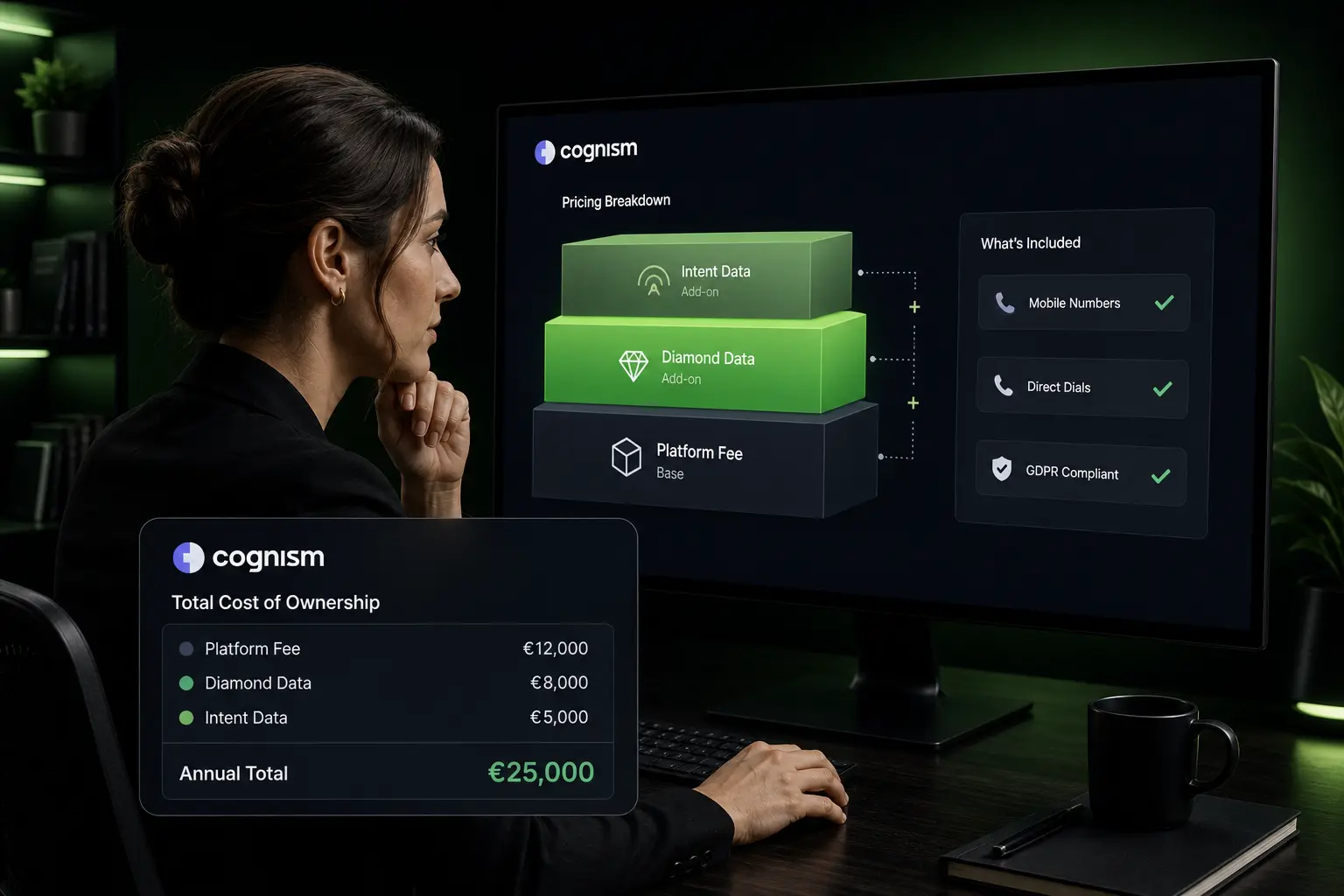
Cognism uses quote-based pricing and is often shortlisted by organizations prioritizing EMEA phone coverage, compliance screening and sales-assisted deployment. Lusha is easier to test and budget at the self-service level because it publishes Free through Premium pricing. Cognism becomes more relevant when procurement expects a negotiated data program rather than a lightweight per-team subscription.
Kaspr
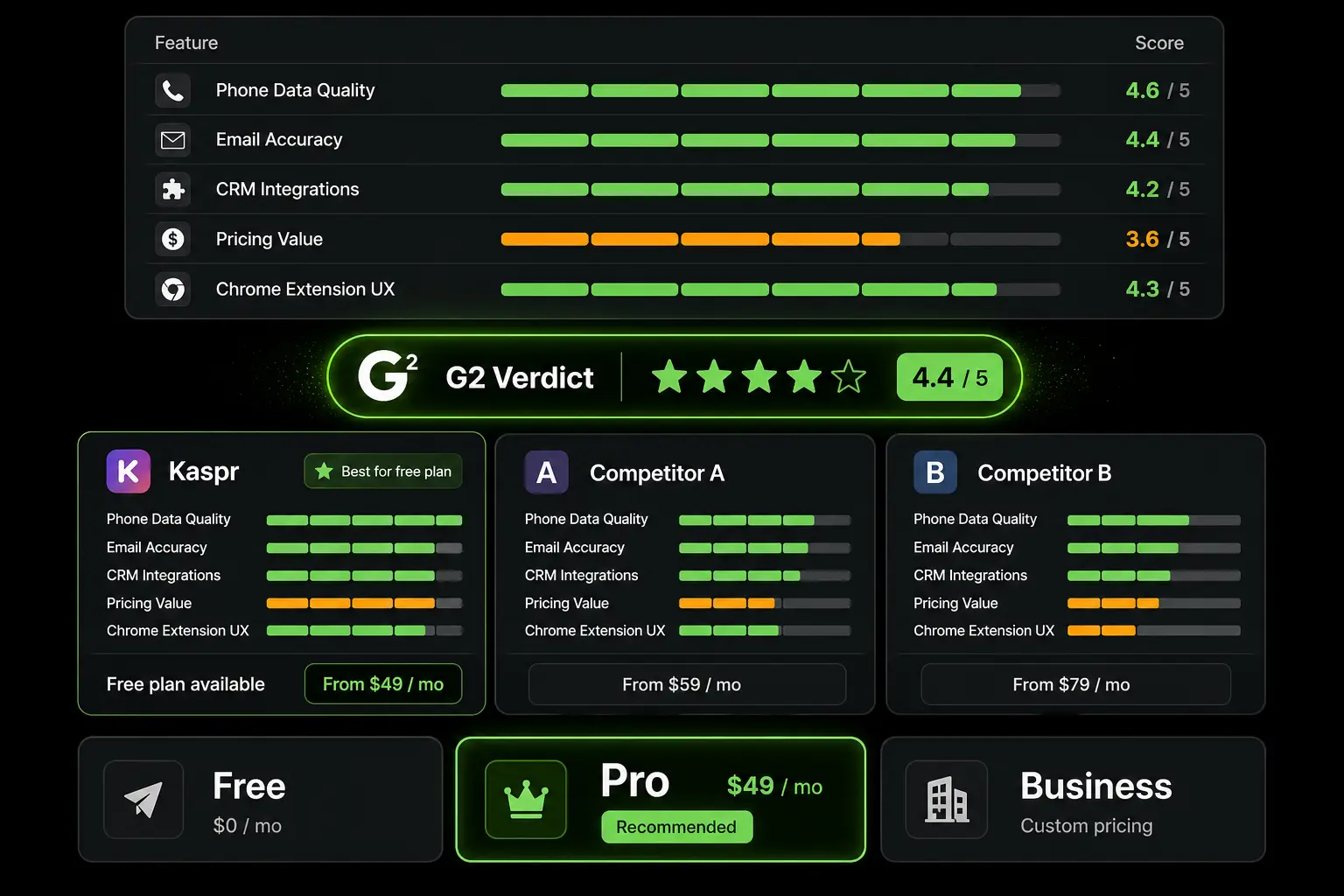
Kaspr is a LinkedIn-first alternative with an extension-centered workflow and public plans. It can suit teams that source primarily from LinkedIn and want phone or email enrichment without adopting a broader prospecting workspace. Compare export-credit behavior, Sales Navigator access and the coverage of your target geography.
Apollo
Apollo combines a large contact database, sequencing, enrichment and broader sales-engagement features. Its public per-seat pricing can be easier to model, but phone, email and export actions follow their own credit rules. Apollo is a stronger comparison when the buying team wants a database and engagement platform rather than a data extension alone.
Zeliq
Zeliq publishes a Free Basic plan, a Starter plan at $59 per user per month with 750 credits per month, and a Custom offer starting at $1,500 per user per year. Starter includes unlimited sequences and multichannel steps, while Zeliq's enrichment waterfall checks more than 40 providers and charges only when verified data is found.
The comparison is not simply “which credit is cheaper.” Lusha charges 1 credit for an email and 5 for a phone; Zeliq publishes 1 credit for an email and 10 for a phone. Zeliq may still reduce total stack cost when its database, waterfall enrichment, assignment, CRM sync and multichannel sequences replace several subscriptions. Lusha may be more economical when the requirement is primarily data and email outreach.
Hunter.io
Hunter is focused on professional email discovery and verification rather than direct-dial data. It is a relevant alternative for email-only prospecting and domain-based research, but not a like-for-like replacement when mobile numbers, intent signals or broader sales intelligence are essential.
9. Benchmark scenario: how an SMB team should evaluate Lusha pricing
Instead of using a fabricated customer case, use a controlled benchmark based on your own ICP and workflows.
Example buying scenario: five SDRs, each targeting 100 new prospects per month and requiring both an email and a phone number. That equals 6,000 complete contacts and 36,000 Lusha credits per year, which fits inside the current Premium allocation of 40,800 credits.
Test design:
- Select 200 contacts from the real ICP, split across the team's main countries, company sizes and personas.
- Process the same contacts through Lusha and the shortlisted alternatives.
- Record whether an email and phone are found, the credits consumed and the time required.
- Verify emails with a consistent method and validate phone numbers through actual call outcomes where legally appropriate.
- Export or synchronize the contacts to the CRM and record duplication, field mapping and cleanup time.
- Run the same outreach cadence and compare positive replies and meetings, not only raw delivery.
| Metric | Calculation | Why it matters |
|---|---|---|
| Email coverage | Verified emails found / contacts tested | Measures usable email availability |
| Phone coverage | Numbers found / contacts tested | Measures direct-dial availability |
| Connected-number rate | Valid or connected numbers / numbers revealed | Separates coverage from usefulness |
| Credit cost per usable contact | Total credits consumed / contacts with required data | Normalizes different credit systems |
| Operator time | Total minutes / CRM-ready contacts | Captures workflow efficiency |
| Annualized TCO | Subscription + extras + connected tools + labor | Prevents a sticker-price decision |
Run this benchmark before annual commitment. A vendor can be less expensive per seat but more expensive per usable contact if coverage is weak on the team's actual market.
10. Frequently asked questions
What does the Lusha Free plan actually include?
The current Free plan includes one seat and 40 credits per month with no credit card required. It also lists verified emails and phones, search filters, company data, automated email sequences, call recordings and AI insights. At the standard contact-data rate, 40 credits equal 40 emails, 8 phone numbers or 6 complete email-and-phone profiles with 4 credits left. Unused Free credits do not roll over. Use the plan to test coverage and workflow quality on a small, representative sample rather than as a production allocation.
How does credit rollover work on monthly and annual Lusha plans?
Monthly plans can roll unused credits forward up to twice the monthly allowance, while annual plans receive the full annual pool upfront. Free credits reset each month. Lusha's help center is inconsistent about whether unused annual credits can carry into a paid renewal: one page says they reset at term end, while another describes conditional renewal rollover. Ask for the applicable rule in writing and use the order form as the source of truth.
What is the best Lusha plan for an SMB team of 3-5 users?
Premium is the most straightforward public configuration for five users because it includes five seats and 40,800 annual credits. Pro includes two seats and can reportedly expand up to ten, but extra-seat pricing and the smaller 7,200-credit pool may make it less economical for an active team. For three or four users, compare a configured Pro checkout with Premium rather than multiplying the headline price. Model the number of emails, phone numbers, API calls, exports and signals the team will actually use before choosing.
11. Conclusion: 3 actions to run this week (July 2026)
Calculate data demand by field. Separate monthly email, phone and complete-profile targets. Multiply emails by 1 credit, phones by 5 and complete profiles by up to 6.
Run a representative Free-plan benchmark. Use the 40 credits on the ICP segments that matter most, then compare coverage, validity, CRM readiness and time against at least one alternative.
Get the final configuration in writing. Confirm promotional expiry, seats, extra-credit pricing, API access, Workspace consumption, annual rollover and renewal terms before approving a contract.
Compare Lusha with an all-in-one prospecting workflow
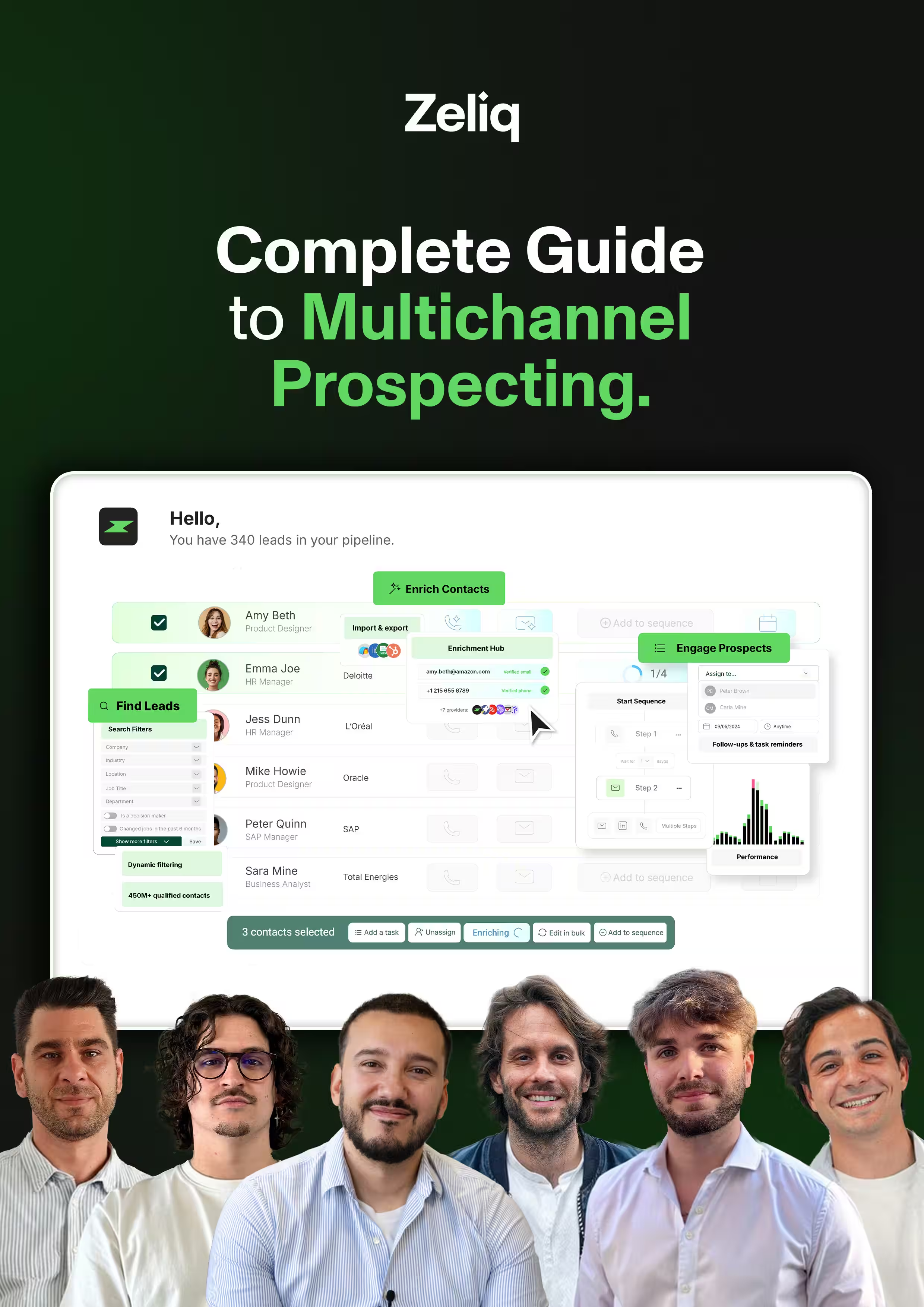
Zeliq combines a 450M+ contact database, enrichment through 40+ providers, CRM-ready lead management and multichannel sequences. Test both platforms on the same contacts and compare the cost per usable opportunity.
Try for freeFor a like-for-like decision, use identical contacts, required fields and sequence steps. You can also try Zeliq for free and compare coverage, credits, CRM workflow and multichannel execution against Lusha.