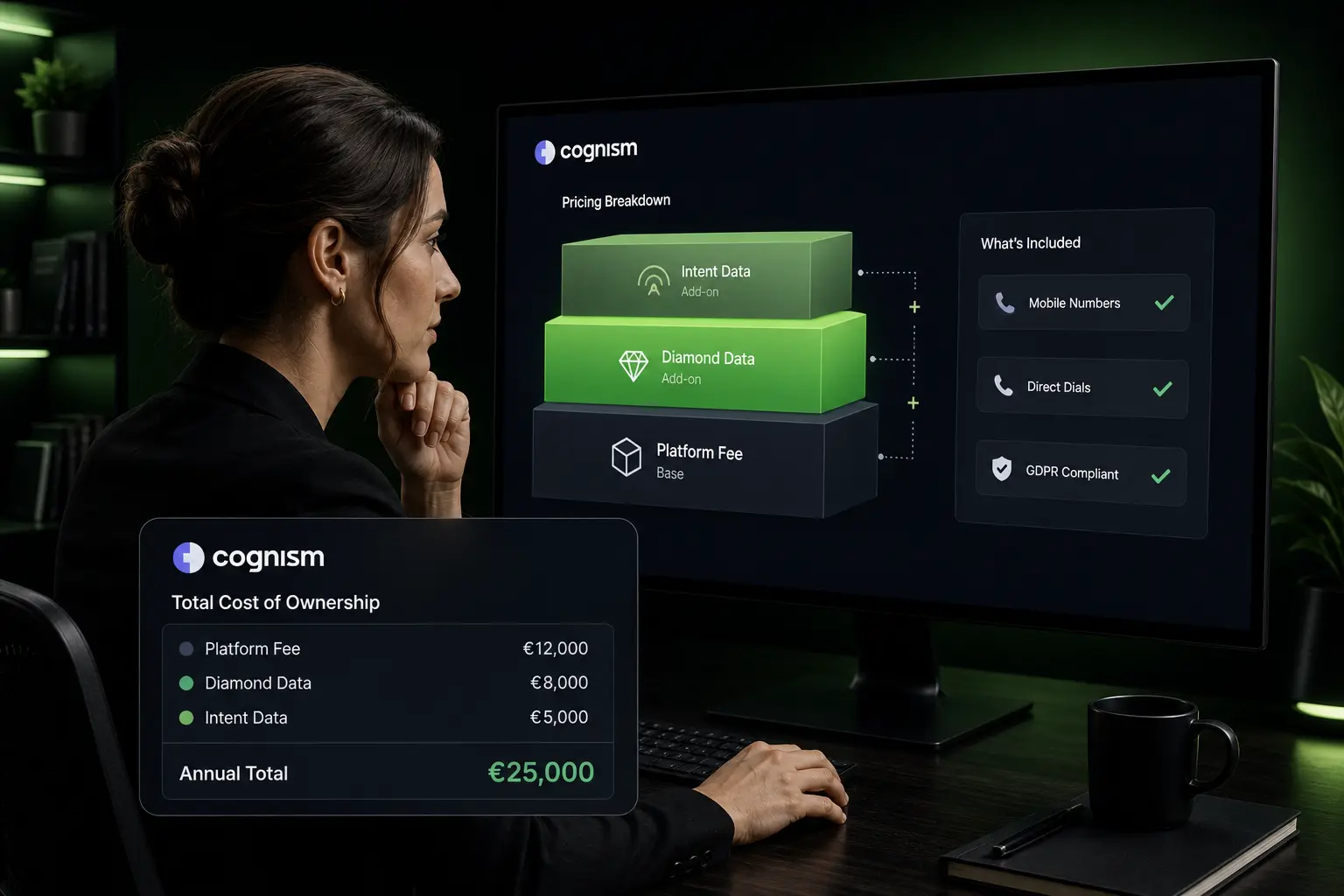

Cognism does not publish a fixed price list in 2026. The company prepares a custom quote based on the product selected, the team setup, the number of users, the volume of contacts required and any additional data-delivery or CRM-enrichment needs. Its public pricing page currently presents two sales-prospecting packages, Standard and Pro, with five seats included in each starting configuration.
This means that claims such as “Cognism starts at $X per month” or “Diamond Data costs $Y per user” should be treated cautiously unless they come from a current, written Cognism proposal. The official offer is not structured as a public self-service subscription with a universally applicable platform fee and seat price.
This Cognism pricing guide explains what is publicly verifiable, how the credit model works, which modules may affect the quote, how to calculate total cost of ownership and when a transparent all-in-one platform such as Zeliq may be a more suitable alternative.
On the agenda:
- How Cognism pricing works in 2026
- The differences between Standard and Pro
- How Cognism credits are consumed and shared
- The role of verified mobile data and intent data
- CRM Enrichment and Data-as-a-Service add-ons
- How to compare annual proposals and negotiate a contract
- A total cost of ownership framework for a 10-SDR team
- Cognism pricing compared with Kaspr, Lusha, ZoomInfo and Zeliq
- A repeatable procurement scorecard instead of a fictional case study
- Answers to the most common pricing questions
Key takeaways:
- No public list price: Cognism provides tailored quotes rather than displaying a standard monthly or annual amount.
- Two prospecting packages: Standard covers core workflows; Pro adds higher-quality mobile-data capabilities, on-demand verification and intent data.
- Five seats included: both public prospecting packages are presented with five seats included.
- Shared credits: credits are pooled across the account and used when a new contact is revealed, enriched or exported.
- One credit unlocks one contact: previously unlocked contacts can be viewed and reused without another charge.
- Additional modules: CRM Enrichment and Data-as-a-Service can be added according to the required volume and delivery method.
- Best fit: Cognism is most relevant to teams prioritizing compliance-first data, verified mobile workflows and enterprise data operations.
- Alternative to consider: Zeliq publishes its prices and combines prospect search, waterfall enrichment and multichannel engagement in one platform.
Important: Cognism pricing is quote-based. Any amount found on a third-party blog, procurement database or review platform may reflect a specific contract, date, geography, seat count or negotiated scope. Ask Cognism for a written proposal before using any figure in a budget.
1. Cognism pricing model 2026
What Cognism publishes about its pricing structure
Cognism states that pricing is tailored according to the product required, the team configuration and the planned use of the platform.
The public offer is divided into three product families:
- Sales Prospecting: access to the Cognism platform through the Standard or Pro package;
- CRM Enrichment: continuous enrichment and maintenance of records already stored in a CRM;
- Data-as-a-Service: delivery of Cognism data through an API or bulk data feed.
Unlike a public per-user SaaS price, the final quote may therefore combine access to the prospecting platform, a volume of credits and one or more data services.
Why there is no universal Cognism price
Two companies can receive different proposals because they do not require the same service.
The main variables likely to shape a quote include:
- the Standard or Pro package;
- the number of seats beyond the five included licenses;
- the number of contacts the team expects to reveal or enrich;
- whether CRM Enrichment is required;
- whether data must be delivered through API or bulk files;
- the countries, teams and workflows involved;
- implementation, support and account-management requirements.
For that reason, reducing Cognism pricing to a platform fee plus a standard seat fee can be misleading. That structure may appear in an individual proposal, but it is not presented as a universal public tariff by Cognism.
How to obtain a comparable quote
Before speaking with Cognism, prepare a short usage brief. It should contain:
- the number of users who genuinely need platform access;
- the number of new contacts expected each month;
- the share of contacts requiring a mobile number;
- the CRM to be enriched and its current record count;
- the need for intent data or on-demand mobile verification;
- the integrations and data-delivery methods required;
- the contract term your procurement team can accept.
Ask for the quote to separate subscription access, included credits, additional credits, add-ons, services and renewal conditions. This makes it much easier to compare Cognism with another vendor on a like-for-like basis.
2. Standard vs Pro pricing
The Standard package
Standard is designed for teams that need the core Cognism prospecting workflow.
According to Cognism’s current public comparison, it includes:
- contact and company data such as revenue, employee count and headquarters;
- emails, mobile numbers, job titles and work history;
- technology information;
- hiring, funding, merger and acquisition, and job-change signals;
- AI company research, persona building and search;
- CSV enrichment;
- single sign-on;
- live-chat support;
- five included seats.
CRM Enrichment and Data-as-a-Service are shown as optional modules rather than automatically included features.
The Pro package
Pro includes the Standard feature set and adds advanced prospecting capabilities.
The current public pricing page lists:
- a premium mobile-data filter;
- mobile verification on demand;
- intent data for identifying accounts showing buying interest;
- an account manager;
- five included seats.
Cognism has historically used the term “Diamond Data” for phone-verified mobile numbers. In the present package comparison, the commercial distinction is expressed through the Pro capabilities rather than a separate public Diamond Data price.
When Pro may justify a higher quote
Pro is most likely to be relevant when mobile outreach is strategically important and a missed connection is expensive.
Typical situations include:
- account-based sales aimed at a relatively small number of strategic companies;
- phone-heavy outbound motions targeting senior decision-makers;
- teams that need on-demand verification before a call campaign;
- organizations that want to prioritize accounts using intent data;
- sales operations teams that place a high value on reducing wasted dials.
Standard may be sufficient when the primary objective is list building, email prospecting and general contact research without advanced intent or verification workflows.
3. Intent data and verified mobile data
Intent data in the current Pro package
Cognism includes intent data in the Pro package. The purpose is to help teams identify accounts showing increased interest in topics related to their market.
This can support account prioritization, but intent data should not be treated as proof that a company is actively preparing to buy. It is a signal that must be combined with firmographic fit, timing, contact relevance and sales judgment.
Before accepting an intent-data component in a quote, ask:
- which topics are available;
- how many topics can be monitored;
- how frequently signals are updated;
- which countries and company sizes have meaningful coverage;
- how the signal enters the CRM and SDR workflow;
- whether additional topics or delivery methods affect the price.
Do not assume a separate public intent price
Cognism does not display a universal public amount for intent-data access. Third-party estimates of a monthly topic fee should not be presented as an official Cognism tariff.
The reliable approach is to request two written scenarios:
- a Standard proposal without intent data;
- a Pro proposal with the exact intent scope required.
The difference between those scenarios shows the real incremental cost for your organization.
How to assess the value of intent data
Measure whether intent signals change commercial behavior and outcomes.
| Metric | What it reveals |
|---|---|
| Accounts activated from intent signals | Whether SDRs actually use the data |
| Positive response rate | Whether signaled accounts respond more often |
| Meeting rate | Whether prioritization produces more conversations |
| Pipeline per targeted account | Whether the higher-priority accounts create commercial value |
| Cost per qualified opportunity | Whether the premium is justified economically |
If the team does not have the process or capacity to act on the signals, paying for intent data is unlikely to improve results by itself.
4. Add-ons and integration costs
CRM Enrichment
CRM Enrichment is presented as a separate Cognism module that works alongside Standard or Pro.
It is designed to:
- improve the coverage and quality of CRM records;
- keep contact data updated over time;
- support segmentation, routing and reporting;
- enrich new records using the credits included in the subscription.
Cognism states that ongoing maintenance is included. A credit is used again only when a key detail changes, such as a contact moving to another job.
Pricing depends on the data volume and the required setup. Ask the proposal to specify the number of records covered, refresh logic, fields maintained, integrations and treatment of duplicates.
Sales-engagement and CRM integrations
A data provider does not automatically replace the tools used to execute sequences, calls and follow-ups.
When calculating Cognism’s total cost, include any separate subscription required for:
- a CRM;
- email and multichannel sequences;
- a dialer;
- LinkedIn workflows;
- reporting and routing;
- automation between the systems.
This is an important point when comparing Cognism with an all-in-one platform. Zeliq combines contact search, multi-provider data enrichment and multichannel execution, which can reduce the number of separate tools required.
Data-as-a-Service and API delivery
Cognism’s Data-as-a-Service offer delivers data through API or bulk delivery.
It is intended for embedded use cases such as:
- internal enrichment workflows;
- lead routing;
- data warehouses;
- custom applications;
- large-volume record processing.
The price is based on data volume and delivery method. Ask whether the quote covers API calls, records delivered, refreshes, implementation and support separately or as one package.
Compliance, security and procurement work
Enterprise procurement may also create internal costs that do not appear in the software quote.
These can include:
- security review;
- data-protection assessment;
- legal review of the data-processing agreement;
- CRM field mapping;
- implementation and user training;
- ongoing administration.
These costs apply to most enterprise platforms, not only Cognism, but they should be included in the business case.
5. Contract terms and procurement
Compare annual value, not only the monthly equivalent
A monthly equivalent can hide important contract conditions.
Ask Cognism to state clearly:
- the total committed amount;
- the initial contract duration;
- billing frequency;
- the renewal process and notice period;
- the number of included seats;
- the annual or subscription credit allocation;
- the cost of additional seats and credits;
- the treatment of unused credits;
- the price of CRM Enrichment and Data-as-a-Service;
- any implementation or service fees.
The annual contract value is the figure that should be compared with other platforms.
Use third-party benchmarks carefully
Procurement databases can provide useful context, but a disclosed contract is not a public tariff.
A benchmark may differ because of:
- the purchase date;
- the number of seats;
- the credit volume;
- the customer’s negotiating leverage;
- the modules included;
- the contract duration;
- the country and currency.
Use external benchmarks to prepare questions, not to state that every customer will pay the same amount.
What to negotiate
The most useful negotiation points are often operational rather than a simple percentage discount.
- a pilot or documented data test before commitment;
- clear acceptance criteria for coverage and accuracy;
- the right number of seats rather than unused licenses;
- additional credits aligned with real volume;
- implementation and training;
- CRM-enrichment scope;
- renewal caps or written renewal conditions;
- export and data-retention rights at the end of the contract.
A lower headline price does not create value if the scope does not match the workflow.
6. Total cost of ownership for a 10-SDR team
Cognism Standard TCO
Because Cognism does not publish a fixed amount, the correct calculation starts with the written proposal.
Annual Standard TCO = Cognism Standard contract + additional seats or credits + CRM Enrichment + Data-as-a-Service + complementary sales tools + implementation and administration.
For a 10-SDR team, verify whether the proposal includes five seats and prices the other five separately, or whether a different package has been negotiated.
Cognism Pro TCO
The same method applies to Pro:
Annual Pro TCO = Cognism Pro contract + additional seats or credits + optional data modules + complementary sales tools + implementation and administration.
The incremental value of Pro should be measured against the incremental contract cost, not against an assumed public Diamond Data price.
TCO worksheet
| Cost category | Annual amount to enter | Question to validate |
|---|---|---|
| Cognism subscription | From the written quote | What package, seats and credits are included? |
| Additional credits | Expected annual purchase | How many new contacts will be revealed or enriched? |
| CRM Enrichment | Quoted add-on | How many records and refreshes are covered? |
| Data-as-a-Service | Quoted add-on | What volume and delivery method are included? |
| Engagement platform | Current annual subscription | Is another tool needed for sequences and calls? |
| Implementation | Internal and external time | What is required to deploy and train the team? |
| Administration | Annual internal cost | Who manages credits, users and data quality? |
Divide the resulting annual TCO by the number of active users, contacts enriched, qualified meetings or opportunities created. This produces a more useful comparison than the nominal cost per seat.
The cost of a fragmented stack
Cognism can provide the data layer, but many teams still need separate tools for engagement and orchestration.
For comparison, Zeliq currently publishes:
- a free Basic plan;
- a Starter plan at $59 per user per month with 750 credits per month;
- a Custom plan starting at $1,500 per user per year for team deployments;
- credits that do not expire;
- one credit for a valid email and ten credits for a phone number;
- prospect search, enrichment and multichannel sequences in the same platform.
The relevant question is not simply which vendor has the lowest subscription. It is which setup produces the lowest cost per usable contact, conversation and qualified opportunity.
Need a transparent alternative?
Zeliq publishes its plans, lets unused credits roll over and combines a 450M+ contact search engine, enrichment across 40+ data providers and multichannel engagement.
7. Cognism pricing vs Kaspr, Lusha, ZoomInfo and Zeliq
Cognism vs Kaspr
Kaspr and Cognism belong to the same group but target different buying contexts.
Kaspr is a self-service, extension-led option with public plans for individual users and smaller teams. Cognism is quote-based and better suited to organizations requiring a broader enterprise data operation, advanced mobile workflows and compliance support.
Choose based on workflow and scale rather than assuming the parent product is automatically the right option.
Cognism vs Lusha
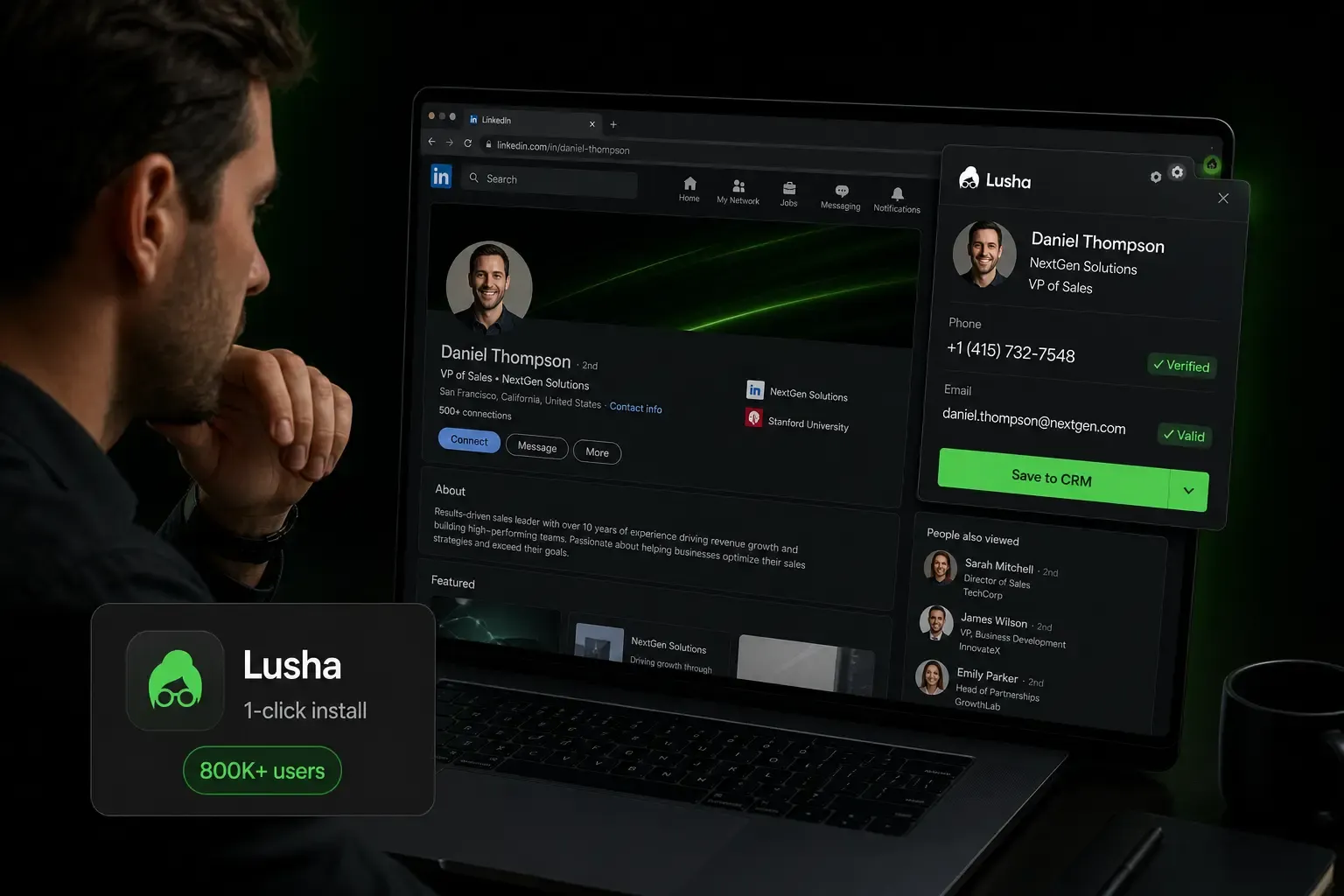
Lusha offers public self-service tiers as well as custom enterprise plans. Cognism requires a sales conversation for pricing.
The comparison should include:
- coverage on the countries and personas targeted;
- phone and email validity;
- credit consumption;
- CRM enrichment;
- intent and verification workflows;
- contract flexibility;
- the total stack required after purchasing the data.
Cognism vs ZoomInfo
Both Cognism and ZoomInfo are commonly evaluated for enterprise sales intelligence and custom data requirements.
Neither should be compared from an unattributed “starting price.” Ask both vendors to quote the same countries, seats, contact volumes, intent scope, integrations and service requirements.
A controlled sample test and a complete TCO worksheet are more reliable than comparing database-size claims alone.
Cognism vs Zeliq
The main difference is the scope and buying model.
| Criterion | Cognism | Zeliq |
|---|---|---|
| Public price | No, custom quote | Yes for Basic, Starter and starting Custom price |
| Prospecting packages | Standard and Pro, five seats included | Basic, Starter and Custom |
| Credit model | One credit per newly unlocked contact, pooled account-wide | One credit per email, ten per phone; unused credits do not expire |
| Data approach | Compliance-first proprietary sales intelligence | Waterfall enrichment across 40+ providers |
| Intent data | Included in Pro | Focus on search, enrichment and engagement workflows |
| Multichannel sequences | Requires the team’s engagement stack | Integrated email, social and call sequences |
| Best-fit buying context | Enterprise data and compliance workflows | Teams seeking transparent, consolidated outbound execution |
Zeliq is particularly relevant when the objective is to reduce the number of subscriptions used for sourcing, enrichment and outreach. Its waterfall enrichment queries multiple providers and charges credits only when verified data is found.
8. Procurement scorecard: how to compare Cognism fairly
Rather than presenting a fictional company with invented savings, use a controlled procurement test.
Step 1: build the sample. Select 100 to 300 contacts representative of your real ICP, across the countries, company sizes and seniority levels that matter.
Step 2: use the same input for every vendor. Provide identical names, companies, domains or professional profile URLs.
Step 3: verify the output. Check email deliverability, phone ownership, current employer, job title and duplicate rate.
Step 4: test the full workflow. Measure how long it takes to move a selected contact into the CRM and then into an email, LinkedIn or call sequence.
Step 5: calculate unit economics.
| KPI | Calculation |
|---|---|
| Coverage rate | Contacts with usable data ÷ contacts tested |
| Valid email rate | Deliverable emails ÷ emails returned |
| Valid phone rate | Correct, reachable numbers ÷ numbers returned |
| Cost per usable contact | Annual TCO ÷ usable contacts obtained |
| Cost per meeting | Annual TCO ÷ qualified meetings attributed |
| Time to first campaign | Time from search to active outreach |
Run the same test in Zeliq during its free trial so the comparison includes both data coverage and the execution workflow. You can then decide whether a specialist enterprise data platform or an all-in-one outbound platform creates more value.
9. Frequently asked questions
What is the minimum Cognism price?
Cognism does not publish a universal minimum platform fee or starting contract amount.
The official pricing page states that pricing is tailored to the product, team setup and planned use. Standard and Pro are displayed with five seats included, but the monetary amount requires a custom quote.
Is Cognism Pro worth the additional cost?
Pro can be valuable for phone-heavy or account-based teams that need premium mobile filtering, verification on demand and intent data.
Its value should be measured by the improvement in reachable numbers, positive replies, meetings and qualified pipeline compared with Standard. Do not rely on an assumed accuracy rate or third-party price premium without testing your own market.
What are the best Cognism alternatives?
The right alternative depends on the requirement:
- Kaspr for a lighter LinkedIn-led enrichment workflow;
- Lusha for extension-first prospecting with public self-service tiers;
- ZoomInfo for another enterprise sales-intelligence evaluation;
- Zeliq for transparent pricing, multi-provider enrichment and integrated multichannel engagement.
For teams that want to consolidate data and outreach, Zeliq can be tested free for 14 days without a credit card.
10. Conclusion: three actions before buying Cognism
Request a written, itemized quote. Separate package access, seats, credits, CRM Enrichment, Data-as-a-Service, services and renewal terms.
Run a representative data test. Compare Cognism with at least one alternative using the same contacts and verification method.
Calculate the full stack cost. Include the CRM, engagement platform, dialer, implementation and internal administration—not only the Cognism contract.
Try Zeliq as a transparent all-in-one Cognism alternative
Search a 450M+ contact database, enrich through 40+ providers and launch email, social and call sequences from one workspace. Start with a 14-day Starter trial and 50 enrichment credits, with no credit card required.
Try Zeliq for freeFor a closer look at the enrichment layer, explore Zeliq’s B2B data enrichment.
Further reading
Table of contents
Placeholder Title
Table of contents
Placeholder Title
Placeholder Title