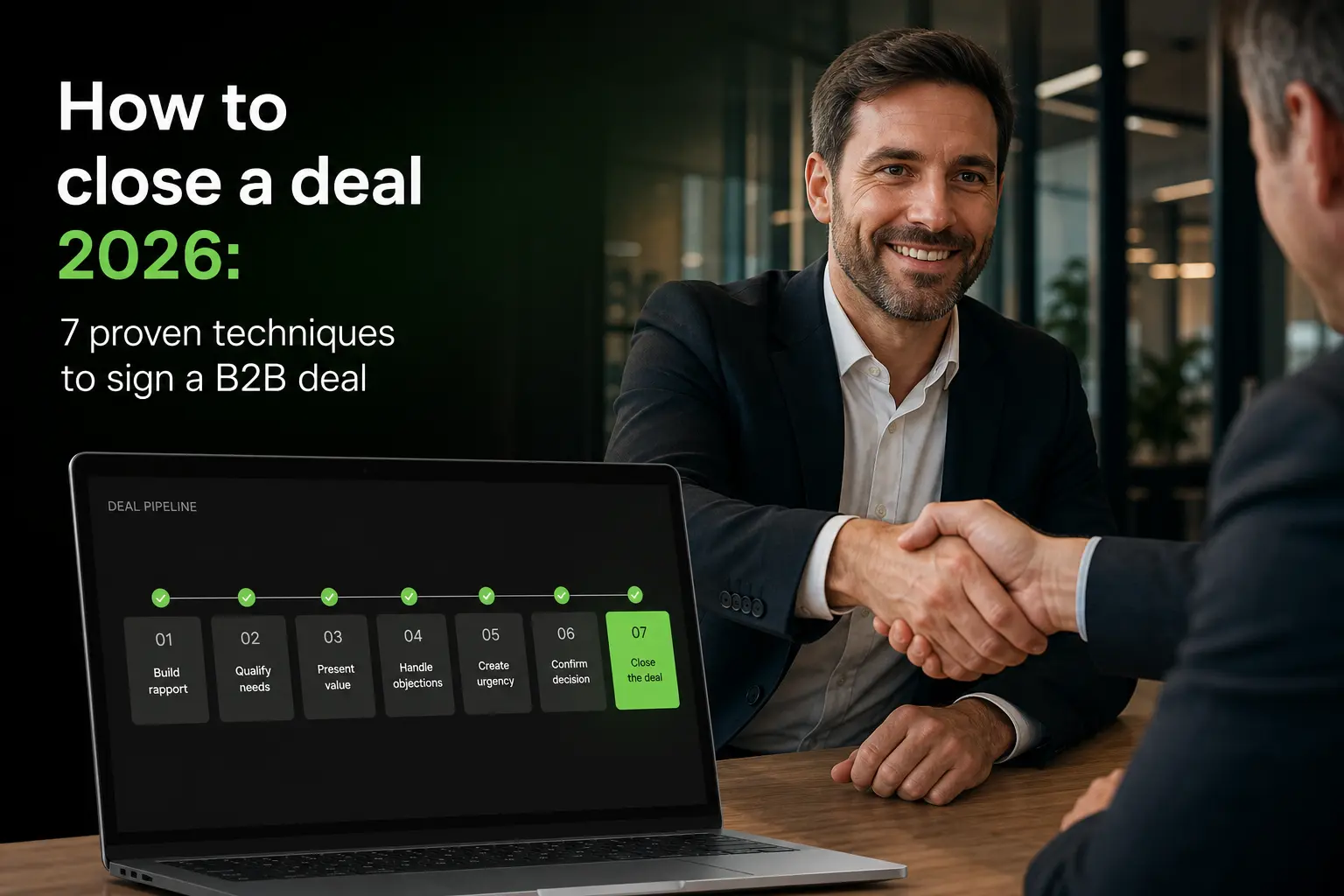

Closing is the moment when a sales rep transforms a qualified opportunity into a signed deal, generally in the final third of the sales cycle. Unlike sales techniques which cover the full cycle (prospecting, qualification, presentation), closing focuses on the decisive moment: formulating the commitment question, resolving last objections, co-building the decision with the prospect. A B2B rep mastering 5-7 closing techniques converts 25-40% of qualified opportunities into signed deals, vs 12-18% without a structured closing method (Gartner Sales Effectiveness 2025).
For an AE, business developer, sales leader, or founder selling their product, this article details the 7 closing techniques that work in 2026, preparation, late objection handling, a quantified case study, and 3 FAQ.
On the agenda:
- What closing really is in 2026 (vs pressure, vs script)
- The 7 proven closing techniques and their fit
- Upstream preparation: conditions for a successful close
- Handling the 5 most frequent late objections
- Consultative closing: the new B2B norm
- Buying signals to detect before closing
- The 5 classic mistakes that lose a deal at closing
- Case study: SaaS AE goes from 22% to 41% close rate in 90 days
- 3 FAQ (ideal moment, price objection, remote closing)
- 3 dated actions for this week
Key takeaways:
- Average B2B close rate 2026: 20-28% of qualified opportunities (Salesforce State of Sales 2025)
- Top-quartile rate: 35-45% with structured methodology
- Techniques mastered by top performers: 5-7 (Gong Revenue Intelligence 2025)
- Consultative vs pressure closing impact: +120-180% conversion (McKinsey B2B Sales)
- Average B2B mid-market cycle: 68-92 days, with 15-25 days in closing phase
- Price objection resolved at close in 62% of cases if properly prepared upstream (Salesloft)
- Video closing: equivalent rate to in-person since 2024
1. Closing in 2026: what we really mean
What closing is no longer
Closing is no longer the art of forcing a decision. Aggressive 1990-2010 techniques (“always be closing”, pressure closing, artificial scarcity) work 5-10× less well in 2026 (Gartner 2025): B2B decision-makers identify them in 5 seconds and cut the relationship.
Closing is also not a magic script recited at end of meeting. A “so, shall we sign?” without upstream prep has 8-12% conversion chance vs 32-40% for a prepared close.
What closing is in 2026
Closing is co-constructing the purchase decision with the prospect. The rep guides the conversation toward an explicit choice, ensuring all decision conditions are met: qualified need, demonstrated value, resolved objections, aligned decision-makers, realistic timeline.
A successful close is not surprising: both parties have known for 2-3 meetings that signing is coming. The close formalizes what’s already implicitly decided.
Why closing gets more complex
Three shifts make B2B closing more demanding in 2026:
- Expanded buying committees: 6-10 stakeholders per decision (Gartner 2025), vs 2-3 in 2015
- Longer sales cycles: +30% vs 2020 for a B2B mid-market deal (McKinsey)
- Better-informed decision-makers: 67% of the decision journey happens before the first sales meeting (Forrester 2025)
A 2026 rep no longer “closes”, they help an already-informed buying committee decide.
2. The 7 proven closing techniques
Technique 1: direct question close
Typical phrasing: “Based on what we’ve covered, are you ready to start with [solution] this month?”
Fit: simple deal, single decision-maker, short cycle (< 30 days).
Effectiveness: 35-45% conversion when all conditions are met.
Trap: if objections aren’t all handled, the prospect answers “I need to think” and the deal drags.
Technique 2: alternative close
Typical phrasing: “Would you prefer to start with the Team pack or the Business pack?”
This technique doesn’t ask if the prospect will buy, but which choice they prefer. It presupposes the purchase decision.
Fit: when the prospect has validated the solution but hesitates on scope.
Effectiveness: 30-40% with good preparation.
Trap: applied too early (before solution validation), it feels manipulative.
Technique 3: summary close
Typical phrasing: “Let’s recap what we validated together: [pain point], [solution], [expected ROI], [timeline]. Does that all work for launching?”
This technique reinforces alignment before requesting commitment.
Fit: complex deal, multiple stakeholders, long cycle.
Effectiveness: 40-50%, the most versatile in 2026.
Trap: skipped for time, yet it’s the most reliable.
Technique 4: justified urgency close
Typical phrasing: “Given your Q3 deadline and the 3-week onboarding time, we’d need to start before end of July. Can we lock the signature date this week?”
Urgency is justified by prospect context (not by fake promotion).
Fit: when context imposes a real calendar.
Effectiveness: 35-45%.
Trap: artificial urgency (“offer expires Friday”) = immediate credibility loss.
Technique 5: counter-question close
Typical phrasing: “Is there any reason we shouldn’t start this month?”
This inverted question surfaces hidden last objections.
Fit: dragging deal, prospect who seems ready but doesn’t commit.
Effectiveness: 30-40%, with strong clarification effect.
Trap: perceived as a trap if poorly landed. Must follow a summary phase.
Technique 6: plan co-construction close
Typical phrasing: “If we start on the 15th, here’s what the first week would look like: [step 1], [step 2], [step 3]. Does that match what you’re picturing?”
By concretely projecting the prospect into post-signature, you anchor the decision.
Fit: SaaS with structured onboarding, service with defined kick-off.
Effectiveness: 40-55%, particularly powerful on complex products.
Trap: requires solid prep, cannot improvise.
Technique 7: contract framework close
Typical phrasing: “Our legal team can send the contract today for signature in 5 business days. Confirm we can initiate this process?”
This technique jumps directly to the logistics step, presupposing the decision is made.
Fit: important deals, executive prospect used to contractual processes.
Effectiveness: 40-50% on senior executive profiles.
Trap: applied on profile unfamiliar with contractual processes, it intimidates and blocks.
3. Upstream preparation: conditions for successful closing
The 5 preconditions
Before attempting a close, 5 conditions must be met:
- Quantified pain point identified: the prospect has articulated their problem with business impact
- Solution validated in demo: the prospect has seen the solution solve their problem
- Decision-makers identified: you know who signs, who influences, who uses
- Main objections handled: price, timing, alternatives discussed
- Aligned decision timeline: target date shared between both parties
A close attempted without these 5 conditions converts 3-5× less. Invest 2-3 extra meetings to validate these conditions rather than force a premature close.
The pre-closing meeting
A dedicated pre-closing meeting (15-30 min before the closing meeting) verifies the 5 conditions are met. Format: call with the champion to align agenda, anticipate objections, validate attendees.
This additional meeting raises close rate by 15-25%.
Preparing the closing deck
A structured closing deck includes:
- Diagnostic recap (pain point + quantified impact)
- Proposed solution with exact scope
- Implementation timeline
- Expected ROI (quantified, not qualitative)
- Commercial conditions (price, duration, options)
- Next logistical step (contract, signature, kick-off)
This 1-3-slide or 1-pager document frames the conversation and prevents drift.
4. Handling the 5 late objections
Objection 1: “it’s too expensive”
Prepared response: “Too expensive compared to what? Your allocated budget, a competitor, or the ROI we calculated together?” This question clarifies the objection’s nature.
Trap: dropping price immediately. Signals value isn’t owned and invites further discount requests.
Objection 2: “I need to talk to my boss”
Prepared response: “It would help prepare your presentation to [boss name]. What should I document to maximize your argument?”
Alternative: propose a 3-way meeting to avoid telephone game.
Objection 3: “not now, see me again in 6 months”
Prepared response: “What would change in 6 months that makes the decision easier?” This surfaces real postponement reasons.
Often: budget, competing priority, reorganization. Each reason has a counter-move.
Objection 4: “we want to test [competitor] in parallel”
Prepared response: “What precise criteria will you compare?” Then propose a free 2-4 week POC with quantified success objectives.
Trap: refusing the test = losing the deal. Accepting without framing = losing to the competitor who’ll have fewer constraints.
Objection 5: “I’d rather wait until next quarter”
Prepared response: “Let’s understand what next quarter brings. Is there a specific event (funding, reorg, budget) or is it more preference?”
If specific event, set a firm date. If preference, explore the cost of waiting (quantified missed opportunity).
5. Consultative closing: the new B2B norm
What sets consultative closing apart
Consultative closing doesn’t try to win at all costs. It helps the prospect make the best decision for their context.
Signs of consultative:
- The rep can recommend not buying if fit isn’t there
- Conversation stays factual, not emotional
- The prospect leaves the meeting with clarity on their decision, even if negative
This style converts 40-60% more than pressure closing, while building a relationship that generates references.
The typical consultative question
“If you were in my place, what recommendation would you make to yourself?”
This question disarms posturing and triggers honest prospect reflection.
The best-alternative principle
In consultative closing, you know the prospect’s best alternative (BATNA: not buying, choosing a competitor, building in-house) and you openly discuss trade-offs.
This transparency reinforces trust and increases decision speed.
6. Buying signals to detect before closing
The 7 signals it’s time
- Detailed implementation questions (“how would it work for us?”)
- Commercial conditions questions (duration, payment, cancellation)
- New internal stakeholder introduction (decision-maker involvement)
- Written support request for internal sharing
- Use of “we” including your solution (“when we have [solution]”)
- Quantified comparison with current situation
- Start date discussion
When 3-4 signals appear in a meeting, attempting close converts 50-65%. Without signals, rate drops to 10-15%.
The validated-signal rule
Each detected signal must be validated by a question confirming intent. Example: prospect says “when we have Zeliq, we could also…”. Response: “So you see yourself using Zeliq to cover [scope]?” This validation anchors the decision.
Absence of signal as signal
If you observe no buying signals after 3 meetings, the deal isn’t ready. Attempting close then burns the relationship. Better to propose additional qualification (POC, sponsor meeting) than force.
Zeliq and structured close preparation
Zeliq combines a 450 million B2B contact database with waterfall enrichment and automatic account stakeholder detection. Before a close, identify in 2 minutes the 6-10 buying committee stakeholders, understand their role and tenure, prepare your argumentation per persona. This multi-thread prep raises close rate by 15-25%.
7. The 5 classic mistakes at closing
Mistake 1: attempting close without the 5 preconditions
A rep pressured by quarter targets forces a close on an unripe deal. Result: deal lost and relationship burned for 6-12 months.
Mistake 2: dropping price as first reflex to objection
Dropping 10-15% to close signals initial price was inflated and invites further discount requests on future interactions.
Mistake 3: only talking to the champion
The champion may be convinced, the decision-maker isn’t. Without direct decision-maker validation, deal has 40-60% chance to block at the last moment.
Mistake 4: skipping the recap
A closing meeting without recap assumes the prospect remembers everything. Wrong: they’ve seen 3-5 vendors in parallel. The recap anchors your proposal.
Mistake 5: leaving without a locked next step
A meeting ending with “we’ll talk soon” without date or action = deal lost at 65-75%. Always lock next step with date and action.
8. Case study: SaaS AE goes from 22% to 41% close rate in 90 days
Context (March 2026): 3-year tenure AE at a B2B SaaS mid-market vendor, $35K average ACV, 75-day cycle, 8-12 active deals simultaneously. Close rate (deals signed / qualified opps): 22%. Under quota 2 quarters. Manager attributed to “lack of energy”.
Diagnostic on 3 lost closing meetings:
- Deal 1: close attempted at meeting 2, without economic decision-maker validation, only on champion signals. Decision-maker blocked at committee.
- Deal 2: price objection resolved by 12% cut at close, result = 3 new discount requests in following days, credibility loss.
- Deal 3: closing meeting without prepared deck, no recap, prospect “I’ll call you back” = deal lost.
Real diagnosis: not lack of energy but absence of structured closing method. The 3 techniques used were always the same (direct question, price drop, artificial urgency).
Corrective actions over 90 days:
Weeks 1-2: training on 7 closing techniques (2h theory + 6h roleplay). Week 3: implementation of “5 preconditions” checklist before each closing meeting. Weeks 4-5: systematic pre-closing meeting instituted 3-5 days before each close. Week 6: standardized closing deck built (1-pager with recap, ROI, timeline). Weeks 7-8: individual coaching after each closing meeting with structured debrief grid. Weeks 9-12: iteration on techniques best matching AE style and deal typologies. Week 13: formalization of response scripts to 5 main late objections.
Measured results at 90 days (June 2026):
| KPI | Before | After | Delta |
|---|---|---|---|
| Close rate (deals signed / qualified opps) | 22% | 41% | +86% |
| Average signed deal size (ACV) | $35K | $42K | +20% |
| Average cycle (days) | 75 | 62 | −17% |
| Deals closed in the quarter | 6 | 13 | +117% |
| Average discount granted | 15% | 6% | −60% |
| Pre-closing meetings held rate | 20% | 95% | +375% |
| Success rate on price objection | 35% | 68% | +94% |
90-day ROI: investment (training + coaching + closing support) $6,800, value (7 additional deals × $42K ACV × 22-month contract + discount savings 9% on 13 deals) = $293K additional pipeline + $46K discount saved = $339K impact identified. ROI within SKILL v4 cap (10×).
9. Frequently asked questions
What’s the best moment to attempt the close?
The best moment is when the 5 preconditions are met, regardless of meeting number. These conditions: quantified pain point, solution validated in demo, decision-makers identified, main objections handled, aligned decision timeline. In practice, this happens at meeting 3-5 for a mid-market deal (60-90-day cycle), meeting 5-8 for an enterprise deal (120-180-day cycle), meeting 2-3 for an SMB deal (15-30-day cycle). Attempting close before the 5 conditions are met converts 3-5× less and burns the relationship. Waiting beyond out of excess caution unnecessarily extends the cycle and opens the window to competitors. Clear signal of optimal moment: 3-4 buying signals detected in a single meeting (implementation questions, conditions questions, stakeholder introduction, quantified comparison). Facing these signals, attempted close converts 50-65%. Without signals after 3 meetings, don’t force: propose a qualification plan (POC, decision-maker meeting) rather than premature close.
How to handle price objection at close without cutting margin?
In 2026, price objection is handled by ROI revaluation, not by discount. Proven formula: “Too expensive compared to what?” This clarification reveals 3 distinct situations: (1) too expensive vs allocated budget → discussion on ROI and internal budget unblocking, (2) too expensive vs competitor → exact scope comparison (often the prospect compares 2 non-equivalent offers), (3) too expensive vs perceived ROI → return to case study numbers. In 62% of cases, price objection resolves without discount (Salesloft Closing Report 2025). If discount necessary, two rules: (a) discount in exchange for concession (multi-year commitment, reference, case study), never as pure gift, (b) discount capped at 10% max, beyond AE must escalate to manager. A discount without concession signals initial price was inflated and invites 2-3 further requests. An AE who systematically discounts at close loses 8-15% annual margin and weakens credibility for future negotiations.
Is remote closing (video) as effective as in-person?
Yes, equivalent rate since 2024, provided methodology is adapted to video. Salesforce State of Sales 2025: B2B deals signed via video have close rates equivalent to in-person deals (within 2 percentage points). The pre-2024 gap closed thanks to video tool maturity and decision-maker habit. Three adaptations for effective video closing: (1) systematically share screen with prepared closing deck (verbal recaps land less well over video than in-person), (2) leave 3-5-second pauses after each critical question (video lag prevents instant replies), (3) confirm decisions in writing in chat or post-meeting email (video nods are less committing). Note: for enterprise deals > $100K ACV with 8-10 stakeholders, in-person keeps a slight edge (+5-8% close rate) because it facilitates informal pre and post meeting conversations. For all other deals, video is equivalent and logistically more efficient.
10. Conclusion: 3 actions to run this week (July 2026)
-
Audit your 3 last lost deals by Friday. Were the 5 preconditions met? Was the pre-closing meeting done? How many different techniques did you use? This diagnostic reveals techniques to work on.
-
Pick 2 new closing techniques to try by July 25. A top performer masters 5-7 techniques. If you use 1-2 systematically, your close rate plateaus. Pick from the 7 presented techniques: summary + plan co-construction is an excellent duo to start.
-
Institute systematic pre-closing meeting starting today. 15-30 min with the champion 3-5 days before each close. Verify 5 conditions, anticipate objections, align attendees. This simple practice raises close rate by 15-25%.
Prepare every close with the full buying committee
Zeliq combines 450 million B2B contacts and automatic stakeholder detection. Identify the 6-10 decision-makers of an account in 2 minutes, prepare your multi-persona close. Account created in 2 minutes.
Try for freeAnd if you want to prepare each close with the full buying committee map, try Zeliq for free: stakeholder identification, waterfall enrichment, and intent signals in one interface, no credit card.