

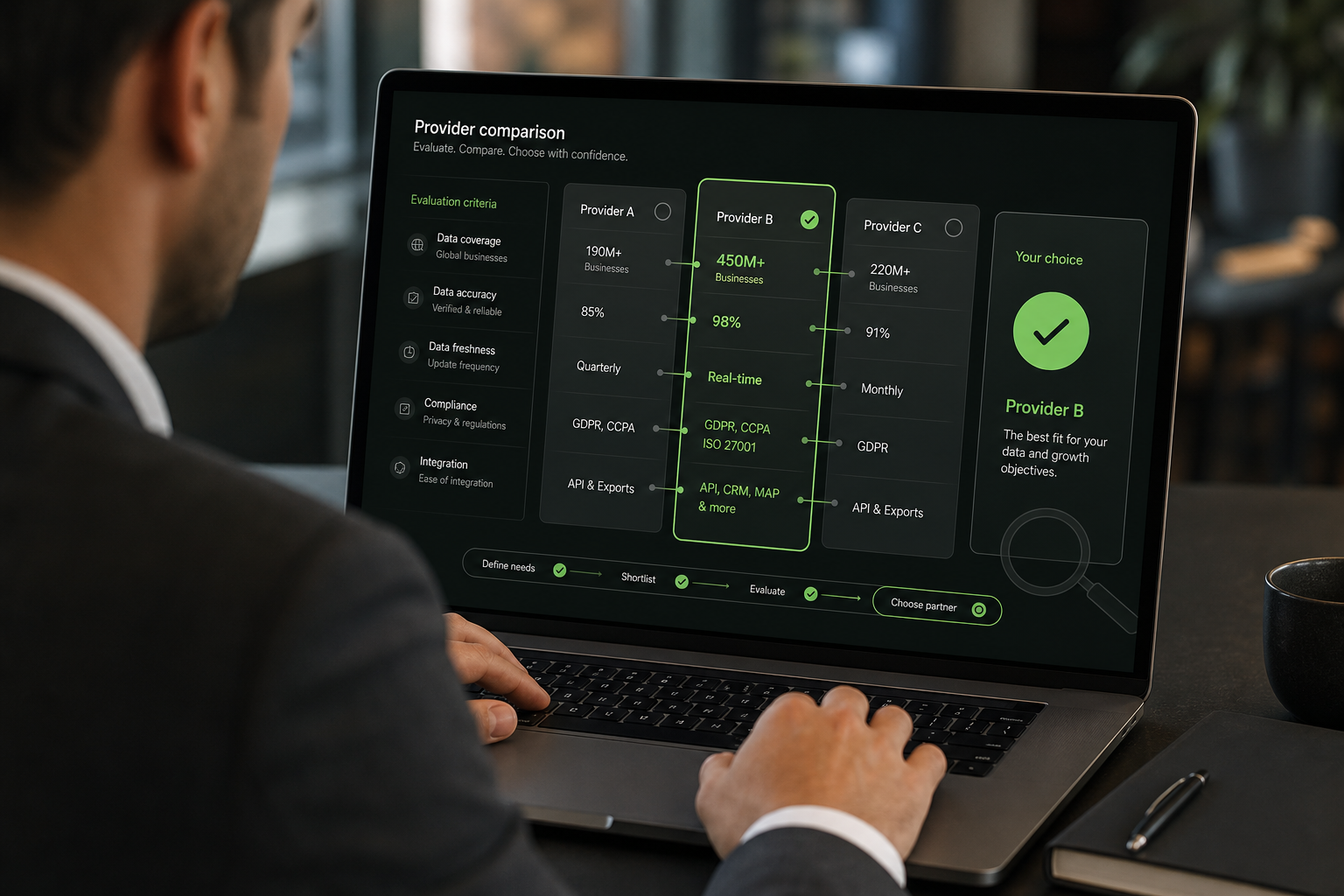

A B2B vendor is a company that delivers goods, services, or data to another company under a contracted relationship. For outbound sales and data, choosing the right B2B vendor means evaluating 6 criteria: geographic and vertical coverage, data freshness, contact verification rate, GDPR and CCPA compliance, CRM integration quality, and pricing model. Per Gartner B2B Buying Survey 2024, 63% of sales teams switch data vendors within 24 months of purchase because they underestimated these criteria upfront.
For a VP Sales, RevOps lead, marketing director, or founder framing a data or outbound contract, this article breaks down B2B vendor types, the 6 evaluation criteria to document, the 5 red flags to spot before signing, a chiffré case study on a scale-up contract renewal, and 3 FAQs on the questions that make or break tens of thousands of euros.
What you’ll learn:
- What a B2B vendor means in 2026
- The 4 major B2B vendor types
- Focus on B2B data and outbound vendors
- The 6 evaluation criteria to document
- How to integrate a new data vendor into your stack
- Pricing models: pay-as-you-go vs subscription vs enterprise
- The 5 red flags to spot before signing
- Case study: SaaS scale-up, renewing a 62K EUR/year data contract
- 3 FAQs (GDPR, exclusivity, CRM integration)
- 3 dated actions to run this week
The gist:
- 63% of teams switch data vendors within 24 months (Gartner 2024)
- Acceptable B2B database freshness: < 6 months on 80% of contacts
- 2026 expected valid email coverage: > 75% (multi-vendor waterfall)
- Expected direct phone coverage: > 50% on sales executives, > 40% on technical roles
- Documented GDPR compliance: signed DPA, listed sub-processors, clear legal basis
- Pay-as-you-go: profitable up to ~500 credits/month; subscription beyond that
- Data vendor onboarding: expect 2 to 4 weeks for a clean CRM integration
1. B2B vendor: what it really means in 2026
The extended definition in digital environments
A B2B vendor is a company that delivers tangible goods (equipment, components), services (consulting, development, training), software (SaaS, licensing), or data (contact databases, enrichment, intent signals) to another company. The relationship is contracted, measured by SLAs, and billed as subscription, consumption, or lump-sum.
In 2026, the definition extends strongly to B2B data and outbound tool vendors, which represent 8 to 15% of the average commercial budget in SaaS scale-ups per Forrester. These vendors deliver B2B contact databases, email verification, direct phone numbers, and behavioral signals that feed the sales pipeline.
Why vendor choice is professionalizing
Five years ago, a company bought 1 or 2 data vendors and accepted their limits. Today, an average mid-market sales team runs 4 to 7 data vendors in parallel, orchestrated through an enrichment waterfall that queries each source in priority order.
This professionalization stems from three factors: inbox saturation demanding more precise data, GDPR pressure enforcing sub-processor audits, and RevOps team maturity that now compares vendors on objective, documented criteria.
2. The 4 major B2B vendor types
Physical goods vendors (production input)
Raw materials, electronic components, packaging, furniture, IT equipment. The relationship is locked by a framework contract with volume commitment, delivery SLAs, and a quality spec. Procurement handles this vendor type.
Professional services vendors
Consulting firms, dev shops for software, marketing agencies, law firms, training providers. Fixed-fee or T&M contract, defined deliverables, often with contracted IP. Business function or procurement co-arbitrate.
Software and SaaS vendors
CRM, marketing automation, sales tools, HR tools, finance tools. Subscription model, per-seat or usage licensing. Average SME SaaS stack is 30 to 60 tools in 2026 (SaaStr). The fastest-growing segment.
B2B data and outbound vendors
Contact databases, email finders, phone finders, intent signals, CRM enrichment, multichannel sequence platforms like Zeliq. Credit-based (pay-as-you-go), monthly subscription, or enterprise licensing model.
These 4 types share common criteria (quality, SLA, price, support), but this article focuses on the last category, the one weighing most on the sales pipeline.
3. Focus on B2B data and outbound vendors
What they actually deliver
A B2B data vendor delivers three bricks:
- A contact database covering N decision-makers by geography, industry, and function (Zeliq claims 450 million global B2B contacts)
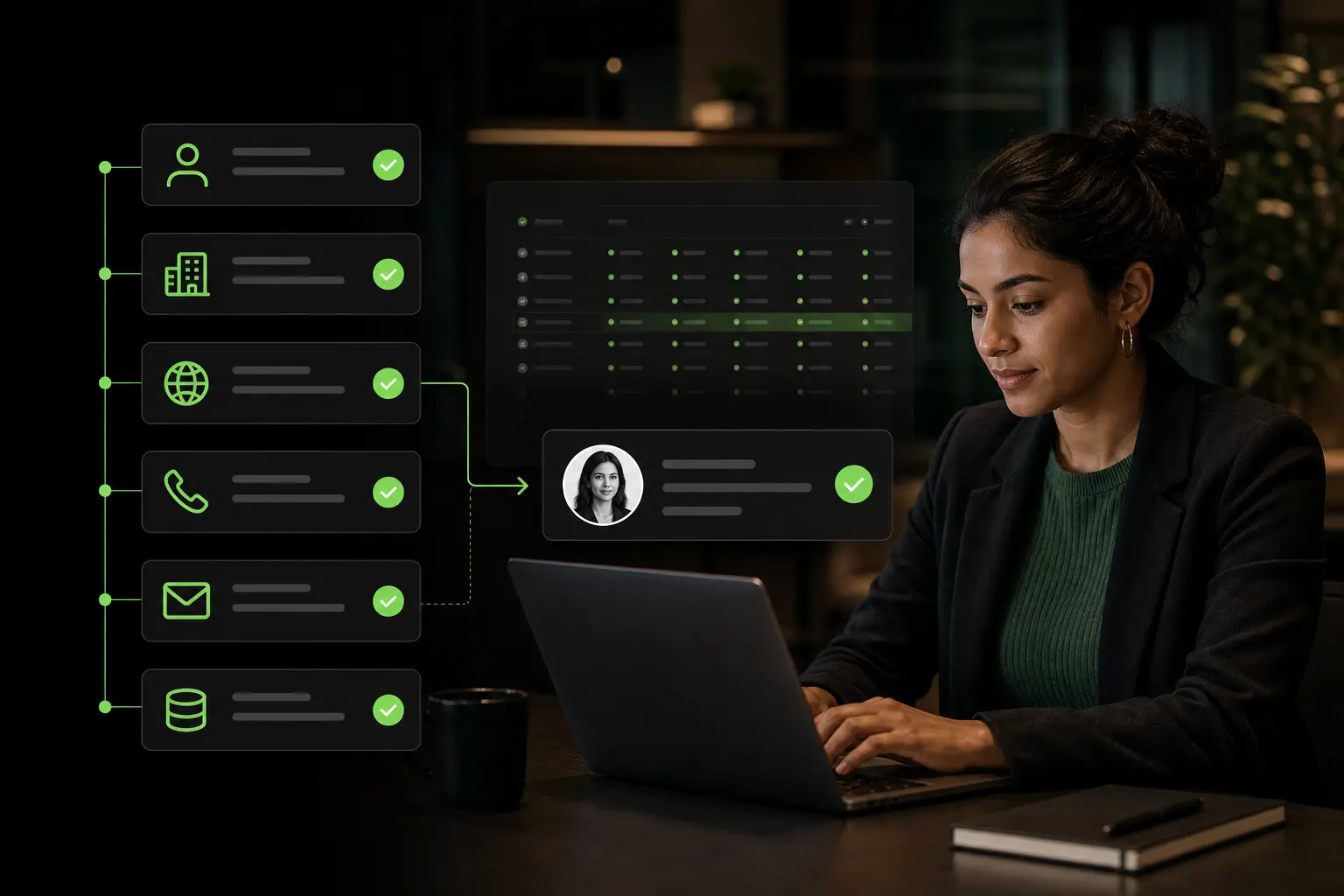
- On-demand enrichment that takes a LinkedIn profile or CSV and returns work email, direct phone, current title, company, tech stack
- Intent signals identifying accounts in active research mode (funding rounds, hiring surges, tech stack changes)
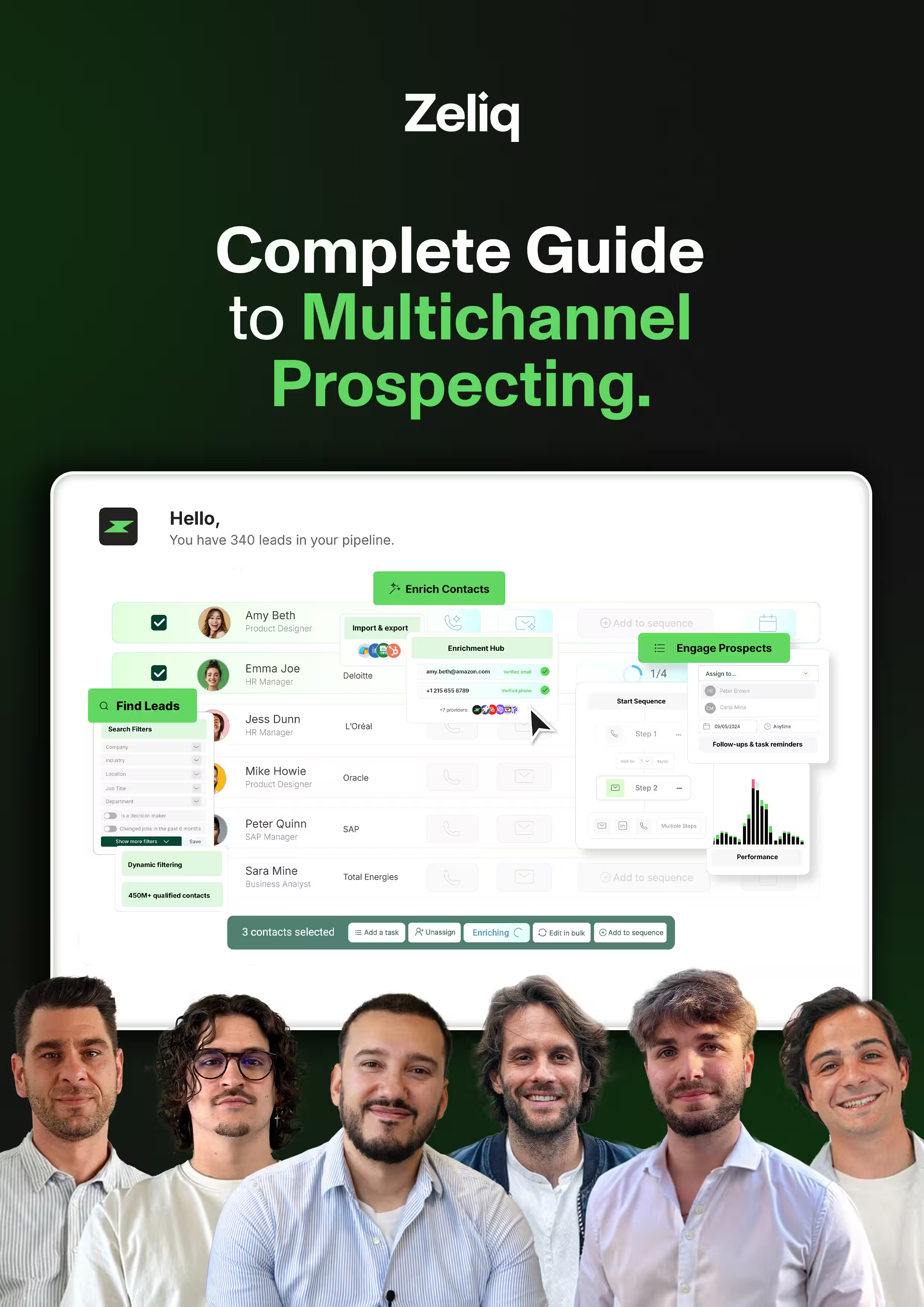
Complementarily, some vendors like Zeliq also deliver the activation layer: multichannel sequences email + LinkedIn + call, engagement scoring, CRM sync.
The difference between database seller and enrichment partner
A database seller sells a list as a lump-sum or license. You grab a CSV and fend for yourself. Transactional model, little value compounded over time.
An enrichment partner plugs its API into your CRM and enriches leads in continuous flow. It keeps data fresh, handles deduplication, alerts on title changes. Relational model, value compounds over time.
The choice depends on your RevOps maturity. A 3-SDR team can start with a database seller. A team of 15+ SDRs or an account-based marketing team needs an enrichment partner.
4. The 6 evaluation criteria to document
Criterion 1: geographic and vertical coverage
Check coverage on your ICP first. A 450M global contact database is worthless if your market is “French industrial mid-market in the North-East”. Ask for a free sample or a 100-contact POC on your exact ICP to measure real coverage.
Acceptable 2026 ratios:
- Coverage on FR companies 50+ employees: > 90%
- Coverage on UK / DE / ES: > 85%
- Coverage on decision-makers by function: > 70% at director level, > 50% at middle management
Criterion 2: data freshness
A fresh database has under 6 months of age on 80% of its contacts. An average one sits between 6 and 12 months. Above 12 months, email bounce rates exceed 12% and burn sender reputation.
Ask the vendor for its refresh process: how frequently they re-scan LinkedIn, cross with public registries, verify emails via SMTP. A serious vendor documents this process during onboarding.
Criterion 3: contact verification rate
The 2026 market reference:
- Valid email (SMTP OK, no high-risk catch-all): > 75%
- Direct phone (mobile or dedicated business line): > 50% on sales functions
- Title and company up to date within 3 months: > 85%
Reject any vendor that won’t display these ratios or refuses to measure them on a sample.
Criterion 4: GDPR and CCPA compliance
The vendor must provide without hesitation:
- A signed DPA (Data Processing Agreement)
- The list of sub-processors and processing countries
- The invoked legal basis (documented legitimate interest for B2B)
- The opt-out process for data subjects
A vendor who hesitates on these documents or delivers vague PDFs is a major legal risk. You remain the data controller, even if the data comes from a third party.
Criterion 5: CRM integration quality
A modern data vendor natively integrates at minimum Hubspot, Salesforce, and Pipedrive via bidirectional API. Integration must allow:
- Auto-push of new contacts to the CRM
- On-demand enrichment from a CRM record
- Custom field mapping
- Deduplication based on work email + LinkedIn ID
A Zapier-only integration is a weak signal: too slow and fragile for daily volume use.
Criterion 6: pricing model and cost predictability
Three models dominate:
| Model | Profitable for | Trap to avoid |
|---|---|---|
| Pay-as-you-go credits | Volume < 500 contacts/month | High unit cost, unpredictable budget |
| Monthly/annual subscription | Volume 500 to 5,000/month | Over-provisioning unused credits |
| Enterprise seat-based | Team of 10+ users | Slow negotiation, 12-24 month lock-in |
The best model depends on your projected volume. Run 12-month calculations across 3 scenarios (low, realistic, high) before signing.
Zeliq and choosing a B2B data vendor
Zeliq combines a 450 million B2B contact database, a waterfall enrichment that queries 40 vendors in cascade to deliver 80% valid emails and 60% direct phones, native Hubspot and Salesforce integration, a complete GDPR DPA, and a flexible pricing model (credits + subscription). Together, this makes Zeliq an enrichment partner, not just a database seller.
5. How to integrate a new data vendor into your stack
Step 1: the 30-day POC
Negotiate a 30-day POC on a limited scope (100 to 500 contacts on your exact ICP). Measure on that sample:
- Real coverage vs promised
- Valid email rate after third-party SMTP verification
- Bounce rate on actual sends
- Reply rate compared to your current baseline
This phase lets you decide without commitment. A serious vendor accepts a free or symbolic POC.
Step 2: CRM field mapping
Document the mapping between vendor fields and your CRM fields (Zeliq function → HubSpot Job Title, company → Company, etc.). The trickiest fields in practice: title (vendor norm vs internal norm), geography (country, region, zip code), and data source (to trace for GDPR audit).
Step 3: deduplication rules
Define merge rules when the vendor pushes an already-present contact: which field overwrites which, which timestamp wins, what behavior on inactive contacts. Without clear rules, your CRM database corrupts in 6 months.
Step 4: continuous monitoring
Set up a weekly dashboard tracking: volume of enriched contacts, bounce rate on sends, reply rate by contact cohort (new vendor vs old), cost per qualified lead. This monitoring surfaces quality degradation in 2-3 weeks instead of 6 months.
6. Pricing models: pay-as-you-go vs subscription vs enterprise
Pay-as-you-go credits: the entry door
One credit = one enrichment (an email found, a number validated, etc.). Average price 0.20 to 1 USD per credit depending on vendor. Profitable to test or for a 1-to-3 SDR team with volume under 500 contacts/month.
Classic trap: “email + phone” credits often count double. Check the exact credit definition in the contract.
Monthly subscription: the cruising regime
Flat fee with included credit quota (e.g., 5,000 credits/month for 400 EUR). Profitable for 3-to-15 SDR teams with predictable volume. Watch out for over-provisioning: paying for 5,000 credits/month when consuming 2,800 is a classic waste.
Negotiate rollover of unused credits to the next month and downgrade flexibility in case of activity drop.
Enterprise seat-based: the structuring contract
Per-user license with 12 or 24-month commitment. Negotiable pricing, with dedicated support, training, custom integration. Profitable above 10 seats or for a team needing a structuring contract with reinforced GDPR, quarterly audit, uptime SLA.
Negotiate: per-seat price after 20 users, exit clause on acquisition, data portability on termination.
7. The 5 red flags to spot before signing
Red flag 1: refusal of POC
A vendor refusing a free POC or forcing a paid POC above 500 USD probably hides disappointing niche coverage. Walk away.
Red flag 2: no quantified verification rates
A vendor who can’t give you email, phone, and title-freshness coverage rates with measurement methodology probably doesn’t measure them. Sign of dubious freshness.
Red flag 3: incomplete or generic DPA
A DPA that doesn’t list sub-processors, doesn’t specify processing countries, or invokes a vague legal basis (“commercial interests”) exposes you to a CNIL fine of 4% of revenue in case of audit.
Red flag 4: Zapier-only CRM integration
No native Hubspot or Salesforce connector, only Zapier or homemade webhooks. Sign of a technically immature vendor with support lagging behind API evolutions.
Red flag 5: 24-month lock-in with no exit clause
A 24-month contract with no exit clause for measurable quality drop is a financial trap. Negotiate at minimum an annual exit clause under 60-day notice in case of documented SLA non-compliance.
8. Case study: SaaS scale-up, renewing a 62K EUR/year data contract
Context (March 2026): French B2B SaaS scale-up, 78 employees, 8.4M EUR ARR, 8 SDRs + 4 AEs. Current data contract with a legacy vendor, 62K EUR/year, commitment ended.
RevOps diagnosis:
- ICP email coverage: 68% (below 75% market benchmark)
- Direct phone coverage: 34% (below 50% benchmark)
- Email bounce rate on sends: 9.2% (above the 5% healthy threshold)
- Database freshness: 41% of contacts over 12 months old
- DPA: 4 undeclared sub-processors discovered during internal audit
Decided actions:
- Parallel POC on 3 candidate vendors with 500 ICP contacts each
- Measurement of 4 real coverage KPIs on POC
- 12-month contract negotiation with 60-day exit clause
- Progressive migration over 90 days to avoid pipeline disruption
Measured results at 6 months (September 2026):
| KPI | Before (March) | After (Sept) | Delta |
|---|---|---|---|
| ICP email coverage | 68% | 82% | +21% |
| Direct phone coverage | 34% | 58% | +71% |
| Email bounce rate | 9.2% | 3.8% | −59% |
| Freshness < 6 months | 41% | 84% | +105% |
| Annual data cost | 62,000 EUR | 48,000 EUR | −23% |
| Team meetings booked/month | 68 | 108 | +59% |
6-month ROI: contract saving 14K EUR/year, value of 40 extra meetings/month × 6 months × 1,200 EUR = 288K EUR additional pipeline. ROI 6.4x on annual data budget.
9. Frequently asked questions
Is a B2B data vendor GDPR-compliant by default?
No, never by default. You remain data controller even when data comes from a third party. Before any purchase, demand the signed DPA, the exhaustive sub-processor list, processing countries, and invoked legal basis. The French CNIL reminded in 2024 that “legitimate interest” invoked for B2B outbound doesn’t waive the obligation to document the process, inform data subjects, and provide opt-out capability. A vendor hesitating on any of these documents is a major legal risk: 61% of 2024 CNIL sanctions concern sub-processor and legal basis failures.
Can I negotiate territorial exclusivity with a B2B vendor?
Rarely relevant for data, more common for services. B2B data vendors refuse territorial exclusivity because their economics rely on database mutualization across all clients. One exception: enterprise contracts with a “first access” clause on new contacts in a targeted vertical, in exchange for a 15 to 30% discount. For services (consulting, agency, dev shop), vertical exclusivity in a zone is frequent and negotiates against a minimum volume commitment. Always document exact scope (vertical, geography, duration) to avoid interpretation disputes.
How long does CRM integration of a new data vendor take?
2 to 4 weeks for a clean integration, depending on stack complexity. Week 1: field mapping, deduplication rule definition, API testing in sandbox. Week 2: import of 1,000 to 5,000 contact sample and quality validation. Week 3: progressive switch on new outbound with KPI monitoring. Week 4: user documentation, SDR training, and advanced automations. A rushed 3-day integration leads to 6 months of technical debt and a corrupted CRM database. Always plan 1 to 2 buffer weeks for unforeseen cases (custom fields, rule conflicts, API latency).
10. Conclusion: 3 actions to run this week (June 2026)
Audit your current data vendor’s real coverage by Friday. Extract 200 ICP contacts, send them to third-party SMTP verification, and measure valid email rate. If under 75%, prepare an alternative POC immediately.
Retrieve your data vendor’s DPA and verify sub-processors by June 12. 61% of 2024 CNIL sanctions target this point. If the sub-processor list is incomplete or the legal basis vague, open the topic internally with your DPO or legal.
Negotiate the exit clause on your next renewal by June 20. Annual exit under 60-day notice in case of documented SLA non-compliance. Without this clause, you’re locked 24 months on a vendor that can degrade without consequence.
Test a B2B data vendor with no commitment
Zeliq combines 450 million verified B2B contacts, waterfall enrichment, and multichannel sequences. Account set up in 2 minutes, no credit card, no commitment.
Try for freeAnd if you want to replace a disappointing data vendor with a platform that combines a 450M contact database, waterfall enrichment, and multichannel sequences, try Zeliq for free: account set up in 2 minutes, no commitment.

.webp)