

Lead Magnet: Definition, B2B Examples and Ideas That Convert in 2026
Outbound volume is dying. Cold lists get burned in weeks, sender reputation collapses under aggressive sending, and reply rates on generic sequences keep sliding toward 1%. Meanwhile, the buyers you actually want spend hours on Google, LinkedIn and Reddit researching their problems before they ever talk to a vendor. The question stops being “how many emails can I send” and becomes “how do I show up for a buyer who is already looking”.
That is what a lead magnet is built to do. It catches a buyer at the moment they raise their hand, gives them something useful, and pulls them into a relationship you can compound with email, retargeting and sales follow-up.
This guide unpacks lead magnets the way a B2B marketer or founder needs to use them in 2026: a working definition, 10 lead magnet types that pull weight, real examples from companies you know, the anatomy of a magnet that converts, the metrics that matter, the mistakes that quietly kill them, and 25 lead magnet ideas you can ship next quarter sorted by ICP.
What is a lead magnet
A lead magnet is a free, gated asset that a company gives away in exchange for contact information (typically a business email, sometimes name, company and job title). It can be a document, a tool, a video, an audit, a checklist or anything else with perceived value high enough that a stranger is willing to identify themselves to get it.
The trade is simple. The visitor gets tangible value right now. The company gets an identified lead with permission to follow up.
Lead magnet vs gated content vs lead magnet funnel
These three terms get used interchangeably and they should not be.
Gated content is the broader category. Anything you put behind a form is gated content: a pricing page hidden until a demo request, a webinar replay locked behind an email field, an analyst report. Gated content is a tactic.
A lead magnet is a specific kind of gated content designed for top-of-funnel and middle-of-funnel acquisition. It is built and promoted with the deliberate goal of capturing leads from cold or semi-warm traffic. Its job is conversion, not just access control.
A lead magnet funnel is the full system around the magnet: traffic source, landing page, form, thank-you page, delivery email, nurture sequence, and the handoff logic that decides when the lead becomes an MQL and when sales should call. The magnet is one piece. The funnel turns that piece into pipeline. A team that ships a magnet without thinking about the funnel ends up with a stack of unworked emails.
Why lead magnets matter in B2B in 2026
Three forces make lead magnets more important right now than they have been in years.
Intent capture beats interruption. Cold email reply rates that hovered at 5-8% in 2020 now sit at 1-3% on most lists, and Google and Microsoft keep tightening sender requirements. A founder who Googles “ROI calculator B2B SaaS” and lands on a calculator that does the math in 30 seconds is a hand-raise. They are doing your prospecting for you. A lead magnet is the trap door that turns that anonymous Google session into a contactable lead.
MQL to SQL conversion is the metric that matters. CFOs have stopped accepting “we generated 5,000 MQLs last quarter” as meaningful. High-quality lead magnets produce MQLs that convert to SQLs at 30-50%. Generic top-of-funnel magnets convert at 5-10%. Same headcount, same ad spend, very different pipeline outcomes.
A counterweight to volume outbound. Even teams that still run outbound hard need an inbound flywheel running alongside. Magnets create assets that earn organic traffic, give SDRs warm conversation starters (“I saw you downloaded our cold email teardown”), and build the audience you eventually retarget on paid social.
10 lead magnet types that work in B2B 2026
Each format has a different production cost, conversion rate and lead quality profile. Most mature B2B teams run 3-6 magnets in parallel, each tuned to a specific ICP segment or funnel stage.
1. Ebook or whitepaper
A 15-50 page document on a focused topic, with original frameworks, data and examples.
Real example: Salesforce State of Sales report, an annual survey-driven asset that has fed their inbound database for years. Drift’s ABM playbook played the same role in their growth phase: packaged thinking that became the reference doc for an entire category.
Conversion: 2-5% on cold ICP traffic, 8-15% on bottom-funnel queries.
Use case: Thought leadership, ranking for big informational queries. Best when you have an opinion strong enough to fill 30 pages without padding. Limit: ebooks are read less than they are downloaded, so lead-to-conversation quality depends on the nurture, not the document.
2. ROI calculator
A web tool that takes a few inputs and outputs a number the visitor cares about: revenue gained, hours saved, headcount avoided.
Real example: HubSpot ROI calculator, quietly compounding leads for over a decade. Drift built a conversational marketing ROI tool, Outreach has a sales engagement ROI calculator. They make the abstract case for a category concrete and personal in 60 seconds.
Conversion: 8-20% on bottom-funnel traffic. The lead is identified at the moment they have just convinced themselves the math works.
Use case: Categories where buyers struggle to justify spend internally. Limit: real engineering effort, and inputs need to be defensible (an obviously inflated calculator destroys trust).
3. Template or swipe file
A ready-to-use document the prospect can copy, paste and ship: cold email scripts, call openers, slide decks, Notion templates, sequence frameworks.
Real example: Lemlist swipe files. Lemlist has built a brand on giving away the cold email templates their best customers actually use. They convert at high rates because the value delivery is instant, the prospect can ship in 10 minutes, and the swipe doubles as a sales pitch for Lemlist itself. HubSpot does the same with their templates library.
Conversion: 10-25% on warm and bottom-funnel traffic. Quality is high when the template is tightly scoped (“the 5 templates we use for outbound to RevOps leaders”, not “100 generic email templates”).
Use case: Picking up SDR-level traffic. Cheap to produce, fast to update.
4. Checklist
A short, scannable document that lists every step or item to handle in a process.
Real example: Stripe’s “B2B SaaS launch checklist”, Klaviyo’s “email pre-send checklist”. They reduce a fuzzy task into a finite list, which is what a stressed operator wants.
Conversion: 8-18% on warm traffic.
Use case: Capturing the broadest top of funnel for an evergreen task. Limit: easy for competitors to replicate, not enough on its own to differentiate.
5. Free audit or teardown
A one-to-one analysis of the prospect’s current setup, delivered by your team. A deliverability audit, ICP audit, website teardown, sales sequence review.
Real example: HubSpot’s free website grader, a brand-defining magnet for 15+ years. Many SaaS companies offer narrower versions: a free email deliverability audit, a free LinkedIn outbound teardown, a free ABM list scoring.
Conversion: 1-3% of visitors request the audit, but those who do are extremely high intent. MQL to SQL can hit 50-70%.
Use case: ABM and high-ACV plays. The audit is a meeting with sales dressed up as free value, and the prospect has already self-selected. Limit: each audit takes a salesperson’s time, so it does not scale below mid-market traffic.
6. Free tool
A standalone web app that does one useful job for free, signup required to save or export.
Real example: Ahrefs Backlink Checker, Hunter Email Verifier. Each does part of what the paid product does and converts the high-intent users to identified leads.
Conversion: 3-8% of free tool users hand over an email.
Use case: Building a long-term acquisition moat. Free tools rank for high-volume queries and can drive 6-7 figures of pipeline yearly once they compound. Limit: real product investment, with all the maintenance that comes with it.
7. Mini-course
A series of 5-10 short videos or emails delivered over days or weeks, on a tightly scoped topic.
Real example: Reforge programs (paid versions are flagship, free intros are the lead magnets). Many founder-led brands run a 5-day email course as a primary lead magnet (“5 days to a working ICP”).
Conversion: 10-20% on warm traffic. 50-70% of signups never finish, but the engaged 30% are a goldmine for sales.
Use case: Brand building, audience nurture, demand creation. Mini-courses position you as the educator, not the vendor.
8. Benchmark report
Original data on a market or function, packaged into a report. The data has to be yours, from a survey, your customer base, or an aggregation no one else has.
Real example: Gong’s Revenue Reality reports, HubSpot’s State of Marketing, Pavilion’s Sales Compensation benchmarks. They get cited in podcasts, quoted on LinkedIn, linked from other people’s articles. Each citation is a free distribution channel.
Conversion: 5-15% on landing pages, but the bigger value is the PR halo. A good benchmark earns top-of-funnel coverage paid ads cannot match.
Use case: Brand and category leadership. Limit: production lift is high, and the methodology has to be defensible (a sketchy benchmark backfires fast).
9. Webinar replay
A recorded session, 30-60 minutes, gated. Often runs as a live event first, then becomes evergreen on the replay landing page.
Real example: Drift’s signature webinars in their growth phase, packaged sessions on conversational marketing that ran on replay for years. Outreach, Salesloft and Gong all run heavy webinar programs with replays as long-tail magnets.
Conversion: 4-10% on landing pages for replays, 10-20% for live registration where the time-bound element raises urgency.
Use case: Mid-funnel education, often co-marketed with a partner brand or guest expert to extend reach.
10. Case study bundle
Multiple case studies packaged into a single download. One case study alone is rarely a strong magnet, but a curated set of 5-10 in a vertical or use case becomes a research artifact.
Real example: HubSpot’s customer success stories bundle by industry. Klaviyo’s e-commerce growth stories. The pitch is “see how 10 companies like yours solved the same problem you have”, which is what a buyer in evaluation wants.
Conversion: 6-12% on bottom-funnel traffic from comparison and competitor queries. Quality is very high.
Use case: Sales acceleration. The bundle is a deal-stage asset sales sends during evaluation, and as a magnet it captures buyers shopping the category.
Anatomy of a high-converting lead magnet
Format alone does not decide whether a magnet works.
Specific outcome. Not “learn about cold email” but “the 7 cold email sequences our 100 best customers use, with reply rate benchmarks”. The promise should answer “what will I have done, decided or known after consuming this”.
Time-to-value under 10 minutes. A buyer skimming on a Tuesday afternoon does not have an hour. The magnet must deliver core value fast, even if 30 deeper pages exist for those who want them.
Format matched to the topic. ROI math wants a calculator, not an ebook. A repetitive task wants a checklist, not a video. Picking the wrong format kills conversion before the form even loads.
ICP-specific framing. A magnet aimed at “marketers” converts worse than one aimed at “B2B SaaS Series B marketing leaders”. Narrower persona, higher conversion among that persona.
Honest CTA copy. “Download” outperforms “Get instant access now!”. 2026 buyers are saturated with hype copy and respond to direct, low-pressure language.
Gating that respects friction. Three fields (email, first name, company) sit at 25-30% conversion on warm traffic. Eight fields drop to 7-10%. Each extra friction step in delivery (email confirmation, mandatory phone, captcha) adds 5-15% drop-off. Worth it only if the lead-quality jump is real. A thank-you page that just says “thanks!” wastes a high-intent moment: put the next CTA there.
How to design and build one
Step 1. Pick a query and an ICP. Find a query with at least 200 monthly searches that maps to a problem you solve, where your ICP is the searcher. The query becomes the title of the landing page and the spine of the magnet.
Step 2. Pick the angle. Three good angles: original data (“we surveyed 200 RevOps leaders”), prescriptive framework (“the 5-step ICP scoring model”), operator playbook (“the exact 8 emails we send for outbound to PLG accounts”). One angle, picked early.
Step 3. Choose format by job-to-be-done. Buyer needs to convince a CFO: calculator. Needs to ship a process: template or checklist. Needs to learn a category: benchmark or ebook. Needs to evaluate vendors: case study bundle or audit.
Step 4. Design for skim. A magnet that requires sequential reading loses 70% of its audience. Headlines, callouts, summary boxes, a TL;DR on page 1, a results summary on row 1.
Step 5. Build the gating layer. Landing page with the promise above the fold, social proof, 3-field form. Test on mobile (30-50% of B2B traffic). Connect the form directly to your CRM or marketing automation.
Step 6. Plug in nurture. Day 0 delivery email with the asset and a clear next step. Days 2, 5, 9, 16 with 4 follow-ups that deepen the topic and progressively introduce the product. Day 21 a sales-led ask if the lead is ICP fit. Without nurture, the magnet is a cost center.
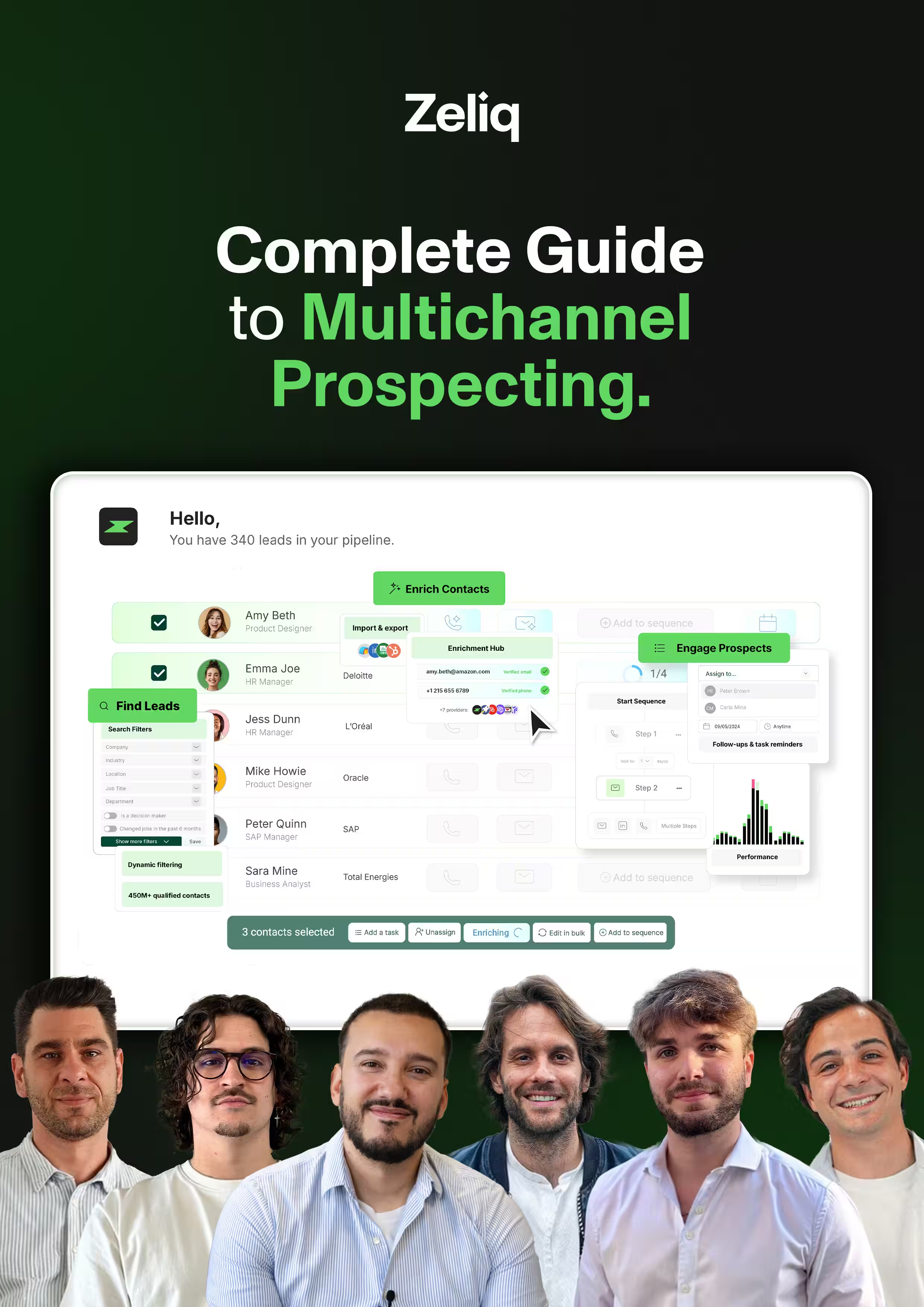
If you want a sales engagement layer that captures these inbound leads and pushes them into multichannel sequences with email, LinkedIn and call steps, Zeliq’s multichannel sequences are built for that handoff. The MQL stops dying in the gap between marketing automation and the SDR’s calendar.
How to promote a lead magnet
A magnet built with no traffic plan is a $5,000 PDF nobody downloads.
Organic SEO. Build the magnet around a query you can rank for. Optimize the landing page like any SEO page (title, meta, H1 with the query). Then write 2-3 surrounding blog posts that link to it, each targeting a related query. This is how HubSpot and Ahrefs build magnets that compound for years.
Paid social. LinkedIn and Meta both work for B2B magnets if targeting is tight. ICP audience by job title and company size, ad creative showing a preview of the asset, single-step lead form on LinkedIn or a fast landing page on Meta. Expect $50-150 cost-per-lead on LinkedIn, $20-80 on Meta, with quality skewing higher on LinkedIn.
Partnerships. Co-produce with a complementary brand. Each side promotes to its list, both keep the leads. Webinars and benchmark reports work especially well in partnership.
Sales-led distribution. SDRs use the magnet as a soft opener: “We just published [magnet], thought it might be relevant to [their priority]. Want me to send the link?”. Reply rates on this pattern beat hard pitches by 2-3x. The magnet replaces the demo ask in the first touch, and only engaged prospects move to a meeting ask.
For teams running outbound at scale, this opener-with-magnet pattern is far more productive when contact data is enriched and messages are sequenced across channels, the combination Zeliq’s lead database and sequence engine were built for, especially for growth marketing teams running both inbound and outbound from the same stack.
Metrics that matter
Five numbers per magnet, not vanity downloads.
Conversion rate by source. A magnet at 4% blended could be 1% from cold paid social and 18% from organic search. Two different actions.
MQL to SQL conversion. Anything under 10% is suspect (wrong-fit leads). Above 30% on bottom-funnel magnets is excellent.
Sales cycle length by source. Leads from a benchmark report often convert slower than leads from an audit. Track per magnet so you know which ones produce fast pipeline and which produce slow brand.
Cost per SQL. Total cost (production + paid traffic + ops time) divided by SQLs sourced. Exposes which magnets actually pay back.
Attribution honesty. Multi-touch is the rule in B2B. A buyer often touches three magnets, two webinars and a friend’s recommendation before talking to sales. Use first-touch and last-touch side by side, accept that “both contributed” is the right answer.
Common mistakes
Magnet is too generic. “The Ultimate Guide to B2B Sales” is a wish, not a magnet. Specificity converts: target a vertical, a job title, a stage, a tool stack.
Ungated outperforms gated. Sometimes the most valuable thing is to leave the asset open, rank for the SEO query, and capture leads via in-content CTAs and retargeting. If a magnet would lose more in SEO traffic than it gains in form fills, leave it open.
No nurture. A magnet without a 4-6 email follow-up sequence is a shopping cart that never sends a receipt.
Broken UX. Forms that fail on mobile, delivery emails caught in spam, calculators that error on edge inputs. A 5-minute QA pass on a fresh browser saves embarrassment.
No handoff to sales. The MQL hits the CRM and dies because nobody owns it. Define the handoff trigger (lead score, ICP match, manual flag) and the SLA (SDR contacts within 24 hours) before launch.
25 lead magnet ideas by ICP
A starter shopping list. Pick the 2-3 that match where you have evidence of demand.
Founders and CEOs (early-stage B2B)
- ICP scoring template with the criteria your fastest-converting customers shared.
- Cold outbound playbook with sequence templates.
- Pricing teardown of 10 SaaS competitors in your category.
- Investor update template based on the format your top backers prefer.
- ROI calculator for the buying decision your product enables.
The Zeliq for Founders page lays out how early-stage teams stack inbound magnets on top of automated outbound without building a 5-tool engine.
Sales leaders and VPs of Sales
- Sales compensation benchmarks for your geography and segment.
- Quota attainment teardown of common Series B sales orgs.
- Free deliverability audit for outbound sender setup.
- SDR ramp plan template with 30/60/90 milestones.
- Forecast accuracy worksheet with the math behind each stage.
The Zeliq for Sales Leaders page describes the team-level visibility a VP typically wants from this kind of audit-led magnet.
Marketing and growth leaders
- Conversion rate benchmarks by industry, scraped from your own customer base.
- Content calendar template with promotion checklist.
- Free SEO content audit on a single URL.
- Webinar in a box: outline, slides, promo emails.
- Multichannel campaign teardown with screenshots and timing.
RevOps and operations
- CRM hygiene checklist: 30 items to fix before quarter close.
- Lead scoring framework with formula and worked example.
- Tech stack consolidation worksheet (replace 5 tools with 2).
- Pipeline health dashboard template (Tableau, Sheets, or Notion).
- Data enrichment ROI calculator.
SDRs and AEs
- 100 cold email subject lines by reply rate, sourced from real data.
- Discovery call script with 12 questions and the why behind each.
- LinkedIn voice note framework with example transcripts.
- Objection handling cheat sheet for the 10 most common objections in your category.
- Prospecting hour playbook: exactly what to do for one focused hour a day.
What to ship next
If you have shipped zero lead magnets, start with one tool (calculator or audit) and one operator template aimed at your sharpest ICP. The tool earns long-tail SEO, the template earns quick wins on social.
If you already run 2-3 magnets and they have plateaued, the leverage is rarely a bigger magnet. It is a tighter ICP, a sharper landing page, a real nurture sequence, and a fast SDR handoff. The mechanics around the magnet always pay back more than the magnet itself.
Lead magnets are the modern way to stop interrupting buyers and start showing up at the moment they ask. Done well, they shift the team’s economics: less cold volume, more compounding pipeline, shorter sales cycles, an audience that grows even when ad budgets tighten. To build the engine that turns those captured leads into booked meetings, see how Zeliq’s pricing and plans bundle the database, enrichment and sequences a 2026 inbound + outbound team needs.