
Opex Definition: Operating Expenses Explained for B2B and SaaS
You stare at your P&L and the operating expense line keeps climbing. Salaries, software subscriptions, marketing budget, contractors, cloud bill. The question keeps coming back. How much does it actually cost to keep the business running every month, and how do auditors, investors, and your own board interpret those numbers?
That is exactly what Opex measures. It is the accounting bucket for the day-to-day cost of running your business, as opposed to the long-term investments captured in Capex. The distinction is not a paperwork exercise. It changes your taxable income, your cash flow profile, your SaaS ratios, and the valuation you get at the next round or exit.
Here is what this article covers:
- A clean definition of Opex and the line that separates it from Capex
- Why the distinction matters for accounting, tax, cash flow and valuation
- The typical Opex categories in a B2B company
- The SaaS angle and the structural Capex to Opex shift
- How to optimize Opex, which ratios to track, and common mistakes to avoid
What is Opex? The plain definition
Opex stands for Operating Expenses. These are the recurring costs required to run your business on a day-to-day basis over an accounting period. Salaries, rent, electricity, software subscriptions, marketing spend, professional services, contractors, office supplies, travel. Anything consumed inside the fiscal year that keeps the lights on and the wheels turning.
Opex hits the income statement immediately. If you pay $1,500 a month for a CRM, those $18,000 in annual subscription costs reduce your net income for the year. No spreading, no amortization. That is the core difference with Capex.
What is Opex in simple terms
Opex is every recurring expense needed to run a business, recorded as a full expense in the period it is incurred, with no spreading over future years.
Capex vs Opex: the line that changes everything
Capex stands for Capital Expenditures: spend used to acquire, build or improve a long-term asset that will serve the business for several years. Industrial machinery, real estate, vehicles, on-premise server infrastructure, internally developed software that meets capitalization criteria, patents, goodwill.
| Criterion | Opex | Capex |
|---|---|---|
| Nature | Day-to-day cost | Long-term investment |
| Useful life | Less than 1 year | Multiple years |
| Accounting treatment | Immediate expense | Capitalized asset, depreciated or amortized |
| P&L impact | Reduces net income in current period | Spread via depreciation or amortization |
| Examples | Salaries, rent, SaaS, marketing | Machines, real estate, capitalized R&D |
| Cash treatment | Cash out within the period | Cash out now, expense spread over time |
| Decision weight | Often recurring, low approval threshold | Capital committee, heavy approval |
In concrete terms, if you buy a $30,000 server and install it in your own data center, that is Capex. You put it on the balance sheet, depreciate it over five years, expense $6,000 per year. If you spend $30,000 a year on equivalent cloud hosting, that is Opex. You expense the full $30,000 in the period. Same economic substance, opposite accounting treatment.
Capex becomes Opex: the structural shift
The rise of cloud computing, SaaS subscriptions and outsourcing has pushed huge chunks of what used to be Capex into Opex. You no longer buy and depreciate a fleet of servers, you rent compute. You no longer build an internal IT department from scratch, you subscribe. You no longer write a $200,000 check for an on-premise CRM, you pay $1,500 per month for a cloud CRM.
This shift has real consequences. EBITDA tends to be lower in the short term because expenses go up, but the balance sheet is lighter (fewer fixed assets), cash flow is more predictable and spread out, and operational flexibility increases. You can cancel a subscription. You cannot cancel a depreciated asset.
Why the Opex vs Capex distinction matters
Accounting. Opex hits the income statement right away. Capex flows through the balance sheet first as a fixed asset, then comes back through the P&L gradually as depreciation or amortization. US GAAP and IFRS both define when an outlay must be capitalized: identifiable asset, controlled, expected to generate economic benefits over more than one period. Below that, it is Opex.
Tax. Opex is fully deductible against taxable income in the period it is incurred. Capex is deducted progressively, over the asset’s useful life (typically 3 to 7 years for IT equipment, 27 to 39 years for US real estate under MACRS). A capex-heavy business pays more tax up front but smooths the burden over several years.
Cash flow. Capex is often a large one-shot outlay. Opex flows continuously, month after month. Free Cash Flow equals cash from operations minus Capex, so an opex-heavy business shows a more stable, predictable FCF profile, which investors generally prefer.
Valuation. Capex-heavy companies (industrial, real estate) are valued on asset or revenue multiples. Asset-light SaaS with mostly Opex is valued on recurring revenue multiples (ARR), gross margin and adjusted EBITDA. The higher the Opex, the lower the EBITDA, which is why aggressive accounting sometimes capitalizes costs that should be expensed. Auditors watch this closely.
SaaS ratios. Three ratios where Opex matters most. Gross margin depends on COGS (hosting, support, tier-1 CS, a specific Opex subset). Magic Number measures GTM efficiency from net new ARR and prior-quarter S&M Opex. Net Revenue Retention depends on the Opex you invest in expansion and support.
Operating expenses examples in B2B
A breakdown of the typical Opex categories you will find in a B2B P&L.
- Software and SaaS subscriptions: CRM (HubSpot, Salesforce, Pipedrive), prospecting, B2B lead database, data enrichment, intent data, engagement platforms, video, e-signature, marketing automation, CMS, analytics. Easily $1,500 to $4,000 per seat per year in subscriptions alone. Watch for tool duplication, unused seats still billed, auto-renewals that never get negotiated.
- Marketing: inbound (content, SEO, demand gen), outbound (paid media, retargeting), events (trade shows, dinners, webinars), brand, marketing ops tooling.
- Sales: base salaries for SDRs and AEs, variable comp (OTE), training, coaching, travel, client entertainment.
- Operations and infrastructure: cloud hosting (AWS, GCP, Azure), CDN, monitoring, security, backups, dev tools.
- HR: salaries, payroll taxes and benefits, training, recruiting, team events, HR tooling.
- Real estate and facilities: rent, utilities, electricity, internet, supplies.
- Professional services: accounting, legal, strategy, audit, cybersecurity.
- Finance and admin: bank fees, payment processing (Stripe), insurance, regulatory subscriptions.
Opex in SaaS: the structural transformation
The SaaS model has accelerated a deep economic shift. What used to be Capex (buy software, install it, maintain it) has become Opex (subscribe monthly, let the vendor operate it).
For the SaaS buyer (CFOs, ops leaders), this means:
- No large upfront investment to depreciate
- Predictable monthly or annual spend
- Smoother cash flow
- Contractual flexibility (you can downgrade or cancel, unless on annual commit)
- Higher vendor dependency (if the vendor sunsets the product, you lose access)
For the SaaS vendor (founders, sales leaders at software companies), this means:
- Recurring revenue (MRR, ARR) that public markets and VCs reward with high multiples
- A sales motion where the pitch “turn Capex into Opex” actually lands
- A specific set of KPIs (churn, NRR, payback period, magic number) that buyers read as the company’s financial ID card
This is why B2B SaaS vendors lean hard on monthly pricing, free trials, no-commit options. They know the most common buying friction is allocating a Capex budget that nobody wants to sign off.
One angle most teams miss: the Opex cost of your prospecting motion
Plenty of B2B teams pay for both SDRs (salary plus OTE plus benefits) and a stack of tools (database, enrichment, sequencing, intent data). Consolidating these line items into a single platform replaces several SaaS Opex lines with one, and frees SDR time for higher-leverage work. That is exactly the angle of a unified B2B prospecting platform: one subscription, one workflow, one line on your stack inventory.
How to optimize operating expenses
Optimizing does not mean cutting blindly. You want to reduce unproductive Opex without breaking the Opex that drives revenue. A four-step method.
- Semi-annual stack audit. List every active subscription: active seats, renewal date, measurable business value, internal owner. You will systematically find 15% to 30% of subscriptions that are dead, oversized, or redundant.
- Renewal negotiation. Any subscription older than 12 months deserves a renegotiation at renewal date. Ask for 15% to 25% off, or a feature upgrade at the same price. SaaS vendors prefer renewed customers to lost ones, especially at quarter-end.
- Stack consolidation. Three tools that cover 80% of the same job often equal one tool that covers 95%. Run the TCO math: subscription price plus onboarding plus internal time plus integration cost.
- ROI per line. Every Opex line should map to a measurable outcome. If you cannot attribute a line to a metric, it is a red flag.
Key Opex ratios to track
- Opex / Revenue: total Opex divided by revenue. Trend metric and benchmarked against the industry. In SaaS, a falling ratio while revenue grows signals increasing operational leverage.
- Opex growth vs revenue growth: if Opex grows faster than revenue, you burn cash and margins compress. The Rule of 40 says revenue growth rate plus EBITDA margin should exceed 40%.
- Magic Number: (net new ARR for the quarter, multiplied by 4) divided by S&M spend the previous quarter. Above 1, GTM Opex pays back in less than a year. Below 0.5, you are burning without leverage.
- Gross margin: revenue minus COGS. In SaaS, 70% to 85% is the expected range. Below that, COGS eats too much revenue.
- Burn multiple: net cash burned divided by net new ARR. Below 1 is healthy. Above 2 is strained.
Accounting standards: US GAAP, IFRS
US GAAP. Operating expenses are recognized in the period incurred. Capitalization rules: ASC 360 for property and equipment, ASC 350-40 for internal-use software, ASC 985-20 for software developed for sale. The default presumption is to expense.
IFRS. Similar in principle. IAS 16 covers property and equipment, IAS 38 covers intangibles. Crucially, IFRS 16 (effective 2019) requires most lease contracts (office, vehicles, equipment) to be recognized as a right-of-use asset on the balance sheet. What was 100% Opex for tenants becomes partly Capex visible on the balance sheet. SaaS subscriptions are typically not in scope of IFRS 16 because they are service contracts, not leases. They remain Opex.
Cloud computing arrangements. Both standards recently clarified that cloud implementation costs (configuration, customization, training) can sometimes be capitalized as prepaid expense and amortized over the contract term. A gray zone many finance teams handle inconsistently. Set a clear internal policy.
B2B use case: the ROI of an Opex tool
Take a typical B2B SMB choosing between hiring an additional SDR or equipping the existing team with a prospecting platform. Rough math (adjust to your market, comp plans, payroll taxes).
Option A: hire one junior SDR in a mid-tier US city
- Base salary: $55,000 to $65,000
- Payroll taxes and benefits (typically 25 to 30%): $15,000 to $20,000
- OTE variable (on target): $15,000 to $25,000
- Onboarding, training, manager time: $5,000 to $10,000
- Total annual cost: roughly $90,000 to $120,000
- Realistic ramp time: 4 to 6 months before full productivity
Option B: equip the existing team with a unified prospecting platform
- Annual subscription: depends on plan and team size (see Zeliq pricing)
- Onboarding: days, not months
- No payroll taxes, no extra workspace, no ramp
- Productivity uplift: an equipped SDR can produce 1.5x to 2x more qualified meetings
The cost-to-output ratio usually favors option B, especially when the current stack is fragmented across a B2B lead database, a separate enrichment tool, and a third engagement platform. It is not about replacing a human. It is about giving the existing team more leverage.
This is exactly the Opex trade-off being debated in most B2B revenue committees right now.
- Underestimating TCO. A $99 per month subscription is never just $99. Add onboarding (person-days), training, integrations, API maintenance, time lost to bugs. Real TCO is often 2x to 3x sticker price.
- Ignoring hidden costs. Ghost seats, usage-based APIs that explode at month-end, auto-renewed contracts nobody opened a ticket for. These typically run 10% to 20% of SaaS Opex.
- Misclassifying Opex vs Capex. Capitalizing what should be expensed (to inflate EBITDA) draws auditor scrutiny. Expensing what should be capitalized draws tax authority scrutiny. Both get expensive.
- Cutting without measurement. Trimming marketing Opex while it feeds the top of funnel, or killing enablement budgets, collapses performance six months later. Audit before amputating.
- Confusing Opex with variable cost. All variable costs are Opex, but Opex can be fixed (rent) or variable (SDR commissions). The distinction matters for break-even modeling.
What is the difference between Opex and Capex in short
Opex funds the present (cost consumed within the year). Capex funds the future (asset serves multiple years). Opex hits the income statement immediately as an expense. Capex sits on the balance sheet and flows back to the income statement gradually through depreciation or amortization. Opex is fully deductible against taxable income in the period incurred. Capex is deducted over the useful life of the asset. A modern SaaS business is dominated by Opex. A heavy industry or real estate business is dominated by Capex.
Is SaaS Opex or Capex?
For the buyer, a SaaS subscription is Opex, almost always. It is a service contract, not a lease of an identifiable asset, so IFRS 16 does not pull it onto the balance sheet. It is expensed in the period the service is consumed.
The only exception is implementation cost. Significant one-time configuration or customization may be capitalized as prepaid expense and amortized over the contract term, under specific GAAP/IFRS criteria. Day-to-day subscription fees remain Opex.
For the SaaS vendor, all the standard Opex categories apply: R&D salaries, hosting, customer success, GTM. Internally developed software for the platform itself can be capitalized under ASC 350-40 if it meets the criteria, but most early-stage SaaS expense everything to keep things simple.
Zeliq and sales stack rationalization
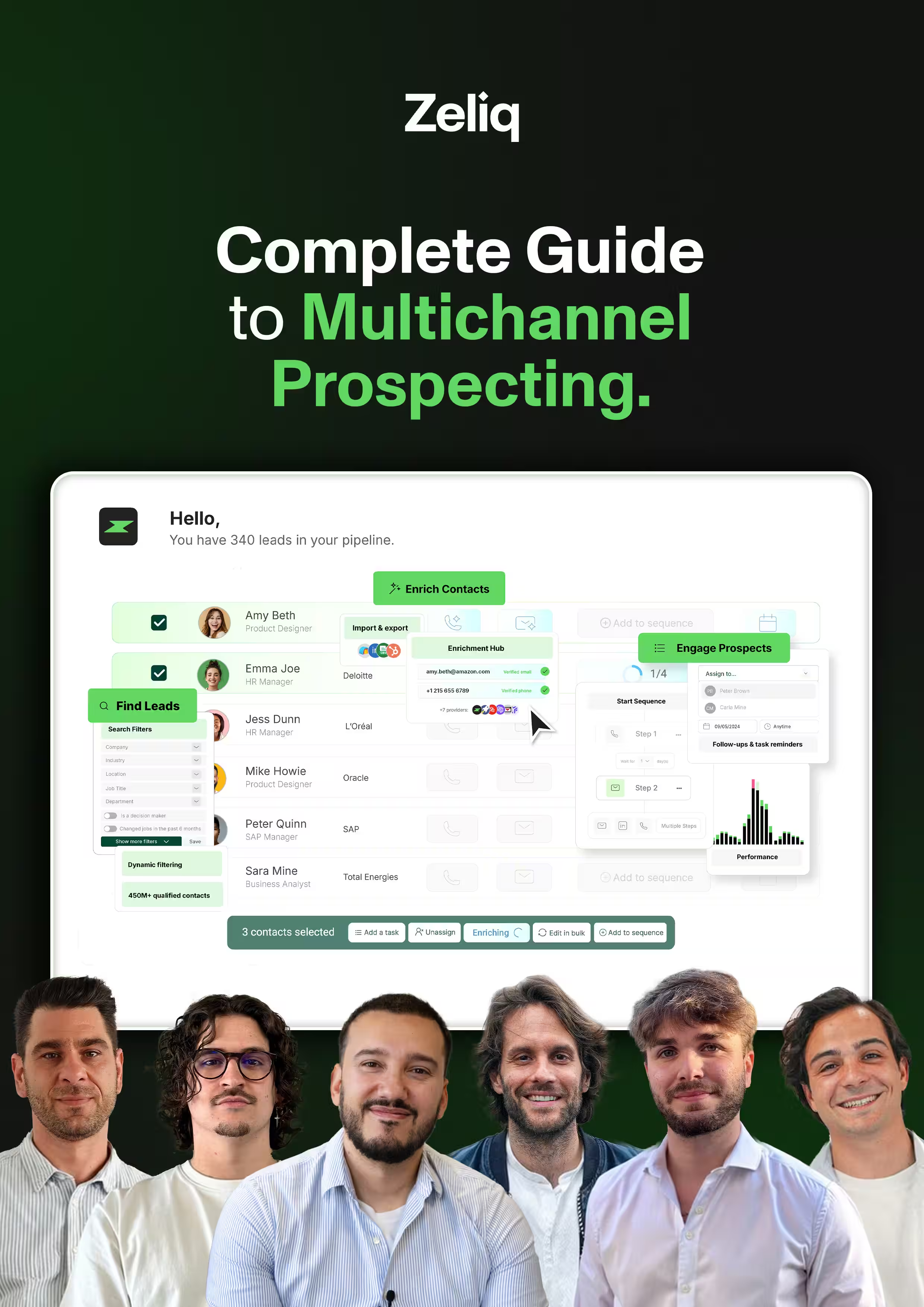
Modern sales stacks typically pile up 4-6 tools (database, finder, verifier, sequencer, dialer, CRM). Zeliq centralizes 4 of these functions in 450 million B2B contacts + enrichment + sequencing + dialer integration. Your SaaS Opex drops while productivity rises.
Conclusion
Opex is not just a line to minimize. It is a signal about the nature of your business, your operational flexibility, your ability to scale without breaking cash flow. Three concrete actions to take this week:
- List every SaaS Opex line, who pays for it, who actually uses it, when it renews.
- Identify two or three tools where you spend over $1,500 a month with no measurable business outcome attached.
- Compare the total cost of an additional SDR against the cost of a tool that gives the current team more leverage. The right Opex trade-off often lives there.
For RevOps teams consolidating their stack or founders scaling go-to-market, regrouping prospecting Opex lines (database, enrichment, sequencing) into a unified B2B data enrichment and outreach platform typically halves total cost while increasing meeting volume. That is the textbook definition of well-spent Opex: lower cost, higher output, measurable.
Want to benchmark your current stack against a consolidated alternative? Check the full Zeliq pricing page and run the math in a few minutes.
Rationalize your SaaS sales stack
Zeliq combines verified contacts, enrichment and multichannel sequences in a single platform. Account created in 2 minutes, no credit card.
Book a demoAnd if you want your Opex SaaS tools to prove their ROI month after month rather than bloat the stack, try Zeliq for free and replace 3 prospecting tools with a single platform.