

Meeting Request Email: 14 Templates That Book Meetings in 2026
A meeting request email looks easy. It almost never is. The wrong subject line, a self-centered opener, a fuzzy ask, and the email lands in archive territory. The right subject, a sharp reason to meet, and two specific time slots, and acceptance rates triple.
If you are an SDR, AE, or BDR sending these every day, you already know the difference between a 2% reply rate and a 12% reply rate is not luck. It is structure, register, and timing.
This guide gives you the anatomy of a meeting request email that performs in 2026, the benchmarks to measure yourself against, and 14 ready-to-personalize templates covering the contexts you actually run into: cold outbound, warm intro, post-demo, post-trial, partnership, exec sponsor, expansion, win-back, post-event, referral, and internal escalation. Each template includes the context, the subject, the body, and a short note on why it works.
When to send a meeting request email (and when not to)
Not every prospect deserves a meeting ask in the first email. Sending too early is the single most common mistake made by junior SDRs.
Send a meeting request when at least one of the following is true:
- The prospect has shown intent (visited pricing, opened multiple emails, attended a webinar, downloaded a whitepaper).
- A buying signal has fired (new role, funding round, hiring spree, leadership change).
- You have a warm path (referral, mutual connection, prior conversation).
- The prospect matches your ICP precisely and the value to them is sharp enough to justify cold asking.
Hold off when the prospect is fully cold and you have nothing personal to anchor the message. In that case, lead with a value-first email (insight, benchmark, useful asset) and request the meeting in email 2 or 3 of your sequence.
According to recent outbound benchmarks, asking for the meeting on email 2 instead of email 1 lifts positive reply rates on cold sequences by roughly 30 to 40 percent for non-intent traffic. The first email earns the right to ask. The second email asks.
Anatomy of a meeting request email that converts
A high-performing meeting request email has six parts. Skip any of them and reply rates drop.
1. Subject line
Short, lowercase-friendly, specific. Under 50 characters. The job is to earn the open, not summarize the email.
Patterns that work in 2026:
- Question framing: “quick question about [their initiative]”
- Time-boxed: “15 min next week, [first name]?”
- Curiosity gap: “[mutual contact] suggested we talk”
- Trigger-anchored: “your Series B and SDR ramp”
Avoid: “Meeting request”, “Touching base”, “Following up”, “Quick chat?”. These read like noise.
2. Opening line
One sentence that proves you know who they are. A recent hire, a product launch, a podcast appearance, a LinkedIn post you actually read. Personalized openers see roughly 17 percent reply rates versus 7 percent for generic ones.
Skip the “I hope this finds you well.” It signals template.
3. Reason for reaching out
One sentence on why you are emailing them, specifically. Tie it to a signal, a peer outcome, or an observation about their business. This is where most reps default to “I wanted to introduce our solution.” Do not.
4. The value (their problem, your angle)
One or two sentences max on what is in it for them. Frame around a problem they likely have, the outcome a similar peer got, or a number that matters to their role. Stay outcome-led, not feature-led.
5. The ask (with specific time options)
This is where the email succeeds or dies. Suggesting two or three specific time windows produces up to 13 times more booked demos than dropping a calendar link cold. The phrasing matters too: “Would Tuesday at 10 or Thursday at 2 work?” beats “Please share your availability at your earliest convenience.”
A calendar link is fine as a backup, never the primary CTA on a cold message. A bare Calendly link signals automation and lifts the prospect’s effort.
6. Easy out + signature
Add a line that lowers the social cost of saying no: “If this is not a fit, just tell me, no offense taken.” Counter-intuitively, this lifts total reply rates because some prospects answer “no” rather than ghosting, which lets you remove dead deals from your pipeline.
End with a signature that is human: first name, role, company, one phone or LinkedIn link. Skip the four-line legal block, the company logo image, and the marketing banner.
Tone register: match the relationship
The same anatomy gets dressed differently depending on context. Five registers cover most of what an SDR or AE writes:
- Cold: respectful, value-led, low pressure. Show research, do not assume.
- Warm intro: borrow the relationship. Mention the referrer in the first line.
- Post-demo: collaborative, structured. Recap, propose next step, name the people.
- Partnership: peer-to-peer, no pitch. Frame around mutual ICP.
- Internal: direct, time-boxed, action-oriented. Skip pleasantries.
Mismatching the register is what makes a cold email read robotic, or a follow-up read needy. Recalibrate every email.
Best practices that move the numbers
These are the practices that show up consistently in 2026 benchmarks across Gong, Outreach, Lavender, and HubSpot data, and they apply across SDR, AE, and BDR roles.
Specificity over volume
A 70-word email with one sharp insight beats a 200-word email with three generic points every time. The 50-125 word range produces reply rates above 50 percent on warm contexts and 5 to 10 percent on cold. Above 200 words, response rates collapse.
Mobile-first formatting
Around 60 percent of B2B emails are first opened on mobile. That changes the rules:
- One idea per paragraph. Two to three short paragraphs total.
- No tables. No images that break above the fold.
- Subject + first 8 to 10 words of preview text need to do the heavy lifting.
If your email is longer than the iPhone preview pane, the prospect makes a decision before opening it. Most of the time, that decision is to not open.
Calendar links: backup, not primary
Use a calendar link as a fallback after suggesting two time slots. Phrase it: “If neither works, here is my calendar.” Do not lead with the link. It reads transactional and signals you are sending the same email at scale.
Follow-up cadence (cold)
A single email rarely books a meeting. The 4 to 6 touchpoint cadence over 14 to 21 days is the current cold benchmark, with email and LinkedIn alternating, ideally one phone touch in the middle. Around 55 to 65 percent of meetings booked on a cold sequence happen on touchpoints 3 to 5, not on the first email.
Send time
Tuesday and Wednesday mornings (9:30 to 11:30 in the recipient’s timezone) consistently outperform other slots in 2026 data. Mondays are noisy, Fridays after lunch are dead, weekends rarely justify the cost.
Tracking what to track
Forget open rates. Apple Mail Privacy Protection has made them noise since 2022. Track reply rate (positive + negative), meeting booked rate, and meeting held rate. Those three numbers tell you whether the message, the targeting, and the show-up rate are healthy.
How Zeliq helps here
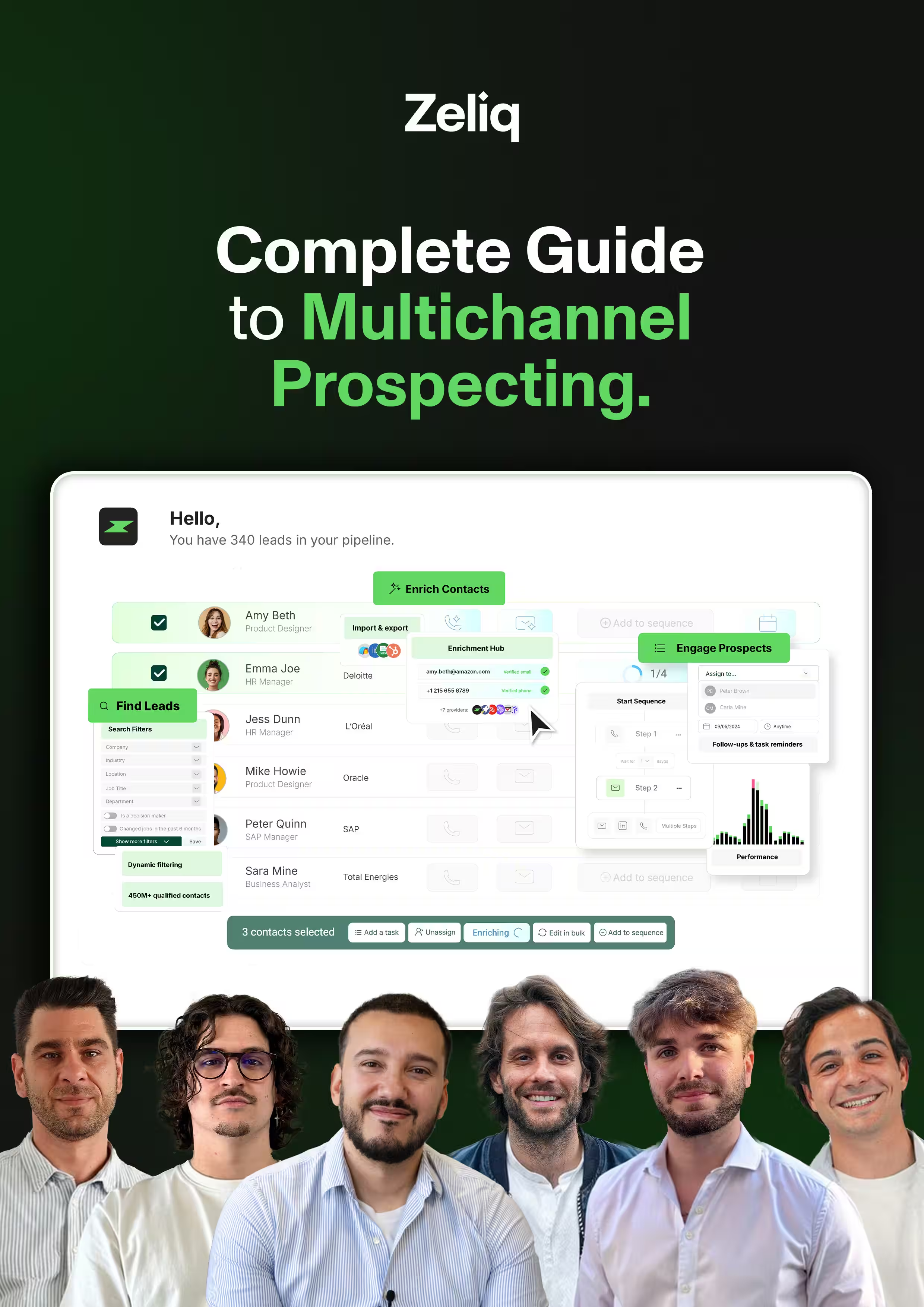
If you are running 4 to 6 touch sequences across email, LinkedIn, and phone, doing it manually past 50 prospects per week is not realistic. Zeliq lets you build multichannel sequences that orchestrate the meeting request and its follow-ups across channels, with personalization tokens pulled from enriched data so each message stays human. See how it works in a live walkthrough.
14 meeting request email templates by context
Each template below is a structure to personalize, not a copy-paste. The signal, the proof point, the angle have to be yours. Templates that book meetings without personalization do not exist.
Cold outbound (4 templates)
Template 1: Cold standard
Context: First email to an ICP-fit prospect. No prior touch, no warm path. You have one specific signal.
Subject: 15 min on [specific topic], [first name]?
Body:
Hi [first name],
Saw you just [specific signal: hired 3 SDRs, launched X, posted on Y]. Congrats on the move.
We work with [peer company type] like [recognizable peer] to [specific outcome, ideally with a number]. [One sentence on how it applies to their context].
Would 15 minutes Tuesday at 10 or Thursday at 2 work to compare notes?
If not the right time, just say so, no offense taken.
[First name]
Why it works: The signal proves research, the peer reference proves relevance, the two slots create an easy decision. Under 70 words.
Template 2: Cold ultra-short (5 lines)
Context: Senior buyer, no time to read. You need to get the ask in under 60 words.
Subject: a thought for [company]
Body:
[First name],
You are scaling outbound at [company]. We help RevOps teams cut SDR ramp by 4 to 6 weeks.
15 min Wednesday morning or Thursday afternoon to swap notes?
If off, no worries.
[First name]
Why it works: Senior people respect short. The ask is the third line, no warm-up.
Template 3: Cold with peer proof point
Context: Cold prospect who likely knows or competes with a peer customer of yours.
Subject: how [peer] cut SDR ramp in half
Body:
Hi [first name],
[Peer company] runs the same outbound stack you do (or did, three months ago). They just cut SDR time-to-first-meeting from 28 days to 11.
Took them one decision and three weeks. I can walk you through what changed.
15 minutes Tuesday at 11 or Thursday at 4?
[First name]
Why it works: Outcome-led, peer-anchored, time-boxed. The “took them one decision” line creates curiosity without revealing the play.
Template 4: Cold on intent signal
Context: A buying trigger fired in the last 7 to 14 days (funding round, leadership hire, expansion).
Subject: your Series A and pipeline pressure
Body:
Hi [first name],
Saw the Series A announcement, congrats. The 18 months after a raise are usually when pipeline pressure goes from “manageable” to “now.”
We help post-A teams lock in repeatable pipeline coverage before headcount overshoots. Curious to share what we have seen across 30+ post-A scaleups.
20 minutes next week, Tuesday at 10 or Thursday at 3?
[First name]
Why it works: Trigger-anchored, peer-grounded (“30+ post-A scaleups”), and the value is framed around their next 18 months, not the product.
Warm intro (1 template)
Template 5: Mutual connection referral
Context: A current customer, partner, or mutual contact mentioned the prospect’s name. You have permission to drop their name.
Subject: [referrer first name] suggested I reach out
Body:
Hi [first name],
[Referrer first name] at [referrer company] mentioned you were looking at [specific area] this quarter, and thought we should compare notes.
Quick context: we work with [peer companies] on [outcome]. [Referrer] said your situation at [their company] is close to what [peer] solved last year.
15 to 20 minutes next week to see if it makes sense? Tuesday at 10 or Thursday at 2 work for me.
[First name]
Why it works: The referral name in subject and first line earns the open and the read. The “close to what [peer] solved” frames the meeting as useful, not exploratory.
Post-demo (2 templates)
Template 6: Demo recap and next step
Context: You ran a discovery or demo, the call went well, you need to lock the next step in writing within 4 hours.
Subject: recap and next step, [first name]
Body:
Hi [first name],
Thanks for the time today. Quick recap to make sure we are aligned:
- Your priority: [specific point they raised]
- Your timeline: [Q3 launch, end of fiscal year, etc.]
- The blocker we discussed: [specific blocker]
- The next step we agreed: [technical demo, security review, pricing call]
Proposing 30 minutes next Wednesday at 11 or Thursday at 3 with [people who need to be there]. Does either work?
[First name]
Why it works: The four-bullet recap makes the prospect feel heard, locks the conversation in writing (useful when they forward to colleagues), and the named next step prevents drift.
Template 7: Multi-stakeholder loop
Context: Prospect mentioned during the call that another decision-maker (CFO, CTO, Head of RevOps) is involved. You need to bring them into the next session.
Subject: looping in [other persona] for next session?
Body:
Hi [first name],
You mentioned [CFO first name] is part of the decision on this. To save us all a round trip, I would suggest we get them in the next session and address their questions directly.
I can prepare a 10-minute slot at the start tailored to what matters to a [their role: CFO]: [topic 1, topic 2].
Tuesday at 2 or Thursday at 11 for the three of us?
[First name]
Why it works: It makes the prospect’s life easier (they do not have to play telephone) and signals you understand multi-stakeholder buying. The role-tailored agenda earns the slot.
Post-trial (1 template)
Template 8: Trial expiring, conversion ask
Context: Self-serve trial user reaching day 10 of 14. They have used the product but you have not had a sales conversation yet.
Subject: 4 days left on your trial, quick check-in?
Body:
Hi [first name],
You have 4 days left on your trial. I noticed you ran [specific action: 2 sequences, enriched 120 contacts] this week, that is great traction.
Before the trial closes, would 15 minutes help map what a paid setup would look like for [company]’s volume? I can also share how teams at your size structure their first 30 days.
Tuesday at 10 or Thursday at 4?
[First name]
Why it works: Trial-aware (you saw their usage), low pressure, framed around helping them decide rather than pushing them. Specific usage data (“2 sequences, 120 contacts”) proves you are not blasting.
Partnership (1 template)
Template 9: Partnership exploration
Context: A non-competing company that targets the same ICP. You are exploring a co-marketing or integration partnership.
Subject: [your company] x [their company]?
Body:
Hi [first name],
We sell to the same buyer (RevOps and Heads of Sales at 50 to 500 person SaaS) without overlapping on the product side. A few possible angles:
- A co-marketed playbook or webinar on [topic]
- A warm referral loop on shared accounts
- A light integration if there is signal
20 minutes next week to see which of those (if any) is worth deeper exploration?
[First name]
Why it works: Concrete angles instead of “synergies”, peer-to-peer tone, and the “if any” leaves space for an honest no. Partnership emails that do not pre-qualify the angle waste both sides’ time.
Exec sponsor (1 template)
Template 10: Asking for an exec for the next call
Context: You are mid-cycle, the deal needs an exec sponsor on your side or theirs to unblock approval.
Subject: bringing [exec first name] to our next session
Body:
Hi [first name],
For our next session, I would like to bring [exec name], our [VP of Sales / CRO]. They have been part of the last three deployments at companies your size and can speak directly to the ramp questions you raised.
Same 30 minutes works, just with one more person in the room. Tuesday at 11 or Thursday at 3?
[First name]
Why it works: Frames the exec as adding value to the prospect (not pressure). The “last three deployments” line gives the exec credibility without oversell.
Customer expansion (1 template)
Template 11: Expansion conversation, existing customer
Context: An existing customer using one product line. You see usage data showing they would benefit from a second product or seat increase.
Subject: a usage trend worth 15 minutes
Body:
Hi [first name],
Pulled your team’s usage for the last 30 days. Two patterns stood out: [pattern 1] and [pattern 2]. Both suggest [hypothesis tied to a product or seat expansion].
Not pitching, just want to share what we are seeing and let you decide if it changes anything for Q4 planning.
15 minutes next Tuesday at 10 or Wednesday at 3?
[First name]
Why it works: Data-led, not pitch-led. “Not pitching, just want to share” is honest and lowers defenses. Existing customers respond to insight more than they respond to upsell.
Win-back (1 template)
Template 12: Re-engaging a closed-lost deal
Context: A deal that closed lost 6 to 12 months ago. Something has changed (new product release, new pricing, leadership change on their side).
Subject: worth a fresh look, [first name]?
Body:
Hi [first name],
Last time we spoke (around [month]), the blocker was [specific blocker, e.g., no Salesforce integration, pricing too high for team size]. Two things changed since:
- We shipped [the relevant fix].
- [Their internal change: new VP, restructure, new tool stack].
20 minutes to see if it is worth a second look? Tuesday at 11 or Thursday at 2.
[First name]
Why it works: Names the original blocker (proves memory), gives a concrete reason it has changed, and asks for a small slot. Closed-lost win-backs convert higher than cold when the original blocker is genuinely solved.
Post-event (1 template)
Template 13: Following up after a conference or webinar
Context: You met the prospect at a booth, panel, or virtual event 24 to 72 hours ago. The conversation was real but short.
Subject: following up from [event name]
Body:
Hi [first name],
Good crossing paths at [event] yesterday. We started talking about [specific topic from the conversation] and I wanted to pick that up.
I owe you the [number / case study / link] I mentioned. Want me to send it over, or would 20 minutes next week be easier? Tuesday at 10 or Thursday at 3 work for me.
[First name]
Why it works: Reminds them of the actual conversation (not just the event), gives them an easy lower-commitment option (send the asset), and proposes the meeting as the upgrade.
Referral ask (1 template)
Template 14: Asking a happy customer for a referral meeting
Context: A customer who has hit results. You want them to introduce you to a peer in their network.
Subject: 10 minutes, a small ask
Body:
Hi [first name],
Quick one. Given the results your team has seen on [specific metric: time-to-first-meeting, pipeline coverage], I wonder if you have a peer at another company who is wrestling with the same problem and would benefit from a similar setup.
Happy to write the intro email so it takes you 30 seconds. 10 minutes next Tuesday or Wednesday to think through the right names?
Either way, thanks again for being a great partner on this.
[First name]
Why it works: Names the result (proves you have earned the ask), pre-loads the work (“happy to write the intro”), keeps the slot tiny. Customers respond to referral asks far more than they admit, as long as the ask is light.
Internal escalation: a bonus template for AEs
Sometimes the meeting you need is not with a prospect, it is internal: pulling in your VP of Sales, your CSM, or a deal desk rep. The same anatomy applies, faster register.
Subject: 15 min on [account name], today or tomorrow?
Body:
[First name],
Need 15 minutes on [account name]. Three points:
- [Point 1: the blocker]
- [Point 2: the stake, deal size and timeline]
- [Point 3: what I need from you specifically]
Today 4 pm or tomorrow 10? Faster the better, [prospect side decision-maker] is sitting on a proposal until Friday.
[First name]
Why it works: Internal stakeholders are even more time-poor than prospects. Give them the three things they need to know in 30 seconds, and the slot.
Common mistakes that kill meeting requests
Watch for these. They are the most common failure modes I have seen in audits of SDR sequences in 2025 and 2026.
Mistake 1: vague subject line. “Meeting request” or “Quick chat?” gets opened by under 20 percent of recipients on cold lists. Be specific.
Mistake 2: opening with you. “I am [name] from [company] and we do X” puts the focus on the wrong side of the table. Open with them.
Mistake 3: monologue value prop. Three bullets of features is a website, not an email. One outcome sentence is enough.
Mistake 4: vague time ask. “Let me know when you are free” is a task you just gave them. Two specific slots is a decision they make in 8 seconds.
Mistake 5: no easy out. Without a graceful “no”, silence is the easiest answer. The escape hatch line lifts total reply rates by 15 to 25 percent on cold.
Mistake 6: giving up at touch 1. Around 55 to 65 percent of cold meetings book on touch 3 to 5. If your sequence stops at touch 2, you are leaving more than half the meetings on the table. See the cold email response rate benchmarks for the multi-touch math.
Mistake 7: calendar link as primary CTA. It signals automation and reduces effort the wrong way. The prospect should have a 1-tap reply, not a 3-tap calendar booking.
Quick benchmarks to measure yourself against (2026)
If you want a north star, here is what high-performing SDR and AE outbound looks like on meeting request emails right now:
- Cold positive reply rate: 4 to 8 percent on a tight ICP, 1 to 3 percent on broader lists
- Warm intro reply rate: 35 to 55 percent
- Post-demo recap reply rate: 70 to 85 percent
- Meeting hold rate (booked to held): 70 to 80 percent on warm, 50 to 65 percent on cold
- Touchpoints to first meeting (cold): 3 to 5 over 14 to 21 days
- Optimal email length: 50 to 125 words
If your numbers are below these, the message, the list, or the cadence is the problem. Almost never the channel.
Bringing it together
A meeting request email is not a magic incantation. It is a small, structured negotiation. You ask for 15 minutes, the prospect decides whether you have earned them, and the answer hinges on six things: the subject, the proof you know them, the relevance, the value, the time slots, and the easy out.
Pick the template that matches your context, personalize the signal and the proof point, keep it under 100 words, and send the second touch on day 4 if there is no reply. Repeat across the cadence until it works or until the prospect tells you no. Both are good outcomes, only silence is bad.
If you are running this kind of cadence at scale, doing it from a Gmail tab past 30 prospects a week becomes a coordination problem. That is what Zeliq is built for: orchestrating cold and warm meeting requests across email, LinkedIn, and phone, with enriched contact data so the personalization tokens are not garbage. SDRs and AEs working from the Zeliq business developer workspace typically run 4 to 6 touch sequences across channels without copy-pasting between tools.
Want to try it on your own list? See pricing and start free, or book a 20-minute walkthrough of the multichannel sequences to see how the cadence above looks inside the platform.
Enter the future of lead gen