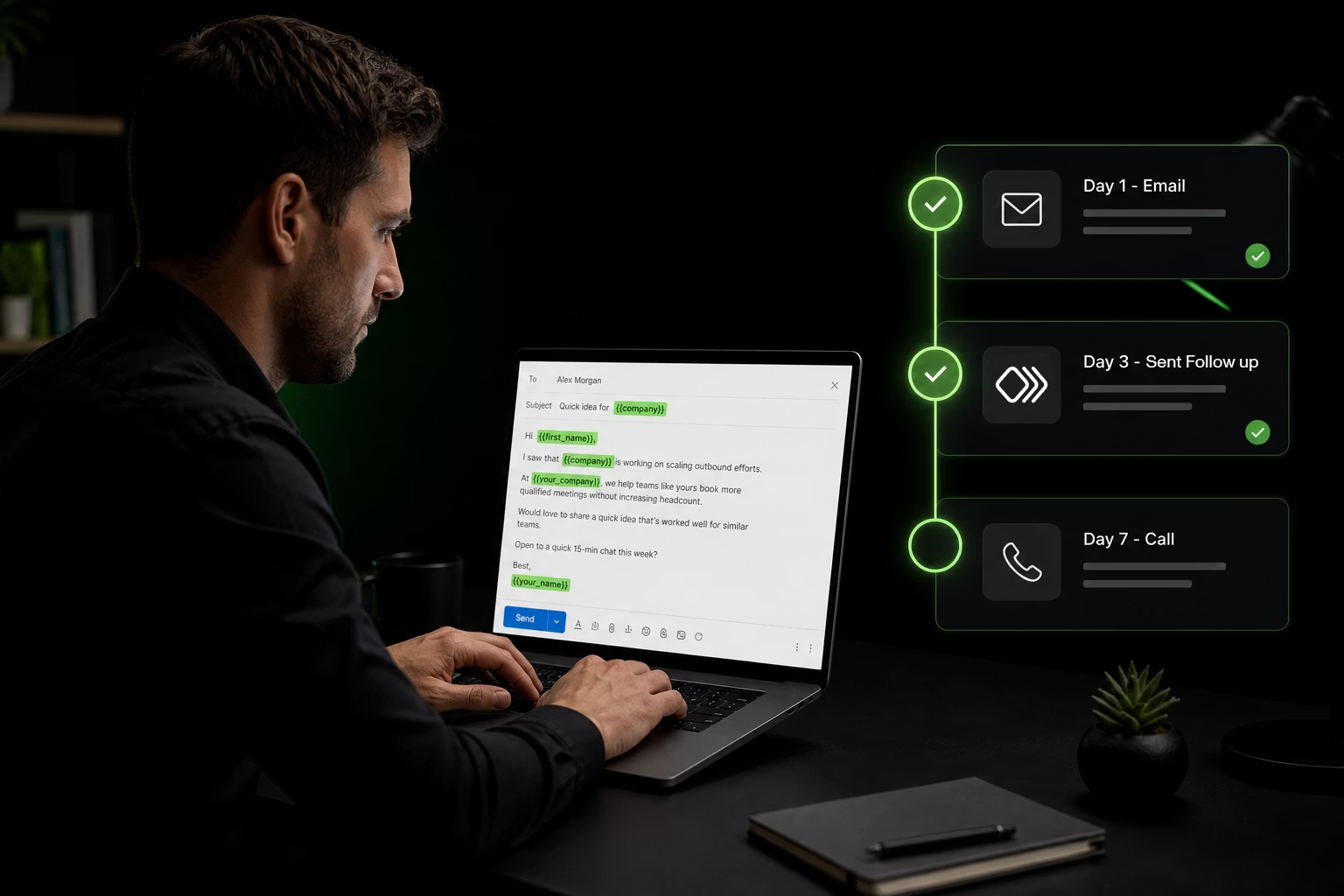

Customer follow-up — whether it’s cold prospects, stalled pipeline opportunities, or unpaid invoices — is the most profitable but most neglected activity of the B2B sales cycle. Per Tegus Cold Email Benchmark 2024, 80% of B2B deals close between the 5th and 12th touch, while 44% of salespeople give up after a single follow-up. On the cash-collection side, McKinsey B2B Cash Collection 2025 measures that each day of delayed follow-up costs 0.8% of invoice value in final recovery rate.
For a B2B salesperson, AE, or Customer Success, follow-up is not a “just in case” email — it’s a structured system: right cadence, right channel, right angle, right timing. Poorly calibrated, follow-up burns the relationship and kills the deal; well-calibrated, it 3-5×s the conversion rate. This guide details the 3 types of follow-up, the 5-7-14 method, verified email templates, and walks through a worked example on a mid-market B2B pipeline.
At a glance:
- The 3 types of B2B follow-up (prospect, opportunity, payment)
- The optimal cadence: 5-7-14 rule
- Channels to activate: email, phone, LinkedIn, video
- 5 follow-up templates by use case
- Worked example: mid-market B2B pipeline
- 3 FAQs and 3 dated actions
Key takeaways:
- 80% of B2B deals sign between the 5th and 12th follow-up (Tegus 2024).
- Optimal cadence: 5 days after initial contact, then 7, then 14 (5-7-14 method).
- Multi-channel increases response rate by 178% vs email-only (Outreach State of Sales 2025).
- A phone follow-up remains the most effective weapon in mid-market B2B (+47% response vs email).
1. The 3 types of B2B follow-up
B2B follow-up covers three distinct situations requiring different approaches:
Follow-up 1 — Cold prospect (outbound). The prospect never replied to your initial outreach. Goal: get a first engagement (reply, meeting). Average response rate: 5-12% per individual follow-up, 22-35% cumulative across 6-9 touches (Lavender Cold Email Benchmark 2025).
Follow-up 2 — Stalled opportunity. The prospect engaged in a conversation then ghosted — no reply for 7+ days on an active opportunity. Goal: restart the conversation or disqualify the opportunity. Average reactivation rate: 28-42% if the follow-up arrives within 14 days, drops to 8% beyond 30 days.
Follow-up 3 — Unpaid invoice (collection). A sent invoice was not paid by the due date. Goal: collection. Average recovery rate: 95% if first follow-up is sent D+1 after due date, 78% at D+30, 45% at D+90 (Atradius 2025 DSO benchmark).
The three types share a common logic (multi-touch, multi-channel, calibrated tone) but require distinct email templates and differently-calibrated cadences.
2. The optimal cadence: 5-7-14 rule
The modern B2B follow-up gold-standard cadence is the 5-7-14 rule, validated by Outreach’s Sequencing Benchmark 2025 across 6 million sequences:
- Touch 1: initial contact (D0)
- Touch 2: D+5 (5 days later) — short follow-up, value-add
- Touch 3: D+12 (7 days after touch 2) — channel switch (phone if email-only)
- Touch 4: D+26 (14 days after touch 3) — “break-up email”
- Touch 5+: D+60, D+90 — seasonal wake-up
This cadence respects three principles:
Principle 1 — Progressive spacing. Too close = perceived as harassment (-23% reply rate). Too spaced = forgotten (-41% memorization). 5-7-14 is the measured sweet spot.
Principle 2 — Angle variation. Each touch must bring a different angle: sector insight, case study, open question, social proof. Repeating the same message kills the sequence.
Principle 3 — Multi-channel after 2 emails. Beyond 2 ignored emails, switch to phone or LinkedIn. Outreach measures +178% response on multi-channel vs email-only sequences.
Cadence for the 3 follow-up types:
| Follow-up type | Standard cadence | Max touches |
|---|---|---|
| Cold prospect | 5-7-14 + seasonal | 8-12 |
| Stalled opportunity | 3-5-10 | 4-6 |
| Unpaid invoice | D+1, D+7, D+15, D+30 | 4 then escalation |
3. Channels to activate: email, phone, LinkedIn, video
Email: dominant B2B follow-up channel (87% of touches per Lavender 2025). Pros: asynchronous, scalable, traceable. Cons: open rates declining (38% in 2025 vs 46% in 2022 due to Apple MPP).
Phone: the most effective channel in mid-market B2B despite its reputation. Outreach measures +47% response on a phone touch vs equivalent email. Pros: emotional engagement, immediate qualification. Cons: not scalable, voicemail rejection.
LinkedIn (InMail + DM + comments): growing channel, particularly effective for senior profiles and tech ICPs. 2025 InMail response rate: 18-22% (Sales Navigator median). Pros: more informal tone, profile visibility. Cons: daily message limit, LinkedIn ToS dependency.
Personalized video (Vidyard, Loom, Bonjoro): premium channel, response rate 3.4× higher than a text email (Vidyard Video for Sales 2025). Pros: strong differentiation, human tone. Cons: production time, tool cost.
2026 channel × situation map:
| Situation | Optimal channel | Why |
|---|---|---|
| 1st cold-prospect follow-up | Scalable, low cost | |
| 2nd prospect follow-up | Email + LinkedIn DM | Multi-channel lift |
| 3rd+ prospect follow-up | Phone | Break the routine |
| Stalled opportunity | Phone | Direct engagement |
| Dormant-customer wake-up | Personalized video | Strong differentiation |
| Unpaid invoice D+1 to D+15 | Email + phone | Written trail + direct pressure |
| Unpaid invoice D+30+ | Certified mail / legal | Legal escalation |
4. Five follow-up templates by use case
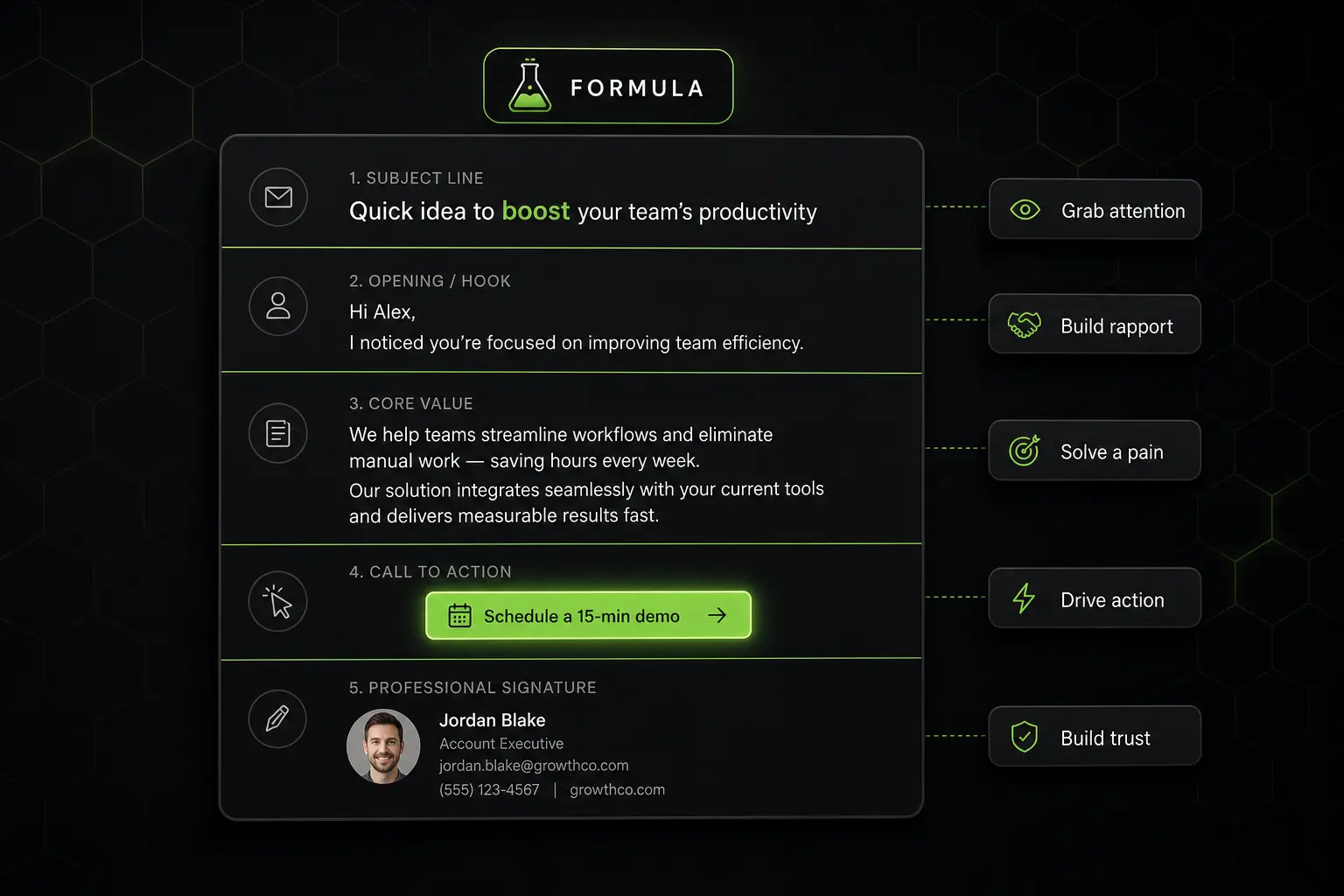
Template 1 — Cold prospect, 2nd touch (D+5)
Subject: [First name], one quick thought on [problem]
Hi [First name],
I know you’re busy. One quick question: how do you currently handle [specific problem] at [company]?
Saw that [verified signal — funding, hire, growth]. In that context, [similar customer] gained [quantified result]. 12-min demo to dig in?
[First name]
Template 2 — Stalled opportunity, 1st follow-up (D+7)
Subject: [First name], are we continuing?
Hi [First name],
Following our conversation on [date], I wanted to check if the priority is still active. Three options:
- Continue the discussion (Monday 2pm or Thursday 11am?)
- Pause for a better moment
- Drop it
Which one fits?
[First name]
Template 3 — Break-up email, 4th touch (D+26)
Subject: Closing your file
Hi [First name],
Without a reply to my last 3 messages, I’m taking it as a sign this isn’t the right time for [company]. I’m archiving your file on my end.
If I read this wrong and you want to reopen, just hit reply with “reopen”.
Take care, [First name]
Template 4 — Invoice follow-up D+7
Subject: Invoice [number] — friendly reminder
Hi [First name],
Quick reminder regarding invoice [number] for [amount], due on [date]. Can you confirm your accounting team has it in process?
Attaching the invoice again for convenience. Available to clarify anything.
[First name]
Template 5 — Dormant-customer wake-up (6 months without contact)
Subject: [First name], 6 months — any update?
Hi [First name],
It’s been 6 months since we last spoke. A lot has evolved on my end: [3 product improvements] + [recent similar customer who achieved X].
If timing is right, 15-min update? Curious to hear where you stand on [problem mentioned last time].
[First name]
These 5 templates cover 80% of B2B follow-up cases. To adapt with one verified fact (the prospect must recognize you did your homework) and one closed question (yes/no, not “what do you think?”).
5. Worked example: mid-market B2B pipeline
Context. An SDR at a US B2B SaaS scale-up (115 employees, $8.4M ARR) observes in January 2025:
- 280 opportunities in pipeline
- 92 stalled opportunities (no reply for 14+ days)
- Stalled → won conversion rate: 4% (very low)
- No structured follow-up sequence
Diagnosis and plan: structure a multi-touch sequence on the 92 stalled opportunities over 60 days.
Applied sequence:
- Touch 1 (D0): Short “are we continuing?” email (template 2)
- Touch 2 (D+5): Phone + voicemail
- Touch 3 (D+12): Email with similar-customer case study
- Touch 4 (D+20): LinkedIn DM
- Touch 5 (D+30): 60-second personalized Loom video
- Touch 6 (D+45): Break-up email
- Touch 7 (D+60): 6-month wake-up email
Measured results at 90 days:
| KPI | Before | After | Change |
|---|---|---|---|
| Stalled responses | 22% | 51% | +132% |
| Reconfirmed meetings | 12 | 38 | +217% |
| Requalified opportunities | 0 | 24 | new |
| Closed-won | 4 | 19 | +375% |
| 90-day ARR generated | $62k | $295k | +$233k |
Investment: 0.8 SDR FTE on the sequence (the SDR allocated 40% of their time to follow-up over 90 days) = ~$15k fully loaded cost.
ROI: $233k / $15k = 15.5× over 90 days.
Beyond raw ROI, the structural gain is deeper: the sequence becomes automatable (Salesloft, Outreach, Lemlist), and the SDR frees up time for top-of-funnel. Virtuous cycle: better follow-up → more deals signed → less acquisition pressure → higher quality in new prospects.
Zeliq and industrialized follow-up
80% of B2B deals close between the 5th and 12th follow-up, yet 44% of salespeople give up after the first. Zeliq automates your multi-touch sequences across 450 million enriched B2B contacts (email + direct phone + LinkedIn DM + calls via Aircall/Ringover integration), with behavioral triggers and native 5-7-14 cadence. No lead slips through the cracks.
6. Frequently asked questions
How many follow-ups before giving up on a prospect?
Tegus 2024 benchmark across 4.2M B2B sequences measures that 80% of deals close between the 5th and 12th follow-up. Yet 44% of salespeople give up after a single follow-up, and 70% give up before the 5th. 2026 recommendation: aim for a minimum of 6-8 multi-channel touches over 60-90 days before archiving a prospect. Beyond 12 touches over 90 days, marginal ROI becomes nil and brand-damage risk starts dominating. If prospecting is dead, switch to passive nurture (newsletter, LinkedIn retargeting) for 6-12 months before a potential wake-up.
Is a phone follow-up still effective in 2026?
Yes — and it’s the channel that has gained the most efficiency since 2022. Outreach State of Sales 2025 measures a 23% increase in phone response rate between 2022 and 2025, as inboxes saturate and mid-market B2B ICPs increasingly appreciate direct contact again. 2026 best practices: call between 10-11am and 3-4pm (peak answer rate), leave a short 25-30 second voicemail max with a clear subject, and follow with an immediate email (multi-channel sequence effect). The same-day email + phone combination generates +47% response vs email alone (Outreach 2025).
How do I know if I’m following up too much or not enough?
Three signs of over-following-up: (1) unsubscribe rate > 0.5% per sequence (healthy norm < 0.3%), (2) spam complaints > 0.1% (norm < 0.05%), (3) negative “stop contacting me” replies trending up. Three signs of under-following-up: (1) stalled → won conversion < 5% (norm 12-18%), (2) median opportunity tenure > 90 days (norm 30-60 days), (3) salespeople saying “I forget to follow up”. 2026 sweet spot: 6-8 touches over 60-90 days per active opportunity, with declining marginal effort after touch 4. A sales-engagement tool (Salesloft, Outreach, Lemlist, Zeliq) automates the cadence and eliminates 80% of over- or under-follow-up risk.
Conclusion: 3 actions to take this week (June 2026)
Audit your follow-up rate on stalled pipeline by Friday. How many opportunities >7 days without contact? If >20% of pipeline, you’re losing money silently. A structured follow-up sequence fixes this in 90 days.
Set up the 5-7-14 sequence before June 12. Salesloft, Outreach, Lemlist or Zeliq let you automate it in 30 min. Without automation, SDRs forget 35% of planned follow-ups (LeanData 2025).
Measure response rate per touch before June 18. Identify the main friction: if touch 1 = 5% and touch 4 = 1%, the issue is message fatigue. If touch 1 = 1%, it’s initial targeting. The diagnosis determines the fix.
Industrialize your B2B multichannel follow-ups
Zeliq combines verified contacts, enrichment and multichannel sequences in a single platform. Account created in 2 minutes, no credit card.
Book a demoAnd if you want your follow-up to move from isolated effort to measurable commercial system, try Zeliq for free and automate the 5-7-14 cadence.
Sources
- Tegus, “Cold Email Benchmark Report 2024”
- Lavender, “Cold Email Benchmark 2025”
- Outreach, “State of Sales 2025”
- Outreach, “Sequencing Benchmark 2025”
- McKinsey, “B2B Cash Collection 2025”
- Atradius, “DSO Benchmark 2025”
- Vidyard, “Video for Sales 2025”
- LinkedIn, “Sales Navigator Benchmark 2025”
- LeanData, “SDR Productivity Report 2025”
- HubSpot, “State of Inbound 2025”