

HubSpot data enrichment in 2026 is delivered natively via Breeze Intelligence, HubSpot’s Clearbit-powered enrichment add-on that starts at $45/month for 100 credits on annual billing (or $50/month on monthly billing) and scales to approximately $450/month for 1,000 credits, but requires a paid HubSpot subscription (from $20/month) and unlocks its most useful workflow features only on HubSpot Professional at $800/month per public pricing verified September 2026. This article breaks down Breeze Intelligence’s actual cost structure, coverage strengths (company data well) and gaps (contact-level data thinner), the alternative third-party enrichment tools that sync with HubSpot CRM, cost comparison, and 3 FAQ.
Transparency note: Zeliq operates a prospecting platform whose enrichment layer competes with HubSpot Breeze Intelligence. This article is therefore published by a competitor. To keep the analysis useful, prices, features, and mechanics rest on HubSpot’s official pricing page and dated public sources indexed in the top-10 SERP as of September 2026.
For a RevOps engineer, Head of Sales, growth marketer, or founder deciding whether to buy Breeze Intelligence or a third-party alternative for HubSpot enrichment, this article gives the honest pricing breakdown and the fit-vs-alternative decision framework.
On the agenda:
- HubSpot data enrichment landscape in 2026
- Breeze Intelligence: what it is and what it delivers
- Breeze Intelligence pricing (Free, credit tiers, hidden requirements)
- Breeze coverage: company data well, contact data gaps
- Third-party alternatives that sync with HubSpot CRM
- Cost comparison: Breeze vs Apollo vs Cognism vs Zeliq
- When Breeze fits vs when a third-party fits better
- Reproducible test methodology
- 3 FAQ (real cost, credit expiry, contact vs company coverage)
Key takeaways:
- Breeze Intelligence pricing verified 2026-09-27: $45/month for 100 credits (annual), $50/month (monthly), ~$450/month for 1,000 credits
- Hidden requirements: paid HubSpot subscription from $20/month; workflow triggers require HubSpot Professional $800/month
- Realistic entry cost: ~$65/month all-in for smallest usable configuration
- Coverage: strong company firmographic (Clearbit-powered); contact-level data thinner
- Credit expiry: monthly reset, unused credits gone (no rollover)
- Alternatives: Apollo, Cognism, Zeliq, Lusha sync natively with HubSpot CRM
- Compliance: FTC CAN-SPAM US, GDPR (CNIL 2025 €486M) EU
1. HubSpot data enrichment landscape in 2026
HubSpot users have three paths for enriching CRM records:
Path 1, Native (Breeze Intelligence): HubSpot’s own enrichment add-on, powered by the Clearbit data assets HubSpot acquired in 2023. Deepest CRM integration by definition, but priced as a per-credit add-on on top of the base HubSpot subscription.
Path 2, Third-party enrichment tools with HubSpot sync: Apollo, Cognism, Lusha, Zeliq, and others offer native HubSpot CRM integrations that push enriched contacts and firmographic data into HubSpot records at Tier 3-4 integration depth (scheduled or real-time bidirectional sync).
Path 3, Workflow platforms: Clay, Openprise orchestrate multi-source enrichment workflows that write to HubSpot. Highest ceiling, steepest learning curve.
The choice depends on volume, ICP, and whether the team is already invested in the HubSpot ecosystem.
2. Breeze Intelligence: what it is and what it delivers
Breeze Intelligence is HubSpot’s data enrichment product, built on the Clearbit data acquired in 2023. It delivers:
Company enrichment: firmographic data (headcount, revenue, industry, tech stack, HQ, funding) on any company record in HubSpot CRM.
Buyer intent: intent signals surfacing when target accounts show buying-phase behavior.
Form shortening: automatically enriches form submissions to reduce required fields (better inbound conversion).
Contact data: verified email and title on contact records where possible.
Breeze runs natively inside HubSpot CRM at the deepest integration tier (Tier 4 real-time bidirectional). No external integration debug required for HubSpot users; it enriches automatically as records are created.
3. Breeze Intelligence pricing (verified September 2026)
Per HubSpot’s public pricing verified September 2026:
| Credit tier | Annual billing | Monthly billing |
|---|---|---|
| Free (limited) | included in HubSpot | included |
| 100 credits/month | $45/month | $50/month |
| 1,000 credits/month | ~$450/month | ~$500/month |
Cost per credit at 100/month: $0.45 (annual) or $0.50 (monthly). Cost per credit at 1,000/month: ~$0.45 constant.
Hidden requirements: - Paid HubSpot subscription starting $20/month (Marketing Starter, Sales Starter, or Service Starter) - Workflow triggers, custom properties, advanced filtering: require HubSpot Professional at $800/month per HubSpot pricing verified September 2026 - Realistic all-in minimum: ~$65/month for the smallest usable configuration (base HubSpot + 100 credits Breeze) - Realistic professional workflow setup: ~$845+/month (HubSpot Professional + 100 credits Breeze)
Credit expiry: credits reset monthly with no rollover. Buying 1,000 credits and using 600 wastes 400 credits ($180-$200 gone). Over a year, that potentially adds up to thousands in wasted credits if consumption is uneven.
4. Breeze coverage: company data well, contact data gaps
Aggregated SERP commentary in 2026 converges on this consistent finding: Breeze enriches company data well (Clearbit’s original strength) but has meaningful gaps at the contact level.
Where Breeze performs: - Company firmographic (headcount, revenue, industry): strong US, moderate EU - Tech stack detection: strong on common SaaS - Buyer intent signals: moderate coverage across categories
Where Breeze has gaps: - Contact-level phone numbers: thinner than dedicated phone providers (Lusha, Cognism, Kaspr) - Non-US contact coverage: weaker than EMEA-native vendors (Cognism, Zeliq) - Custom filters and segmentation: requires HubSpot Professional plan - Waterfall multi-source enrichment: not supported natively (single-source only)
For teams needing deep contact-level phone or EMEA-heavy ICPs, Breeze alone often falls short of the required match rate.
5. Third-party alternatives that sync with HubSpot CRM
Third-party enrichment tools with native HubSpot integration (verified September 2026):
Apollo: mid-market contact + firmographic + intent. Native HubSpot bidirectional sync. Starts $49/user/month billed annually per Apollo public pricing.
Cognism: EMEA-native GDPR-compliant with 98% phone verification per vendor claim. Native HubSpot sync. Annual enterprise pricing.
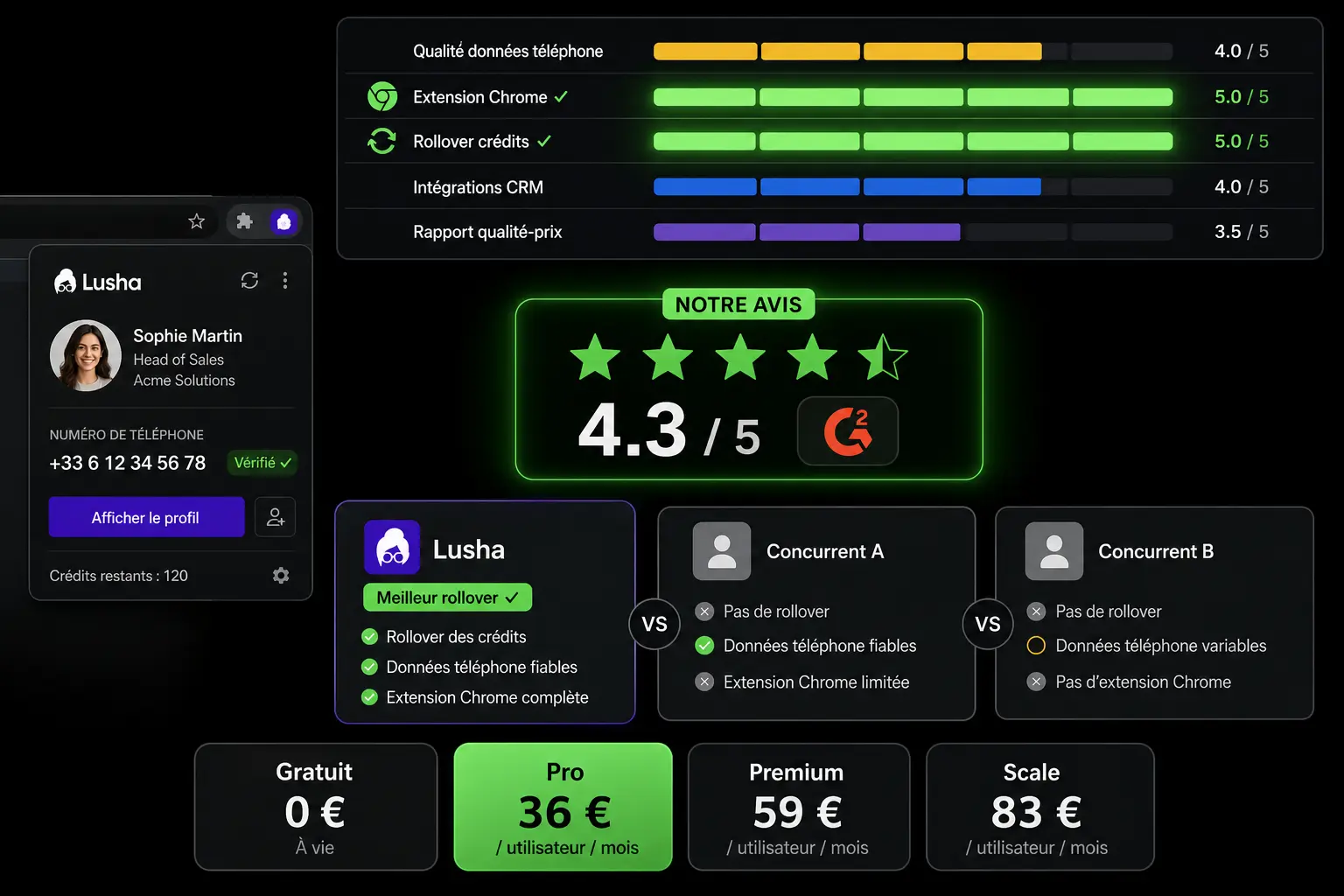
Lusha: phone-first contact enrichment. Native HubSpot sync. Starts $37/month per Lusha public pricing.
Zeliq: 450M B2B contacts with waterfall enrichment built-in, integrated email verification, and multichannel sequences. Native HubSpot CRM sync at Tier 3-4 depth. European positioning, GDPR-native.
UpLead: 160M+ leads with 95% real-time verification. Native HubSpot integration.
These vendors deliver waterfall multi-source enrichment (higher match rate than Breeze single-source) and multichannel sequencing (which Breeze does not include). For teams already invested in HubSpot Professional or Enterprise, they add complementary coverage without displacing HubSpot’s own CRM workflows.
6. Cost comparison: Breeze vs alternatives
Concrete math for a 5-SDR team enriching ~5,000 contacts/month, mid-market pricing verified September 2026:
Breeze Intelligence path (all-in on HubSpot native): - HubSpot Professional: $800/month (required for workflow triggers) - Breeze Intelligence: ~$2,250/month (5,000 credits allocated at ~$0.45/credit) - Total: ~$3,050/month + credit-expiry waste risk
Apollo third-party: - Apollo Professional: $79-149/user/month × 5 = $395-745/month - HubSpot Starter or CRM Free: $0-100/month - Total: ~$395-845/month
Zeliq third-party: - Zeliq mid-market: $150-400/user/month × 5 = $750-2,000/month covering enrichment + verification + sequences - HubSpot Starter or CRM Free: $0-100/month - Total: ~$750-2,100/month
Cognism enterprise: - Cognism enterprise annual: ~$15k-30k/year = $1,250-2,500/month - HubSpot Starter or CRM Free: $0-100/month - Total: ~$1,250-2,600/month
At 5,000 enrichments/month, Breeze Intelligence is the most expensive option because credit-based pricing scales linearly while third-party per-user pricing amortizes across volume. Below 500 enrichments/month, Breeze can be cheaper if HubSpot Professional is already in place.
Zeliq as a HubSpot enrichment alternative
Zeliq combines a 450 million B2B contact database, waterfall enrichment across multiple sources with integrated email verification, and multichannel sequences with native HubSpot CRM sync at Tier 3-4 depth. Where Breeze runs single-source, Zeliq stacks providers to reach 90%+ match rate. GDPR-native suppression, European positioning.
7. When Breeze fits vs when a third-party fits better
Breeze Intelligence is more adapted if you are already on HubSpot Professional or Enterprise, your primary need is company firmographic enrichment (not deep contact-level phones), your monthly enrichment volume is stable at 500-2,000 credits (predictable cost + minimal expiry waste), and you value the deepest possible integration with HubSpot workflows (Tier 4 native).
A third-party enrichment tool (Apollo, Cognism, Zeliq, Lusha) is more adapted if your volume exceeds 5,000 enrichments/month (unit economics beat Breeze), your ICP requires deep contact-level phone data or EMEA coverage where Breeze is thinner, you want waterfall multi-source enrichment (Breeze is single-source), you need multichannel sequences bundled with enrichment (Breeze does not include), or you want to avoid HubSpot Professional’s $800/month floor.
A hybrid approach works for teams with both inbound-heavy and outbound-heavy motions: Breeze for real-time inbound enrichment (form-fill enrichment), third-party for outbound waterfall coverage.
Reader picks the tool that matches their ICP, existing HubSpot investment, and workflow style. No single tool wins across every dimension.
8. Reproducible test methodology
To decide fit for your specific ICP without generic pros/cons:
Step 1: build a 500-contact sample representative of your ICP.
Step 2: enrich the same sample through Breeze Intelligence (using free Breeze credits available in HubSpot trial or paid subscription).
Step 3: enrich the same sample through 1-2 third-party alternatives (Apollo free 900 credits/year, Zeliq free trial credits, or similar).
Step 4: measure per tool: (a) verified email match rate against independent SMTP verification, (b) verified phone match rate, (c) firmographic completion, (d) contact-level vs company-level depth.
Step 5: compute cost per usable verified contact at your expected monthly volume.
Document the results. This methodology is more defensible than any vendor’s published benchmark.
9. Compliance: GDPR, CAN-SPAM, CCPA
EU GDPR: enrichment feeds outreach; outreach must document legitimate interest + provide opt-out + honor suppression + respect 3-year retention. CNIL 2025 sanctions hit €486M total, including SOLOCAL Marketing Services at €900k for prospecting without sufficient legal basis. For EMEA ICPs, prefer GDPR-native vendors.
US CAN-SPAM: FTC compliance guide requires accurate subject line + valid physical address + functional opt-out + honor opt-out within 10 business days.
California CCPA/CPRA: right to know, delete, opt-out. B2B partial exemption but disclosures expected.
10. Common mistakes with Breeze adoption
Mistake 1: Buying without simulating monthly credit usage. Credits reset monthly with no rollover. Under-forecast wastes budget; over-forecast blocks workflows mid-month.
Mistake 2: Skipping HubSpot Professional gate. Advanced Breeze features require Professional at $800/month. Team on Starter can’t use workflow triggers.
Mistake 3: Assuming Breeze covers contact-level data as well as company. It doesn’t; contact-level phone in particular is thinner than dedicated phone providers.
Mistake 4: Not testing alternatives before committing. Every alternative offers free tier or trial for 500-contact validation.
11. Frequently asked questions
What is the real total cost of HubSpot Breeze Intelligence?
Realistic entry cost ~$65/month all-in (base HubSpot Starter $20 + 100 Breeze credits $45 annual); realistic professional workflow setup ~$845/month (HubSpot Professional $800 + 100 credits Breeze $45); realistic mid-market team at 1,000 credits/month runs ~$1,250/month all-in. Per HubSpot’s public pricing verified September 2026, Breeze Intelligence itself costs $45/month for 100 credits on annual billing or $50/month on monthly billing, scaling to ~$450/month for 1,000 credits. But three hidden costs inflate the real bill: (1) Base HubSpot subscription required, starting at $20/month for Starter tiers. Without a paid HubSpot subscription, Breeze cannot be activated. (2) Advanced features (workflow triggers, custom properties, advanced filtering) require HubSpot Professional at $800/month. Teams on Starter cannot automate Breeze inside workflows, which caps its ROI. (3) Credit expiry: unused credits reset monthly with no rollover. Uneven consumption wastes budget: a team that buys 1,000 credits and uses 600 loses 400 credits worth $180. Over a year, ~$2,000 potentially wasted. For accurate budgeting, simulate 3 months of expected usage before committing to a credit tier. Rule of thumb: buy the credit tier that matches your MEDIAN monthly usage, not peak. If peak-to-median gap > 30%, consider monthly billing (higher per-credit cost but no annual over-commit risk).
How do Breeze Intelligence credits work and do they expire?
Credits reset monthly with no rollover, unused credits at month-end are gone permanently, which can waste 20-40% of the credit budget for teams with uneven month-to-month enrichment volume. Mechanics per HubSpot’s public pricing verified September 2026: each Breeze plan tier allocates a fixed number of credits per month (100 credits at $45, 1,000 credits at ~$450, etc.). Credits are consumed on each enrichment operation (contact or company enrichment). At the end of each billing month, remaining credits reset to zero. There is no rollover to the next month. Impact: teams that enrich unevenly (e.g., campaign-driven bursts) waste credits during low-volume months. Example: a team buying 1,000 credits/month at $450, using 1,200 credits in Month 1 (buying 200 overage credits at higher per-credit rate), then 400 credits in Month 2 (wasting 600 credits worth $270). Net effect: paid $450 + overage vs realistic value of ~$180 for the underused month. Over 12 months, credit-expiry waste for uneven consumption typically runs 15-30% of budget spent, or $800-$1,600 per year on a 1,000-credit plan. Mitigation: (1) monitor monthly consumption for 3 months before committing to an annual plan, (2) buy the tier matching median usage not peak, (3) use monthly billing for the first 3-6 months to identify actual consumption pattern before locking in annual. Or evaluate alternatives with unlimited-seat pricing (Clay unlimited seats with usage-based credits) or per-user pricing (Apollo, Zeliq) where under-utilization doesn’t waste per-credit spend.
Does Breeze Intelligence cover contact-level data as well as company data?
Breeze delivers strong company firmographic data (its Clearbit heritage) but has meaningful gaps at the contact-level, particularly on direct phone numbers and EMEA contact coverage where dedicated third-party enrichment vendors outperform it. Coverage pattern verified across SERP top 10 September 2026: (1) Company data: strong US firmographic, moderate EU, tech stack detection reliable on common SaaS. Clearbit’s original data assets excel here. (2) Contact data: verified email available on many US contacts; contact-level phone coverage thinner than Lusha, Cognism, or Kaspr (which are phone-first vendors). (3) EMEA contact coverage: thinner than Cognism (GDPR-native EMEA specialist) or Zeliq (European positioning). Practical implication: for teams whose outbound relies on direct-dial phones (SDRs cold-calling US mid-market) or on EMEA contacts (French, German, Spanish decision-makers), Breeze alone typically caps match rate at 55-70% vs 85%+ available from a specialized phone or EMEA vendor. Mitigation options: (1) supplement Breeze with a phone-first tool (Lusha, Kaspr) for direct-dial coverage, (2) supplement with a waterfall-native tool (Zeliq, Clay) for EMEA coverage, (3) accept the gap if your ICP is US enterprise where company firmographic drives more value than contact-level phone. Test methodology: run 500 in-ICP contacts through Breeze, measure verified email + phone match rates, then run the same sample through 1-2 alternatives to compare on your real ICP.
12. Conclusion: 3 actions to run
Audit current Breeze usage within 7 days. How many credits are you consuming vs allocated? If under-utilization > 30%, downgrade tier or switch to monthly billing.
Test one alternative on 500 in-ICP contacts within 15 days. Apollo, Zeliq, Cognism, or Lusha free tiers. Compare verified match rate vs Breeze on your real ICP.
Reassess Breeze vs third-party within 30 days at your actual monthly volume. Above 5,000 enrichments/month, third-party per-user pricing usually wins. Below 500/month, Breeze can win if HubSpot Professional is already in place.
HubSpot-native waterfall enrichment with multichannel sequences bundled
Zeliq combines 450 million B2B contacts, waterfall enrichment with integrated verification, and multichannel sequences with native HubSpot CRM sync at Tier 3-4 depth. Where Breeze runs single-source, Zeliq stacks providers to 90%+ match. GDPR-native suppression.
Try for freeAnd if you want waterfall multi-source enrichment that syncs natively with HubSpot CRM and includes multichannel sequences, try Zeliq for free: sourcing, enrichment, verification, and outreach in one interface, no credit card required.