
Pecha Kucha Presentation: The Complete Guide to the 20x20 Format
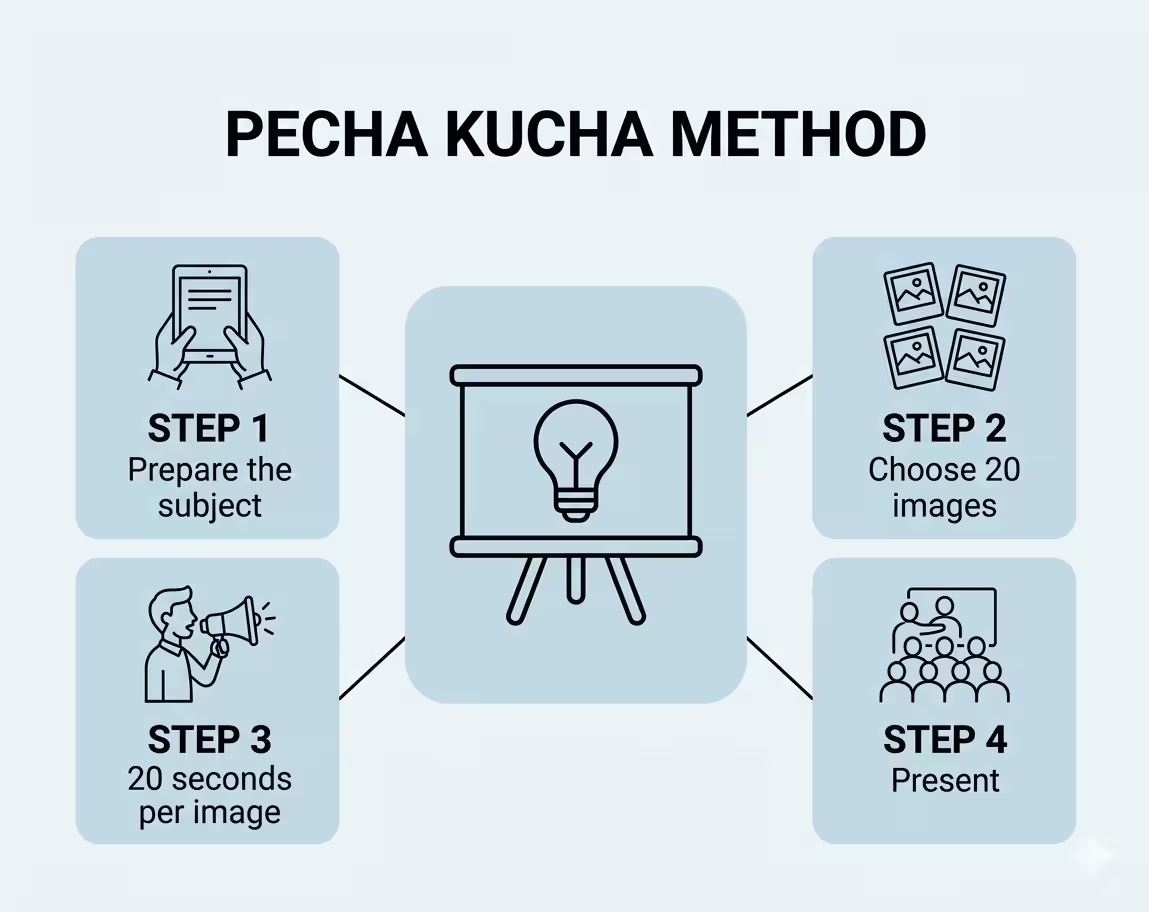
If you have ever sat through a presentation that dragged on for forty minutes while the speaker read bullet points from their slides, you understand the problem that the Pecha Kucha format was designed to solve. Pecha Kucha is a presentation method built on a single, elegant constraint: 20 slides, 20 seconds each, for a total of exactly 6 minutes and 40 seconds. The slides advance automatically. You keep up. The audience stays awake.
The result is a presentation style that is dense, focused, fast, and memorable in a way that conventional slide decks almost never are. This guide explains what a Pecha Kucha presentation is, where it came from, how to prepare one, how to deliver it well, and what separates the people who thrive in this format from those who freeze.
What Is Pecha Kucha?
Pecha Kucha (pronounced “peh-chak-cha”) is a structured presentation format based on two fixed numbers: 20 slides and 20 seconds per slide. Once the presentation begins, the slides advance on their own. The speaker cannot pause, linger, or stall. The format enforces discipline that no amount of coaching or prep typically achieves on its own.
The name comes from a Japanese term for the sound of chatter or conversation, which reflects the format's original spirit: less lecture, more energy, shorter and more social.
The total runtime of a Pecha Kucha presentation is always 6 minutes and 40 seconds. Not 6:41. Not 6:30. The slides stop when they stop, and the speaker's job is to be ready for every one of them.
Origin: Tokyo, 2003
Pecha Kucha was invented in Tokyo in 2003 by architects Astrid Klein and Mark Dytham of the firm Klein Dytham Architecture. The format was created for a specific reason: Klein and Dytham were frustrated by the presentations they were seeing at architecture events. Speakers would show up with sprawling slideshows, talk well past their allotted time, and bury their best ideas under layers of exposition.
Their solution was to design a constraint that made verbosity impossible. If the slides advance every 20 seconds regardless of what you are saying, you simply cannot ramble. You are forced to prepare, to distill, to know your material cold.
The first Pecha Kucha Night was held at their Tokyo venue Super Deluxe on February 20, 2003. It was an event for creatives to share work in a fast, convivial format. The concept spread quickly, and Pecha Kucha Nights now take place in cities around the world, from New York to Berlin to Lagos, as public events where speakers present to general audiences on topics ranging from architecture and design to science, travel, and personal projects.
In the years since, the format has crossed out of the creative world and into business meetings, conference talks, university classrooms, pitch sessions, and team standups.
The Rules: What Makes It Pecha Kucha
The format has four core rules, and none of them are optional:
Rule 1: Exactly 20 Slides
Not 18. Not 22. Twenty slides. This forces you to make hard decisions about what to include and, more importantly, what to cut. Most presenters discover that the discipline of fitting their message into 20 slides is itself a clarifying exercise. If an idea does not earn a slide, it probably did not belong in the presentation.
Rule 2: Exactly 20 Seconds Per Slide
Each slide is on screen for 20 seconds. The rhythm this creates is part of what makes the format work. Twenty seconds is enough time to make one point, share one image, or tell one moment of a story. It is not enough time to explain a complex chart with six variables, read three bullet points aloud, or hedge your way through a difficult idea.
Rule 3: Slides Advance Automatically
This is the rule that changes everything. In a conventional presentation, the speaker controls the pace. If they get nervous, they can slow down. If they go on a tangent, they can delay the next slide. With auto-advance, that safety net is gone. The presentation moves at its own speed. You either keep up or you visibly fall behind.
Rule 4: Images Over Text
Pecha Kucha slides are primarily visual. A photograph, an illustration, a diagram, a single word in large type. The more text you put on a slide, the more the audience reads instead of listening to you, and the harder it becomes to stay synchronized with the 20-second clock. Your voice carries the argument. Your slides provide the visual context.
Why Use the Pecha Kucha Format?
The constraints of Pecha Kucha are not arbitrary. They solve real problems that plague conventional presentations:
It forces clarity. You cannot be vague in 20 seconds. Every slide demands a precise point. The preparation process alone sharpens your thinking in ways that longer formats never require.
It eliminates filler. The format strips out throat-clearing, hedging, and repetition by design.
It respects the audience's time. A 6 minute 40 second presentation has a defined end. Audiences engage differently when they know the constraint. There is a sense of anticipation, even sport, in watching a presenter navigate the ticking clock.
It is memorable. The format is unusual enough that audiences remember it. A well-delivered Pecha Kucha sticks in the memory in a way that a conventional 30-minute talk often does not.
It democratizes the room. At a Pecha Kucha Night or a multi-speaker event, every presenter gets exactly the same amount of time. The format levels the playing field between the polished veteran and the nervous first-timer.
How to Prepare a Pecha Kucha Presentation
Preparation is where Pecha Kucha is won or lost. The delivery problems most people experience (freezing, losing their place, going blank when a new slide appears) are almost always the result of insufficient preparation. Here is how to do it right.
Step 1: Choose One Clear Thesis
A Pecha Kucha presentation should have one central idea. Not three ideas. Not a survey of a topic. One thesis, one argument, one story. Everything in your 20 slides should serve that single idea.
Write your thesis in one sentence before you open your slide software. If you cannot state your core point in one sentence, you are not ready to build slides yet. The sentence does not need to be elegant. It just needs to be clear.
Step 2: Map Your 20 Slides to One Idea Per Slide
Think of your 20 slides as 20 beats in a story, not 20 containers for information. A useful structure for many Pecha Kucha presentations looks like this:
- Slides 1 to 3: Set the context. What is the situation, the problem, or the world you are entering?
- Slides 4 to 6: Introduce the tension or the question. Why does this matter?
- Slides 7 to 14: Develop your argument, share your evidence, tell your story.
- Slides 15 to 17: Build toward a resolution or insight.
- Slides 18 to 20: Close with your thesis restated, a call to action, or an image that resonates.
Each slide gets one job. If you find yourself trying to make two points on one slide, split them, cut one, or rethink your structure.
Step 3: Choose Your Images
In Pecha Kucha, your images do the heavy lifting your words cannot. Choose visuals that are specific, not generic (a photo of the actual place, person, or thing you are describing is always stronger than a stock photo), high contrast (legible at a glance, from the back of a room), emotionally resonant (images that make the audience feel something keep them engaged), and free of excessive text (if you need text on a slide, use very few words in very large type).
Step 4: Write Your Script for Each 20-Second Block
Write exactly what you will say for each slide. Not an outline. Not bullet points. A full script, written in your natural speaking voice. Then time yourself reading it aloud. A comfortable speaking pace covers roughly 45 to 55 words in 20 seconds. If your script runs to 80 words for a single slide, cut it.
This scripting process is where most presenters discover that their preparation was shallower than they thought. Writing forces precision. If you cannot write a crisp 20-second script for a slide, you do not yet know what you want to say.
Step 5: Practice with Auto-Advance
This step is non-negotiable. Set your presentation to auto-advance at 20-second intervals and run through it start to finish. Not once. Multiple times.
The first run-through will almost certainly go badly. That is normal and useful. You will discover which transitions feel awkward, which slides you are not ready for, which moments your script does not quite match the image. Each subsequent run will be smoother.
Practice until the auto-advance feels like a companion, not an adversary. The goal is to reach a state where the slide change feels like a natural punctuation mark in your delivery, not a surprise interruption.
How to Deliver a Pecha Kucha Presentation Well
Technical preparation gets you ready. Delivery makes it land. Here are the principles that separate strong Pecha Kucha presentations from anxious ones.
Stay in Your Own Rhythm
Do not watch the slides advance. This is harder than it sounds. The impulse to glance at the screen when a new slide appears is almost universal. But if you are looking at the screen, you are not looking at the audience, and eye contact is what makes a presentation feel like a conversation rather than a performance.
Trust your preparation. You know what comes next because you practiced it.
Use Transitions as Breathing Room
The moment a slide changes is a natural pause. A brief beat between slides is not dead air. It is the breath that separates one idea from the next. Audiences process and reset during that pause. Let it happen. Do not rush to fill every millisecond.
Handle Nerves by Anchoring to the First Slide
Pre-presentation nerves are worst in the ten seconds before you start. Once the first slide appears and you hear yourself saying your opening words, the nerves typically drop. Anchor your focus on your first line. Know it so well that it comes out automatically, regardless of how you feel. Everything flows from that opening.
Recover Gracefully When You Lose Your Place
Even with thorough practice, you may lose your thread. A slide advances while you are mid-sentence, and you find yourself momentarily blank. The recovery technique is simple: take one breath, look at the current slide, say what the image makes you think of, and move forward. The audience does not know what you planned to say. They only see what you actually say.
Common Mistakes to Avoid
The format punishes certain habits harshly. Here are the most common ones:
- Too much text per slide: If your slide has four bullet points, the audience is reading, not listening. The 20-second clock runs out while they are still on bullet point two.
- Not rehearsing with auto-advance: Practicing with manual slide control is not the same experience. The auto-advance dynamic must be rehearsed, not imagined.
- Covering too many ideas: Trying to make five points in a 20-slide format means no single point lands clearly. One thesis, developed with depth, is always stronger than five ideas treated shallowly.
- Memorizing word-for-word without flexibility: If you are locked into exact phrasing, any interruption (a cough, a stumble, a loud door) can derail you. Know your script well enough to paraphrase it, not just recite it.
- Neglecting the visual design: A slide with a blurry image or a poorly chosen stock photo undermines your credibility even when your words are strong. Invest time in finding the right visuals.
B2B Use Cases for Pecha Kucha
The format has moved well beyond creative events into practical business applications:
Pitch presentations: A Pecha Kucha pitch forces founders and sales professionals to strip their pitch to its most essential elements. Investors and prospects appreciate the discipline. A concise, well-structured 6 minute 40 second pitch is often more persuasive than a sprawling 20-minute one.
Team meetings: Rather than a 45-minute all-hands where four topics are covered loosely, a Pecha Kucha-structured update from each team lead delivers information with speed and clarity. Meetings end on time. Teams stay engaged.
Investor demos: Early-stage fundraising presentations often benefit from the Pecha Kucha constraint. It prevents founders from going too deep on product details before establishing the market opportunity, the problem, and the team.
Conference talks: At multi-speaker events, Pecha Kucha sessions allow more speakers to present in less time, with a format that keeps the audience's energy up across many presentations.
Internal training: New employee onboarding, process walkthroughs, and knowledge-sharing sessions can all be delivered more efficiently in a Pecha Kucha format than in conventional slide decks.
The Deeper Lesson
Pecha Kucha is more than a presentation format. It is a thinking tool. The discipline it imposes on a presentation reflects a broader principle: clarity is not the absence of complexity, it is the result of working hard enough to make complexity simple. The constraint of 20 slides and 20 seconds forces that work. And the audiences who receive the result, a tight, focused, energetic 6 minutes and 40 seconds, are always better for it.
Whether you are presenting at a creative event, pitching a product, or running a team meeting, the core skill that Pecha Kucha builds, the ability to say exactly what you mean in exactly the time you have, is one of the most valuable professional skills you can develop.
If you are a B2B professional looking to sharpen how you communicate and prospect, Zeliq gives you the tools to reach the right people with the right message, at the right time.
Try Zeliq for free