LinkedIn Private Mode: Complete Guide for Sales Professionals (2026)
LinkedIn private mode is one of those features that sounds simple but has real consequences for how you prospect. Toggle it on, and you can browse profiles without leaving a trace. Toggle it off, and every profile view becomes a subtle signal, a digital tap on the shoulder that says “someone’s looking at you.”
For sales professionals, SDRs, and anyone doing active outbound prospecting, the choice between browsing privately or visibly isn’t just a privacy preference. It’s a strategic decision that affects how your prospects respond, whether they look you up in return, and ultimately whether your outreach lands as warm or cold.
This guide covers everything you need to know: what LinkedIn private mode actually does, how to activate it in 2026, what it takes away, and when you should absolutely turn it off.
What Is LinkedIn Private Mode?
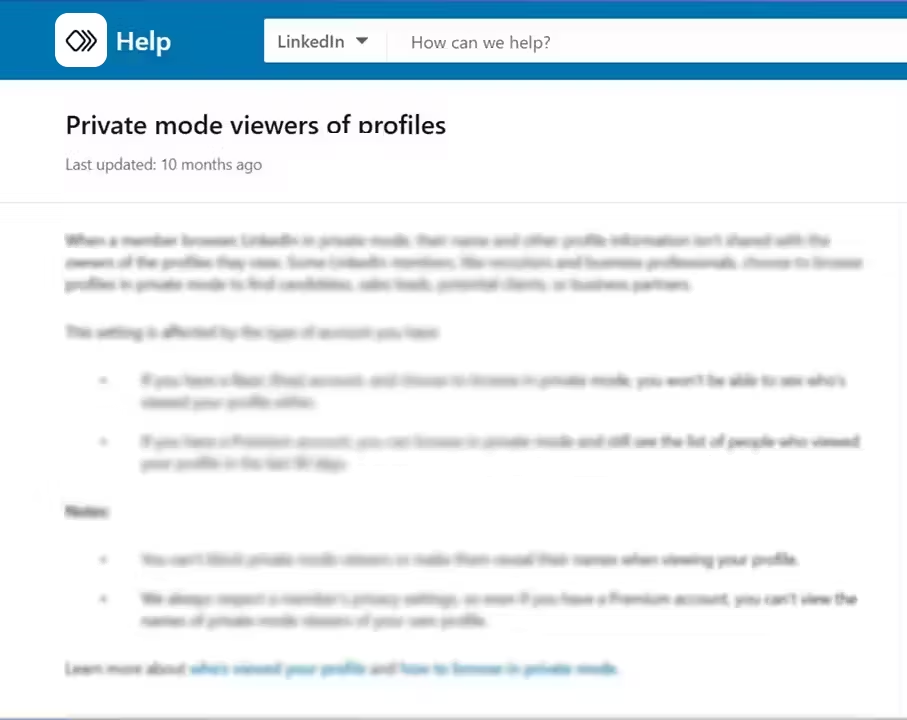
LinkedIn private mode (officially called “Private mode” under Profile viewing options) lets you browse other members’ profiles without your name and information appearing in their “Who viewed your profile” list.
When you view someone’s profile normally (not in private mode), LinkedIn notifies them. They see your name, headline, and profile photo in their “Who viewed your profile” section, which lives in the left sidebar of the homepage on desktop and under the “My Network” tab on mobile.
In private mode, that notification disappears. The person you viewed sees instead an entry like:
- “Someone from the staffing industry”
- “A LinkedIn member”
- “Someone from London”
The level of anonymization depends on your privacy settings. LinkedIn offers a middle option too: “Semi-private mode”, which shows your general profile characteristics (industry, title category, location) but not your name or photo. Full private mode shows nothing identifiable at all.
What private mode does NOT do:
- It does not hide you from LinkedIn’s own data collection (LinkedIn still logs your views internally)
- It does not prevent company page admins from seeing your profile visits to their pages
- It does not make you invisible to LinkedIn’s algorithm, which still uses your browsing behavior to surface content and ads
- It does not affect who can see your posts, comments, or connection requests
How to Turn On LinkedIn Private Mode (2026 UI)
The navigation has shifted a few times over the years. Here are the exact steps for the current 2026 LinkedIn interface, both desktop and mobile.
On Desktop (linkedin.com):
- Click your profile photo in the top-right corner of the LinkedIn header
- Select “Settings and Privacy” from the dropdown menu
- In the left sidebar, click “Visibility”
- Under “Visibility of your LinkedIn activity”, click “Profile viewing options”
- You’ll see three options:
- Your name and headline (public mode, default)
- Private profile characteristics (semi-private)
- Private mode (fully anonymous)
- Select “Private mode” and the change saves instantly
On Mobile (iOS and Android):
- Tap your profile photo in the top-left corner
- Tap “Settings” (gear icon) at the bottom of the left panel
- Tap “Visibility”
- Tap “Profile viewing options”
- Select “Private mode”
The change is immediate and applies to all future profile views until you change it back. There’s no session-level toggle.
What You Lose When You Browse Privately
Here’s the trade-off that LinkedIn doesn’t make obvious enough: when you switch to private mode, you lose the ability to see who viewed your own profile.
This is a significant exchange. LinkedIn’s “Who viewed your profile” feature is one of the platform’s most valuable signals for salespeople. It tells you:
- Which prospects are researching you after receiving your email or InMail (a strong buying signal)
- Which companies are looking at your profile after you’ve reached out to multiple stakeholders (account-level interest)
- Which former clients or partners have revisited your profile (potential re-engagement opportunities)
- Whether your recent LinkedIn activity (posts, comments, shares) is driving profile traffic
When you’re in private mode, all of that goes dark on your end too. You can see the total count of profile views, but not who they are, unless you have a Premium account, which restores some (but not all) of that visibility.
LinkedIn Premium and private mode:
With any Premium tier (Career, Business, Sales Navigator), you get access to expanded “Who viewed your profile” data, including up to 365 days of history. But here’s the nuance: if someone else is in private mode when they view your profile, you still can’t see them, even with Premium. Premium lifts your visibility restriction on what others share, it doesn’t override their privacy choice.
The Strategic Case for Private Mode in Sales
There are legitimate, smart reasons to browse LinkedIn privately as a sales professional.
Competitive research:
When you’re researching a competitor’s team, strategy, or recent hires, you probably don’t want their employees getting notifications that someone from [your company] is browsing their profiles. A senior exec at a competitor seeing your name in their “Who viewed your profile” section might tip them off to whatever you’re researching.
Pre-call account research:
When you’re deep-researching an account before a first call, especially if it’s a warm inbound lead or a referral, you might look at a dozen profiles: the champion, the economic buyer, the technical evaluator, the potential blocker. Leaving a trail of views across an entire buying committee before you’ve even had a first conversation can feel premature or even slightly odd from their perspective.
Sensitive prospecting situations:
Sometimes the timing of being noticed matters. If you’re prospecting into an account where you know a competitor is also active, showing up in multiple people’s “Who viewed your profile” before you’ve established any relationship could alert the wrong person.
Research phases vs. outreach phases:
Think of your prospecting process in two phases: research (where privacy helps) and outreach (where visibility helps). Private mode is most valuable in the research phase, when you’re building your account map, identifying stakeholders, and gathering context before you reach out.
When to Turn Private Mode OFF (and Why It Helps Outreach)
This is the part that many guides on LinkedIn private mode completely miss, and it’s arguably more important for salespeople than the privacy aspect.
Profile views as a prospecting tactic:
In outbound sales, visibility is a feature, not a bug. When a prospect sees that someone from [Your Company] viewed their profile, a certain percentage of them will look you up in return. They click through to your profile, read your headline, check your experience, maybe look at your recent posts. And then they’re familiar with you before your cold email or InMail arrives.
This technique, sometimes called “profile view warm-up”, works because it:
- Reduces the “cold” in cold outreach by establishing a micro-touchpoint before your first message
- Triggers curiosity (most people are naturally interested in who’s looking at them professionally)
- Increases familiarity, which research consistently shows improves response rates to subsequent outreach
- Creates a reason to connect: some prospects will send you a connection request themselves after seeing your view
The sequence looks like this:
- View the prospect’s profile (with private mode OFF)
- Wait 24-48 hours
- Send your connection request or cold email
By the time step 3 happens, the prospect has potentially already looked at your profile, read your headline, and formed an initial impression. Your outreach lands with context already established.
Combining with multichannel sequences:
The profile view tactic works best as part of a coordinated multichannel sequence rather than in isolation. Zeliq’s multichannel prospecting platform lets you build sequences that include LinkedIn touches (views, connection requests, messages) alongside email and call steps, so the timing and coordination are handled automatically rather than tracked manually in a spreadsheet.
Private Mode vs. Semi-Private Mode: Which to Use When
LinkedIn’s semi-private mode (showing general characteristics like industry and title category but not your name) is an interesting middle ground that most people overlook.
When semi-private makes sense:
- You want to signal general interest (e.g., “someone from the software industry”) without fully identifying yourself
- You’re doing exploratory research where you want a slight hint of interest but not full attribution
- You’re new to a market and haven’t built out your profile yet (a bare or incomplete profile might actually hurt you if seen)
The honest answer for most salespeople: semi-private mode offers the worst of both worlds. You’re not fully invisible (a prospect can sometimes infer your company or role from the description), and you’re not creating the warm-up effect that comes from a fully visible view. Default to either full public mode (for active prospecting) or full private mode (for competitive research).
How This Connects to Your Overall LinkedIn Prospecting Strategy
LinkedIn profile views are one signal among many. The SDRs who get the best results from LinkedIn aren’t just toggling private mode on and off. They’re building a systematic LinkedIn presence and activity strategy that makes their visible profile views actually land:
An optimized profile: When a prospect looks you up after seeing your view, what they find matters enormously. A profile with a strong headline, clear value proposition, recent relevant posts, and social proof (recommendations, shared connections) converts that curiosity into interest. A sparse profile with no activity does the opposite.
Regular content activity: Publishing posts, commenting on relevant content, and engaging in industry discussions builds ambient familiarity with your target audience over time. Prospects who’ve seen your name on posts are far more receptive when your outreach arrives.
Precise targeting with verified data: The profile view warm-up only works if you’re viewing the right profiles. Using Zeliq’s B2B contact data to identify and qualify prospects before you start viewing ensures you’re not warming up the wrong stakeholders.
Extension-powered enrichment: Zeliq’s browser extension lets you enrich a prospect’s contact data directly from their LinkedIn profile while you’re viewing it, so the research phase and the data collection phase happen simultaneously. You’re not just looking at a profile, you’re building a contact record at the same time.
Practical Recommendations by Use Case
| Situation | Recommended Mode |
|---|---|
| Researching competitors’ teams | Private mode |
| Mapping a new target account before any outreach | Private mode |
| Pre-call research on a booked prospect | Private mode |
| Active outbound prospecting (1:1 profile views before outreach) | Public mode |
| Running profile-view warm-up before email sequences | Public mode |
| Building brand awareness in your target market | Public mode |
| Checking on a former client or partner | Semi-private or public, depending on intent |
The Settings Worth Reviewing While You’re There
If you’re digging into LinkedIn’s Visibility settings to adjust private mode, there are a few other settings worth reviewing that affect your prospecting workflow:
Profile discovery via email address: If this is on, people who have your email can find your LinkedIn profile. Useful for inbound scenarios, less relevant for outbound.
Connections visibility: Controls whether your connections list is visible to others. For competitive reasons, many salespeople set this to “Only you” so competitors can’t mine your network.
Active status: The green dot that shows you’re online. Turning this off prevents prospects from knowing when you’re active, which matters less than the profile view setting but is worth knowing.
Followers vs. connections: LinkedIn lets you configure whether people can follow you without connecting. Enabling this can expand your content reach without needing mutual connection approval.
The Bottom Line for Sales Professionals
LinkedIn private mode is a useful tool, but it’s only half the picture. The real skill is knowing when to use it and when to put your name front and center.
Use private mode for research: mapping accounts, studying competitors, doing pre-call prep. Switch to public mode for prospecting: when you want that profile view to land as a warm-up signal, create curiosity, and make your subsequent outreach feel less cold.
The SDRs who consistently outperform aren’t the ones who hide from LinkedIn. They’re the ones who show up strategically, with a strong profile, relevant content activity, and outreach backed by verified contact data that actually reaches the inbox.
Turn your LinkedIn research into a full prospecting workflow. Zeliq enriches contacts directly from profiles and sequences your outreach across email, LinkedIn, and calls.
Try Zeliq for free