
A sales sequence is a structured series of scheduled outreach touchpoints across multiple channels (email, LinkedIn, phone, video) that a sales team runs against a prospect list to move contacts from cold introduction to booked meeting, typically consisting of 8-12 touches over 14-21 business days for cold outbound and 6-8 touches over 7-10 business days for warm inbound follow-up. In 2026, aggregated SERP benchmarks (verified September 2026) show that multichannel sequences combining email + LinkedIn + phone lift reply rates by up to 287% versus single-channel, with top-performing teams hitting 15-20% reply rate through tight ICP targeting + AI-assisted personalization. This article walks through the standard sequence structures, touchpoint templates, timing benchmarks, tooling, and 3 FAQ.
For an SDR, RevOps engineer, growth manager, or founder building a sales sequence workflow, this article gives the exact structure, touch spacing, and channel mix that drive results.
On the agenda:
- What a sales sequence is (touches + channels + timing)
- Cold outbound sequence: 8-12 touches over 14-21 days
- Warm inbound follow-up: 6-8 touches over 7-10 days
- Enterprise sequence: 18-24 touches over 6-8 weeks
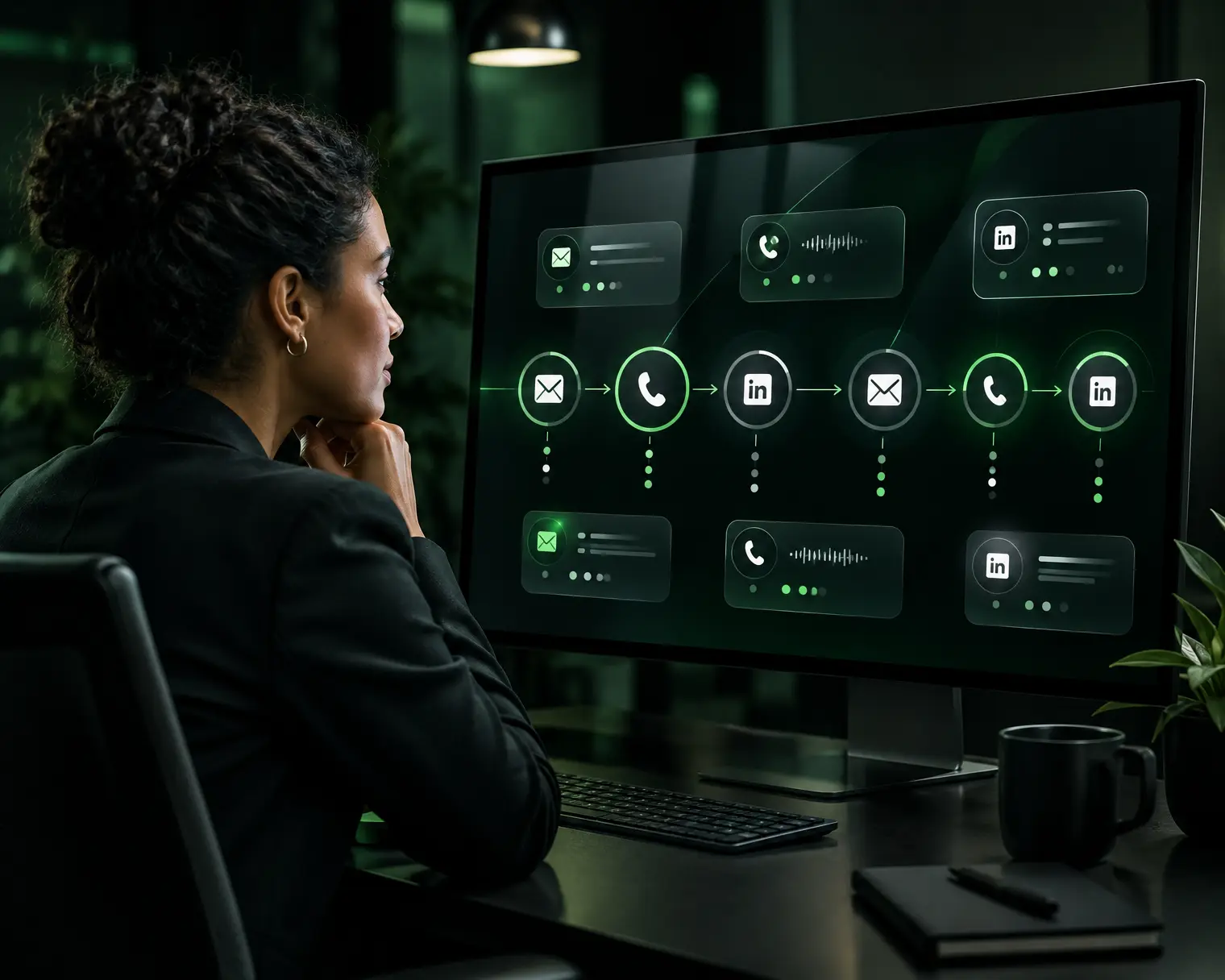
- The 3-channel mix: email + LinkedIn + phone
- Touch-by-touch template
- Signal-led vs demographic-only: 3-4× reply rate difference
- Sales sequence tools and platforms
- Compliance: GDPR, CAN-SPAM, LinkedIn ToS
- 3 FAQ (structure, timing, reply-rate benchmarks)
Key takeaways:
- Definition: structured multichannel touches from cold intro to booked meeting
- Cold outbound: 8-12 touches over 14-21 business days
- Warm inbound: 6-8 touches over 7-10 business days
- Enterprise: 18-24 touches over 6-8 weeks
- Channel mix impact: +287% reply rate multichannel vs single per aggregated SERP
- Top-team benchmark: 15-20% reply rate on well-executed sequences
- Data prerequisite: verified email + LinkedIn URL + phone required
- Compliance: FTC CAN-SPAM US, GDPR (CNIL 2025 €486M) EU
1. What a sales sequence is
A sales sequence is the operational unit of outbound: a scheduled series of touchpoints designed to move a prospect from initial contact to a booked meeting. Three parameters define the sequence:
Touches: individual outreach actions (an email sent, a LinkedIn message, a phone call, a video pitch). Cold outbound sequences typically hold 8-12 touches; enterprise sequences 18-24.
Channels: the medium of each touch. Email, LinkedIn (connect + message), phone (dial + voicemail), video (loom, personalized), sometimes SMS. Multichannel means using 3+ channels in the same sequence.
Timing: the spacing between touches, calibrated to human patience windows without triggering spam or fatigue signals.
Without structure across these three parameters, outreach becomes noise. Structured sequences produce reply rates 3-4× higher than ad-hoc outreach per aggregated SERP benchmarks.
2. Cold outbound sequence: 8-12 touches over 14-21 business days
The standard cold outbound sequence in 2026 aggregated from SERP top 10:
| Day | Channel | Touch |
|---|---|---|
| Day 0 | Connect request with personalized note (< 300 chars) | |
| Day 2 | Opener referencing a signal (funding, hire, tech switch) | |
| Day 5 | Phone | Call + voicemail if no answer |
| Day 7 | Message if connection accepted | |
| Day 10 | Value-add resource (case, template, insight) | |
| Day 12 | Phone | Second call attempt |
| Day 15 | Direct meeting ask | |
| Day 18 | Breakup email (“moving on” tone) |
Total: 8 touches across 3-4 channels over 18 business days. Extend to 12 touches for enterprise-adjacent mid-market prospects; compress to 6 touches for smaller-ticket SMB prospects.
3. Warm inbound follow-up: 6-8 touches over 7-10 days
Warm inbound leads (form fills, content downloads, demo requests) require faster and lighter follow-up because intent already exists:
| Day | Channel | Touch |
|---|---|---|
| Day 0 (within 5 min) | Auto-acknowledgment + calendar link | |
| Day 0 (within 30 min) | Phone | Rep call while intent is hot |
| Day 1 | Personalized outreach if no meeting booked | |
| Day 3 | Connect request | |
| Day 5 | Phone | Second call attempt |
| Day 7 | Value-add + meeting ask | |
| Day 10 | Breakup |
Total: 7 touches across 3 channels over 10 business days. Speed to first touch matters more than sequence length; 5-minute response beats 24-hour response by 6-8× in conversion per aggregated SERP.
4. Enterprise sequence: 18-24 touches over 6-8 weeks
Enterprise deals require longer patience. The prospect has more stakeholders, deeper research needs, and slower buying cycles.
Structure highlights: - 18-24 touches spread over 6-8 weeks - 4-5 channels: email + LinkedIn + phone + sometimes video + eventually in-person or event-based - Multiple stakeholders in the same account touched in parallel - Cadence pauses for prospect engagement (opened email → wait for reply before next touch; ignored email → follow-up per schedule) - Signal-triggered re-entries: if the account triggers a fresh signal mid-sequence, restart with new opener
Enterprise sequences require CRM sync and orchestration tooling because manual tracking breaks above ~10 touches per prospect.
5. The 3-channel mix: email + LinkedIn + phone
Multichannel outperforms single-channel by up to 287% per aggregated SERP benchmarks. The mechanism: prospects have different response preferences, and touching multiple channels compounds the probability that at least one lands.
Email: highest scale, easiest to personalize with templates + tokens. Best for value-add + first cold introduction.
LinkedIn: highest context (prospect sees your profile + posts + shared connections). Best for warming a cold contact before email or phone.
Phone: highest signal but lowest scale. Best for high-value accounts + response-triggered calls.
Coordination principle: email opens → phone call within 24-48h. LinkedIn engagement → email within 48h. Phone voicemail → email confirmation within same day.
See multichannel prospecting guide for deeper channel design.
6. Signal-led vs demographic-only: 3-4× reply rate difference
Demographic sequences (targeting by title + industry + size) cap at 3-5% reply rate. Signal-led sequences (opening with a specific trigger event) reach 8-15% reply rate per aggregated SERP benchmarks, a 3-4× lift.
Common signal triggers: - Recent funding round (Series A-D) - Hiring surges in target function (“+5 SDRs in 30 days”) - Tech switch detected (moved from competitor) - Executive change (new CFO, new VP Sales) - Content downloads on your category from the account’s IP
Signal freshness matters: filter signals older than 30-90 days to preserve actionability.
7. Sales sequence tools and platforms
Categories of tools that run sequences at scale:
All-in-one platforms: Apollo, Zeliq, and similar bundle sourcing + enrichment + sequences in one interface. Mid-market pricing $150-400/user/month.
Dedicated sequencers: Outreach, Salesloft category leaders for enterprise. Enterprise pricing $100-200+/user/month typically.
Email-first tools: Instantly, Lemlist, Smartlead focus on email deliverability + sequences without deep CRM sync. $30-100/user/month.
LinkedIn automation: Waalaxy, Expandi automate LinkedIn actions within rate limits. Compliance-sensitive; use within LinkedIn ToS boundaries.
Tool choice depends on primary channel mix. Email-heavy teams pick email-first tools; LinkedIn-heavy pick LinkedIn automation with email add-on; multichannel pick all-in-one or dedicated sequencer.
8. Data prerequisite: verified email + LinkedIn URL + phone
No sequence delivers 15-20% reply rate on bad data. Prerequisites before running any sequence:
- 100% SMTP-verified emails (bounce rate < 3%)
- LinkedIn URL for each contact
- Direct phone for the accounts you plan to call
- Signal tags on any contact where you have a trigger event
- Suppression list check before send
Missing any of these caps sequence performance below 5% reply rate regardless of copy quality. See B2B contact data for the data prep layer.
9. Compliance: GDPR, CAN-SPAM, LinkedIn ToS
US CAN-SPAM: FTC compliance guide requires accurate subject line + valid physical address + functional opt-out + honor opt-out within 10 business days.
EU GDPR: legitimate interest per ICP + opt-out on every email + suppression + 3-year retention. CNIL 2025 sanctions hit €486M total (vs €55M in 2024), including SOLOCAL Marketing Services at €900k for prospecting without sufficient legal basis. Choose GDPR-native vendors for EMEA ICPs.
LinkedIn ToS: prohibits automated access without permission. Stay under ~100 connection requests per week per account. Automation tools that push beyond risk account restrictions.
California CCPA/CPRA: right to know, delete, opt-out. B2B partial exemption but disclosures still expected.
Zeliq and multichannel sales sequences
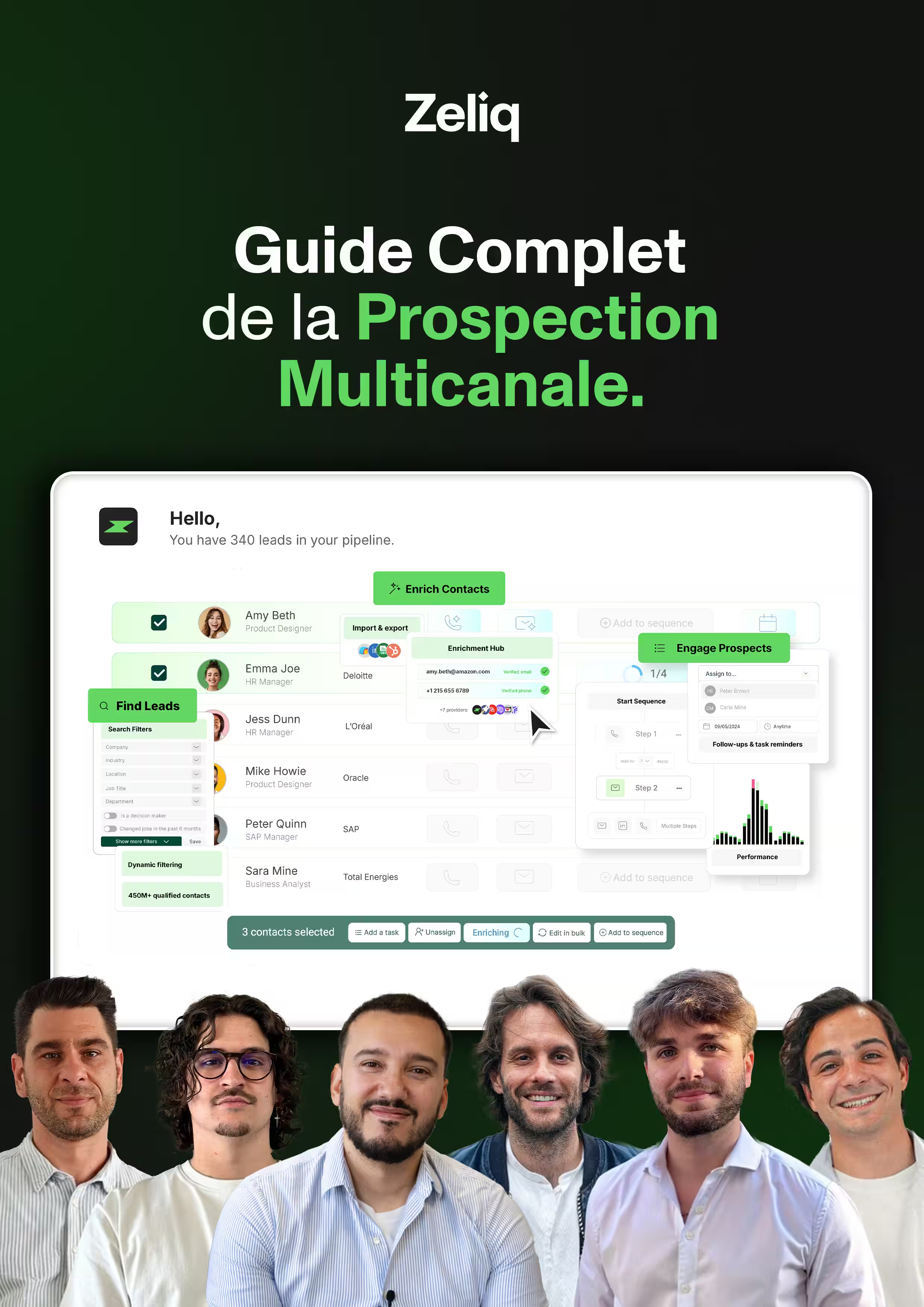
Zeliq combines a 450 million B2B contact database, waterfall enrichment across multiple sources with integrated email verification, and multichannel sequences in one interface. Build the list, enrich to verified email + phone, run the multichannel sequence (email + LinkedIn + phone), all without stitching four tools. GDPR-native suppression, European positioning.
10. Common mistakes
Mistake 1: Single-channel sequences. Email-only caps reply rate ~3%. Add LinkedIn + phone for 287% lift.
Mistake 2: Too many touches, too little space. 12 touches over 5 days = spam. 8 touches over 18 days = professional cadence.
Mistake 3: Generic personalization tokens. Hi {first_name}, I noticed {company} is in {industry} = worse than plain text. Use signal-specific openers.
Mistake 4: No breakup email. Breakup emails generate 10-15% of total sequence replies from fence-sitters.
Mistake 5: Sending without verification. 15-30% bounce = wrecked sending reputation for 2-4 weeks.
11. Frequently asked questions
What is the optimal length for a cold outbound sales sequence?
8-12 touches over 14-21 business days for standard mid-market cold outbound, 18-24 touches over 6-8 weeks for enterprise, and 6-8 touches over 7-10 days for warm inbound follow-up. The cold outbound sweet spot of 14-21 business days balances patience with responsiveness: too short (< 10 days) doesn’t give the prospect enough time to notice and respond across channels; too long (> 25 days) leads the prospect to forget the earlier touches and treats each new touch as a first contact. Touch count of 8-12 ensures multiple channels get covered without saturating any one channel: 3-4 email touches + 2-3 LinkedIn touches + 2-3 phone touches spread across the 21-day window. Enterprise sequences extend to 18-24 touches over 6-8 weeks because enterprise buying committees are larger (5-10 stakeholders per account), buying cycles are longer, and the marginal cost per additional touch is offset by the higher deal value. Warm inbound follow-up compresses to 6-8 touches over 7-10 days because intent is already hot; speed to first touch matters more than sequence length. Compress further to 3-5 touches over 5 days for high-intent leads (demo request, pricing page visit within 24h). Rule of thumb: match sequence length to buying cycle. If prospects typically take 30-60 days from first contact to close, don’t run sequences longer than 21 days; if enterprise deals take 6-12 months, sequences of 6-8 weeks match the buying rhythm.
How much does a multichannel sales sequence lift reply rate vs single channel?
Multichannel sequences combining email + LinkedIn + phone lift reply rates by up to 287% vs single-channel sequences per aggregated SERP benchmarks in 2026, with top-performing teams hitting 15-20% reply rates through tight ICP targeting + AI-assisted personalization. The 287% number is the ceiling of well-executed multichannel; typical mid-market teams see 2-3× lift moving from email-only to email + LinkedIn + phone. Mechanism: prospects have different channel preferences (some prefer email, some phone, some LinkedIn); touching multiple channels compounds probability that at least one lands. Also, the compounding effect of impressions: seeing your name in email + LinkedIn + missed call creates familiarity that a single email does not. Baseline benchmarks: (1) Email-only cold outbound: 2-4% reply rate typical, 5-7% with good copy. (2) Email + LinkedIn: 5-8% reply rate. (3) Email + LinkedIn + phone: 8-15% for typical teams, 15-20% for top-performing teams with signal-led personalization and clean data. (4) Enterprise multichannel with account-based coordination: 20-30% engagement rate on target accounts (though not always reply-rate; sometimes just meaningful engagement metrics). Prerequisites for hitting the higher end: (a) verified email + LinkedIn URL + phone on 90%+ of the list (bad data caps reply rate below 5% regardless of channel), (b) signal-led openers referencing a specific trigger event, (c) sequence spacing that doesn’t feel like spam (see previous FAQ), (d) breakup emails that generate 10-15% of total replies from fence-sitters.
What tools are needed to run a professional sales sequence?
A CRM as system of record ($0-150/seat/month), a contact database + enrichment platform ($150-400/seat/month), and a sequencer that supports multichannel ($100-200/seat/month standalone or bundled in all-in-one platforms), totaling $250-750/user/month at mid-market pricing. Concrete tool categories: (1) CRM (HubSpot CRM Free, Salesforce Essentials, Pipedrive Starter): $0-30/seat/month entry; $50-150/seat/month for professional tiers with workflow triggers. (2) Contact database + enrichment (Apollo, Cognism, Zeliq, ZoomInfo): $150-400/seat/month at mid-market. Provides verified email + phone + firmographic + signals. (3) Sequencer with multichannel support: category leaders (Outreach, Salesloft) at $100-200+/seat/month enterprise; bundled in all-in-one platforms (Apollo, Zeliq) at no additional seat cost. Email-first alternatives (Instantly, Lemlist, Smartlead) at $30-100/seat/month cover email + LinkedIn only. (4) Dialer for phone-heavy motions: $30-80/seat/month (Aircall, Ringover, Orum, PhoneBurner). Total stack at mid-market: $250-750/user/month stitched, or $200-500/user/month all-in-one (Apollo, Zeliq consolidate database + enrichment + sequencer). Beyond direct tool cost, factor CRM seat cost, integration debug (5-15 hours/month for stitched, near zero for all-in-one), and refresh cadence overhead. Team scaling: consolidation savings compound above 3-5 SDRs where seat multiplication amplifies unit costs. See multichannel prospecting guide for tool selection framework.
12. Conclusion: 3 actions to run
Audit current sequence structure within 7 days. Count touches, channels, spacing. If single-channel or > 12 touches < 21 days, restructure.
Test signal-led openers within 15 days. Pick 100 in-ICP contacts with a fresh trigger event (funding, hire, tech switch). Compare reply rate vs demographic-only baseline.
Verify data quality within 30 days. Run current list through SMTP verification. If bounce rate > 3%, pause sequences until data cleaned.
Multichannel sales sequences with verified data and signal triggers built-in
Zeliq combines 450 million B2B contacts, waterfall enrichment with integrated verification, and multichannel sequences (email + LinkedIn + phone) in one interface. Signal-led openers, GDPR-native suppression. Free trial credits included.
Try for freeAnd if you want to run multichannel sales sequences on verified data with signal-led openers in a single interface, try Zeliq for free: sourcing, enrichment, verification, and multichannel sequences without stitching four tools, no credit card required.