

Kaspr vs Lusha: An Honest Comparison for B2B Sales Teams in 2026
Choosing between Kaspr and Lusha is a decision many B2B sales teams face when evaluating prospecting tools. Both platforms promise accurate contact data, both offer LinkedIn Chrome extensions, and both serve the same fundamental need: getting verified emails and phone numbers for prospects so your team can reach out without bouncing into the void.
But the similarities stop there. Kaspr is built around LinkedIn and leans heavily into European market coverage, while Lusha takes a broader database approach with particular strength in direct dial phone numbers and US market depth. This article breaks down both platforms across every dimension that matters for a sales team: data quality, extension UX, bulk enrichment, integrations, pricing, GDPR posture, and the scenario where each tool wins, plus a third option worth considering.
Positioning: What Each Tool Was Built For
Kaspr
Kaspr was founded in France and acquired by Cognism in 2022. It is positioned primarily as a LinkedIn-first prospecting tool, deeply integrated with LinkedIn and LinkedIn Sales Navigator. The product is strongest for teams prospecting in Europe, particularly in markets like France, Germany, the UK, and the Benelux region.
Its core use case is extracting verified emails and phone numbers directly from LinkedIn profiles and Sales Navigator lists, then syncing those contacts to a CRM or sequencing tool. Kaspr also offers a dashboard for managing and exporting leads, but the extension is where most of the value lives.
Key positioning attributes: - LinkedIn-native workflow (built around Sales Navigator) - Strong European database coverage - GDPR-forward messaging and EU data infrastructure - Cognism’s data layer as backbone post-acquisition
Lusha
Lusha was founded in Israel and has built a significantly larger global database, with particular depth in North American contacts and stronger direct dial phone number coverage. It is positioned as a broad-coverage sales intelligence platform, suitable for teams prospecting across multiple regions and verticals.
Lusha also offers a Chrome extension but its interface and data retrieval extend beyond LinkedIn to company websites and other professional profiles. The platform has invested heavily in API access and CRM enrichment workflows, making it popular with revenue operations teams who need to enrich large contact databases programmatically.
Key positioning attributes: - Larger global database with US depth - Stronger direct dial phone number coverage - Broader API and CRM enrichment capabilities - Suited for larger, cross-regional teams
Data Quality: Email Accuracy and Phone Numbers
Data quality is the only thing that actually matters in a prospecting tool. A tool that gives you 10,000 contacts with 40% accuracy is less valuable than one that gives you 1,000 contacts with 90% accuracy. Here is how Kaspr and Lusha compare on the two most critical data types.
Email Accuracy
Both tools claim high email accuracy, but real-world performance varies by region and vertical:
- Kaspr performs best for European B2B email addresses, particularly for mid-market and enterprise contacts in France, the UK, and Germany. For US contacts, accuracy is more variable.
- Lusha has stronger US coverage and tends to perform better for North American contacts, especially at the enterprise level. Its European coverage is good but thinner than Kaspr’s for certain markets.
For teams prospecting primarily in Europe, Kaspr’s email accuracy edge is meaningful. For North America-focused teams, Lusha’s database depth is the advantage.
Phone Numbers: Direct Dials vs. Switchboard Numbers
This is one of the clearest differentiators between the two tools. Direct dial phone numbers (numbers that reach the individual, not a company reception) are dramatically more valuable for cold calling than switchboard numbers.
- Lusha has a well-established advantage in direct dial coverage. For US-based contacts, Lusha’s direct dial rate is consistently higher than Kaspr’s in user surveys and independent comparisons.
- Kaspr provides phone numbers but a higher proportion of them are switchboard or company numbers in some markets, especially for smaller companies.
If cold calling is a core part of your outreach motion, Lusha’s phone data is a meaningful advantage, particularly for US-market teams.
LinkedIn Chrome Extension: UX and Data Freshness
Both tools offer Chrome extensions that sit inside LinkedIn and Surface contact data on profile pages and Sales Navigator search results. The extension experience is where most SDRs spend the majority of their time with either tool.
Kaspr’s Extension
The Kaspr extension is tightly integrated with LinkedIn’s interface, appearing as a sidebar panel when viewing a profile or hovering over a search result. The UI is clean and the credit consumption is clear before you reveal contact data.
Strengths: - Seamless Sales Navigator integration for bulk list processing - Clear credit display per action - Fast data retrieval for European profiles - Ability to add contacts directly to sequences or CRM without leaving LinkedIn
Limitations: - Data outside LinkedIn (company websites, other directories) is not surfaced by the extension - Phone number availability for non-European contacts can be lower
Lusha’s Extension
Lusha’s extension works across LinkedIn and company websites, giving it a broader activation surface. When you visit a company’s website, the extension can surface contacts at that company, not just the person whose LinkedIn profile you are viewing.
Strengths: - Works on multiple surfaces beyond LinkedIn - Strong direct dial data for US contacts - Team dashboard for tracking credit usage across reps - Prospecting list building from search results
Limitations: - Some users report the extension feeling slightly heavier in terms of performance impact - Credit costs per reveal are not always immediately obvious in older interface versions
Verdict: For pure LinkedIn-first workflows, Kaspr’s extension is more purpose-built. For teams who also prospect from company websites or need broader surface coverage, Lusha has an edge.
Bulk Enrichment: CSV and CRM Workflows
Beyond individual profile lookups, both tools offer bulk enrichment capabilities: uploading a CSV of contacts and getting emails and phone numbers back, or connecting to a CRM and enriching existing records.
Kaspr Bulk Enrichment
Kaspr offers bulk export from Sales Navigator lists, which is its strongest bulk use case. You can build a list in Sales Navigator, run Kaspr’s extension across those results, and export a clean CSV with contact data. The workflow is streamlined for this specific scenario.
CSV upload enrichment is available but the matching accuracy depends heavily on having LinkedIn profile URLs in your file. Without them, match rates can drop.
Lusha Bulk Enrichment
Lusha has invested more heavily in standalone bulk enrichment workflows. Its CSV enrichment tool matches on name, company, and domain combinations, meaning you do not need LinkedIn URLs to get good results. This is a meaningful advantage for teams with existing contact databases they want to enrich outside of a LinkedIn context.
Lusha also offers a prospecting API that revenue ops teams use to enrich records at scale programmatically, making it more suitable for large-scale data enrichment use cases.
Integrations: CRM and Sales Stack Compatibility
Kaspr Integrations
Kaspr natively integrates with: - Salesforce (bidirectional sync) - HubSpot (contact and deal sync) - Pipedrive - Salesloft and Outreach (for sequencing) - Lemlist - Zapier for custom workflows
For most mid-market B2B sales stacks, Kaspr’s integration coverage is sufficient. However, the depth of some integrations (particularly around field mapping and activity logging) is more limited than enterprise-grade tools.
Lusha Integrations
Lusha offers a broader integration catalog: - Salesforce (with stronger field-level enrichment options) - HubSpot - Pipedrive - Microsoft Dynamics - Outreach and Salesloft - Gong - API access (available on higher plans)
For teams with more complex CRM setups or those using Microsoft Dynamics, Lusha’s integration breadth is advantageous. The API access also makes Lusha more flexible for custom integrations built by RevOps teams.
Pricing Comparison
Both tools use a credit-based model where each contact reveal consumes credits. Exact pricing evolves, but here is the general structure as of 2026:
| Dimension | Kaspr | Lusha |
|---|---|---|
| Free plan | Yes (limited credits/month) | Yes (limited credits/month) |
| Entry paid plan | ~50 EUR/month per user | ~39-49 USD/month per user |
| Credit system | Per email/phone reveal | Per contact reveal |
| Team plans | Volume discounts available | Volume discounts available |
| Annual commitment | Discount for annual billing | Discount for annual billing |
| API access | Higher-tier plans | Higher-tier plans |
| Unlimited plans | Not standard offering | Available for larger teams |
Key pricing considerations:
- Kaspr’s credit model separates email credits and phone credits, meaning you pay for each data point individually. This can be cost-effective if you only need emails, but expensive if you need both.
- Lusha bundles email and phone in a single “contact” credit on most plans, which simplifies budgeting.
- For small teams (1-5 users), both tools are similarly priced. For larger teams (10+ users), Lusha’s team plan structures tend to offer better per-user economics.
- Neither tool publishes fully transparent pricing for enterprise tiers, requiring a sales conversation for custom quotes.
GDPR Compliance: Where Each Tool Stands
GDPR compliance is a serious concern for any team prospecting in Europe, and both tools have made significant investments here.
Kaspr and GDPR
As a French-founded company (acquired by Cognism, also GDPR-focused), Kaspr has historically positioned itself strongly on compliance. Key claims include:
- Data sourced from public sources and partner data providers with consent frameworks
- EU data storage and processing
- Regular data audits and removal workflows for opt-outs
- Integration with GDPR-mandated opt-out mechanisms
Kaspr’s European roots and Cognism’s compliance-heavy positioning give it a credibility edge with European prospects who ask about data provenance.
Lusha and GDPR
Lusha is ISO 27701 certified (the privacy extension of ISO 27001) and GDPR-compliant. It maintains a formal Data Processing Agreement (DPA) for EU customers and has invested in compliance infrastructure. However, being an Israeli-founded company with a US-first history, some European buyers historically viewed its GDPR posture with more scrutiny.
Lusha has addressed this with formal certifications and infrastructure investments, and in practice, both tools are considered compliant for EU use by most legal teams.
Bottom line: If your legal team is particularly rigorous about EU data provenance, Kaspr’s positioning may be easier to defend internally. For most teams, both tools pass a standard GDPR compliance review.
Decision Framework: Kaspr vs. Lusha, Which to Choose?
| Scenario | Recommended Tool |
|---|---|
| Primarily prospecting in Europe (France, DACH, Benelux, UK) | Kaspr |
| Primarily prospecting in North America | Lusha |
| Heavy LinkedIn and Sales Navigator workflow | Kaspr |
| Need strong direct dial phone numbers (US) | Lusha |
| Large existing database to enrich via CSV | Lusha |
| Strict EU GDPR positioning required | Kaspr |
| Complex CRM setup (Dynamics, API) | Lusha |
| Small team with tight budget | Kaspr (EU focus) or Lusha (global) |
| RevOps team needing API enrichment | Lusha |
| SDR team running pure LinkedIn outbound | Kaspr |
When Zeliq Is the Better Alternative
Here is the scenario neither Kaspr nor Lusha addresses well: you need contact data, enrichment, AND outreach sequencing in one place without patching together three separate tools.
Both Kaspr and Lusha are fundamentally data providers. They find and surface contact information. What happens after that, the actual outreach: the emails, the LinkedIn messages, the follow-ups, the tracking, requires separate tools like Lemlist, Salesloft, or Outreach, each adding cost, complexity, and sync failures.
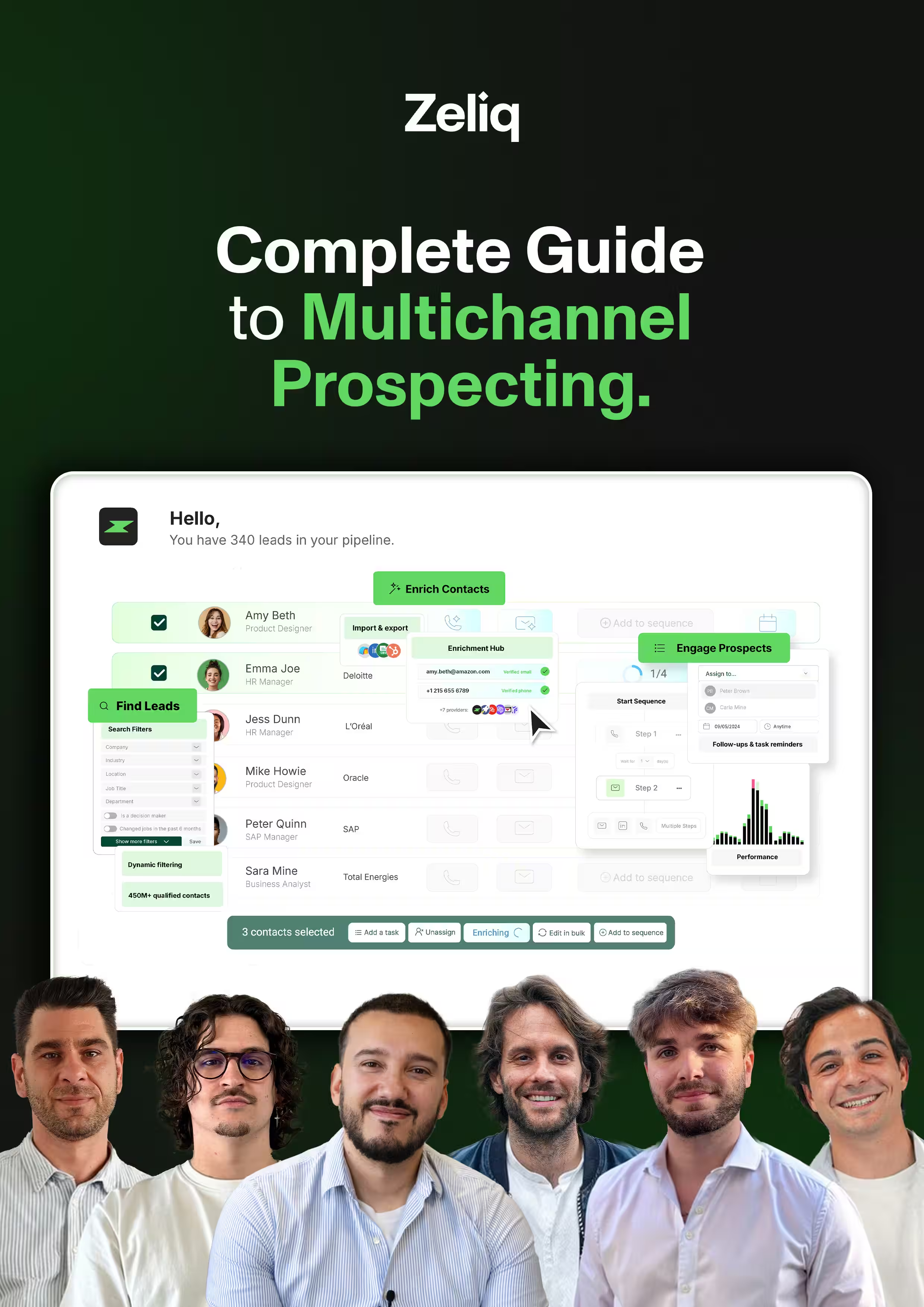
Zeliq is built as an integrated platform: contact discovery, data enrichment, and multichannel sequencing in a single product. Instead of Kaspr (or Lusha) + a sequencer + a CRM enrichment workflow, Zeliq handles the full loop.
Specifically:
- Find verified B2B contacts directly inside Zeliq, with emails and phone numbers sourced from multiple data providers
- Enrich your existing contact data in bulk: upload a CSV or connect your CRM and Zeliq fills the gaps
- Run multichannel prospecting sequences (email, LinkedIn, and more) without switching tools
- Use the browser extension to capture contacts from LinkedIn and enrich them instantly inside your workflow
For a small or mid-sized sales team that finds itself paying for a data tool and a sequencer separately, and then spending time keeping them in sync, Zeliq’s all-in-one architecture eliminates a layer of tooling complexity and reduces the total cost of the stack.
Zeliq is not the right choice for every team. If you need deep enterprise-grade CRM enrichment at API scale and already have a sequencing tool you love, Lusha’s data layer plus your existing setup may be fine. If you are a large organization with a mature tech stack and specific regional data needs, Kaspr or Lusha may slot in cleanly.
But for growing B2B sales teams that want to move faster with fewer tools and cleaner workflows, Zeliq is worth a serious look.
Summary
Kaspr wins for: European-market outreach, LinkedIn-native workflows, GDPR-sensitive contexts, and teams that live in Sales Navigator.
Lusha wins for: North American outbound, direct dial phone coverage, large-scale CSV enrichment, and teams with complex CRM or API needs.
Zeliq wins for: teams that want data plus outreach in one place, without the overhead of integrating and maintaining separate tools across the prospecting stack.
Why pay for a data tool and a sequencer separately? Zeliq gives you verified B2B contacts, enrichment, and multichannel sequences in one platform, so your team can spend less time switching tabs and more time closing deals.
Try Zeliq for free