
Every minute a sales representative spends on the wrong sales prospect is time lost with a potential customer who could actually move forward in the buying process.
It’s not just about the purchase decision you’ll never win: it’s wasted time, missed quota, and qualified opportunities slipping out of your sales pipeline.
Experienced sales teams know the lead qualification process is what separates activity from real progress. You learn fast that not every name in your CRM deserves a call. Some leads have no budget authority, no decision-making power, or no urgency to act.
That’s why the prospect qualification process matters so much.
You cut out the unqualified leads before they drain your time, and keep your sales reps focused on potential customers who:
- fit your ideal customer profile,
- meet your main qualification criteria,
- and show real buying signals.
It’s what keeps the sales funnel clean, the forecast honest, and the sales cycle running at a pace that can actually close deals.
Instead of drowning in theory, this guide walks you through what really works in the field: the sales qualification frameworks reps actually use, the sales qualifying questions that uncover intent, and the criteria that separate a curious contact from a true qualified lead.
You’ll also see how sales teams:
- spot high-opportunity prospects,
- avoid the common mistakes that waste time,
- and put tools like ZELIQ to work: bringing firmographic, technographic, and behavioral data together so your reps spend less time guessing and more time closing.
If you want the bigger picture on outbound, you can also check our complete guide to sales prospecting.
What is a qualified prospect?
A qualified prospect isn’t just a name in your CRM. It’s a potential client whose profile matches your ideal customer profile (ICP), who has a clear reason to act, and whose decision makers are engaged in the buying process.
They’re not just curious: they’re positioned to make a purchase decision in a timeframe that fits your sales cycle.
For a broader view of what makes a strong prospect client in B2B, see our dedicated breakdown.
The main signs you’re talking to the right person
Sales professionals often look for a mix of signals:
- Fit with your ICP in company size, industry, and job title.
- A defined problem your product or service can solve.
- Confirmed budget authority or direct access to the person holding it.
- A sense of urgency or a clear timeline to decide.
- Involvement in the purchasing decision or influence over the decision makers.
MQL, SQL and qualified prospect: how they differ
- An MQL is a lead marketing has warmed up. They’ve engaged with content, but they’re not necessarily ready for a sales call.
- An SQL has been vetted by a sales rep as ready for direct conversations.
- A qualified prospect is further along: you’ve validated the fit, the need, the budget, and the authority.
Tightening your qualification process is one of the fastest ways to protect your sales pipeline from wasted time and bad forecasts.
How to qualify a prospect
When qualifying a prospect, the first filter is always the ICP.
If the potential customer doesn’t look like your ideal client on paper, there’s no point pushing forward.
That means checking basic firmographic data: company size, industry, location, and sometimes even tech stack.
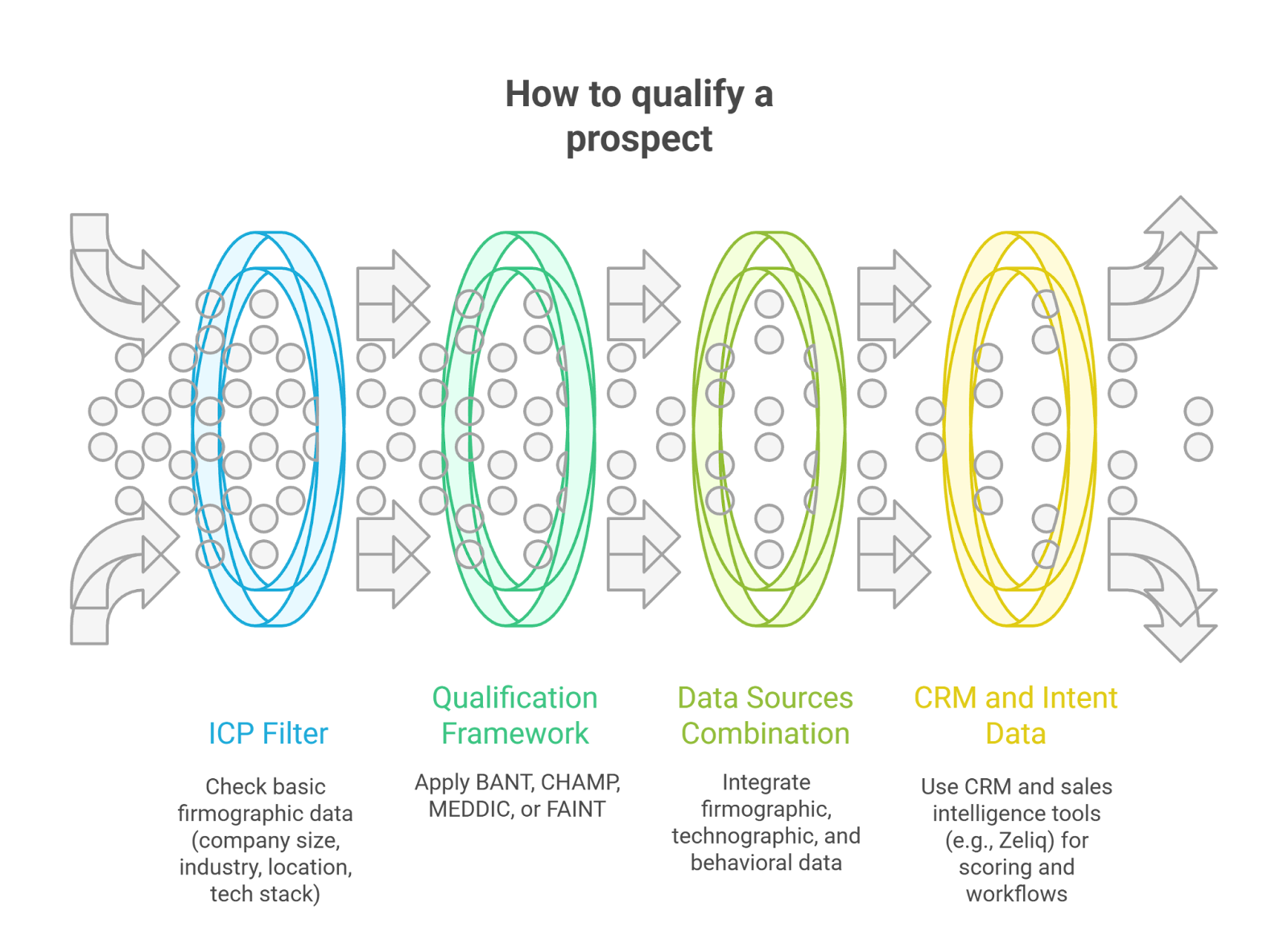
Sales reps who skip this step often burn hours chasing “interesting” accounts that have no realistic path to becoming a qualified lead.
Start with a quick match check. If they don’t fit, they don’t move forward.
Choose the right qualification framework
A good sales qualification framework keeps your team consistent. Four of the most effective are:
- BANT : budget, authority, need, timing.
Still one of the simplest ways to cover the essentials. - CHAMP : challenges, authority, money, prioritization.
A more problem-centric version of BANT. - MEDDIC : metrics, economic buyer, decision criteria, decision process, identify pain, champion.
Perfect for complex B2B sales. - FAINT : funds, authority, interest, need, timing.
Useful when budget isn’t fixed but can be allocated if the value is clear.
The key is not to treat these like checklists. Use them as a structure for a real conversation that uncovers fit, influence, and urgency.
Combine multiple data sources
Relying on one type of data to qualify prospects is risky. The best sales teams combine:
- Firmographic data: company size, industry, revenue.
- Technographic data: tools and platforms the prospect uses.
- Behavioral data: actions like repeated visits to your pricing page or attending a webinar.
When these signals align, you can be confident you’re looking at a high-opportunity level prospect.
Use CRM and intent data to speed up decisions
Modern CRMs and sales intelligence tools like ZELIQ make this process easier.
You can score leads automatically based on qualification criteria, trigger workflows when intent signals appear, and enrich records with job title, budget authority, and stakeholder level information.
This is about avoiding the trap of wasting time. A sales representative who spends half their week chasing the wrong sales prospect is costing the company both revenue and morale.
From lead to qualified opportunity: what is the sales qualification process
Moving a prospect through the sales cycle isn’t a box you tick once. It’s a step-by-step process where you test if the lead is really worth your team’s time.
You begin with the basics: does this potential customer fit your ideal customer profile? From there, you qualify further: do they have budget authority, influence with decision makers, and a reason to act now?
Each layer of validation tells you whether you’re looking at a true sales opportunity or just another name that will drain time from your pipeline.
Done right, this shifts someone from “just another name in the CRM” to a qualified opportunity you can actually forecast.
All of this sits inside a broader B2B sales process that connects prospecting, qualification, and closing into one coherent motion.
A typical flow looks like this:
- Lead intake: from outbound prospecting, inbound lead generation, or referrals.
- Initial qualification: quick ICP and interest check.
- Deeper discovery: assessing need, budget, and the decision-making process.
- Internal review: confirming opportunity level before passing to an account executive.
To keep these steps consistent across outbound and inbound, many teams rely on a documented prospecting plan that aligns SDRs and AEs on who to prioritize and when.
Where qualification happens in the sales funnel
For many sales teams, qualification begins the moment a prospect enters the funnel:
- In inbound sales, it can start within minutes of a form submission.
- In outbound prospecting, it might happen during the first cold calling session or email exchange.
The important part is to define exactly where in your sales funnel the qualification handoff occurs (between SDR and AE, for example), so no one assumes a prospect is further along than they really are.
Timing and follow-up matter
A qualified lead today might not be ready tomorrow if you lose momentum.
Speed to lead is critical
Equally important is structured follow-up.
Many potential clients drop off, not because they’re unqualified, but because the sales rep didn’t stay present in their buying process. A consistent cadence shows commitment and keeps the conversation moving toward a purchase decision.
What questions to ask when qualifying prospects?
The fastest way to figure out if a lead is worth your time is to ask the right questions.
Not a script. Not a checklist. Real questions that get a potential customer talking about their challenges :
- how they make a purchase decision,
- and what’s driving their timeline.
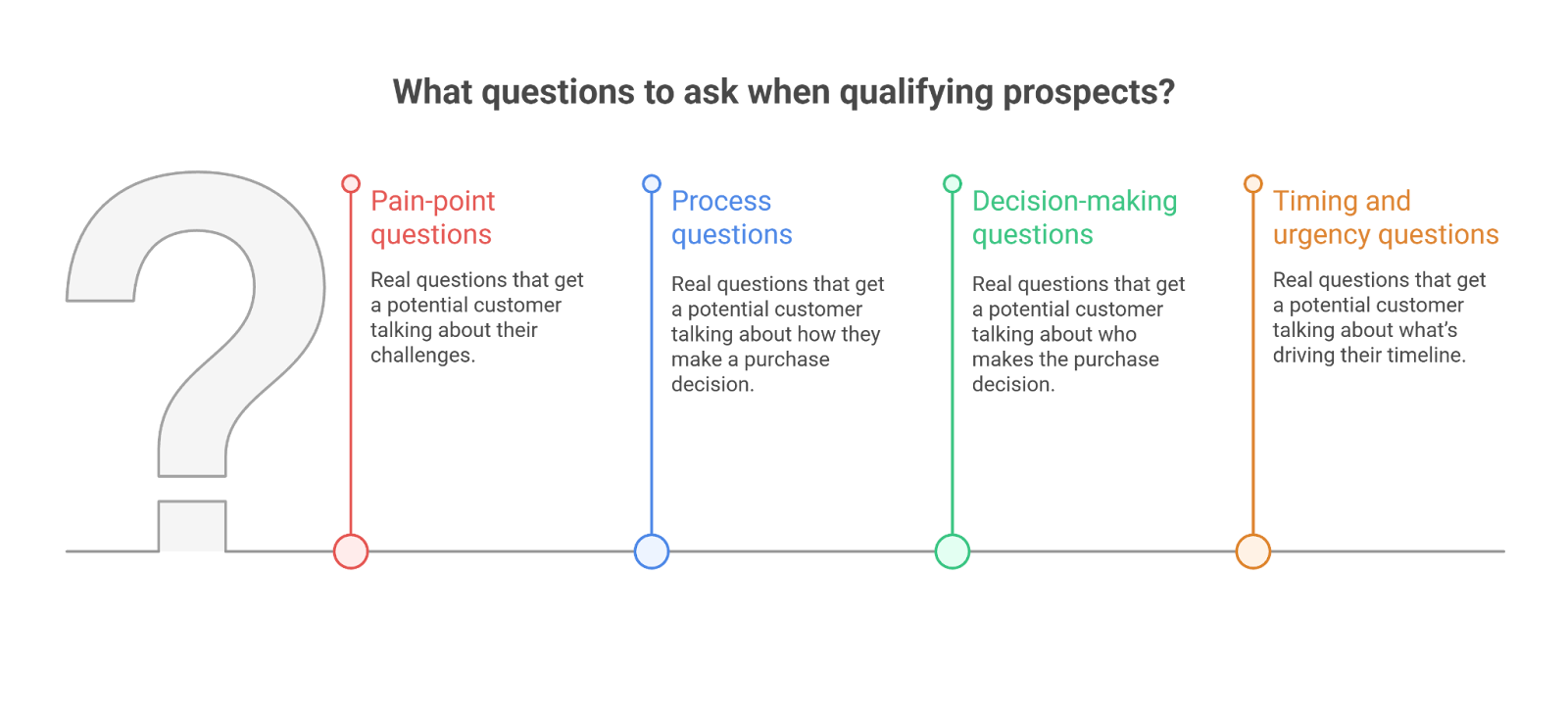
Pain-point questions
Your first goal is to uncover the real problem your potential customer is trying to solve. These questions build trust and position you as a consultative partner.
Examples:
- “What’s the biggest challenge you’re facing in your sales cycle right now?”
- “Why is this problem a priority at the moment?”
- “Have you tried solving this before? What worked and what didn’t?”
- “What happens if this problem isn’t solved in the next quarter?”
These conversations reveal whether your product or service can realistically address the issue, and if the sense of urgency is strong enough to move forward.
Process questions
Understanding the prospect’s internal process avoids nasty surprises later in the buying decision.
Examples:
- “How do you typically evaluate new vendors or solutions?”
- “Who else should be involved in this discussion early on?”
- “What does the approval process look like from your side?”
Answers here tell you about stakeholder level involvement, decision-making power, and the average length of their purchasing decision cycle.
Decision-making questions
These are about mapping the influence network and finding your champion inside the organization.
Examples:
- “Who makes the final purchasing decision?”
- “Have you already discussed budget allocation with decision makers?”
- “What would be a deal-breaker for your team?”
- “Besides yourself, who else will need to sign off before moving forward?”
- “How does your team usually reach consensus on a purchasing decision?”
If you can’t get clarity on these points, you risk wasting time with someone who can’t move the deal forward.
Timing and urgency questions
A qualified lead with no timeline is a pipeline risk. You need to know if the timing aligns with your sales cycle.
Examples:
- “What’s your ideal timeline for solving this?”
- “Are there any external deadlines driving this decision?”
- “If we found the right fit, how soon could you move ahead?”
These help you prioritize high-opportunity level prospects, and manage follow-ups for those not ready yet.
What are the characteristics of a qualified prospect
Not every sales prospect with interest is a qualified prospect. To avoid wasting time, sales reps need to look for a few concrete signs:
Budget authority or direct access to it
A truly qualified prospect either controls the budget or can directly influence the decision makers who do.
If your contact has to “check with someone” for every step, you’re not speaking to the right stakeholder level.
Signs to look for:
- They openly discuss budget ranges or confirm funds are available.
- They can explain the internal purchasing decision process.
- They’re willing to involve the economic buyer early.
- They can confirm whether funds are already secured or need executive approval.
- Bonus: they proactively suggest bringing finance or procurement into the conversation.
A well-defined need aligned with your offer
Qualified prospects know what they want to achieve, and their objectives align with your product or service’s capabilities.
They can articulate the pain point in concrete terms, which makes it easier to position your solution as a fit.
Clues:
- They’ve tried other solutions but weren’t fully satisfied.
- They’re clear on the business impact of solving this problem.
- They can link the problem to strategic company goals.
- They can describe the internal challenges or inefficiencies they want to eliminate.
A realistic timeline and sense of urgency
Even if the need is clear, a weak timeline often means the opportunity level is low.
A qualified prospect has an internal reason to act within a timeframe that makes sense for your sales cycle.
Indicators:
- There’s an external event or deadline driving the decision.
- They’ve already allocated time for implementation.
- They express the cost of delaying the purchase decision.
Willingness to engage and explore value
This is more than politeness: it’s about active engagement in the sales process.
They ask relevant sales qualifying questions, share useful information, and are open to discussing next steps.
Typical signs:
- They attend scheduled calls, without repeated chasing.
- They ask for additional details, demos, or case studies.
- They show genuine curiosity about how you solve their specific challenges.
- They involve other decision makers or stakeholders early in the buying process.
- They respond promptly to emails or follow-ups, showing a real sense of urgency.
How to identify a qualified lead
Spotting a qualified lead means checking for the right signals, from behavior and firmographic fit to scoring models and automation:
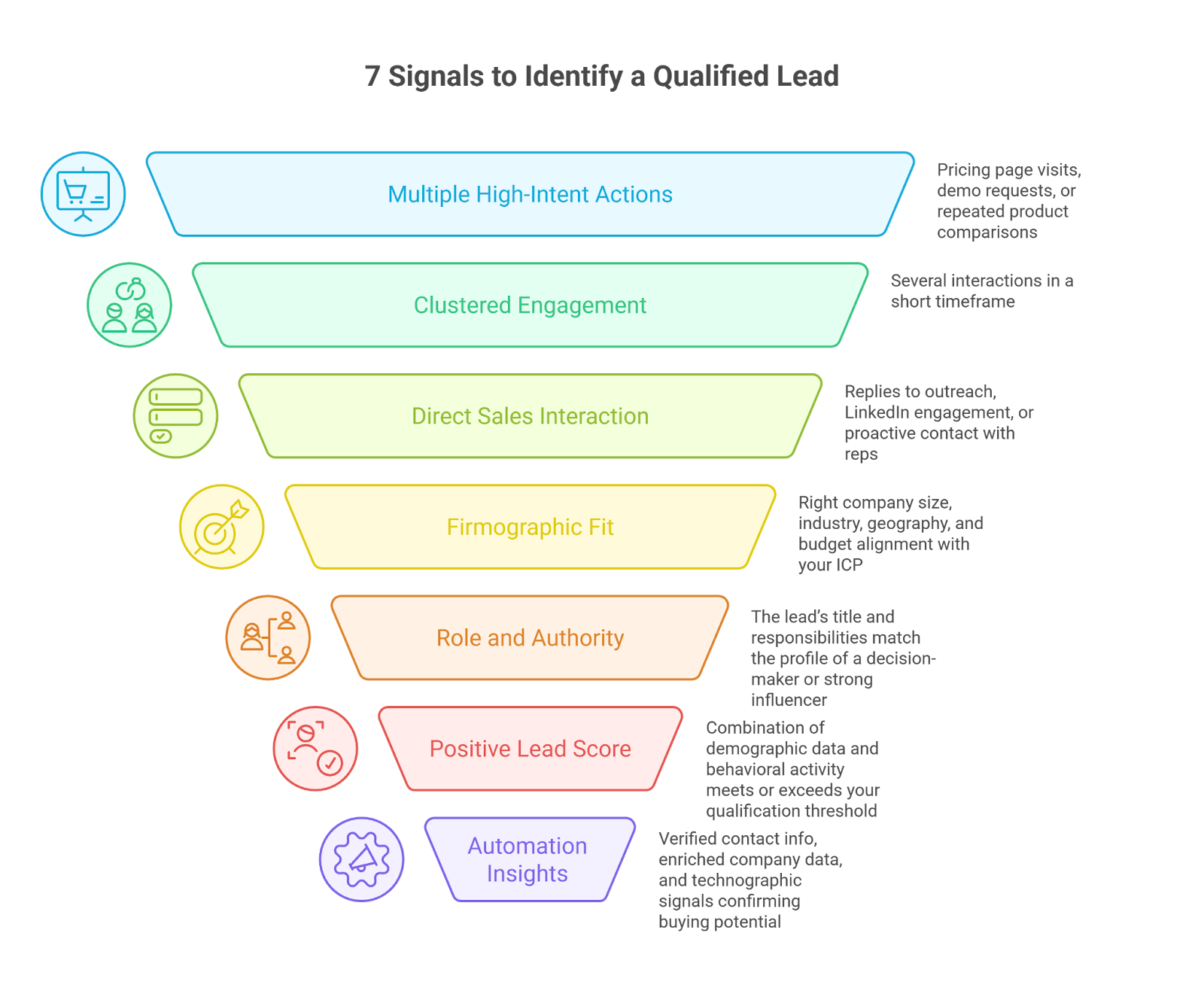
Behavioral triggers
One of the fastest ways to know if someone’s worth your time is: to watch what they actually do.
Leads with real buying intent rarely stay passive.
They’ll click through your pricing page more than once, compare you with other vendors, or take the time to request a demo.
Sometimes they’ll engage directly with your sales reps on LinkedIn, react to content, or reply quickly to outreach.
The key is to look for a cluster of these actions in a short time frame. A single website visit doesn’t mean much; three visits, a whitepaper download, and a webinar registration in the same week tells a different story.
Firmographic filters
Before you get too excited about behavior, check the basics. Does this lead fit your ideal customer profile in terms of company size, industry, and market?
You might love their enthusiasm, but if they’re outside your target segment, the chances of closing are slim.
Some reps chase “interesting” companies for months only to find out their budget or operational setup could never support their product or service. A quick ICP check early on saves you from that.
Scoring models
Lead scoring is where instinct meets process. A good model blends the hard facts (like job title, location, and stakeholder level) with the softer signals from your CRM: pages visited, emails opened, events attended.
The best sales teams adjust as they see what actually converts, using thresholds to decide when a lead is truly sales qualified.
It’s about keeping the sales pipeline focused, not just full.
Using automation to pre-qualify
Manual research on every lead is a luxury most sales teams can’t afford.
Tools like ZELIQ can handle the “heavy lifting”: pulling verified contact details, enrichment data, and even technographic insights in seconds.
This means your reps walk into the first conversation already knowing the lead’s likely budget authority, decision-making power, and how far along they are in their buying process.
It’s efficient and shows the difference between prospecting blind and starting halfway to the close.
What mistakes to avoid in prospect qualification
Chasing volume instead of fit
A big pipeline looks great in a dashboard, but if half of it is made up of people who will never buy, it’s a false sense of security. I’ve seen sales teams hit activity KPIs yet miss revenue targets because they spent weeks working low-fit leads. Quality beats quantity—every time.
Confusing interest with readiness
Just because a potential customer takes your call or downloads a whitepaper doesn’t mean they’re ready to make a purchase decision. Without budget, timing, and a clear need, you’re looking at a long nurture cycle, not a quick win. Recognizing this early helps you set the right expectations and focus your follow-up.
Ignoring red flags
Evasive answers about budget, unclear decision-making processes, or reluctance to involve other stakeholders are warning signs. Too often, reps push past them because they want to keep the deal alive. In reality, addressing these head-on saves weeks of wasted time in the sales cycle.
Not confirming decision-making power
Talking to the wrong person isn’t always a waste—sometimes they can introduce you to the decision makers—but if you never push to get that access, you’ll stall. Always map the stakeholder level early, and make sure you know who has the authority to buy.
Why is qualifying prospects critical for sales productivity
Every hour your sales reps spend on a low-fit lead is an hour they’re not talking to a potential client who could actually buy. If you want to go deeper on this topic, you can explore our guide on increasing sales productivity and see how tight qualification multiplies output per rep.
When qualification is tight, you avoid bloated pipelines and the demotivation that comes from chasing deals that were never real opportunities.
Increasing close rates
A focused sales pipeline isn’t just smaller, it’s healthier.
When most of the prospects in it have budget authority, decision-making power, and urgency, close rates go up.
It’s not magic, it’s math: more qualified conversations equal more wins.
Improving pipeline visibility
For a Head of Sales, forecast accuracy depends on knowing which deals are truly viable.
If your team qualifies prospects consistently, your sales funnel becomes a reliable tool for resource planning and revenue prediction, not just a list of names.
Prioritizing high-potential opportunities
Qualification lets you segment your sales prospects by opportunity level.
This way, your team can double down on the ones most likely to move forward, while setting aside others for longer-term nurture, avoiding the trap of treating all leads as equal.
What role does the sales rep play in qualification
A strong rep asks the right questions, but does it in a way that feels like a genuine conversation. The best qualification calls don’t sound like interviews.
Curiosity opens doors: when a prospect feels you’re trying to understand, not just “qualify,” they’ll share the details you actually need.
Finding the real decision path
It’s not always the person you’re talking to who signs the contract.
Sometimes they’re an influencer, sometimes a gatekeeper.
A good sales rep figures that out early and maps the path to the decision makers. That might mean asking directly, or piecing it together from how they describe their buying process.
Creating value before the pitch
Too many reps think qualification is a box-ticking step before “the real selling” starts.
In reality, you can create value in the very first conversation: by sharing a quick win, a relevant example, or even just reframing their challenge.
That’s what makes you memorable and moves you from “another vendor” to “a trusted partner” in the prospect’s mind.
How to handle unqualified prospects gracefully
Follow these three simple steps to keep the door open without wasting time or energy on prospects who aren’t ready yet.
Leave the door open
When a prospect isn’t ready, it doesn’t mean the conversation is over. The worst move is to cut it short and disappear.
End on a positive note instead: “Sounds like the timing isn’t right: let me share a quick guide or case study that might help in the meantime.”
You stay on their radar and, more importantly, keep the relationship intact.
Keep a light touch
Some accounts have real potential, just not right now.
Some deals come back 12-18 months later simply because the rep kept a gentle line of communication: commenting on a LinkedIn post, sending a short email with a relevant insight, or inviting them to a webinar.
It doesn’t take much time, but it makes all the difference when they’re ready to re-engage.
Spot the right moment to come back
Reaching out too soon is noise. Too late, and you’re forgotten.
The best sales reps look for signals: a decision maker taking a new role, a funding round, a shift in strategy.
With a tool like ZELIQ, these intent signals pop up in your CRM automatically. That’s when you restart the conversation, when the odds of moving forward are much higher.
What tools and data sources improve qualification
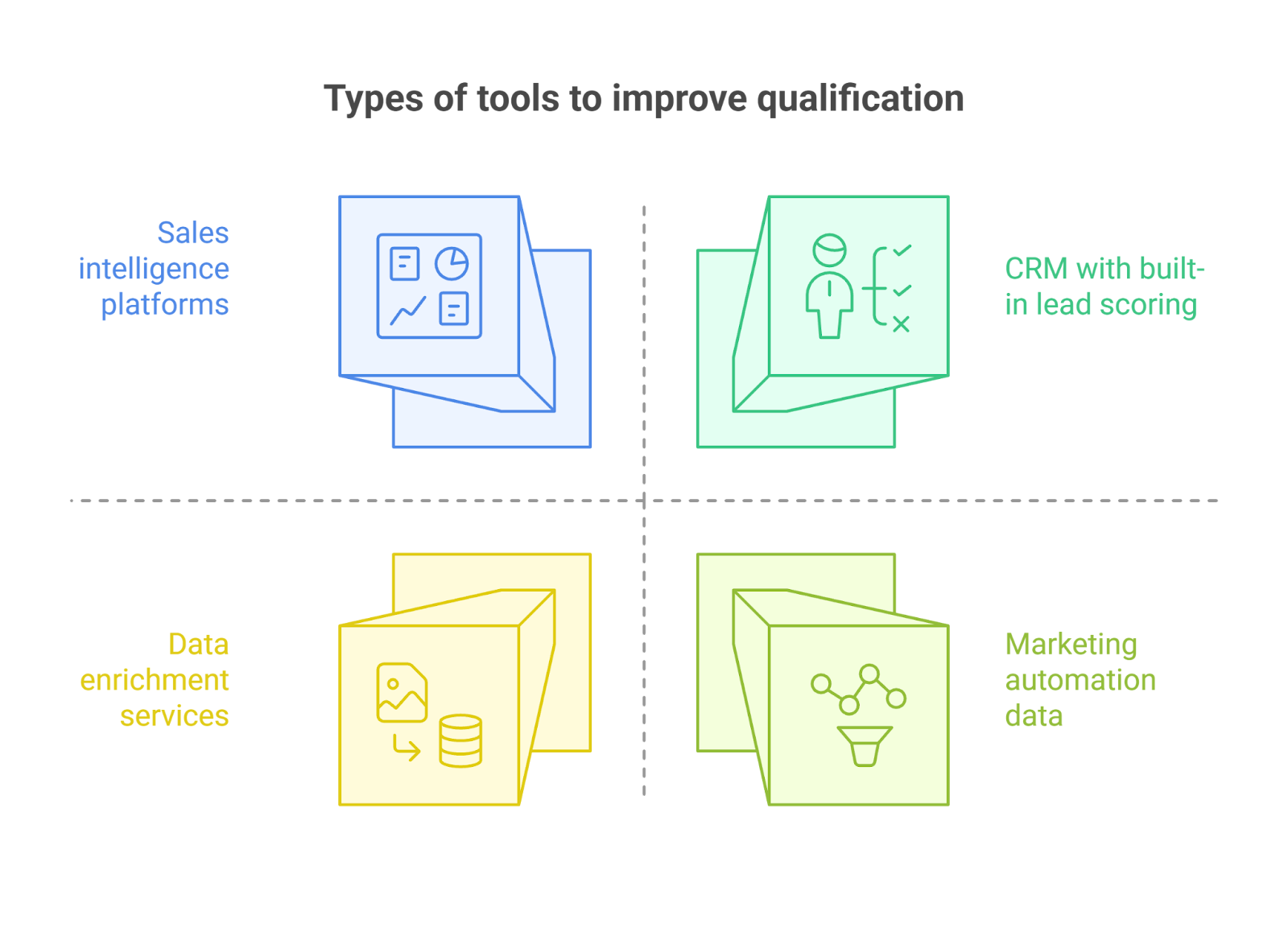
CRM with built-in lead scoring
A good CRM is your team’s command center.
Platforms like Salesforce or HubSpot let you combine firmographic, behavioral, and engagement data into a single lead score. Reps can see at a glance who’s worth calling today and who belongs in a nurture sequence.
Sales intelligence platforms
Tools like ZELIQ, Cognism, or Apollo go beyond contact details.
They enrich profiles with verified B2B emails, direct dials, technographics, and even buying signals. That’s the difference between cold calling a random “contact” and calling a decision maker with context, using a tested cold call script instead of improvising every time.
Marketing automation data
Your marketing stack is a goldmine for qualification.
Email engagement rates, content downloads, and webinar attendance tell you who’s paying attention. When this data flows into your CRM, sales reps can time their outreach to match the prospect’s buying process.
Data enrichment services
Services like Clearbit or ZoomInfo fill in the gaps (company size, funding stage, hiring trends), so your reps don’t waste time researching from scratch.
Enriched data also makes it easier to match leads against your ideal customer profile before the first touchpoint.
Examples of qualifying questions by sales stage
1. Discovery stage
At this point, you’re trying to understand the lay of the land: what’s driving the conversation, what’s broken, and who’s involved.
Examples:
- “What’s the main challenge you want to solve in the next quarter?”
- “How have you tried to address this before?”
These questions surface urgency and context without diving too quickly into a pitch.
2. Evaluation stage
Now you’re mapping the buying process and identifying stakeholders. This is where you confirm if you’re speaking to the right people.
Examples:
- “Who will be impacted by this purchase and should be involved in the conversation?”
- “What other solutions are you comparing us with?”
It’s about knowing the decision-making path and tailoring your value to it.
3. Decision stage
This is where you clear the final hurdles. If you’ve qualified properly, there should be no big surprises here.
Examples:
- “What would make this a no-brainer for you?”
- “Are there any concerns holding you back from moving forward?”
- “What’s your ideal timeline for implementation?”
By now, the answers should confirm your opportunity level, or tell you it’s time to walk away.
Qualifying in outbound vs. inbound sales
Inbound: reading the signals
Inbound leads often arrive with self-qualification baked in.
They’ve filled out a form, downloaded content, maybe even requested a demo. But don’t assume they’re ready to buy: check that they fit your ideal customer profile and have budget authority before moving them deeper into the sales funnel.
The upside is you already have behavioral data to guide your approach.
Outbound: uncovering the fit
With outbound prospecting, your reps are walking in cold.
The job is to figure out fast if the sales prospect has real potential. That means putting qualifying questions on the table early (about their challenges, their buying process, and their timeline), so you don’t waste weeks chasing a deal that was never going to close.
Speed and context matter
In both inbound and outbound, timing can make or break the deal.
An inbound lead answered within minutes can turn into a qualified opportunity before a competitor even reacts.
Outbound is different: you win by showing context. If your outreach proves you understand their business before you pitch your product or service, you earn attention.
Platforms like ZELIQ give reps that context automatically, so every call and email feels relevant instead of random.
When to disqualify a prospect
No budget, no fit with your ideal customer profile, and no willingness to make a change are all clear signs that a prospect should be disqualified.
No budget and no timeline
If a prospect can’t fund the solution and has no plan to revisit it soon, it’s not a deal, it’s a distraction. Keep them in your nurture track, but don’t let them clog the active sales pipeline.
No alignment with your ICP
Even if they’re enthusiastic, if they don’t fit your ideal customer profile, the long-term value will be low. Selling outside your target market often leads to churn, poor ROI, and frustrated customer success teams.
No readiness to make a change
Some companies are aware of their challenges but aren’t ready to act. If there’s no internal drive or external pressure to move forward, you’ll spend months following up without progress. Spot this early and move your focus to prospects with a real sense of urgency.
How to use ZELIQ for sales qualification
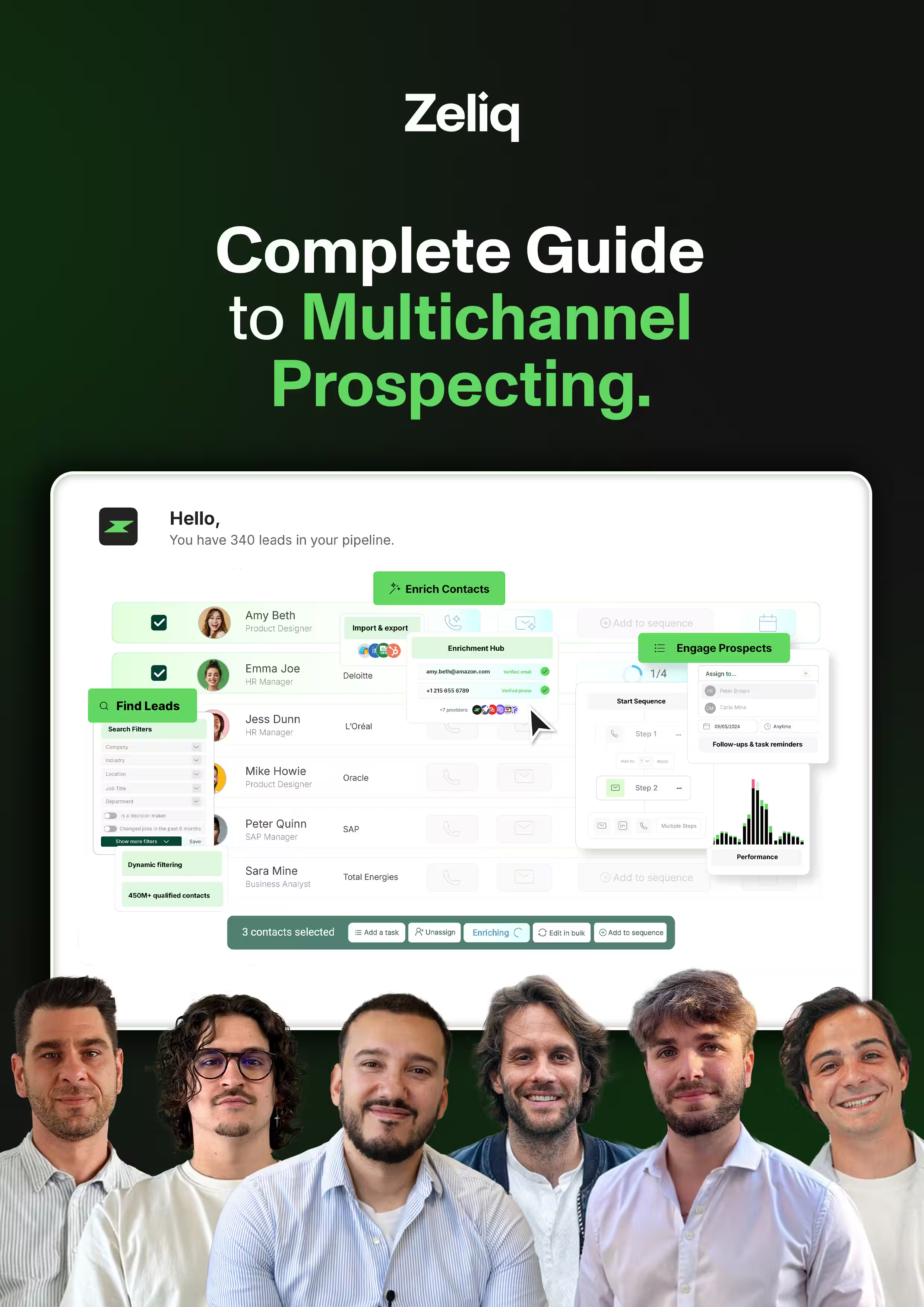
ZELIQ is your all-in-one sales copilot: it pulls accurate prospect data from a massive, real-time database, enriches leads automatically, prioritizes them with smart scoring, and empowers multichannel outreach in one seamless platform.
ZELIQ centralizes lead data and signals
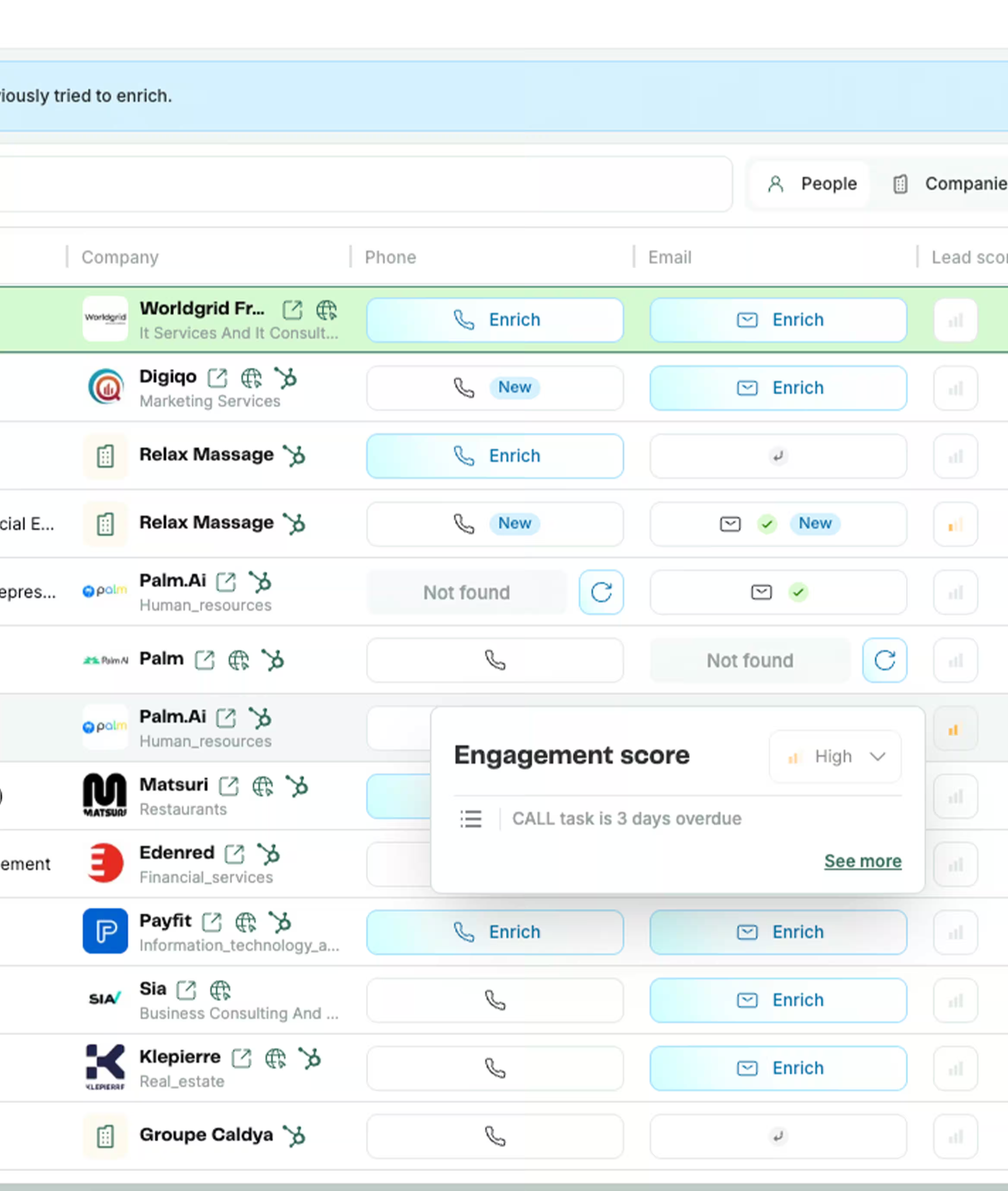
ZELIQ pulls your lead data into one place: firmographic details, verified contact info, technographic data, and buying intent signals.
This means your sales reps don’t waste time jumping between tools to piece together the basics before a call.
Automate enrichment and segmentation
Instead of manually researching every sales prospect, ZELIQ enriches profiles automatically.
It adds missing job titles, confirms budget authority, and flags decision makers. Leads are then segmented based on your qualification criteria, so your team can prioritize high-opportunity accounts.
Trigger workflows based on real-time actions
The minute a potential customer asks for a demo, checks your pricing page again, or reacts to your posts, ZELIQ ‘pings’ the right rep.
No waiting, no digging through reports. You catch the prospect while they’re still thinking about their buying decision, not days later when the momentum is gone.
CONCLUSION - Next steps: put qualification into practice with ZELIQ
Qualifying a prospect isn’t just a step in the sales cycle, it’s the filter that keeps your sales pipeline healthy, your forecasts reliable, and your sales reps focused on potential customers who can actually buy.
By combining proven frameworks, sharp qualifying questions, and the right data sources, like ZELIQ, you cut wasted time and turn more conversations into real opportunities.
ZELIQ makes that process faster and easier, giving your sales team the insights and automation they need to qualify leads with confidence. Ready to see it in action? Start your free trial today.
Enter the future of lead gen
Table of contents
Placeholder Title
Table of contents
Placeholder Title
Placeholder Title