

Pour les équipes commerciales ciblant les grossistes immobiliers, décrocher le téléphone reste l'un des moyens les plus rapides de générer des prospects, qualifiez les intérêts et lancez des offres.
Mais le succès ne vient pas de la lecture d'un script d'appel à froid raffiné : il s'agit de savoir comment fonctionne réellement la prospection à froid dans le secteur de l'immobilier en gros.
Les grossistes agissent rapidement. Si vos 15 premières secondes vous semblent génériques (ou pire, si vous n'en avez aucune idée), vous avez terminé. Ils ne veulent pas de fonctionnalités dumps ou de mots à la mode. Ils veulent une valeur claire :
- aidez-les à fermer plus rapidement,
- filtrer les acheteurs sérieux,
- ou simplifiez le flux des transactions.
Que vous proposiez du SaaS, du marketing direct ou du financement, votre script doit parler leur langue.
Ce guide présente des scripts de démarchage en gros qui ont fait leurs preuves, la gestion des objections et des conseils tactiques pour aider votre équipe à établir des liens, et pas seulement à lancer.
Oubliez les fonctionnalités de présentation. Lorsque vous posez les bonnes questions (par exemple, comment ils sélectionnent les acheteurs ou ce qui ralentit leurs ventes), vous passez du statut de fournisseur à celui de résolveur de problèmes. C'est ainsi que vous entamez de vraies conversations et que vous obtenez des suivis.
Si votre équipe reçoit des messages vocaux ou se fait éliminer rapidement, il ne s'agit pas d'appeler plus fort. Il s'agit d'appeler plus intelligemment.
Ces scripts et tactiques sont conçus pour les commerciaux qui souhaitent parler comme s'ils étaient dans le jeu.
Quelles sont les principales objections lors des appels avec les grossistes ?
Les appels à froid auprès des grossistes ne sont jamais une ligne droite.
Même les commerciaux chevronnés connaissent la routine : vous êtes à mi-chemin de votre présentation lorsque le prospect vous interrompt la conversation en vous disant « pas intéressé » ou, pire encore, raccroche.
Mais derrière chaque objection se cache un signal : un indice sur le calendrier, la confiance ou les priorités. Pour vendre efficacement aux grossistes, vous devez décoder, et non détruire au bulldozer, leur résistance.
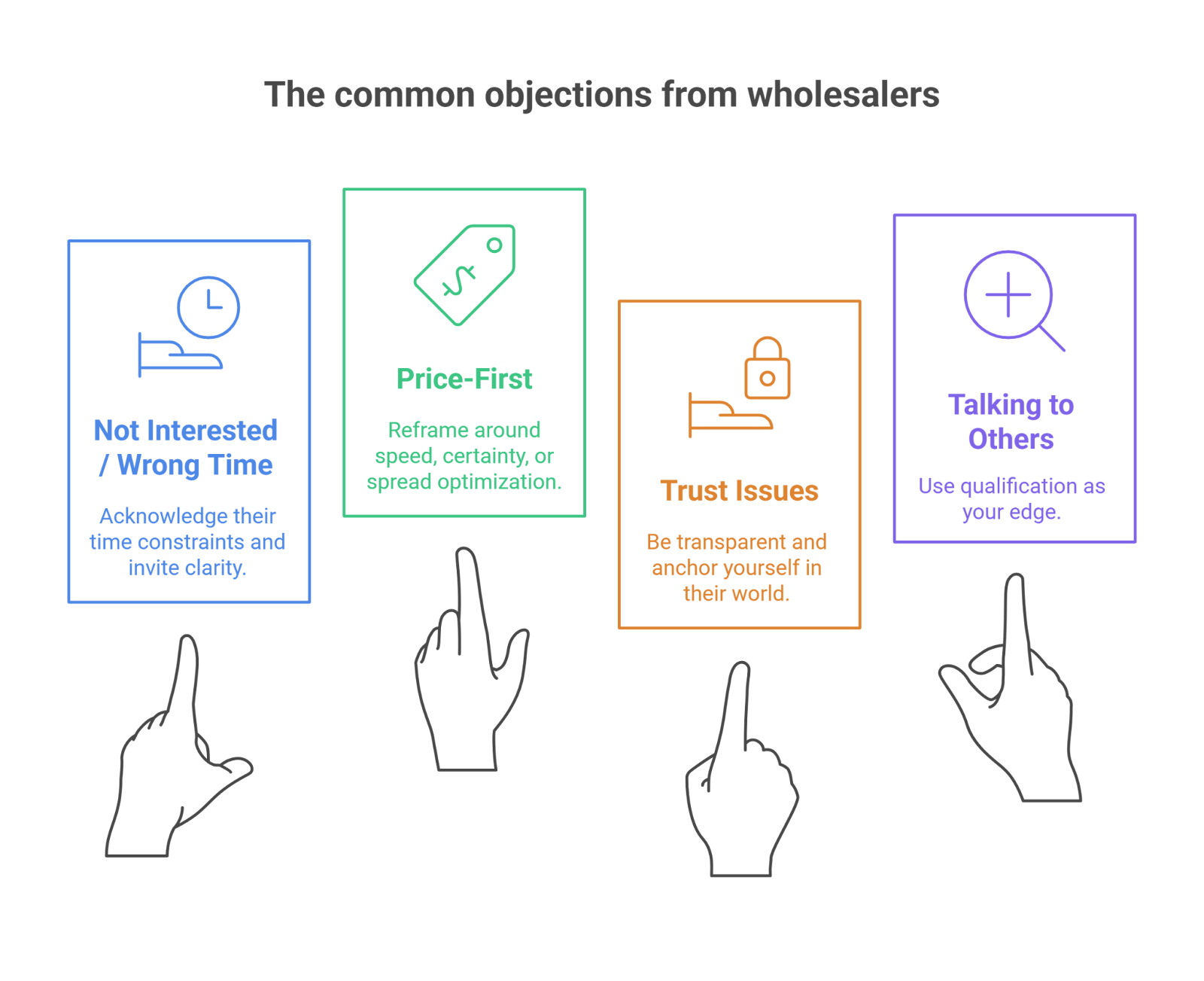
Décomposons les quatre familles d'objections les plus courantes que vous rencontrerez :
1. L'objection « pas intéressé ou au mauvais moment »
Ce qu'ils disent :
- « Ça ne m'intéresse pas. »
- « Appelle-moi plus tard. »
Ce que cela signifie :
Ce n'est souvent qu'un réflexe. Les grossistes agissent rapidement : si vous ne résolvez pas un problème connu dans les 10 premières secondes, ils vous repoussent par défaut.
Comment répondre :
- Rouvrez la porte en tenant compte du contexte. Ne contestez pas directement le « non », pivotez.
- Utilisez un ton qui tient compte de leurs contraintes de temps tout en invitant à la clarté.
Exemples :
- « Je comprends parfaitement. Juste avant que je ne parte : travaillez-vous déjà avec quelqu'un pour [type de solution], ou est-ce que ce n'est tout simplement pas le bon moment pour le moment ? »
- « C'est juste. Je peux être bref. Est-ce que 5 h 15 aujourd'hui ou 10 h 40 demain fonctionneraient mieux pour un enregistrement de 3 minutes ? »
Astuce de pro: S'ils vous demandent de rappeler, réservez immédiatement, ne vous contentez pas de revenir en arrière. Temps bloqué = temps conservé.
2. L'objection du « prix d'abord »
Ce qu'ils disent :
- « Je veux un ARV complet et au meilleur prix. »
- « Fais-moi d'abord une offre. »
Ce que cela signifie :
Ils vérifient si vous comprenez comment ils fonctionnent. Les discussions sur les prix dès le début portent rarement sur le prix, mais sur le contrôle.
Comment répondre :
- Ne commencez pas par des chiffres. Redéfinissez l'optimisation de la vitesse, de la certitude ou de la diffusion.
- Échangez de la valeur contre des données et utilisez-les pour vous qualifier plus rapidement.
Exemples :
- « C'est logique. Vous concentrez-vous davantage sur les frais de mission les plus importants ou sur la rapidité et l'obtention d'une certaine somme d'argent ? La plupart de nos partenaires optimisent pour le second. »
- « Je suis heureuse de faire une offre, pour ne pas vous faire perdre votre temps. Quel type de spread ciblez-vous généralement sur vos meilleures offres ? »
Rappel: Les grossistes respectent les autres négociateurs. Si vous vous couchez trop tôt, vous perdez confiance.
3. Le message « Qui êtes-vous ? Puis-je avoir confiance en vous ? » objection
Ce qu'ils disent :
- « Qui es-tu ? »
- « Êtes-vous un agent ? »
- « J'ai déjà reçu de mauvais appels. »
Ce que cela signifie :
C'est une question de crédibilité. Les grossistes sont confrontés à des centaines de propositions non qualifiées par mois. Si votre introduction semble vague ou trop raffinée, vous déclencherez leur alarme de « perte de temps ».
Comment répondre :
- Ancrez-vous clairement dans leur univers.
- Soyez transparent à propos de qui vous êtes et de ce que vous êtes pas.
Exemples :
- « Je ne suis pas un agent : je travaille directement avec des investisseurs et des grossistes sur des transactions hors marché. Je vous contacte pour voir s'il y a un quelconque chevauchement dans ce que vous souhaitez attribuer. »
- « Je comprends, vous avez probablement reçu une douzaine d'appels inutiles cette semaine. Si ce n'est pas pertinent, je me retirerai. Je peux te demander une petite question avant de le faire ? »
Astuce: Baissez la pression, augmentez la transparence. Cela renforce la confiance plus rapidement que des accessoires à valeur ajoutée.
4. L'objection « Je parle déjà à d'autres personnes »
Ce qu'ils disent :
- « Je discute déjà avec quelques acheteurs. »
- « D'autres grossistes nous ont contactés. »
Ce que cela signifie :
Ils font des achats ou vous font prouver que vous n'êtes pas un nom comme les autres sur une liste. Il s'agit d'un test de différenciation.
Comment répondre :
- Tenez compte du fait qu'ils comparent.
- Utilisez la qualification comme avantage, ce n'est pas le cas de la plupart des représentants.
Exemples :
- « C'est logique, tu devrais. Par curiosité, si deux offres étaient identiques, donneriez-vous la priorité à une clôture plus rapide, à une attribution plus fluide ou à un POF plus efficace ? »
- « Tout à fait juste. Beaucoup de gens nous contactent avec des numéros génériques. Je préfère me qualifier dès le départ et n'aller de l'avant que si la case d'achat s'aligne. »
En maîtrisant ces familles d'objections (et en adaptant votre ton et votre langage en temps réel), vous commencerez à convertir les « non merci » en conversations significatives. N'oubliez pas : les objections ne sont pas des blocages. Ils achètent des signaux déguisés.
Quelles sont les stratégies de démarchage les plus courantes pour vendre aux grossistes ?
Tendre la main à des grossistes, ce n'est pas comme appeler des PME ou lancer des plateformes de marketing. Vous parlez à des négociateurs rapides qui jonglent avec les vendeurs, les acheteurs et le financement, souvent le même jour.
C'est pourquoi les cadres de vente génériques échouent ici. Au lieu de cela, les stratégies d'appel à froid gagnantes destinées à ce public sont précises, optimisées dans le temps et réparties sur plusieurs points de contact.
Ciblage et création de listes
Vous ne pouvez pas vendre mieux qu'un mauvais ciblage. Si votre liste n'est pas construite avec intention et précision, même le meilleur ouvreur échouera.
Votre grossiste potentiel idéal :
Il s'agit d'un exemple de prospect idéal.
- Actif dans une zone métropolitaine ou un type de propriété défini (par exemple, une maison unifamiliale, un petit immeuble multifamilial, un commerce en difficulté)
- Attribution de 2 à 10 offres par mois
- Engagé dans des groupes REI, des cercles d'investisseurs sur Facebook ou des communautés LinkedIn
- Affiche l'activité sur les meetups PropStream, BatchLeads ou REI
- Maintient une liste d'acheteurs ou parle d'une telle liste
Comment créer des listes plus intelligentes :
- Utilisez des outils tels que ZELIQ
- Recouper les documents publics locaux avec les groupes Facebook et les profils LinkedIn
- Surveillez les commentaires YouTube et les podcasts REI : les grossistes s'identifient eux-mêmes ou laissent souvent leurs coordonnées
- Enrichissez vos contacts avec des numéros de téléphone vérifiés et des e-mails B2B
- Marquez votre liste par source (groupe REI, LinkedIn, PropStream, etc.) pour améliorer les analyses après l'appel
Règles d'hygiène des données :
- Purger les contacts avec un taux de connexion inférieur à 20 %
- Revérifiez les courriels/téléphones chaque semaine
- Supprimez toute liste dont les résultats sont inférieurs à 30 % de votre taux de contact moyen
N'oubliez pas: La plupart des représentants échouent non pas à cause de leur pitch, mais parce qu'ils traitent des pistes fantômes.
Rythme d'appels quotidien
Les grossistes travaillent en mode sprint, vous devriez faire de même.
Leurs heures d'alimentation (heure locale) :
- Matin : 9 h 00 à 11 h 00
- Fin d'après-midi : 16 h 00 à 18 h 00
Exemple de cadence d'appel :
- 3 sprints ciblés de 45 minutes par jour
- Blocs de 15 minutes entre les mises à jour de l'administration ou du CRM
Points de référence de performance (par représentant) :
- 150 à 250 cadrans par jour
- 20 à 30 conversations
- 3 à 5 vendeurs qualifiés
- 1 à 2 rendez-vous réservés
Le créneau de 10 h à 10 h 45 est souvent le meilleur.
Astuce de pro: chargez toujours vos meilleurs prospects dans votre bloc d'heures le plus performant.
Playbook multi-touch
Les grossistes respectent la persévérance lorsqu'elle est structurée et utile, et non lorsqu'elle est du spam.
Séquence de 8 touches recommandée (répartie sur 14 jours ouvrables) :
- Appel à froid #1 - ouvre-bouteille croustillant
- Dépôt de messages vocaux - uniquement en cas de réponse
- SMS Nudge - par exemple, « Je viens de vous laisser une VM rapide. C'est cool si c'est mauvais maintenant. »
- Courriel #1 - lieu de référence ou offre récente
- Appel de suivi - « Juste pour faire suite à l'e-mail que j'ai envoyé concernant : [ville] »
- Courriel #2 - ton plus clair, peut-être une étude de cas ou une offre
- Connexion LinkedIn - avec une note : « Contente de discuter si vous faites toujours des offres dans [le métro]. »
- Dernier appel ou message de rupture - pause du signal sauf demande contraire
Angle de rotation :
Ne répétez pas le même crochet. Messagerie alternative par :
- Vitesse de fermeture
- Qualification des acheteurs
- Aperçu du marché local
- Flexibilité du financement
- Automatisation de la vérification des transactions
Règle d'or : Chaque contact doit apporter de la valeur ou de la curiosité. Pas de suivis vides.
Ton et prestation
La façon dont vous dites les choses compte plus que ce que vous dites, surtout pour les grossistes qui décident en quelques secondes si vous êtes crédible.
Conseils d'exécution :
- Parlez de 140 à 160 mots par minute : chaleureux, détendu, confiant
- Utilisez des phrases courtes (moins de 10 à 12 mots)
- Dirigez chaque appel avec :
« Salut [Nom], c'est [Vous] de [Entreprise]. Je peux prendre 30 secondes pour expliquer pourquoi j'appelle ? » - Évitez les termes de vente tels que « retour en arrière », « base tactile » ou « proposition de valeur »
- Parlez comme quelqu'un qui comprend les ARV, la propagation et les risques liés à l'assignation ; pas simplement quelqu'un qui lit un pitch deck
Changement mental: Vous n'êtes pas un plus proche : vous êtes un filtre d'offres. C'est ce qui vous permet de gagner du temps.
Comment générer des prospects grâce au cold calling ?
Le cold calling consiste à transformer cette brève interaction en un prospect qualifié capable de suivre votre pipeline. Et lorsque vous vendez à des grossistes, vous devez faire preuve d'une pertinence immédiate par rapport à leur univers : rapidité de conclusion, fiabilité des acheteurs et cohérence des transactions.
Comment préparer, positionner et réorienter vos appels téléphoniques pour susciter un réel intérêt (pas seulement des réponses polies) ?
Personnalisez votre script d'appel à froid pour les grossistes immobiliers
Si vous appelez à froid des grossistes immobiliers, votre script d'appel pour la promotion immobilière doit être précis, pertinent et rapide.
Les meilleures stratégies d'appel à froid pour les grossistes immobiliers ne présentent pas de fonctionnalités : elles proposent des solutions concrètes aux investisseurs immobiliers soucieux de la rapidité des transactions et de la certitude des acheteurs.
Un interlocuteur téléphonique qui contacte des grossistes doit parler leur langue :
- les frais de mission,
- acheteurs au comptant,
- retards de financement.
Le bon script d'appel à froid doit positionner votre outil ou service de manière à simplifier le chaos, et non à l'aggraver.
Commencez votre script par quelque chose comme :
« Bonjour [Nom], je travaille avec d'autres grossistes et je jongle entre 4 et 6 missions actives par mois. La plupart utilisent [outil] pour qualifier les acheteurs plus rapidement, éviter les pertes et conclure plus facilement. Je peux prendre 30 secondes ? »
À partir de là, gérez les objections qui se présentent constamment :
- « J'ai déjà un système » → « Totalement. Cela vous aide-t-il à suivre les réponses des acheteurs ou à chronométrer les retards ? »
- « Ce n'est pas génial maintenant » → « Compris. Vous voulez fixer une heure après la fermeture la semaine prochaine ? »
Un excellent script de démarchage immobilier vous aide à vous qualifier plus rapidement et à réserver un suivi. Essayez d'obtenir leur adresse e-mail, proposez-leur d'envoyer un résumé de 2 minutes ou un exemple de flux de travail qui prouve que vous n'êtes pas une autre perte de temps.
Votre mission n'est pas de vendre sur place : c'est de créer un climat de confiance et d'ouvrir la porte. C'est ce qui définit une conversation immobilière réussie dans ce créneau.
Que vous utilisiez une approche manuelle ou des outils tels que ZELIQ pour améliorer les tarifs d'appels à froid, n'oubliez pas que même les meilleurs scripts d'appel à froid ne sont efficaces que s'ils sont fournis par un interlocuteur qui semble comprendre la pression liée à la réalisation de cinq offres par mois.
Faites vos devoirs avant de composer
Les grossistes peuvent sentir une odeur générique à un kilomètre et demi de distance. Si vous voulez attirer leur attention, commencez par le contexte.
Liste de contrôle pour la recherche préalable à l'appel :
- Sur quels marchés ou codes postaux sont-ils actifs ?
- Est-ce qu'ils attribuent actuellement des offres ? (Consultez les groupes Facebook, PropStream, REI)
- Mentionnent-ils leur liste d'acheteurs ou leurs partenaires sur LinkedIn ?
- Quel est l'écart moyen ou le prix de leurs dernières offres ?
- Y a-t-il des signes d'accords de coentreprise ou d'activité locale ?
Même deux minutes de recherche ciblée peuvent vous donner un meilleur résultat que 10 minutes de monologue.
Lorsque vous commencez l'appel, utilisez ce que vous avez appris pour créer une ouverture naturelle qui soit ancrée dans leur monde. Une question réfléchie basée sur une activité récente peut changer le ton instantanément, passant d'un argumentaire à une véritable communication. Cela ne permet pas seulement d'attirer l'attention : cela ouvre la porte à une discussion personnalisée.
Les bons appels à froid ne sont pas une question de scripts, mais visent à apporter de la valeur rapidement et à établir une relation réciproque. Lorsque vous avez l'air prêt, le grossiste se sent vu ; et c'est là que la véritable opportunité commence. Chaque seconde compte, alors accordez de l'importance à votre expérience.
Du plomb qui a de la valeur, pas des caractéristiques
Les grossistes ne recherchent pas d'outils, de plateformes ou de fonctionnalités. Ils recherchent un effet de levier, tout ce qui peut les aider à :
- Attribuez des offres plus rapidement
- Qualifiez mieux les acheteurs
- Évitez les échecs de fermeture
- Réduisez la fatigue oculaire
Positionnez votre offre selon l'un des trois angles suivants pour générer des prospects :
- Vitesse
« Nous aidons les grossistes à réduire leur délai de clôture de 30 à 40 %, en particulier lorsque les acheteurs tardent à le faire. » - Certitude
« Notre plateforme vous aide à repérer les acheteurs sérieux dès le départ, afin que vous n'ayez pas à courir après un contrat avec des acheteurs sans issue. » - Efficacité
« Nous travaillons avec des grossistes qui ne disposent plus de feuilles de calcul, en particulier ceux qui jonglent entre 4 et 5 offres actives à la fois. »
Utilisez des questions pour vous qualifier, pas seulement pour vendre
Le moyen le plus rapide de perdre un grossiste ? Je parle trop.
Passez plutôt rapidement en mode diagnostic. Les bonnes questions font également office de filtres à plomb :
- « Comment gérez-vous votre liste d'acheteurs en ce moment : feuille de calcul, CRM ou SMS Blast ? »
- « Quelles sont généralement les causes de l'échec de vos transactions : financement, retards liés aux acheteurs, problèmes de titre ? »
- « Est-ce que vous gérez 100 % de vos missions en solo, ou vous associez-vous parfois à des partenaires locaux ? »
- « À quelle vitesse vos acheteurs doivent-ils généralement conclure une transaction une fois qu'une transaction est signée ? »
Chaque réponse vous indique si elle convient à votre solution, et quel avantage souligner ensuite.
Ne poussez pas pour terminer : tirez pour passer à l'étape suivante
La génération de prospects ne consiste pas à conclure dès le premier appel. Il s'agit de gagner le droit de poursuivre la conversation (idéalement avec un signal d'aptitude plus fort).
En fonction de leurs réponses, voici quelques mesures « incitatives » :
- « Il semblerait que la vitesse soit une véritable priorité pour toi. Serait-il judicieux de vous expliquer comment nous avons aidé d'autres acteurs [du marché] à clôturer leurs activités plus rapidement ? »
- « Si j'envoyais plus de trois échantillons de prospects correspondant à votre panier d'achat, seriez-vous prêt à les examiner avant vendredi ? »
- « Comprenez bien que vous êtes à mi-chemin. Tu veux que je revienne mercredi prochain, à la même heure ? »
La phrase magique à garder dans votre poche arrière : « Est-il judicieux de [insérer l'étape suivante] ? »
Il n'est pas insistant, leur donne le contrôle et fonctionne même lorsqu'ils sont sceptiques.
Utiliser CRM + intégration de séquences
Enfin, si votre équipe génère des prospects manuellement sans les synchroniser avec votre CRM, vous perdez du temps.
- Marquez chaque contact en fonction de sa source (groupe REI, Facebook, données publiques)
- Enregistrez les notes de conversation immédiatement après l'appel
- Déclenchez des séquences de suivi (e-mail/SMS) pour chaque prospect qualifié
- Utilisez des libellés tels que « Intéressé - Rapidité », « Call Back - JV Potential », etc. pour hiérarchiser les suivis
Des outils tels que ZELIQ vous permettent de suivre la source de prospects par rapport au taux de conversion, ce qui vous permet de redoubler d'efforts sur les canaux les plus performants.
Comment améliorer le succès du démarchage téléphonique ?
Les appels à froid auprès des grossistes génèrent un volume élevé, un taux de rejet élevé et une grande récompense... mais uniquement si vous le considérez comme un système performant, et pas simplement comme une routine quotidienne.
Succès ici ne proviennent de « se bousculer plus fort », mais de optimisation des contrôlables: vos données, votre livraison, votre cadence et vos boucles de feedback.
Voici comment les 1 % des meilleurs représentants obtiennent régulièrement des résultats dans ce créneau.
1. Prioriser la liste et la qualité des données
Vous ne pouvez pas convertir ce que vous ne pouvez pas connecter. Si vos numéros rebondissent, si votre taux de contact baisse ou si vos e-mails tombent dans le spam, aucun script ne vous sauvera.
Ce que font les équipes les plus performantes :
- Vérifiez les numéros de téléphone chaque semaine à l'aide d'outils tels que NeverBounce ou des enrichisseurs CRM intégrés
- Marquez chaque contact par source (par exemple, PropStream, groupe REI, LinkedIn)
- Marquer et supprimer les contacts dont le taux de réponse est inférieur à 20 %
- Supprimez les listes dont les performances sont inférieures à 30 % de votre taux de connexion moyen
2. Maîtrisez la discipline du script, sans avoir l'air scénarisé
Les scripts sont des échafaudages, pas des chaînes. Le but n'est pas de lire, mais d'internaliser le flux afin que vous puissiez pivoter naturellement en cours d'appel.
Structure d'appel à froid à mémoriser :
- Ouvreur : qui vous êtes et pourquoi vous appelez
- Contexte : phrase rapide adaptée à leur marché, à leur volume ou à leurs offres
- 3 questions clés : qualifier, pas interroger
- Étape suivante : demandez : démo, échantillon, rappel ou suppression de ressources
Exemple :
« Hey James, je travaille avec des grossistes de Houston pour accélérer la qualification des acheteurs. Juste par curiosité : est-ce que vous gérez toujours tout par e-mail et par feuilles de calcul, ou utilisez-vous quelque chose de plus automatisé de nos jours ? »
3. Suivez ce qui compte
La plupart des représentants comptent les cadrans. Les meilleures équipes suivent ce qui se passe une fois que quelqu'un décroche.
Champs CRM suggérés à suivre :
- « Liste d'acheteurs gérée ? » : Manuel/CRM/Pas clair
- « Fréquence idéale ? » : Hebdomadaire/Mensuel/Inactif
- « Type d'objection ? » : Prix/Confiance/Calendrier/Autres
4. Réalisez des évaluations hebdomadaires
Chaque vendredi, les meilleures équipes font ce que les équipes moyennes évitent : elles écoutent en retour. Passez en revue 3 à 5 appels par représentant et identifiez les points de baisse (mauvaises intros, signaux d'achat manqués, transitions précipitées).
5. Adaptez-vous en fonction des signaux des acheteurs
Le tueur #1 du succès du démarchage téléphonique ? Traiter tous les prospects de la même manière.
- Si quelqu'un travaille déjà avec un acheteur, passez à la différenciation : « Qu'est-ce qui fonctionne pour vous ? Qu'est-ce que vous amélioreriez si vous le pouviez ? »
- S'ils disent « appelez-moi plus tard », réservez le calendrier dès maintenant. Ne vous contentez pas d'un vague suivi
- S'ils hésitent sur le prix, redéfinissez le prix en fonction de la certitude ou de la rapidité d'attribution
Comment établir des relations avec les grossistes ?
Les grossistes sont confrontés chaque jour à des offres nécessitant peu d'efforts. Si vous voulez une véritable traction, vous avez besoin de plus qu'un script soigné : vous avez besoin de confiance.
Rapport est ce qui permet de recevoir des rappels, d'ouvrir des boîtes de réception et de faire avancer les offres.
Comprenez d'abord leur monde
Ce sont des négociateurs qui jonglent avec les acheteurs, les contrats et les délais serrés. Parlez leur langue : demandez-leur s'ils attribuent ou clôturent deux fois, faites référence à des offres de coentreprises ou mentionnez des listes d'acheteurs. La crédibilité commence par la familiarité.
Dirigez avec curiosité
Au lieu de les pitcher, commencez par poser des questions intelligentes qui les invitent à partager leur processus. Qu'est-ce qui les ralentit ? Comment trouvent-ils des acheteurs ? À quoi ressemble leur offre idéale ? Quand ils parlent, vous apprenez à positionner votre valeur.
Montrez où ils se trouvent
La confiance grandit lorsque vous êtes présent, et non insistant. Rejoignez les groupes REI, commentez sur LinkedIn, participez à des rencontres ou envoyez des informations utiles sur le marché via DM.
Pas de demande, juste de la valeur. La familiarité l'emporte sur les intros tape-à-l'œil.
Offrez de la valeur avant qu'ils ne demandent
Vous voulez établir des relations rapidement ? Partagez un rapport sur les tendances des acheteurs, présentez-les à un partenaire de coentreprise ou suggérez une société de titres qui évolue rapidement. Même un petit conseil (comme une structure de financement qui a fonctionné sur leur marché) vous positionne comme une personne utile, et non comme une source de ventes.
Soyez cohérent
Les grossistes ne se soucient pas du charme, ils se soucient du suivi. Si vous dites que vous allez envoyer quelque chose, faites-le.
Réservez vos suivis lors de l'appel. Souvenez-vous de leurs préférences et présentez-vous quand cela compte. Un bon appel n'est rien, trois d'affilée renforcent la confiance.
Reflétez leur style
Parler vite ? Sois affûtée. Vous préférez les détails ? Va en profondeur. Plus votre livraison correspond à la leur, plus la connexion s'établit rapidement.
L'établissement de relations n'est pas une compétence générale, c'est un levier de vente. Dans un monde bruyant et animé, le représentant qui écoute, livre et fait preuve de constance devient celui qui fait avancer les affaires.
Quels sont les scripts de démarchage efficaces ?
Un script de cold calling, c'est comme un échafaudage : il soutient votre flux mais ne doit pas vous enfermer. Les meilleurs scripts pour les grossistes sont courts, directs et conçus pour susciter une véritable conversation, et non pour livrer un monologue.
Voici des formats de script éprouvés que vous pouvez intégrer à vos processus de vente dès aujourd'hui : tous adaptés au monde de la vente en gros à haute vitesse et sans fioritures.
Script 1 : l'ouvreur de valeur directe
« Bonjour [Nom], c'est [Votre nom] de [Entreprise].
Nous aidons les grossistes à conclure des transactions plus rapidement en [insérez le principal avantage, par exemple, la vérification des acheteurs ou le financement instantané].
Disposez-vous de 30 secondes pour que je ne vous fasse pas perdre votre temps ? »
Pourquoi ça marche: Vous dirigez avec clarté, pas en faisant du battage médiatique. La demande est respectueuse, la valeur est claire.
Script 2 : le crochet de pertinence locale
« Salut [Nom], petit mot : effectues-tu toujours des missions dans [ville/marché] ?
Nous avons travaillé avec quelques grossistes des environs qui perdaient des acheteurs en raison de la lenteur du processus de vérification. Vous êtes curieux de savoir comment vous gérez cette pièce ? »
Pourquoi ça marche: Hyper-spécifique + conversationnel = crédibilité.
Scénario 3 : l'ouverture du désarmement (perspectives sceptiques)
« Hey [Nom], je sais que vous recevez probablement une tonne d'appels aléatoires : je vais le garder en moins de 45 secondes.
Je travaille avec des grossistes qui souhaitent conclure plus rapidement sans renoncer au spread. Si ce n'est pas votre objectif, je vous laisserai partir. »
Pourquoi ça marche: Cela réduit la résistance et témoigne du respect pour leur temps.
Script 4 : réponse « appelle-moi plus tard »
« Tout à fait juste, je peux être bref. Est-ce que 5 h 15 aujourd'hui ou 10 h 40 demain fonctionneraient mieux pour un enregistrement rapide ? »
Pourquoi ça marche: Il transforme un vague intérêt en un engagement concret.
Script 5 : recadrage en cours d'appel
« La raison pour laquelle j'ai appelé : nous avons aidé quelques grossistes de [la ville] à réduire leurs heures de fermeture de 30 à 40 %.
Si je pouvais vous montrer comment cela fonctionne, cela vaudrait-il la peine de faire une visite guidée de 10 minutes la semaine prochaine ? »
Pourquoi ça marche: Permet de se concentrer sur l'avenir, ce qui est idéal pour les prospects curieux mais occupés.
Scénario 6 : réengagement
« Hey [Nom], en tournant en arrière. Si ce n'est pas le cas, je peux faire une pause pour l'instant.
Mais avant moi, accordez-vous actuellement la priorité à la rapidité, à la marge ou au volume des transactions ce trimestre ? Cela m'aide simplement à savoir quand me reconnecter. »
Pourquoi ça marche: Cela leur permet de s'en sortir facilement, mais cela leur permet également de définir de véritables priorités.
Rappel final: Les scripts ne permettent pas de conclure des transactions, mais les conversations.
Utilisez-les comme points de départ, et non comme scripts à réciter. Choisissez votre ton, donnez une valeur réelle à votre leadership et soyez toujours prêt à changer en fonction de ce qui compte pour eux.
Le démarchage téléphonique dans le secteur de la vente en gros n'est pas une question de volume, mais de précision, de rapidité et de pertinence. Lorsque vos scripts donnent les bons résultats et que votre audience est axée sur ce qui intéresse réellement les grossistes, les conversations évoluent rapidement, tout comme les offres.
Si votre équipe souhaite atteindre ce type de précision, Zeliq peut vous aider. Qu'il s'agisse de créer des listes intelligentes, de suivre les appels ou d'obtenir des informations en temps réel, il est conçu pour aider les commerciaux à traiter les appels sortants comme une compétence. Ça vaut le coup d'essayer ? C'est à vous de décider.
Enter the future of lead gen
Sommaire
Placeholder Title
Sommaire
Placeholder Title
Placeholder Title